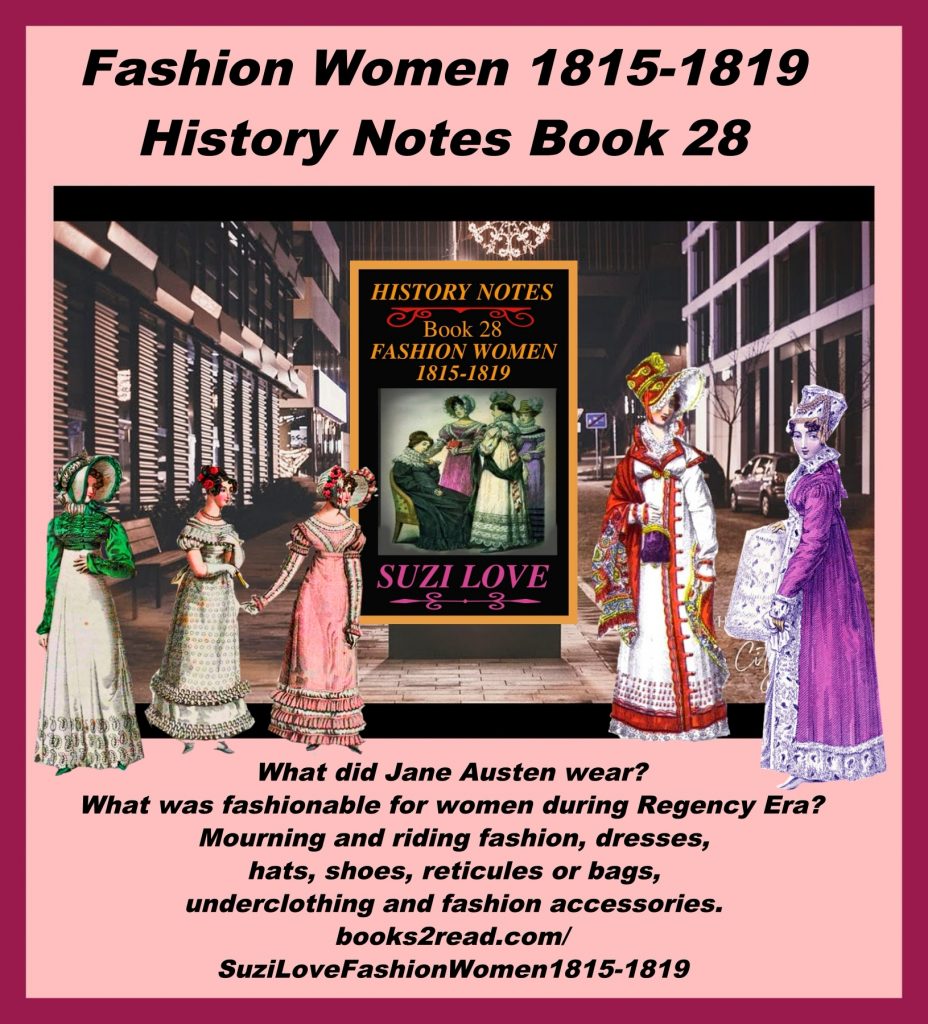
Love the Bridgerton family and Jane Austen? Reader Or Writer of Regency Era stories? Mourning and riding fashion, dresses, hats, shoes, reticules or bags, underclothing and fashion accessories. books2read.com/SuziLoveFashionWomen1815-1819
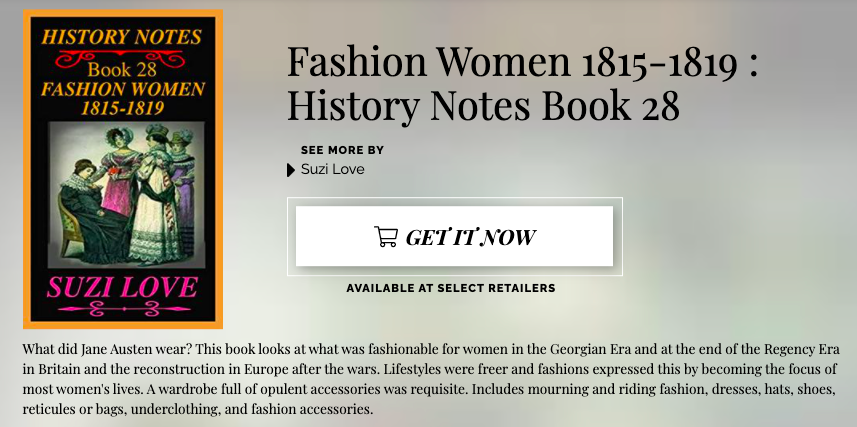
History Notes 28 Fashion Women 1815-1819: This book looks at what was fashionable for women in the Georgian Era and at the end of the Regency Era in Britain and the reconstruction in Europe after the wars. Lifestyles were freer and fashions expressed this by becoming the focus of most women’s lives. A wardrobe full of opulent accessories was requisite. Includes mourning and riding fashion, dresses, hats, shoes, reticules or bags, underclothing, and fashion accessories.
Ladies clothing in the early 1800’s featured a high waist line called an Empire Line, or Empire style dress, with a waist line just under the natural bust line and much higher than the natural waist. High-waisted Empire Line styles dominated fashions for at least three decades from the 1790s until the 1820s. The high-waisted, or short-bodied, Regency styles shifted focus away from the natural waist and so left the natural waist unconstricted, in direct contrast to previous and future styles.
Britain took these simple European styles and progressively made them more elaborate by adding more and more complicated embroidery onto white fabrics to create the white on white look popular for many years. The empire look of fine muslin dresses left women more exposed than in the Georgian Era when fabrics had been thicker and styles bulkier. Women, especially in England, preserved their modesty by adding lace, frills, flounces, ruches, and fabric plaits to dresses to adequately cover any parts that might inadvertently be exposed. Outer layers, such as Spencers, coats and shawls, were also added.
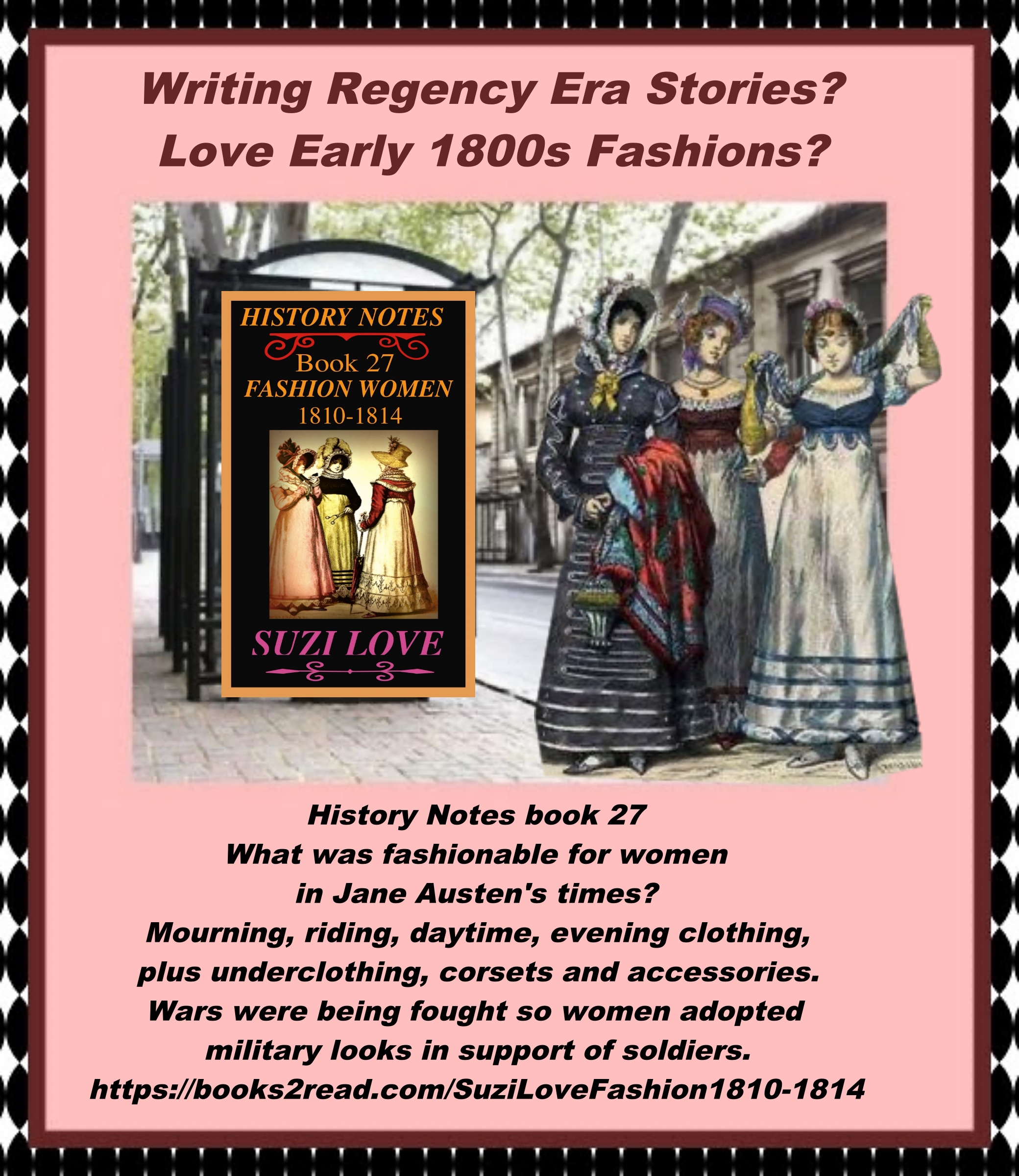
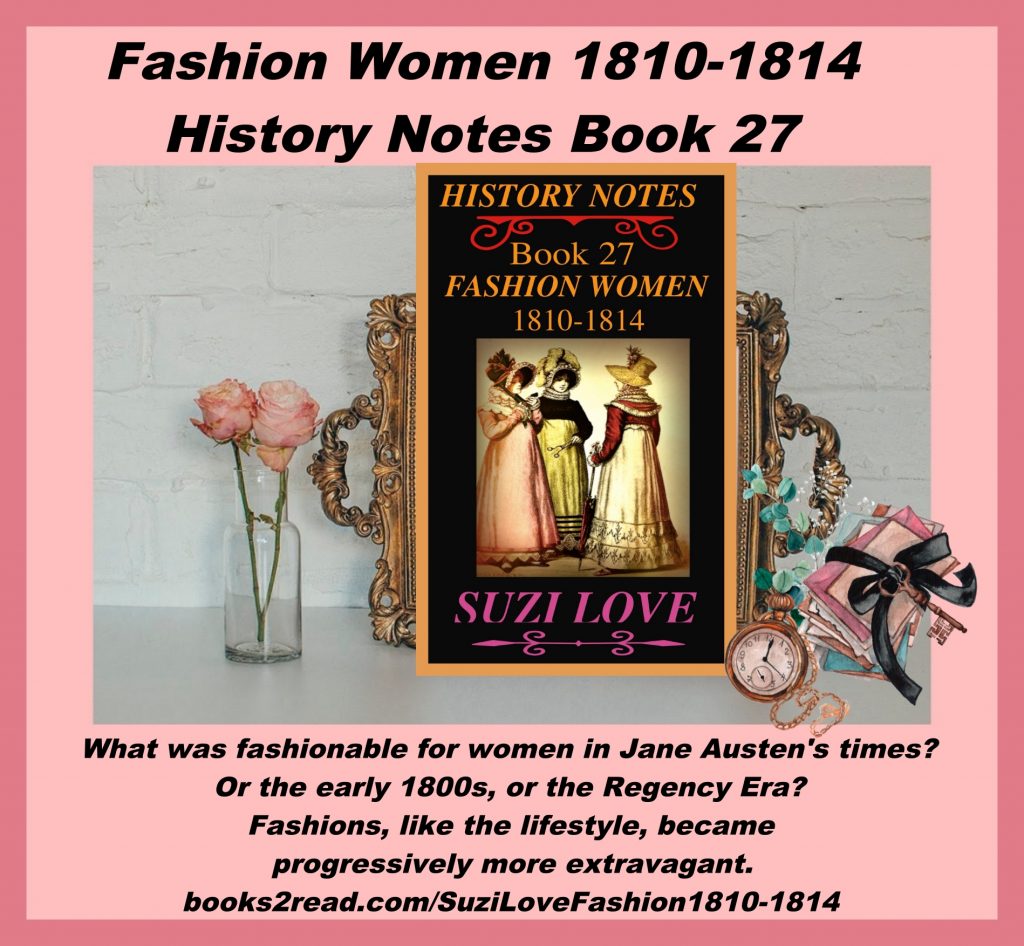
Are you a reader or writer of Regency Romance? Love Jane Austen and the Bridgertons? Want to know more about the mourning, riding, underclothing and other Regency Era women’s fashions in Regency romances? What was fashionable for women in Jane Austen’s times? Mourning, riding, daytime, evening clothing, plus underclothing, corsets and accessories. This book looks at what was fashionable for women in Jane Austen’s times, or the early 1800s, or the Regency Era in Britain. Wars were being fought around the globe so women’s fashion adopted a military look in support of soldiers. Fashions, like the lifestyle, became progressively more extravagant and accessories went from colorful to over-the-top. https://books2read.com/SuziLoveFashion1810-1814
The Lady’s Magazine said of the basis of women’s fashion that was popular for the first twenty years of the 1800s, ‘White is still the prevailing color for robes. For morning dresses, linen gowns, in large diamonds or squares, are fashionable. Indian muslins, plain or embroidered, are preferred to Florence and satins. The designs of embroidery for shawls are of infinite variety. Long gloves, which reach above the elbow, are not yet laid aside. Medallions are hung around the neck from crossed chains and some of these medallions are shaped like the bags, called ridicules. These reticules are of the lozenge or hexagon shape, with a small tassel at each angle. Reticules, or ridicules, are in lozenge or hexagon shapes with a small tassel at each angle. In capotes, or hats, and ribbands, the violet and dark green prevail over jonquil. Bracelets in hair, pear-shaped ear-rings, medallions on square plates, saltiers of colored stones, are still in fashion.’
History Notes book 27 What was fashionable for women in Jane Austen’s times? Mourning, riding, daytime, evening clothing, plus underclothing, corsets and accessories. Wars were being fought so women adopted military looks in support of soldiers. https://books2read.com/SuziLoveFashion1810-1814
A sedan chair is a portable enclosed chair for a single passenger. It was generally carried by two “chairmen” holding poles attached to either side of the chair. Sedan chairs were fashionable in England and Europe during the 17th, 18th and early 19th centuries and were an important part of the social life of the times. They were very useful for negotiating crowded, unsafe, narrow, winding and often filthy streets and were particularly used by “invalids, ladies and party goers”. Sedan chairs had the advantage of being able to be carried up and down stairs and could deliver the passenger from inside their own home to inside their destination without having to step outside.
1784 Sedan Chair. ‘The return from a masquerade. A morning scene.’ A young lady dressed as shepherdess with staff slumps in a sedan chair. Asleep or drunk her head and shoulders hang outside window. Two porters smile and dwarf chimney sweep carries a mask.’ By Robert Dighton and Cari.
1784 Sedan Chair. ‘The return from a masquerade. A morning scene.’ A young lady dressed as shepherdess with staff slumps in a sedan chair. Asleep or drunk her head and shoulders hang outside window. Two porters smile and dwarf chimney sweep carries a mask.’ By Robert Dighton and Cari.
The 19th century English author, Elizabeth Gaskell, described the use and function of the sedan perfectly in her novel “Wives and Daughters” when she reminisced how the Browning sisters chose to be transported to a ball by sedan chair, which ‘came into the parlor, and got full of the warm air, and nipped you up, and carried you tight and cosy into another warm room, where you could walk out without having to show your legs by going up steps, or down steps.’
The Bath Chair was invented in Bath, England, in the mid 18th Century to transport the wealthy and the sick around the city. It could be steered by the passenger and rivaled and then outdid the Sedan Chair as only one chairman was needed to operate it. The last Bath Chairman retired in 1949.
Typical 1700s, or Eighteenth Century Sedan Chair. Portable enclosed chair for single passenger usually carried by two chairmen holding poles attached to either side of chair. Fashionable during 17th, 18th and early 19th centuries when needed to negotiate crowded, unsafe, narrow, and dirty streets. Used by invalids, ladies and party goers. The sedan chair comprises a small kiosk with a curved timber roof which is covered with leather and studded with brass nails. The front and side panels are painted in green with floral decorations of cherubs and flowers. The back panel is of plain timber. Access to the chair was via a hinged door at the front. Inside, the chair is upholstered in silk and features padded upholstered arm rests. The windows have raw silk curtains which are gathered with tassels. The present brackets and poles are reproductions made in 1986 prior to display in the Transport exhibition. The total length of the new poles are 80 inches. The sedan chair door lock features the initials “V.F.” and a set of crossed keys with the wording “PARIS” and the number “34”. Via Powerhouse Museum, Sydney, Australia.
Typical 1700s, or Eighteenth Century Sedan Chair. Portable enclosed chair for single passenger usually carried by two chairmen holding poles attached to either side of chair. Fashionable during 17th, 18th and early 19th centuries when needed to negotiate crowded, unsafe, narrow, and dirty streets. Used by invalids, ladies and party goers. The sedan chair comprises a small kiosk with a curved timber roof which is covered with leather and studded with brass nails. The front and side panels are painted in green with floral decorations of cherubs and flowers. The back panel is of plain timber. Access to the chair was via a hinged door at the front. Inside, the chair is upholstered in silk and features padded upholstered arm rests. The windows have raw silk curtains which are gathered with tassels. The present brackets and poles are reproductions made in 1986 prior to display in the Transport exhibition. The total length of the new poles are 80 inches. The sedan chair door lock features the initials “V.F.” and a set of crossed keys with the wording “PARIS” and the number “34”. Via Powerhouse Museum, Sydney, Australia.
The longest journey recorded in a sedan chair was made by Princess Amelia, youngest daughter of King George III, who in 1728 was carried by 8 chairmen working in reliefs from London to Bath, a distance of 172 kms (107 miles). This sedan chair door lock features the initials “V.F.” and a set of crossed keys with the wording “PARIS” and the number “34”.
HN_10_D2D_RetailerBuyLink_ History Notes Book 10 books2read.com/SuziLoveTravel
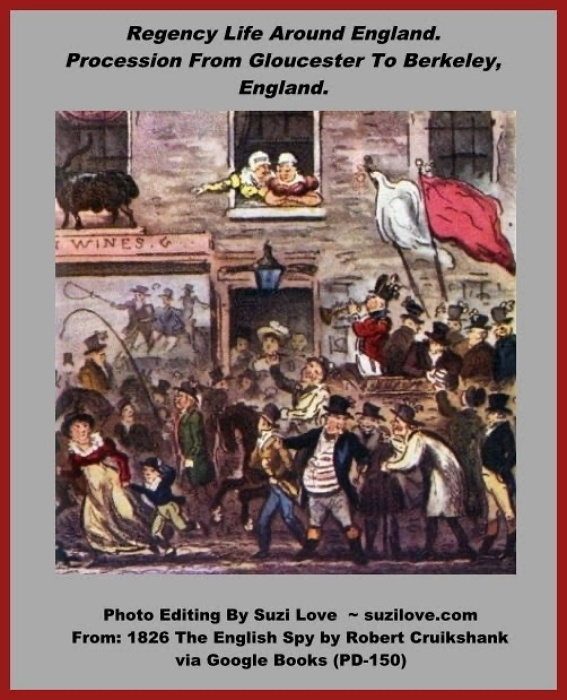
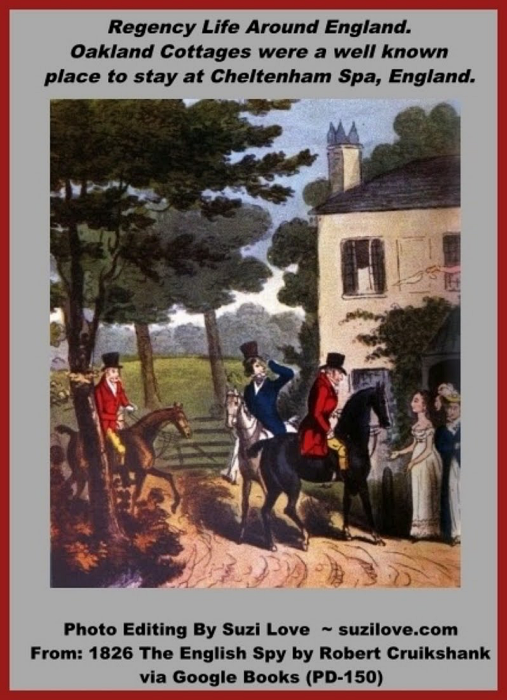
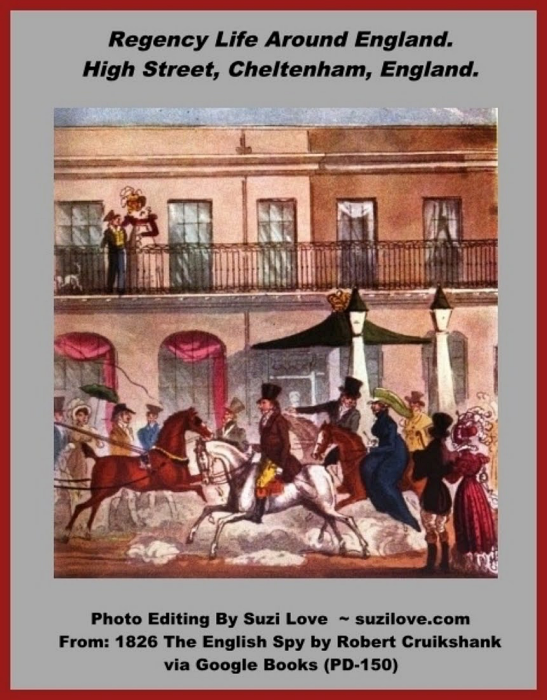
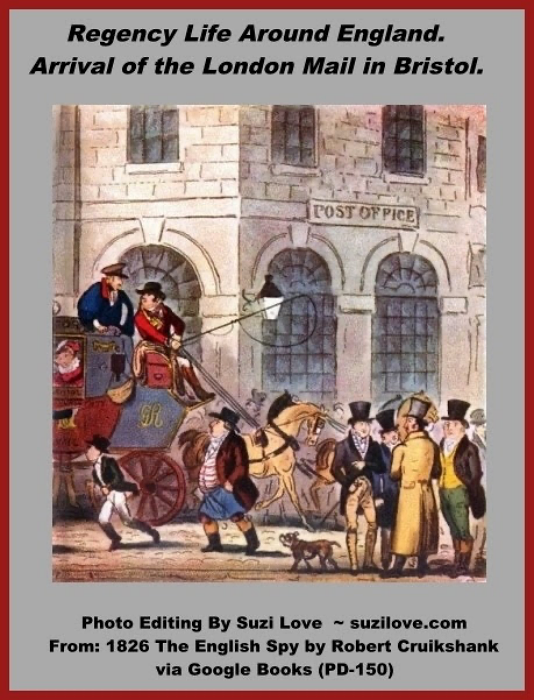
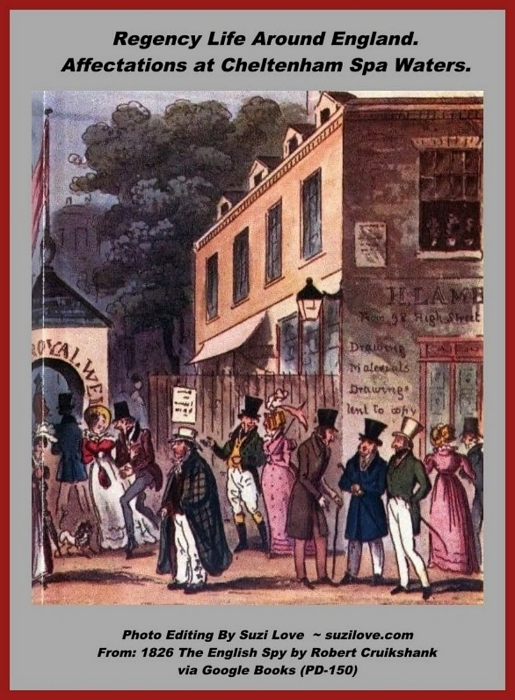
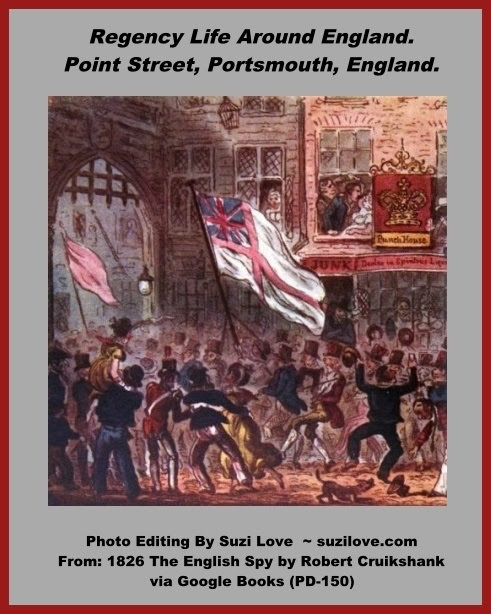
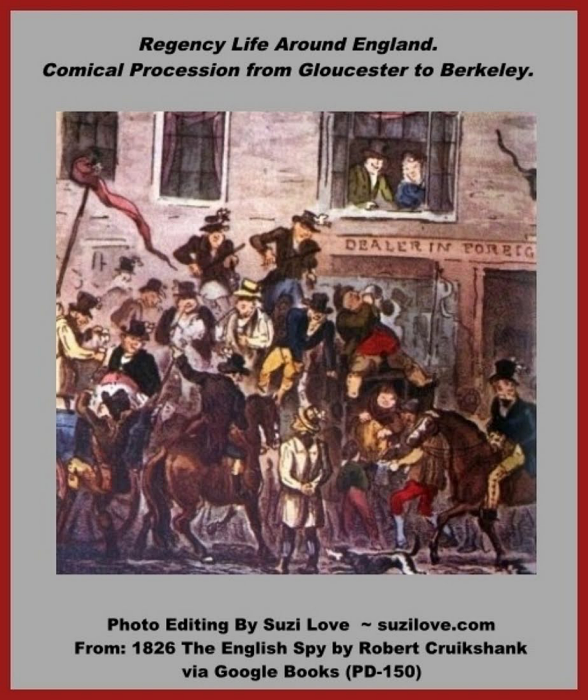
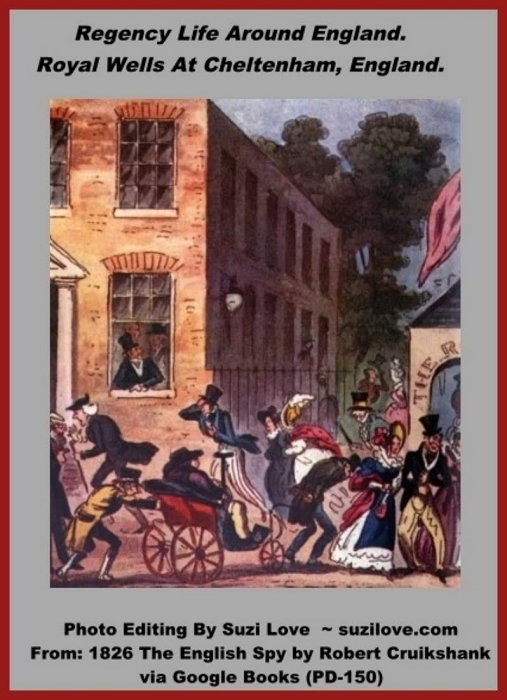
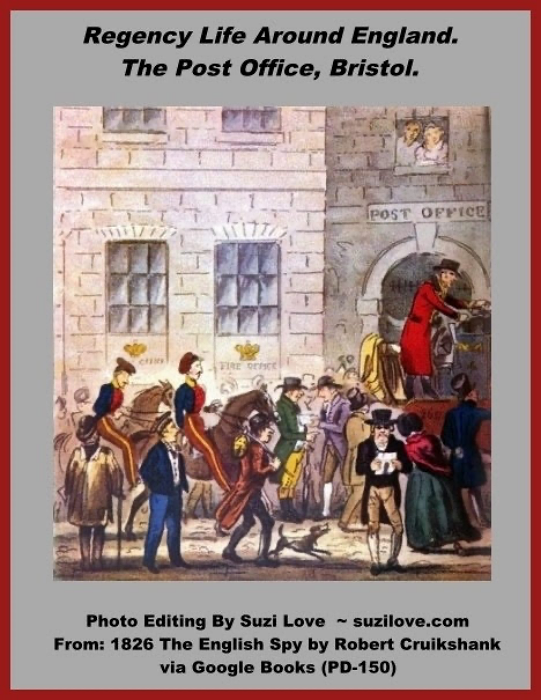
1826 Sights the Bridgertons and Jane Austen Saw Around Regency England. The sights that the families and friends would have seen around while traveling around England. via 1826 The English Spy By Robert Cruikshank via Google Books (PD-150)
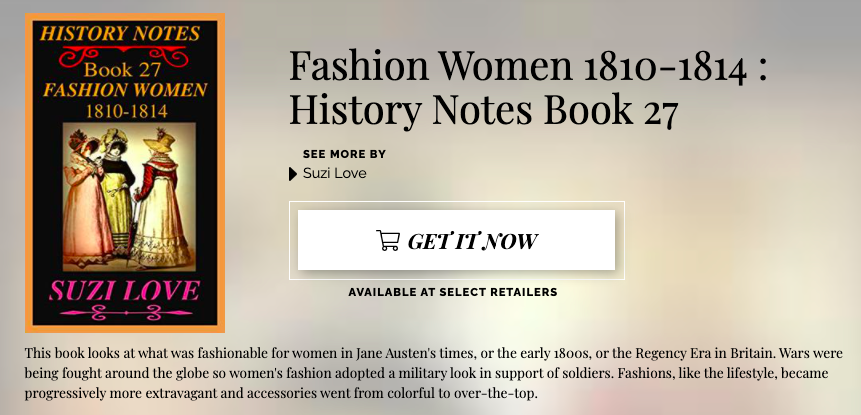
What was fashionable for women in Jane Austen’s times? Mourning, riding, daytime, evening clothing, plus underclothing, corsets and accessories. Fashion Women 1810-1814 History Notes Book 27 This book looks at what was fashionable for women in Jane Austen’s times, or the early 1800s, or the Regency Era in Britain. Wars were being fought around the globe so women’s fashion adopted a military look in support of soldiers. Fashions, like the lifestyle, became progressively more extravagant and accessories went from colorful to over-the-top. https://books2read.com/SuziLoveFashion1810-1814
The Lady’s Magazine said of the basis of women’s fashion that was popular for the first twenty years of the 1800s, ‘White is still the prevailing color for robes. For morning dresses, linen gowns, in large diamonds or squares, are fashionable. Indian muslins, plain or embroidered, are preferred to Florence and satins. The designs of embroidery for shawls are of infinite variety. Long gloves, which reach above the elbow, are not yet laid aside. Medallions are hung around the neck from crossed chains and some of these medallions are shaped like the bags, called ridicules. These reticules are of the lozenge or hexagon shape, with a small tassel at each angle. Reticules, or ridicules, are in lozenge or hexagon shapes with a small tassel at each angle. In capotes, or hats, and ribbands, the violet and dark green prevail over jonquil. Bracelets in hair, pear-shaped ear-rings, medallions on square plates, saltiers of colored stones, are still in fashion.’
What was fashionable in Bridgerton and Jane Austen times? Mourning, riding, daytime, evening fashion plus corsets and underclothing. #Bridgerton #RegencyFashion #JaneAusten https://books2read.com/SuziLoveFashion1810-1814
Love the Bridgerton family and Jane Austen? Reader Or Writer of Regency Era stories? Mourning and riding fashion, dresses, hats, shoes, reticules or bags, underclothing and fashion accessories. books2read.com/SuziLoveFashionWomen1815-1819
History Notes 28 Fashion Women 1815-1819: This book looks at what was fashionable for women in the Georgian Era and at the end of the Regency Era in Britain and the reconstruction in Europe after the wars. Lifestyles were freer and fashions expressed this by becoming the focus of most women’s lives. A wardrobe full of opulent accessories was requisite. Includes mourning and riding fashion, dresses, hats, shoes, reticules or bags, underclothing, and fashion accessories.
Are you a reader or writer of the Regency Era? Lover of the Bridgertons and Jane Austen? Mourning and riding fashion,underclothing and corsets. #Bridgerton #JaneAusten #RegencyFashion #mourningFashion https://books2read.com/SuziLoveFashionWomen1815-1819
Fashion Women 1815-1819 History Notes Book 28 What did Jane Austen wear? This book looks at what was fashionable for women in the Georgian Era and at the end of the Regency Era in Britain and the reconstruction in Europe after the wars. Lifestyles were freer and fashions expressed this by becoming the focus of most women’s lives. A wardrobe full of opulent accessories was requisite. Includes mourning and riding fashion, dresses, hats, shoes, reticules or bags, underclothing, and fashion accessories.
1809 Wedgwood and Byerley showrooms for Wedgwood china, York Street, London, UK. Plate via Rudolph Ackermann’s Repository of Arts. The premises of master potter Josiah Wedgwood in York Street, St James’ Square, London, U.K. Wedgwood china was known for its high quality, beautiful glazes and Wedgwood trademark printed on the back of each item. The London show-room was managed by Thomas Byerley, who also held a quarter share of the business. From 1790 to 1810 the firm was known as Wedgwood and Byerley. Josiah Wedgwood had smallpox as a child with left him with a weakened knee so he couldn’t work the foot pedal of a potter’s wheel. Instead, he concentrated on designing pottery and unique glazes. By 1763, he was commissioned by high ranking British people, including Queen Charlotte.
In 1780, his longtime partner died and Wedgwood’s left leg had been amputated so he asked Erasmus Darwin to help run the business and their children married. The Wedgwood inheritance allowed Charles Darwin to pay for being a naturalist. From 1786 to 1789, Wedgwood took on the project of duplicating the Portland Vase from the 1st century BD. His two sons took over the business and Josiah died at home in 1795. During his life, he helped invent modern marketing and direct mail, money-back guarantees, traveling salesmen, self-service, free deliver, buy one get one free and illustrated catalogs.
1809 Josiah Wedgwood and Thomas Byerley China Showrooms in Jane Austen’s times in York Street, London. #JaneAusten #RegencyEra #London #trade https://books2read.com/suziloveYLD
1814 Statistics On Classes, Properties and Population In Great Britain. From: 1814 A Treatise On Wealth and Power. By Patrick Colquhoun. These are the statistics for England in Jane Austen’s time, or the early 1800s, or Regency Era.
1814 Statistics On Classes, Properties, Population In Jane Austen’s Great Britain. #JaneAusten #BritishHistory #RegencyEra #Statistics books2read.com/suziloveROver
What was fashionable for women in Jane Austen’s times? Mourning, riding, daytime, evening clothing, plus underclothing, corsets and accessories. Fashion Women 1810-1814 History Notes Book 27 This book looks at what was fashionable for women in Jane Austen’s times, or the early 1800s, or the Regency Era in Britain. Wars were being fought around the globe so women’s fashion adopted a military look in support of soldiers. Fashions, like the lifestyle, became progressively more extravagant and accessories went from colorful to over-the-top. https://books2read.com/SuziLoveFashion1810-1814
The Lady’s Magazine said of the basis of women’s fashion that was popular for the first twenty years of the 1800s, ‘White is still the prevailing color for robes. For morning dresses, linen gowns, in large diamonds or squares, are fashionable. Indian muslins, plain or embroidered, are preferred to Florence and satins. The designs of embroidery for shawls are of infinite variety. Long gloves, which reach above the elbow, are not yet laid aside. Medallions are hung around the neck from crossed chains and some of these medallions are shaped like the bags, called ridicules. These reticules are of the lozenge or hexagon shape, with a small tassel at each angle. Reticules, or ridicules, are in lozenge or hexagon shapes with a small tassel at each angle. In capotes, or hats, and ribbands, the violet and dark green prevail over jonquil. Bracelets in hair, pear-shaped ear-rings, medallions on square plates, saltiers of colored stones, are still in fashion.’
These are the types of outfits worn by Jane Austen and contemporaries in English magazines, where French fashions were obsessively copied despite the two countries being at war for many years. In Jane Austen’s years, she and her contemporaries spent a lot of time walking outdoors. People were encouraged to partake in outdoor pursuits to maintain good health. Fragile slippers were worn for balls and evening events but for walking sturdier shoes were needed, In the early 1800s, these were typically made of leather, had a very small heel, slightly rounded toes and were laced up on the top.
What was fashionable in Bridgerton and Jane Austen’s times? Mourning, riding, daytime, evening fashion plus underclothing. #Bridgerton #JaneAusten #RegencyFashion https://books2read.com/SuziLoveFashion1810-1814