Almack’s Assembly Rooms often appear in Regency Era romances as they were a well known gathering place for those in the Ton looking for wives or husbands. 1770-1840 . Almack’s or Willis’s Rooms, King Street, St James, London, UK. Almack’s Assembly Rooms, founded by William Almack at No. 26-28, were on the site of the present Almack House. The club was originally a gaming establishment but moved from Pall Mall. The Assembly rooms were on the South side of King Street in St James’s and were opened on February 12, 1765. At the time the subscription was ten guineas for which there was a ball and supper each week for the twelve weeks of the season.
Assemblies were held on Tuesdays and Thursdays, but only four or five times a season. Dates were listed in the paper along with the names of the Patronesses. When Lady Jersey took over Almack’s around 1815, assemblies were changed to Wednesdays. Many aristocrats were reportedly offended by something that happened at Almack’s but Lord Jersey is reported to have refused to duel over any inferred slights because it would have meant he was forever involved in a duel. The other well-known Patronesses were Lady Bathurst and Lady Downshire.
1826 Almack’s Revisited by Charles White.: ‘It was what most correct persons called ‘horrid bad Almack’s’. #RegencyEra #London #BritishHistory1817 April Ladies’ Voucher for all the Wednesday balls at Almack’s in April 1817. via The Huntington Library, San Marino, California, U.S.A.1815 The First Quadrille at Almack’s Assembly Rooms, London. Left to Right: Marquis of Worcester, Lady Jersey, Clanronald MacDonald and Lady Worcester. “It was not until 1815 that Lady Jersey introduced from Paris the favourite quadrille, which has so long remained popular. I recollect the persons who formed the very first quadrille that was ever danced at Almack’s: they were Lady Jersey, Lady Harriett Butler, Lady Susan Ryde, and Miss Montgomery; the men being the Count St Aldegonde, Mr Montgomery, Mr Montague, and Charles Standish.” From The Reminiscences of Captain Gronow 1810-1860.
1765-1840 ca. Almack’s, or Willis’s, Assembly Rooms, South Side Of King Street, St James, London. commons.wikimedia.org
1800s Early Exterior of Almack’s Assembly Rooms, London, UK.
Captain Gronow, an army officer in London around 1814, wrote about the rules of Almack’s in Captain Gronow’s Recollections and Anecdotes, 1864 , but only gives his views on a few years of Almack’s history.
In 1814, the dances were Scotch reels and the old English country-dance; and the orchestra, being from Edinburgh, was conducted by the then celebrated Neil Gow. From Captain Gronow’s Recollections 1864.Screenshot
1800s Almack’s Assembly Rooms, London, and Regency Vouchers in Jane Austen and Bridgerton years. #JaneAusten #Bridgerton #regencyera #almacks #london books2read.com:suziloveYLD
Writing Regency Era Fiction Or Nonfiction? Need more information on Older Gentleman’s Day in early 1800s, or the Bridgerton family or Jane Austen’s Regency Era. A lighthearted overview of an older gentleman’s clothing, social life, and responsibilities in the early 1800s. Take a look at where an older man went, what he wore, and how he managed the family’s finances and his estates. Older Gentleman’s Day Regency Life Series Book 3 books2read.com/suziloveOGD
RL_3_OGD_Older Man’s Day Regency Life Series Book 3 by Suzi Love #Regency #History books2read.com_suziloveOGD
Writing Regency Era Fiction Or Nonfiction? Need information on Older Gentleman’s Day in Bridgerton And Jane Austen’s Years? #RegencyEra #Bridgerton #JaneAusten #BritishHistory http://books2read.com/suziloveOGD
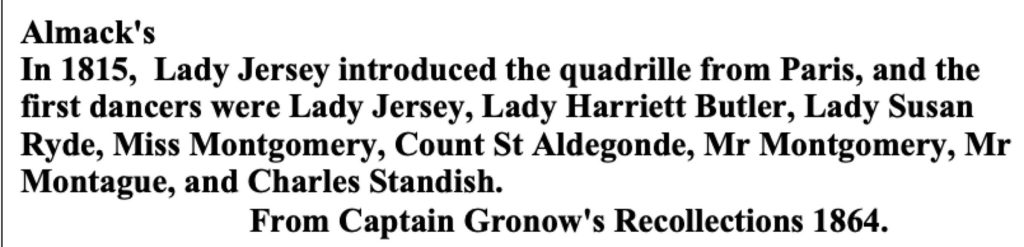
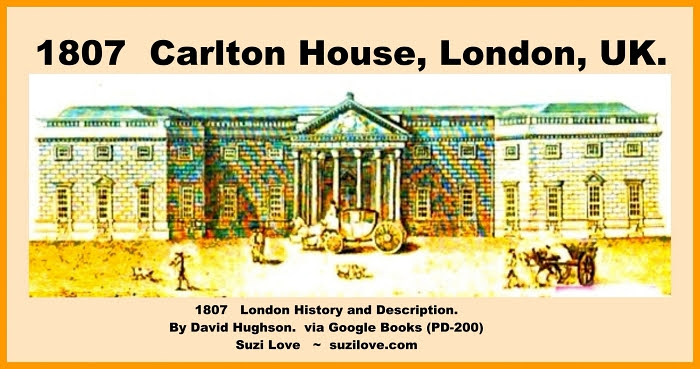
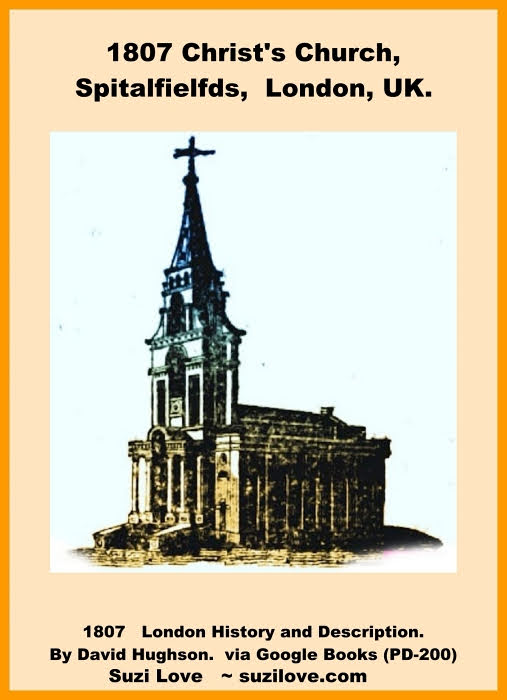
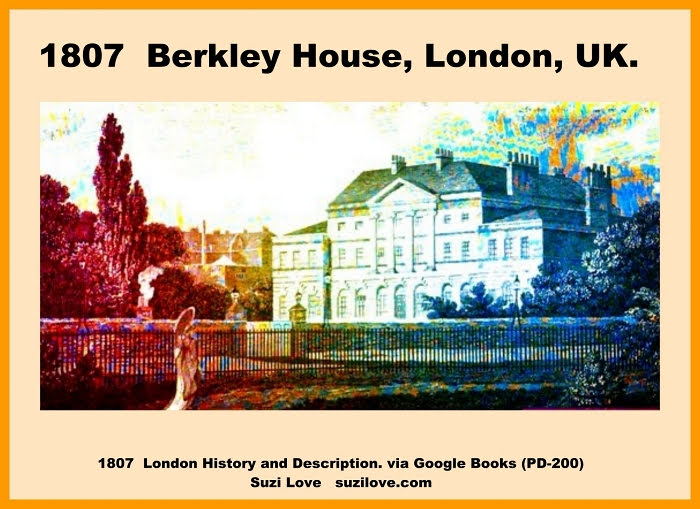
1807 London: being an accurate History and Description of the British Metropolis and its Neighborhood to Thirty Miles Extant. By David Hughson. via Google Books (PD-200)
1807 London in Jane Austen’s era. From History and Description. #RegencyEra #London #BritishHistory #JaneAusten books2read.com/suziloveROver
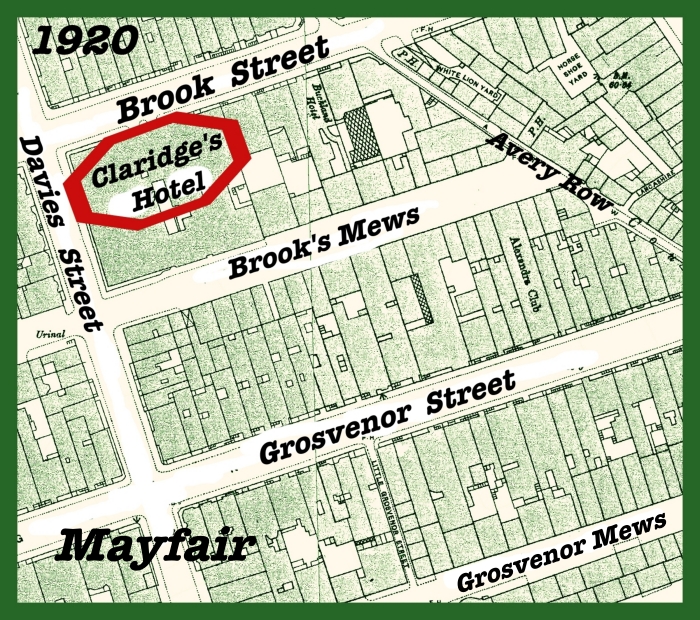
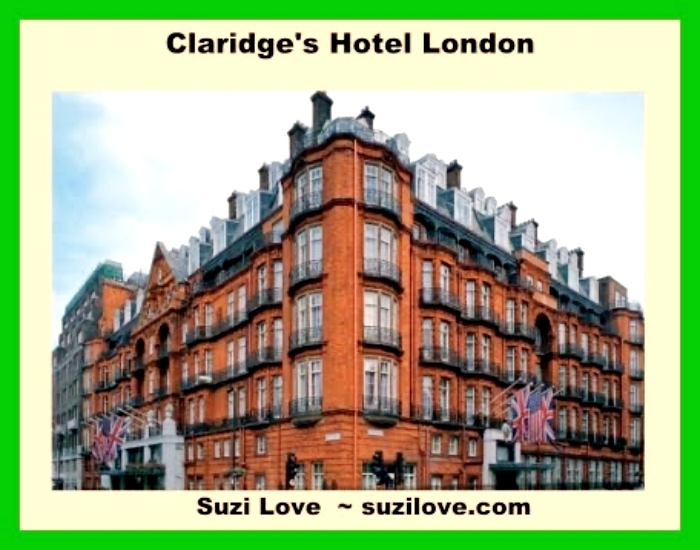
Claridge’s Hotel – London’s Historic Places Claridge’s was founded in 1812, during the Regency Era, as Mivart’s Hotel at 51 Brook Street, Mayfair, London, UK.
Lord William Beauclerk leased the terrace house from the Grosvenor Estate with permission to turn it into a hotel run by James Edward Mivart, the anglicized name for French chef Jacques Mivart. By 1838, the hotel grew to buy five consecutive houses along Brook Street, knocking down the walls to create one large hotel and Mivart prospered by introducing English county families to subtle French cooking to replace their traditional stodgy fare. Mivart designed the hotel for guests who wished to stay longer, so apartments were let by the month to foreign royalty and nobility who enjoyed the ambiance of the well-run hotel yet had the privacy of their own suites. The Prince Regent, who succeeded to the throne as King George IV in 1820, had a suite of rooms permanently reserved for him so he could discreetly carry on his playboy lifestyle.
In 1827, The Morning Post noted that Mivart’s was the fashionable rendezvous for the high Corps Diplomatique. In 1854, the hotel was sold to Mr and Mrs Claridge who ran a separate hotel at 49 Brook Street. They combined the two operations to trade as “Mivart’s at Claridge’s” until, after Mivart’s death, the hotel changed its name to Claridge’s in 1856, adding “late Mivart’s” underneath.
In 1860, Queen Victoria and Prince Albert visited the Empress Eugènie of France, who had made Claridge’s her winter quarters, and Queen Victoria was so impressed that she wrote to her uncle, Leopold I, King of the Belgians, in glowing terms of Claridge’s. The hotel became so connected to royalty it was called an “extension to Buckingham Palace”.including the Grand Duke Alexander of Russia and King William III of the Netherlands, until by 1853, The Times decided London had just three first-class hotels- Mivart’s, The Clarendon in Bond Street and Thomas’s in Berkeley Square.
In 1881, William Claridge’s failing health forced them to sell to a consortium, but the hotel consisted of several private houses and couldn’t be upgraded to compete with purpose built hotels cropping up all over London. The Savoy for example, built in 1889, offered lifts to all floors, electricity, en suite bathrooms and the best chef in Europe, Auguste Escoffier. So in 1894, Richard D’ Oyly Carte, founder of the rival Savoy Hotel, purchased Claridge’s and commissioned CW Stephens, designer of Harrods, to rebuild the hotel from the ground up. The new Claridge’s opened in November 1898.
1897 Claridge’s Hotel, Mayfair, London, U.K. A perspective view of the new building showing the front entrance in Brook Street and the return front in Davies Street. Drawn by C. W. Stephens, architect.
After World War I, Claridge’s flourished due to demand from aristocrats who no longer maintained a London house and Carte’s son, Rupert D’ Oyly Carte, added a new extension. During World War II, Peter II of Yugoslavia and his wife spent their exile at Claridge’s until on 17th June 1945, suite 212 was ceded by the UK to Yugoslavia for a single day to allow their heir, Crown Prince Alexander, to be born on Yugoslav soil.
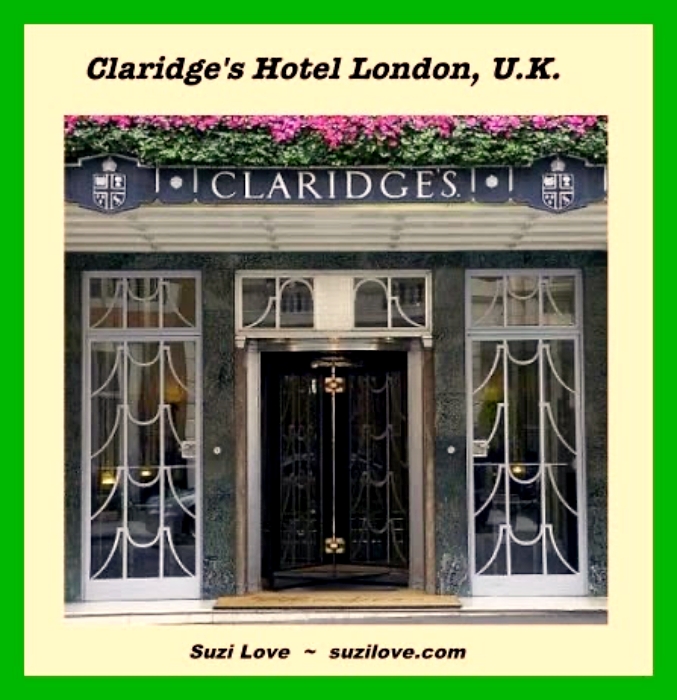
Claridge’s Hotel, Mayfair, London, during Bridgerton and Jane Austen years. #Bridgerton #janeausten #London #BritishHistory #ClaridgesHotel #travel https://books2read.com/suziloveROver
Policing in the 17th and 18th centuries – one unarmed able-bodied citizen in each parish a man was appointed or elected annually to serve for a year unpaid as parish constable.
Worked in co-operation with the local Justices in observing laws and maintaining order.
In towns, responsibility for the maintenance of order was conferred on the guilds
Later conferred on other specified groups of citizens
These supplied bodies of paid men, known as The Watch
The Watch guarded the gates and patrolled the streets at night
Huge social and economic changes and increases in town populations meant parish constables and Watch systems couldn’t cope.
In 1812, 1818 and 1822, Parliamentary committees investigated crime and policing.
Impotence of the law-enforcement machinery was a serious menace
Conditions became intolerable and led to the formation of the New Police
The Metropolitan Police
Established by an Act of Parliament in 1829 by Sir Robert Peel
Peel appointed 2 Commissioners
Appointed 895 Constables, 88 Sergeants, 20 Inspectors and 8 Superintendents.
Superseded the local Watch in the London area but the City of London was not covered.
Numbers increased
Grew to include the Greater London area (excluding the City of London)
Included parts of the Home Counties and all Royal Naval Dock Yards throughout the country.
First officer was given the warrant number ‘1’
Today the service is reaching near to a quarter million
The warrant number is unique to the officer
Different from the shoulder number which changes as the officer moves stations. Scotland Yard
Colonel Charles Rowan and Richard Mayne organized and designed the New Police
The two Commissioners occupied a private house at 4, Whitehall Place
The back opened on to a courtyard and used as a police station
This address led to the headquarters of the Metropolitan Police being known as Scotland Yard.
Sir Robert Peel, 2nd Baronet, (5 February 1788 – 2 July 1850) British Conservative statesman who served twice as Prime Minister of the United Kingdom, Chancellor of the Exchequer, and Home Secretary. Regarded as the father of modern British policing as he founded the Metropolitan Police Service.
Other Police organizations
Some older police establishments remained outside control of the Metropolitan Police Office
The Bow Street Patrols, mounted and foot, commonly called the Bow Street runners.
Police Office constables attached to the offices of, and under the control of, the Magistrates.
The Marine or River Police.
By 1839 all these establishments had been absorbed by the Metropolitan Police Force.
The City of London Police was set up in 1839 and is an independent force to this day.
1800s Early The Metropolitan Police In Jane Austen and Bridgerton Years, London. #JaneAusten #Bridgerton #BritishHistory #RegencyEra #police #London books2read.com/suziloveROver
1802 Pianoforte By John Broadwood. Square form, pale mahogany case with ebony wood stringing throughout. Inscribed ‘1802 John Broadwood and Sons, Makers to his Majesty and the Princesses, Great Pulteney Street, Golden Square, London.’ via Sotheby’s Auctions. ~ sothebys.com
Definition Piano- Forte: Well-known stringed and keyed instrument of German origin, so called from its equal command both of softness and strength. Its principal advantage over the harpsichord is its capacity of obeying the touch so the performer can vary the expressions and strike lights and shades. Jane Austen and her contemporaries played the pianoforte to entertain family and guests.
D2D_RetailerBuyLink_HN_7 Piano
books2read.com/suziloveMusicPiano
1809 Messrs. Harding Howell and Co., London, UK. View of interior of Harding Howell and Co., draper’s shop on Pall Mall. Ladies examine latest fashions and fabrics which they could then request of their dressmakers. This house extended 150 feet from front to back and was divided by glass petitions into four departments, furs and fans, haberdashery, jewellery, ornaments and perfumes, and millinery. bl.uk
1809 Interior of Messrs. Harding Howell and Co. Draper’s Shop, Pall Mall, London, U.K.
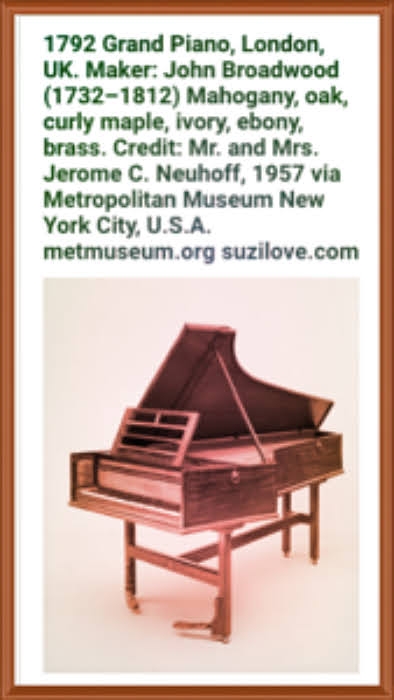
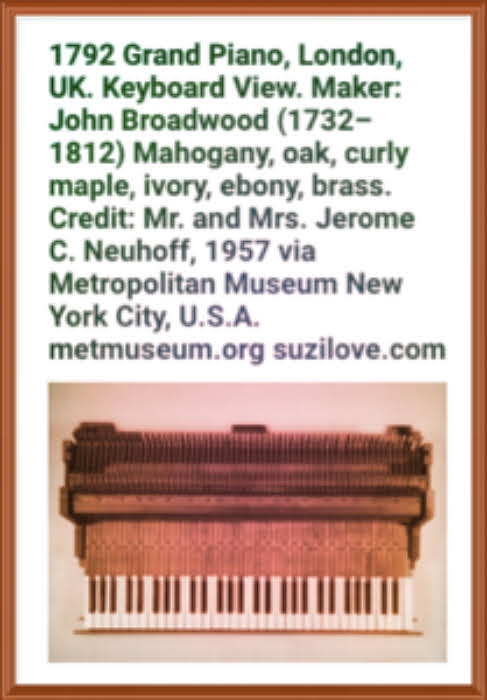
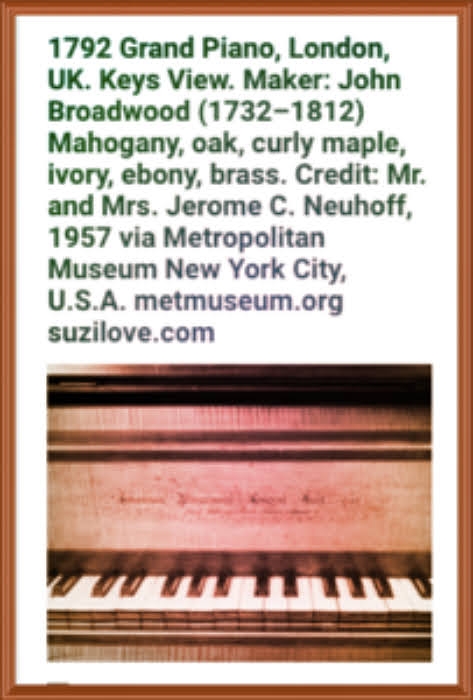
1792 Grand Piano, London, UK. Maker John Broadwood (1732–1812) Mahogany, oak, curly maple, ivory, ebony, brass. Credit: Mr. and Mrs. Jerome C. Neuhoff, 1957 via Metropolitan Museum New York City, U.S.A. metmuseum.org books2read.com/suziloveMusicPiano
HN_7 D2D Retailer Buy Link Music Piano History Notes
Excerpt: Lady Laura Jamison had turned to run, when an intractable force grasped her bodily and threw her off her feet, hurling them both sideways. Winchester, or to be precise, his muscled arms, had circled her body, heavy, protective, and immovable. Women screamed on the street below. Footsteps pounded across the stone steps.
Laura and Richard hit the ground a few feet from where they’d been standing and he rolled, his arms wrapped around her. The cocoon of his body stopped her from slamming onto the harsh stone, and he kept her lifted free of the blistering gravel on the pavement. After a series of rolls and tumbles, they pulled up in a tangled heap, a foot short of the tree-lined fence that separated church land from a row of buildings.
Not out of danger but, thank God, no longer sitting ducks. A large palm spread across the back of her head and gripped, as the Earl thrust her head into the concave shell of his chest. Her rib cage hurt as she struggled to open her lungs. She sucked in noisy streams of air, bobbed her head skyward and fought for normal breaths. His hand brushed her hair.
“Shush. Just breathe. Slowly.”
His mouth nuzzled, soothed, and hot breath lifted her curls. Under his guidance, she managed to slow her breathing to ease the ache in her chest and calm herself. She turned her head to listen, before peering out from under his arm. Sweat dripped off her brow and splashed onto the gravel below her chin, while drops fell from Winchester’s face onto her.
From beyond the high-piled vegetable cart, which provided a little protection, came chaotic noises—the terrified whinny of horses and high-pitched shrieks from humans. By the mix of lower-class voices calling to each other along the pavement, the crowd was confused about what had happened. Though not Laura.
She’d been stunned for a few seconds, but hadn’t needed any announcements to know a bullet had been fired. Not after several other incidents in recent months. They’d been physically threatened, and Becca had witnessed the murder of their friend who did the book-keeping at the Women’s Betterment Society.
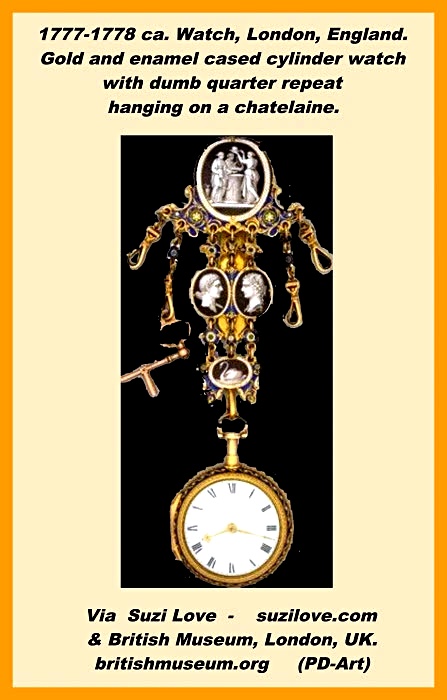
1777-1778 ca. Gold and enamel Cased Cylinder Watch with dumb quarter- repeat and en-suite Chatelaine, London, England. Via British Museum, London, UK. britishmuseum.org books2read.com/SuziLoveChatelaines
D2D_RetailerBuyLink_HN_9. Chatelaines and Chains History Notes Book 9 By Suzi Love. #regency Women in charge of houses wore long chains holding important household items around their waist e.g. keys, pen, notebook, sewing. books2read.com/SuziLoveChatelaines