1826 The Dinner Party. Social Life. From 1826 The English Spy By Robert Cruikshank. via Google Books (PD-180).
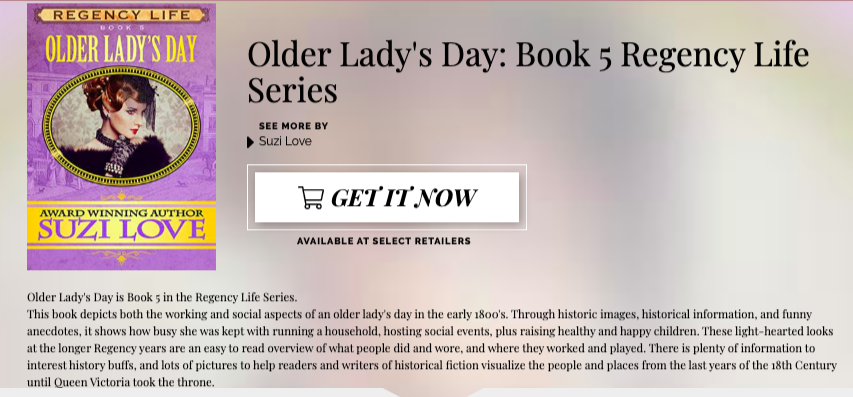
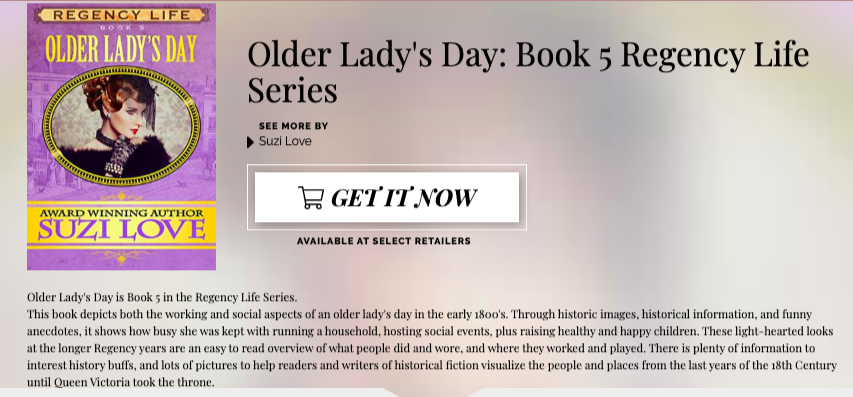
An older lady usually controlled the servants and the serving of meals. For more about this, take a look at Older Lady’s Day Regency Life Series Book 5 by Suzi Love. Overview of what an older lady did, wore, and how she lived in the early 19th Century. Information for history buffs and pictures for readers and writers of historical fiction. books2read.com/suziloveOLD
Young Lady’s Day is Book 4 in the Regency Life Series. This book depicts the often-frivolous life and fashions of a young lady in the early 1800’s, but also gives a glimpse into the more serious occupations a young lady may undertake. Through historic images, historical information, and funny anecdotes, it shows how a young lady fills her day, where she is permitted to go, and who she is allowed spend time with. These light-hearted looks at the longer Regency years are an easy to read overview of what people did and wore, and where they worked and played. There is plenty of information to interest history buffs, and lots of pictures to help readers and writers of historical fiction visualize the people and places from the last years of the 18th Century until Queen Victoria took the throne.
RL_4-5_Young Lady’s Day and Older Lady’s Day in Books 4 and 5 in the Regency Life Series. These books depict the often-frivolous life and fashions of ladies in the early 1800’s, or during the lifetime of Jane Austen, but also gives a glimpse into the more serious occupations ladies may undertake.
Are you a Bridgerton fan? Love Jane Austen? Love history? Take a look at a Young Gentleman’s Day in early 1800s. Young Gentleman’s Day Regency Life Series Books 2 by Suzi Love. Easy to read books on what a young gentleman did, wore, and lived during the early 1800s, or the Regency Era when King George 3rd was mad and his son, Prince George, was the Regent in Britain. #Regency #JaneAusten #amwriting books2read.com/suziloveYGD
1800s Early Tattersall’s Horse Auctions, London, U.K.. Top sporting venue for Regency Life in London. ‘A mixture of persons of nearly all ranks’. By Pierce Egan. Via Wikimedia Commons (PD-ART)
In Jane Austen’s and Bridgerton times, or the Regency Era, horse riding was a vital mode of transport and Tattersall’s was the best place to buy and sell horses. Tattersall’s was established in 1773 near Hyde Park Corner for the sale by auction of horses, carriages, hounds and harnesses. Sales during the winter months were every Monday and Thursday, and on Mondays only during the spring and summer. On the mornings when there was no sale, Tattersall’s was a meeting place for fashionable sporting gentlemen.
Pierce Egan’s Description of Tattersall’s
A masquerade could scarcely exhibit more motley groups than the attendants of this place of fashionable resort. There were Peers, Baronets, Members of Parliament, Turf gentlemen and Turf-servants, Jockies, Grooms, Horse-dealers, Gamblers, &c. There you might see the oldest and some of the best blood in England, disguised like coachmen.
From: 1820 Sporting Anecdotes by Pierce Egan via Google Books (PD-150)
1826 Cartoon: A squeeze at Carlton Palace in Bridgerton and Jane Austen times. From Regency Social Life. #JaneAusten #Bridgerton #Cartoon #England https://books2read.com/suziloveYGD
I love these snippets from Captain Gronow’s Recollections 1864. Even though they were written after the Regency, they give us fun bits of information about Almack’s Assembly Rooms, the Prince Regent or later King George IV.
“Good society at the period to which I refer was, to use a familiar expression, wonderfully “select.” At the present time one can hardly conceive the importance which was attached to getting admission to Almack’s, the seventh heaven of the fashionable world. Of the three hundred officers of the Foot Guards, not more than half a dozen were honoured with vouchers of admission to this exclusive temple of the beau monde; the gates of which were guarded by lady patronesses, whose smiles or frowns consigned men and women to happiness or despair. These lady patronesses were the Ladies Castlereagh, Jersey, Cowper, and Sefton, Mrs Drummond Burrell, now Lady Willoughby, the Princess Esterhazy, and the Countess Lieven.
Almack’s: Exclusive temple of the beau monde. The gates of which were guarded by the lady patronesses,The Ladies Castlereagh, Jersey, Cowper, Sefton, Willoughby, Princess Esterhazy, and Countess Lieven.
From Captain Gronow’s Recollections 1864.
The most popular amongst these grandes dames was unquestionably Lady Cowper, now Lady Palmerston. Lady Jersey’s bearing, on the contrary, was that of a theatrical tragedy queen; and whilst attempting the sublime, she frequently made herself simply ridiculous, being inconceivably rude, and in her manner often ill-bred. Lady Sefton was kind and amiable, Madame de Lieven haughty and exclusive, Princess Esterhazy was a hon enfant, Lady Castlereagh and Mrs Burrell de tres grandes dames.
Many diplomatic arts, much finesse, and a host of intrigues, were set in motion to get an invitation to Almack’s. Very often persons whose rank and fortunes entitled them to the entree anywhere, were excluded by the cliqueism of the lady patronesses; for the female government of Almack’s was a pure despotism, and subject to all the caprices of despotic rule: it is needless to add that, like every other despotism, it was not innocent of abuses.
Almack’s
The fair ladies who ruled supreme over this little dancing and gossiping world, issued a solemn proclamation that no gentleman should appear at the assemblies without being dressed in knee-breeches, white cravat, and chapeau bras.
From Captain Gronow’s Recollections 1864.
1815 The First Quadrille at Almack’s Assembly Rooms, London. Left to Right: Marquis of Worcester, Lady Jersey, Clanronald MacDonald and Lady Worcester. “It was not until 1815 that Lady Jersey introduced from Paris the favourite quadrille, which has so long remained popular. I recollect the persons who formed the very first quadrille that was ever danced at Almack’s: they were Lady Jersey, Lady Harriett Butler, Lady Susan Ryde, and Miss Montgomery; the men being the Count St Aldegonde, Mr Montgomery, Mr Montague, and Charles Standish.” From The Reminiscences of Captain Gronow 1810-1860.RL_1_D2D_Regency Overview RetailerLinks
https://books2read.com/suziloveROver
‘How dare you.’ Lady Lillian spat the words at the Earl of Mallory and gave him her fiercest glare. ‘You shouldn’t have interfered like that. If those gentlemen recognize you, they might work out who I am, which is exactly what you wanted to avoid.’ She huffed. ‘Besides, I instigated that kiss.’
‘Why would you do such a brazen thing? Risk your good name and your life in such an impulsive manner.’
She sighed, all her anger deflating. ‘My good name evaporated when Geoffrey’s sexual preferences became known after his death. The men he mixed with kept his secrets when he was alive, and possibly even liked whips and ropes as much as Geoffrey, but dead men can’t reveal their secrets so they felt safe to expose him, while distancing themselves from those activities.’
‘But why would they risk incriminating themselves?’
‘I learned later that two girls had died, a day apart and in different areas of London, but both had been physically tormented and their bodies were left in parks in Mayfair. Government officials were sent to investigate after a minister’s wife and children stumbled upon one of them, and there was a push to find the culprit and to close down any houses of ill repute in respectable neighborhoods.’
‘I read about the murders, but surely they don’t think Geoffrey had anything to do with that. He wasn’t the most respected man and nor was he a decent husband, but I cannot imagine him killing women.’
‘The enquiry cleared Geoffrey, but as those houses were places that Geoffrey and his cohorts visited, his so-called friends decided to toss out Geoffrey’s name and draw the scrutiny away from them.’
Brent took her hands and shook them lightly. ‘Why didn’t you tell me?’
She shrugged. ‘Geoffrey was dead and I simply wanted to forget all the sordidness and start afresh.’ She waved a hand at the guests, whose conversations had become bawdier and louder the more punch was consumed and, as inhibitions were drowned in liquor, both women and men had stripped away clothing and were well on their way to public sex. ‘Here, I can reclaim myself, because everyone indulges in excesses and they don’t judge each other badly because they’ve let down their guards for an evening.
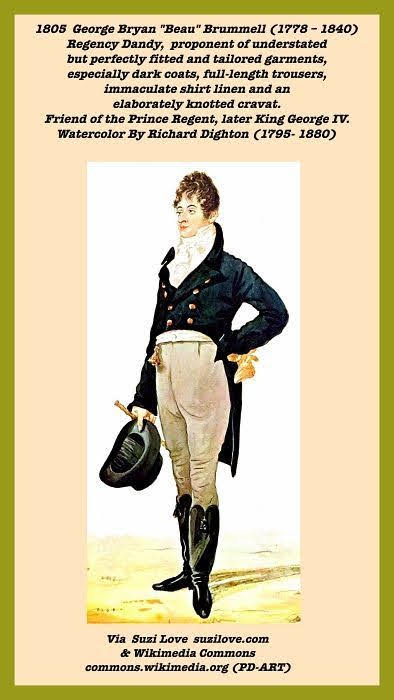
George Bryan “Beau” Brummell (June 7th 1778 – March 30th 1840) Arbiter of men’s fashion and friend of the Prince Regent, the future King George IV. Established mode of dress for men that rejected overly ornate fashions for understated but perfectly fitted and tailored clothing. Look based on dark coats, full-length trousers rather than knee breeches and stockings, with immaculate shirt linen and an elaborately knotted cravat. 1855 Engraving of Beau Brummell from an article in Harper’s New Monthly Magazine.
1805 Beau Brummell (1778-1840) Regency Dandy, proponent of understated but perfectly fitted and tailored garments, especially dark coats, full-length trousers, immaculate shirt linen and an elaborately knotted cravat. Friend of the Prince Regent, later King George IV. Watercolor By Richard Dighton (1795- 1880) Via Wikimedia Commons commons.wikimedia.org (PD-ART) https://books2read.com/SuziLoveFashionMen1800-1819
What did an older lady do in the Bridgerton family’s and Jane Austen’s times, or the early 1800s. An easy to read overview of what an older lady did, wore, and how she lived in the early 19th Century. Information for history buffs and pictures for readers and writers of historical fiction. Older Lady’s Day, Regency Life Series, Book 5, by Suzi Love. books2read.com/suziloveOLD
Through historic images, historical information, and funny anecdotes, it shows how an older lady in Jane Austen’s times fills her day, where she goes, and with whom she spends her time. This light-hearted look at the longer Regency years is an easy to read overview of what people did and wore, and where they worked and played. There is plenty of information to interest history buffs, and lots of pictures to help readers and writers of historical fiction visualize the people and places from the last years of the 18th Century until Queen Victoria took the throne.