“Two nights ago,” Lady Rebecca Jamison said, “the woman we engaged at the Women’s Betterment Society to tally the Stock Exchange ledgers — our friend — was murdered. The killer was still inside Peggy’s house when I arrived. Her slayer stopped at the back door and stared directly at me, memorizing my features.”
Her pronouncement was flat-voiced, deadly calm.
“Thankfully, his immediate concern was escaping with our two accounting books. But when the cache identifies me as the woman who saw their lackey’s face, I am certain they will send him to dispose of me as well. They are peers, titled and wealthy, and cannot risk being exposed as members of an illegal group. If we cannot stop these men, brutes who employ cold-blooded assassins to do their dirty work, I will certainly be the next to die.”
The Duke of Sherwyn’s chilled blood turned to ice.
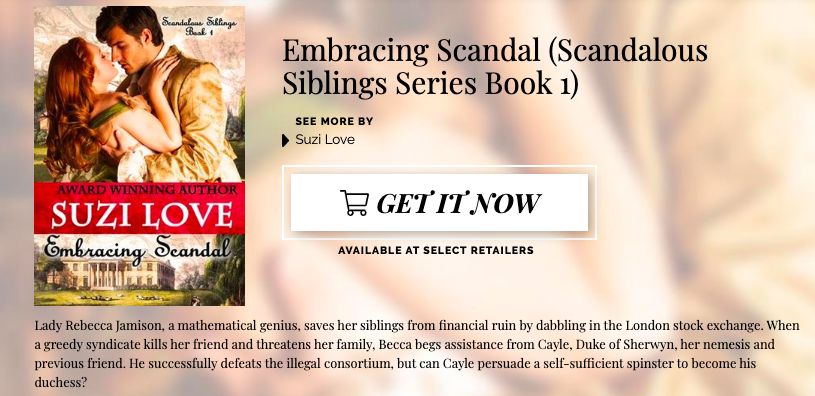
Embracing Scandal (Scandalous Siblings) by Suzi Love. Lady Rebecca Jamison saves her family from financial ruin by investing in railways, but when a greedy syndicate murders her friend, Becca is forced to beg assistance from Cayle St. Martin, the new Duke of Sherwyn. https://books2read.com/suziloveES
ES_ Embracing Scandal Book 1 Scandalous Siblings Series D2D_ES_ https://books2read.com/suziloveES
Tired past the point of arguing, Gabe undid the buttons on his trousers and awkwardly sank to the floor. Thin though the mattress was, he groaned with relief to be seated and able to stretch out his aching leg. He bent and tugged at his boots, but Lady Melton swatted his hands away. “Lean back and let me take care of you.”
He blinked at her in surprise. His uncle’s housekeeper had filled the role of mother for him often enough, but other than Mrs. Green, no one had ever fussed over his physical well-being. The women he’d been intimate with had fretted over pleasing him sexually, but his role as the male and provider had been to ensure they were well-housed, fed, and clothed. Role reversal made him uncomfortable, and yet Anne’s caring was oddly reassuring.
His upcoming task wasn’t going to be easy. Eleven men, a lady, and a small boy had to be transported to England. Plus, Wellesley’s dispatches were sewn into the lining of his uniform, which not even the Lieutenant knew. Gabe carried the official summation of the battle, papers that he’d been ordered to personally deliver to the War Office in London. Messengers were adequate for shorter notes, but the War Office needed a full report from Wellington, plus observations from his trusted officers, which amounted to a hefty and valuable package for him to conceal.
If Anne could lessen his pain, even a little, his thinking would be clearer during their journey, and only an ungrateful idiot would refuse her offer.
1826 The Dinner Party. Social Life. From 1826 The English Spy By Robert Cruikshank. via Google Books (PD-180).
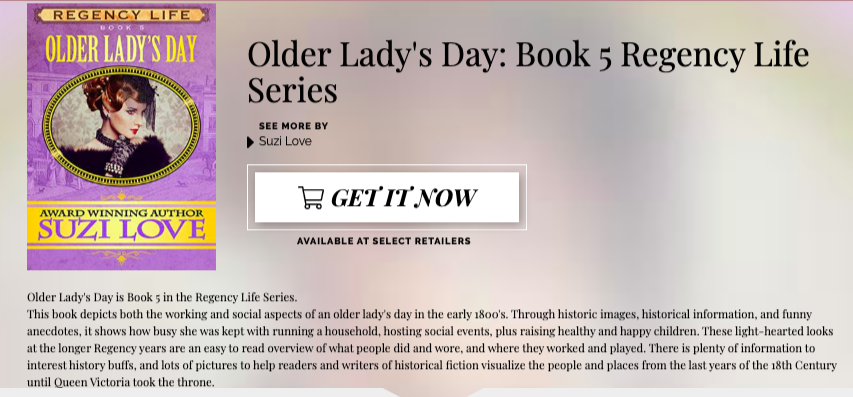
An older lady usually controlled the servants and the serving of meals. For more about this, take a look at Older Lady’s Day Regency Life Series Book 5 by Suzi Love. Overview of what an older lady did, wore, and how she lived in the early 19th Century. Information for history buffs and pictures for readers and writers of historical fiction. books2read.com/suziloveOLD
1810 Stockdale’s Peerage King George William Frederick III. From Stockdale’s Peerage of England, Scotland and Wales. Containing an Account of All the Peers of the United Kingdom . via Google Books Printed for John Stockdale, Piccadilly, London, U.K.
1804 King George III. via Kearsley’s Complete Peerage. Google Books (PD-180)
Our present Most Gracious Sovereign, was born May 24, 1738 and baptized June, 1738, at Norfolk House. Succeeded his father in the titles of Prince of Great Britain, Electoral Prince of Brunswick-Lunenburg, Duke of Edinburgh, Marquis of the Isle of Ely, Earl of Carrick and Eltham, Viscount Launceston, Baron of Renfrew and Snowdon, Lord of the Isles, and Steward of Scotland ; but the Duchy ot Cornwall was merged in the crown. He was, by letters patent, April zr, 1751, created Prince of Wales ; and on the death of his royal grandfather, George II. the crown of Great Britain devolved on his Royal Highness, Oct. z$, 1760, and he was proclaimed the next day with the usual solemnities. His Majesty married, Sept. 8, 1 76 1 , Sophia-Charlotte, Princess of Mecklenburg-Strelit, sister to the present and late Duke, and their Majesties were crowned the 22d of the same month.
By his royal Consort, who was born May 19, 174.4, his Majesty has issue :
1. GEORGE- AUGUSTUS- FREDERICK, Prince of Wales. See Prince of Wales.
2. Frederick, Bishop of Osnaburg, Duke of York ; see Duke of York.
3. William-Henry, Duke of Clarence; see Duke of Clarence,
4. Charlotte-Augusta- Matilda, born Sept. 29, 1766, Lady of the Russian Imperial Order of St. Catherine ; married, May 18, 1797, Frederick-Charles-William, King of Wirtemburg, brother to the Empress of Russia, and relict of the eldest daughter of the Duke of Brunswick, by Augusta, his Majesty King George the third’s eldest sister.
5. Edward, Duke of Kent and Strathern; see Duke of Kent.
6. Sophia-Augusta, born Nov. 8, 1768.
7. Elizabeth, born May 22, 1770.
8. Ernest-Augustus, Duke of Cumberland ; see Duke of Cumberland.
9. Augustus-Frederick, Duke of Sussex ; see Duke of Sussex.
10. Adolphus-Frederick, Duke of Cambridge; sec Duke of Cambridge.
11. Mary, born April 25, 177*.
I2. Sophia, born Nov. 3, 1777. 1
13. Octavius, born Feb. 23, 1779, and died May 3, 1783.
14 Alfred, born Sept 22, 1780, and died Aug. zo, 1782. .
15. Amelia, born Aug. 7, 1783.
PRINCE OF WALES.
GEORGE- AUGUSTUS -FREDERICK, Prince of Great Britain, Prince of Wales, Electoral Prince of Brunswick- Lunenburg, Duke of Cornwall and Rothesay, Earl of Chester and Carrick, Baron of Renfrew, Lord of the Isles, Hereditary Great Steward of Scotland, a Colonel in the Army, and Colonel ef the 10th Regiment of Light Dragoons, Captain-General of the Royal Artillery Company, High Steward o! Plymouth, Knight of the Garter, and F. R. S. Born Aug. 12,1762; and, on the 17th of the same month, his Majesty ordered letters patent for creating him Prince of Wales and Earl of Chester ; and Nov. 1783, his Royal Highness took his seat in the House of Peers ; in 1765, elected a Knight Companion of the Most Noble Order of the Garter, and installed at Windsor, July 25, 1771. Married, April 8, 1795, Caroline-Amelia- Elizabeth, second daughter of the late Duke of Brunswick (born May 17, 1768), by whom he has a daughter, Charlotte-Caroline-Augusta- born Jan 7, 1796. Edward, the Black Prince, was the first Duke of Cornwall, created 1337, in perpetuity to his heirs; by virtue of which the eldest son of the King of England is Duke of Cornwall. The Earldom of Chester is by creation by letters patent 3 1 Henry III. 1247, and has been invariably annexed to the eldest son of the King of England. The titles of Hereditary Steward of Scotland, Duke of Rothesay, Earl of Carrick, and Baron of Renfrew, were titles annexed by B’ belt III. King of Scotland, 1399, to the eldest to the eldest Prince of Scotland, on his birth, and have continued from that period. The title of Prince of Wales was first conferred on the infant son of Edward I 1284, and has never been bestowed but on the heir to the Throne.
DUKE OF YORK. PRINCE FREDERICK, Duka of YORK and ALBANY in Great Britain, and Earl of Ulster in Ireland, Bishop of Osnaburg, Knight of the Garter and Bath, D. C L. F. R. S. and a Field-Marshal, Colonel of trie First Regiment of Foot Guards, Colonel in Chief of the sixtieth (or. Royal American) Regiment of Foot, and of the Royal Dublin Regiment of in.fantiry, Lord Warden of Windsor Forest and Great Park, and Warden and Keeper of the New Forest, Hampshire ; second son of his Majesty. Born Aug. 16, 1763. Created as above Nov. 27, 1784. Married, Sept. 29, 1791, Frederica Charlotte- Ulrica-Catharina, Princess Royal of Prussia (born May 7, 1767), eldest daughter to the late King of Prussia, by his first consort, Elizabeth-Ulrica-Christiana, Princess of Brunswick- Wolfen- buttel, sister to the late Duke.
DUKE OF CLARENCE: PRINCE-WILLIAM-HENRY, Duke of CLARENCE and x ST. ANDREWS in Great Britain, and Earl of Munster in Ireland, Knight of the Garter and Thistle, Admiral of the Red, and Ranger of Bushy Park ; third son of his Majesty. Born Aug. 21, 1765. Created as above, May 16, 1785.
DUKE OF KENT: PRINCE EDWARD, Duke of KENT and STRATHERN Great Britain, Earl of Dublin in Ireland, fourth son of his Majesty, Knight of the Garter and of St. Patrick, Field-Marshal of the Forces, Governor of Gibraltar, Colonel of the First Regiment of Foot, Keeper and Paler 0/ Hampton Court Park. Born Nov. 2, 1767. Created as above, April 23, 1790. Arms.
DUKE OF CUMBERLAND. PRINCE ERNEST-AUGUSTUS, Duke of CUMBERLAND and TlVIOTDALE in Great Britain, Earl of Armagh in Ireland, fifth son of his Majesty, a Knight of the Garter, and D. C. L. Chancellor of the University of Dublin, a General in the Army, and Colonel of the 15th Regiment of Dragoons. Born June 5, 1771. Created as above, April 43, 1799. Arms.
DUKE OF SUSSEX: PRINCE AUGUSTUS-FREDERICK, Duke of SUSSEX, Earl of Inverness in North Britain, Baron Arklow in Ireland, Knight of the Garter. Born Jan. 27, 1773, sixth son of his Majesty. Created as above, Nov. 7, 1801. His Royal Highness married, April 3, 1793, Augusta Murray, second daughter of John Earl of Dunmore, by whom he had Augustus-Frederick, born Jan. 13, 1794; and was re-married Dec 5, 1793, at St. George’s church, Hanover Square, London. This marriage was declared null and void, being in violation of stat. 12 Geo. III. c. 11. which enacts that no descendant of the body of King George II. (other than the issue of princesses married into foreign countries) is capable of contracting. matrimony without the previous consent of the King, signified under the great seal ; and any marriage contracted without such consent is void. And the marriage was accordingly dissolved in August 1794. Arms. — See plate 3.
DUKE OF CAMBRIDGE. PRINCE ADOLPHUS- FREDERICK, Duke of CAMBRIDGE, Earl of Tipperary in Ireland, and Baron of Culloden in North Britain, seventh son of his Majesty. Born Feb. 24, 1 774. Knight of the Garter, a General in the Army, Colonel of the id or Coldstream Regiment of Foot Guards. Created as above, Nov. 27, 1801.
DUKE OF GLOUCESTER: PRINCE WILLIAM-FREDERICK, DUKE of GLOUCESTER and EDINBURGH in Great Britain, Earl of Connaught in Ireland, Knight of the Garter, a General in the Army, Colonel of the third- Regiment of Foot Guards, and Ranger of Bagshot Park and Walk. Born at Rome, Jan.-J5, 1776. Succeeded his father, Prince William-Henry, the, late Duke, Aug. 25,. 1805. His Royal Highness’s father, Prince William-Henry, Duke of Gloucester, was third son of his Royal Highness Frederick- Lewis, Prince of Wales, and brother to his Majesty ; born, Nov. 25, 1743, and by patent Nov. 14, 1764, created Duke of Gloucester and Edinburgh in Great Britain, Earl 0/ Connaught In Ireland, Knight of the Garter, Senior Field-Marshal of his Majesty’s Forces, Colonel of the first Regiment of Foot Guards, Chancellor of the University of Dublin, Ranger and Keeper of Cranbourne Chase, Ranger of Hampton Court Park, Lord Warden and Keeper of the New Forest, Hampshire. His Royal Highness married, Sept. 6, 1766, Maria, Countess Dowager of Waldegrave, widow of James, second Earl of Waldegrave, and daughter of Sir Edward Walpole, Knight of the Bath, and by her (who died Aug. 23, 1807) had issue: (• Sophia-Matilda, born May 29, 1773-; 2. Caroline- Augusta- Maria, born June 24, 1774, died March 14, 1775; 3.Wil liam-Frederick, the present Duke. His Royal Highness died Aug. 25, 1805, and was succeeded by his only son, Prince William-Frederick, the present and second Duke. Anms.
The King’s sons, brothers, uncles, and nephews are Styled Princes of the Blood Royal, and have precedency of all other Dukes, with the title of Royal Highness.
1840 ca. The York To London Royal Mail. By A. Anson Martin. Mailcoach in the village of Bedale, Yorkshire, U.K. Church at the end of the wide country road and thatched cottages behind the coach. Signed and Inscribed ‘(All Right)’. Via British Postal Museum, London, U.K. ~ postal museum.org
The dreadful condition of British roads caused great apprehension to all classes of travelers. Making a journey anywhere in the country was a big undertaking and often a gentleman composed his last will and testament before his departure. Traveling in vehicles was only possible during the day or on the nights with very bright moonlight with few vehicles attempting road travel in winter and any travel on a Sunday was frowned upon. books2read.com/SuziLoveTravel
Description of Stage Coach Travel in England. via 1815 Journal Tour of Great Britain. “The gentlemen coachmen, with half-a dozen great coats about them, immense capes, a large nosegay at the button-hole, high mounted on an elevated seat, with squared elbows, a prodigious whip, beautiful horses, four in hand, drive in a file to Salthill, a place about twenty miles from London, and return, stopping in the way at the several public-houses and gin-shops where stage-coachmen are in the habit of stopping for a dram, and for parcels and passengers on the top of the others as many as seventeen persons. These carriages are not suspended, but rest on steel springs, of a flattened oval shape, less easy than the old mode of leathern braces on springs. Some of these stage coaches carry their baggage below the level of the axletree.”
HN_10_D2D_RetailerBuyLink_Travel and Luggage By Suzi Love History Notes Book 10 #History #travel How did people travel in past centuries? What did they take with them to make their long journeys easier? books2read.com/SuziLoveTravel
1810-1820 ca. Double Breasted Red Hunting Coat, English.
1810-1820 ca. Red Hunting Coat, English. Hunting was both a popular sport and an essential part of social success. Double-breasted tailcoat of woolen superfine, lined with sateen and cotton, M-notch lapels, nine gold buttons with heraldic crest, cuffs with three smaller matching buttons. via Collection from Castle Howard, Yorkshire, U.K. Victoria and Albert Museum, London, UK. Hunting coats, or colors, often red coats called pinks, were worn by hunt masters and hunters. In Bridgerton and Jane Austen times, or the early 1800s, gentlemen wore red coats like this while riding to the hounds.
Historically, hunt members wore ‘colors’ to distinguish between types of hunters and their level of experience. Traditional red coats were worn by huntsmen, masters, former masters, whippers-in, regardless of sex, while other hunt staff members and male members invited by masters wore colors and hunt buttons as a mark of appreciation for their involvement in the organization and running of the hunt. After the Hunting Act in England and Wales, only Masters and Hunt Servants wore red coats or hunt livery. Gentleman subscribers usually wore black coats, with or without hunt buttons and in some countries, women wore colored collars on their black or navy coats to help them stand out from the rest of the field. Some hunts, including most harrier and beagle packs, wear green rather than red jackets, and some hunts wear other colors such as mustard.
Do you need more factual and visual information for your historical fiction? History of fashion, music, peerage and customs in 18th and 19th centuries. Non-fiction series full of gorgeous pictures and engraved fashion plates. A visual history of fashion, music, peerage, social manners and customs from late 1700s to late 1800s, or 18th and 19th centuries.
ance”As the Duke of Sherwyn, you’ve entree into the best houses and social events.”
After a scowl towards the ceiling, he muttered, “Thanks to my stepmother, I’m forced into it. But what does my recent social popularity have to do with your current predicament?”
“In daylight, with other ladies, I can stroll about the streets. Visit shops, sometimes slip unnoticed into the twice-weekly stock auctions at the Hall of Commerce in Threadneedle Street. And I’ve already searched the desks of many of the mere misters and lesser peers of the lower orders of the consortium, as their houses aren’t guarded like fortresses.”
“Do you mean to say you entered these men’s homes and rifled their papers?”
“Well yes, but–”
“Are you mad?”
“I risked little, because those sort of houses cannot afford a footman guarding every passageway. Especially not on occasions such as those I attended, where every footman is needed to fetch drinks for belligerent guests. Slipping into those libraries was child’s play.” She sighed. “What I cannot do is visit the homes of the highest ranking peers to scour their correspondence for any that bears the special seal of the consortium. Nor secure enough privacy to copy any incriminating letters I may find. Someone always hovers, and watches, at those type of houses.”
He paced before her like a restless panther, an angry scowl pulling his face taut. His fine looks had always turned heads, but this brooding beast carried a lethal combination of strength and menacing masculinity. She shivered. His newly acquired arrogance of bearing enhanced, rather than detracted from, his magnetism, although this time, she knew to avoid his magnetic pull.
“You intend searching the houses of every peer in the city who is making money from stock shares?”
“No, no, not all of them. We’ve done a lot of research–”
“We?”
“My family have become quite adept at research. We’ve narrowed our search to gentlemen known to invest in railway expansions in a large way. Our final list is of those we consider to be involved in the inner, and most secret, tier of the syndicate. It contains eighteen names, the majority of whom are high-ranking peers.
“Bloody hell, Becca.” He ground the expletive out through clenched teeth. “You’re out of your depth. I’ve been involved in similar commercial groups. They’ll stop at nothing for the sake of money.”
“Nevertheless, we need certain details you may overhear at clubs about certain gentlemen having sudden windfalls. Or things gleaned at certain balls and soirees.
“Unbelievable.” Both hands went up in the air. “That’s certainly as clear as muddy water.”
“Clear or not, I’m asking you to trust me. To help me.”
She held out both hands, palms up, and hoped he wouldn’t notice their tremors. “With your assistance, I can verify more names. Collect proof of each one’s involvement and hand it over to Scotland Yard. Time is of the essence, as we’ve now less than two weeks.”
She watched him absorb, assess, decide. In under a minute, he guided her to his desk and seated her before it.
“Make a start. List the names of every man you suspect to be a member.” He placed writing materials before her. “Then list those you consider inner tier, and include their ranking.”
Lady Jamison saves family from financial ruin by railway investing but when her friend is murdered, Becca begs assistance from new Duke of Sherwyn. https://books2read.com/suziloveES
ES_ Embracing Scandal Book 1 Scandalous Siblings Series D2D_ES_ https://books2read.com/suziloveES
1818 December 11th A dandy fainting or – an exquisite in fits. Scene a private box opera. A dandy lies back fainting in a chair, his limbs rigid, supported by three others while a fourth (left) draws the curtain, cutting off a view of the (distant) stage where a singer is posturing. Via British Museum, London, UK. britishmuseum.org (PD-Art)
1800 ca. Writing Box, British, as would have been used by people in Jane Austen’s times, or, the Regency Era. Small brass bound solid mahogany writing box of dovetail construction. Green baize sloping writing surface with compartments for storing papers beneath. Small size may be designed for private intimate correspondence. Drop down carrying handles on two sides are early form of handle. Side drawer pulls out after retaining brass pin is taken out. via hygra.com
HN_13_D2D_WritingTools Book 13 What did the lady of the house use to pen notes? What sat on the desk of the man of the house when managing his accounts? #History #Nonfiction #travel books2read.com/SuziLoveWritingTools