Travel and Luggage By Suzi Love History Notes Book 10. How did people travel in Bridgerton’s and Jane Austen’s times? What did they take with them to make their long journeys easier? Travel by road, ship, canal, or railway all took a long time and had dangers so people learned to prepare. And then, in the nineteenth century, road improvements, inventions, and scientific developments made travel more pleasurable. books2read.com/SuziLoveTravel
1800 – 1820 ca. Bag, Or Reticule, Dutch. Cotton, glass and with drawstring. via Metropolitan Museum New York City, U.S.A. metmuseum.org http://books2read.com/suziloveReticules Because reticules were so popular, Jane Austen and her family and friends and the Bridgerton family would have made reticules for each other for gifts and carried these small purses with them whenever they went out.
From Historic Dress In America: ‘Reticules were so universally carried during the first part of the nineteenth century that they were called Indispensables, and a few years later ridicules. Miss Southgate describes one in a letter in 1802, ‘Martha sent me a most elegant Indispensable, white lute-string spangled with silver…’
Definition Reticule Or Bag or Purse: Often with a drawstring to pull closed and usually made of cloth or covered cardboard and often decorated with beading or embroidery. A reticule, or purse, or handbag, was usually carried by a woman during the Regency period to carry all their daily necessities. Earlier, women used pockets that tied at the waistline and were hidden in the folds of their skirts. Empire style, or early 1800s, high-waisted dresses made it impossible to either sewn in a pocket or to tie on a pocket. So women began carrying small, decorated bags called Reticules, or ridicules, which generally pulled close at the top with a drawstring.
• Beadwork: Attaching beads to one another by stringing with a needle and thread or thin wire, or sewing them to cloth. Includes loom weaving, stringing, bead embroidery, bead crochet, and bead knitting.
• Embroidery: Decorating fabrics with a needle and thread, or cloth, such as a needlepoint picture of a house or hand sewn initials.
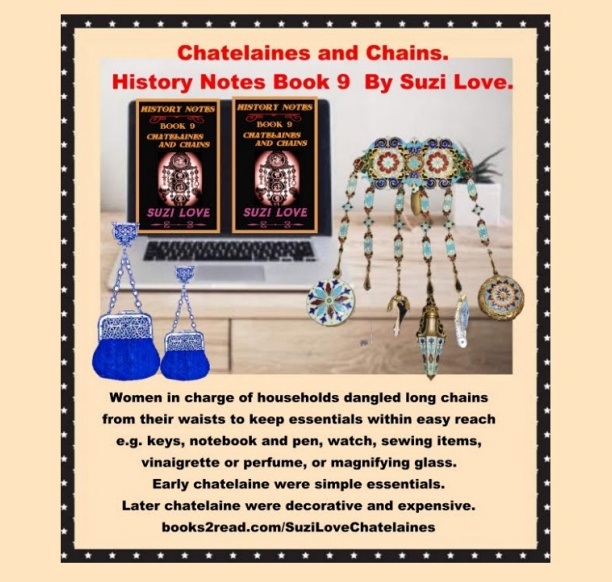
Chatelaines and Chains History Notes Book 9 By Suzi Love. What do you know about Chatelaines and Chains worn in Jane Austen’s and Bridgerton times? Women in charge of households carried important items with them. History Notes Book 9 Chatelaines and Chains. books2read.com/SuziLoveChatelaines
Personal Necessities, keys, or chatelaines was a set of useful items hung from waist by decorative chain. Chatelaines and Chains. History Notes Book 9 By Suzi Love. Women in charge of households dangled long chains from their waists to keep essentials within easy reach e.g. keys, notebook and pen, watch, sewing items, vinaigrette or perfume, or magnifying glass. Early chatelaine were simple essentials. Later chatelaine were decorative and expensive. http://books2read.com/SuziLoveChatelaines
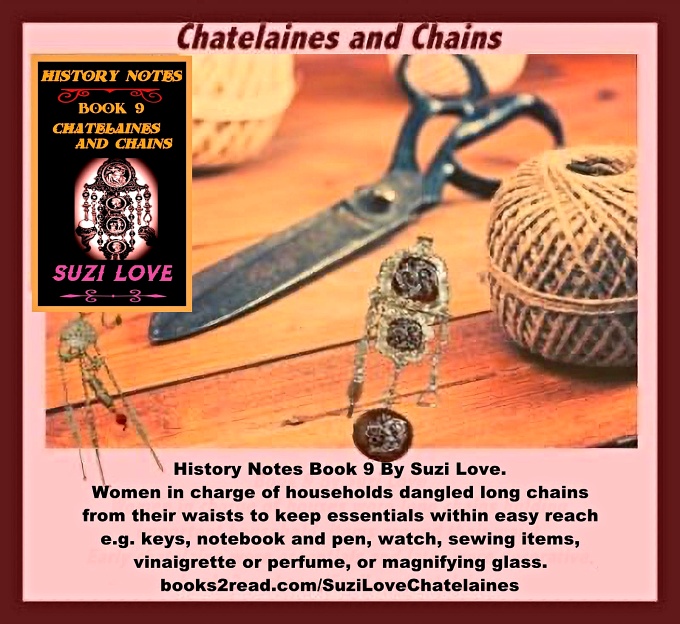
Definition Chatelaine: The word Chatelaine is French and means the keeper of the keys. Chatelaine” derives from the Latin word for castle. In Medieval times, the chatelaine was in charge of the day-to-day running of the castle. Women in charge of households dangled long chains from their waists to keep essentials within easy reach e.g. keys, notebook and pen, watch, sewing items, vinaigrette or perfume, or magnifying glass. Early chatelaine were simple essentials. Later chatelaine were decorative and expensive.books2read.com/SuziLoveChatelaines
What did a chatelaine do? Most important task was keeper of the keys. Also ordered supplies, did bookkeeping, supervised servants, taught castle children, and organized guests.
1804–1815 ca. Fawn Cotton Dress With Embroidery Beading, Austrian. Simple Empire style dress with A-line skirt from a high waistline and short bodice as Jane Austen and contemporaries across Europe would have worn. Fawn colored cotton with deep bead embroidered hem, embroidery on the wrists and around the wide scooped neckline. Transparent fabrics of the early were beginning to be replaced with fabrics with more weight that were less likely to tear. Plain silks in vivid colors were at first made up in the simple lines of muslin dresses but then plain gowns began to be decorated with intricate contrasting applications and beading. This dress was part of “The Fine Art of Costume” exhibition, 1954 October 15th at the Met Museum, N.Y.C. via Metropolitan Museum, NYC, U.S.A. metmuseum.org.
Empire Style Dress: Named after the First Empire in France. Empire dresses had a low neckline and skirts started directly under the bust and flowed into the classical relaxed wide styles of Greece and Rome. This style of dress is associated with Jane Austen and her contemporaries as a high-waisted dress was worn most days. Cotton, silk or taffeta were the popular fabrics.
1804-1815 ca. Front Fawn Cotton Dress with Bead Embroidery, Austrian.
1804-1815 ca. Back Fawn Cotton Dress with Bead Embroidery, Austrian.
1804-1815 ca. Side Fawn Cotton Dress with Bead Embroidery, Austrian.
1804-1815 ca. Black and White. Fawn Cotton Dress with Bead Embroidery, Austrian.
1804-1815 ca. Black and White Group. Fawn Cotton Dress with Bead Embroidery, Austrian.
1804-1815 ca. Beading View. Fawn Cotton Dress with Bead Embroidery, Austrian.
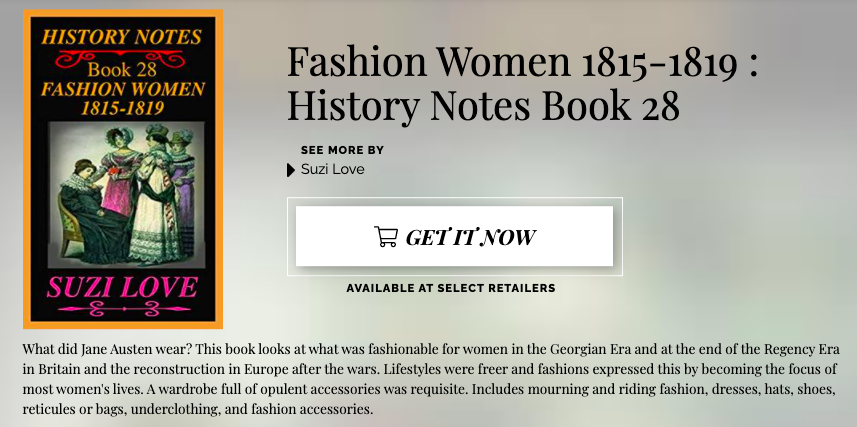
1804-1815 ca. Fawn Cotton Dress With Embroidery Beading, Austrian. #Regency #JaneAusten #Fashion https://books2read.com/SuziLoveFashionWomen1805-1809 Share on X Fashion Women 1805-1809 History Notes Book 26 What did Jane Austen and friends wear? https://books2read.com/SuziLoveFashionWomen1805-1809
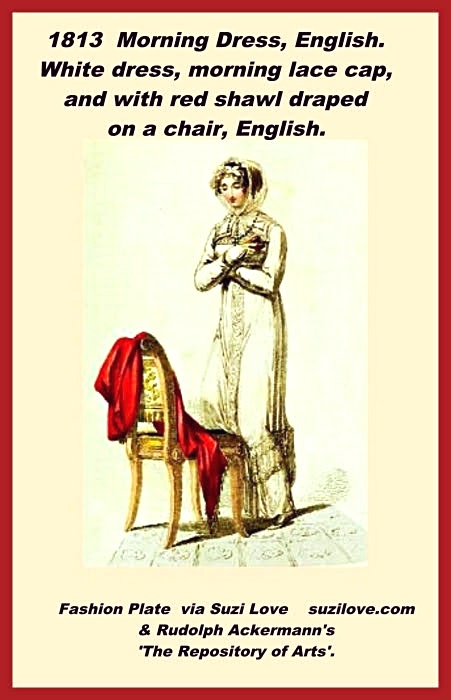
19th Century Early Women’s Cotton Caps. Worn as morning caps, night caps, or under other hats. The proper 19th century woman wore various forms of headwear throughout the day and evening. Unstructured, finely decorated cotton caps were worn in the morning hours with the informal attire appropriate for the early part of the day. Jane Austen and her family and female friends, and the Bridgerton family, would have worn caps like these, sometimes during the morning at home, to bed to keep their long hair from becoming knotted, or under a bonnet to hold a hairstyle in place. via Museum of Fine Arts, Boston, U.S.A. mfa.org
Definition Boudoir Or Morning Cap: worn by women in the privacy of their ‘boudoir’ and was not a simple night-cap but a lightweight, decorated cap which covered the hair before it was dressed for daytime activities or for at-home pursuits.
Definition Cornette or Morning Cap: Muslin or other lightweight material, worn to cover hair during at-home pursuits such as reading or sketching, tied under chin and sometimes worn under bonnet.
Definition Lappets: Two long strips of material, often lace, hanging from top of head down back or over shoulders. Sometimes extensions of a headdress and a requirement for court dress.
1817 Couple In Jane Austen and Bridgerton style Walking Dress and Gentleman in Same Green Redingote.
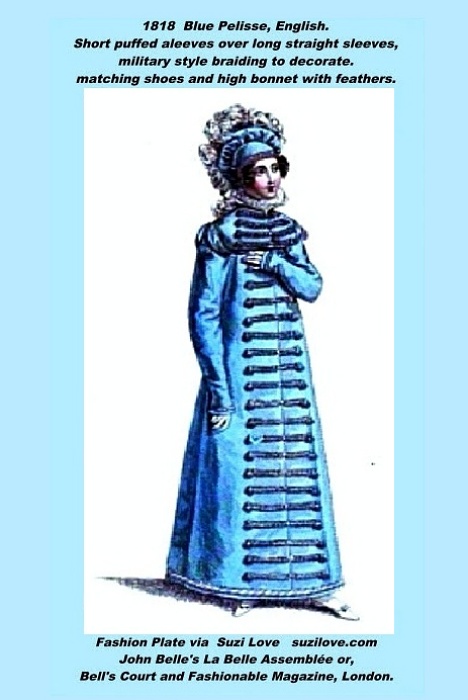
Lady: Blue satin Spencer over a white dress with puffed trimming around hem, pink bonnet, white ruff and tucker. Man: Long green Redingote, or overcoat, in the English style. Long brown trousers, striped waistcoat or vest, top hat, gloves and boots. Fashion Plate via Journal des Dames et des Modes, or Costume Parisien. Definition Redingote Or Coat Or Pelisse: Long fitted outdoor coat worn over other garments for warmth. French word developed from English words, riding coat. French fashion plates call these coats a Redingote and English plates call them a Pelisse, Or Walking Dress, or Carriage Costume. These are the types of outfits worn by Jane Austen and contemporaries in English magazines, where French fashions were obsessively copied despite the two countries being at war for many years.
This same Fashion Plate is seen below for the gentleman.
1800 ca. White Silk Reticule. Gathered into square top with filigree edge, piped with green satin. Embroidered with green velvet ivy sprays applied with gold couching. Lined with white silk. Handmade. bowesmuseum.org.uk http://books2read.com/suziloveReticules
1800 ca. White Silk Reticule. Gathered into square top with filigree edge, piped with green satin. Embroidered with green velvet ivy sprays applied with gold couching. Lined with white silk. Handmade. bowesmuseum.org.uk
The term ‘ridicule’ derived from the Latin ‘ridiculum’ and first used in France during the 17th century and meant subjecting something or someone to mockery. As women’s tiny bags were mocked, or ridiculed, for being a useless fashion accessory carried outside when they were first used in the late 1700s, it’s likely this is how the name ‘ridicule’ started. The later term ‘reticule’ derived from the Latin reticulum, meaning ‘netted bag’ and was applied when bags became larger and often made from netting. In the late 1700s and early 1800s, they were also known as indispensables as they carried all the personal items a lady needed upon her person every day. They were easily made by ladies, easy to carry and became an indispensable fashion accessory.
In the early nineteenth century, reticules started to look like future handbags as they were often made from rigid card or molded mâché or card into a variety of shapes. Early bags were circular and with a drawstring but as women wanted their reticules to look individual they could be made with two halves and a hinged metal closure or with concertina sides. Materials varied from silk, cotton and string and shapes were round, hexagonal or lozenge shapes with shell shaped bags becoming very popular during the Regency and Romantic Eras.
1800s magazines were written for well bred women who could read, so they gave plenty of ideas for how ladies could make and embellish reticules for their own use and as pretty gifts. Needlework was highly encouraged as a pastime for a lady so bags were frequently embroidered or decorated with beading. By the 1820s, reticules became more like our modern handbags using soft leather gathered at the top or hard leather with a rigid fastener and metal chain for carrying.
1800-1815 ca. Vest, Or Waistcoat, French. Embroidery with spangles and a standing collar. Vests gave a layer of protection from the elements and a fashion arena, as early 1800s coats were either cutaway or designed to be left open in the front. Typical Style of Early 1800s Vest: Standing collar, straight cut, front pockets, heavily embroidered and with tiny spangles to accentuate. via Metropolitan Museum, N.Y.C., U.S.A. metmuseum.org
Typical of a gentleman’s waistcoat, or vest, worn during the early 1800s, or Regency Era, or Jane Austen’s times with a standing collar, straight cut, front pockets, and heavily embroidered with tiny spangles to accentuate.
1810 Silk Brocade Waistcoat. Cream silk twill with a polychrome floral brocade stripe having narrow double breast, fold-down collar and wide lapel, black wool-covered buttons, straight pockets, cotton back and lining. The gentlemen of Jane Austen’s acquaintance would have worn waistcoats like this. via Christie’s Auction Rooms. christies.com
1804 London Hairstyles,Turbans and Hats. Gold, Pink, and White With Feathers. Jane Austen and her friends would have worn gorgeous hats and turbans like these. via Fashion Plate via Fashions of London and Paris, Published By Richard Phillips, St. Paul’s Church Yard, London, UK.