1815-1818 ca. Morning Dress, British. Typical Regency Era Day Dress. Very simple printed cotton dress with long sleeves and a very high waist. This is the typical Empire style, or high-waisted dress made of printed cotton that Jane Austen and her female friends and family would wear during a normal day. via Metropolitan Museum, N.Y.C., U.S.A. metmuseum.org
1815-1818 ca. Morning Dress, British. Front View.1815-1818 ca. Morning Dress, British. Back View. 1815-1818 ca. Typical Regency Era Printed Cotton Day Dress. #Regency #Fashion #JaneAusten
Here is an example of when English magazines copied French fashion plates.
1815 December Left: French fashion plate Ensembles French and English via Journal des Dames et des Modes. White short length ball dress with tiny bodice.
Right: English fashion plate by Rudolph Ackermann in the Repository Of arts. Blue sarsnet Pelisse, or Walking dress, or Redingote. Decorated with white lace trim on neck, vertical front, and hem. Carrying red shawl and with high plumed bonnet.
1815 December Blue Walking Dress, English. Blue twilled sarsnet pelisse, or Redingote, with ribbon bows adorning the front. Decorated with white lace trim on neck, vertical front, and a border of leaves on the hem. Slashed sleeves at shoulders and wrists plus an elaborate collar would have been time consuming to make. Carrying a red shawl and with a high bonnet with a white plume, or feather. Fashion Plate via Rudolph Ackermann’s ‘The Repository of Arts’.
1815 December Blue Walking Dress, English. Decorated with white lace trim on neck, vertical front, and hem. Carrying red shawl and with high plumed bonnet. Fashion Plate via Rudolph Ackermann’s ‘The Repository of Arts’.
Below is the French version of this pelisse but with a lady in a ball dress. Possibly another example of the English magazines ‘copying’ French designs.
1815 Ensembles French and English. White short length ball dress with tiny bodice and sleeves. Blue sarsnet Redingote, or pelisse, decorated with white lace trim and border of leaves, slashed sleeves at shoulders and wrists, elaborate collar, red shawl, high bonnet with white plume, or feather. Fashion Plate via Journal des Dames et des Modes, or Costume Parisien.
Fashion Women 1815-1819 History Notes Book 28
What did Jane Austen wear? This book looks at what was fashionable for women in the Georgian Era and at the end of the Regency Era in Britain and the reconstruction in Europe after the wars. Lifestyles were freer and fashions expressed this by becoming the focus of most women’s lives. A wardrobe full of opulent accessories was requisite. Includes mourning and riding fashion, dresses, hats, shoes, reticules or bags, underclothing, and fashion accessories.
D2D_HN_28_https://books2read.com/SuziLoveFashionWomen1815-1819
19th Century Inkstand, English. Ormolu and tortoiseshell. The type of inkstand that households would have in Bridgerton’s and Jane Austen’s times for writing letters and keeping track of estate matters. Curved, recessed top, two square inkwells of faceted cut glass with round necks and ormolu lids. via 1st Dibs Auctions ~ 1stdibs.com
HN_13_D2D_WritingTools Book 13 What did the lady of the house use to pen notes? What sat on the desk of the man of the house when managing his accounts? #History #Nonfiction #travel books2read.com/SuziLoveWritingTools
1818 May ‘Beau’s of 1818’ By George Cruikshank. Two Dandies shake hands while third watches. All wearing bell-shaped top-hats, extra high collars, short waists, long spurs and yellow gloves. One with moustache wears wide and short white trousers, one wears top-boots and riding-breeches and has monocle in his eye and third has very full trousers gathered above ankle. These are the sort of outfits that the Bridgerton men and Jane Austen’s male contemporaries would have worn. Hand colored etching. Via British Museum, London, UK. britishmuseum.org (PD-Art)
1818 May ‘Beau’s of 1818’ By George Cruikshank. Two Dandies shake hands while third watches. All wearing bell-shaped top-hats, extra high collars, short waists, long spurs and yellow gloves. One with moustache wears wide and short white trousers, one wears top-boots and riding-breeches and has monocle in his eye and third has very full trousers gathered above ankle. Hand colored etching. Via British Museum, London, UK. britishmuseum.org (PD-Art)
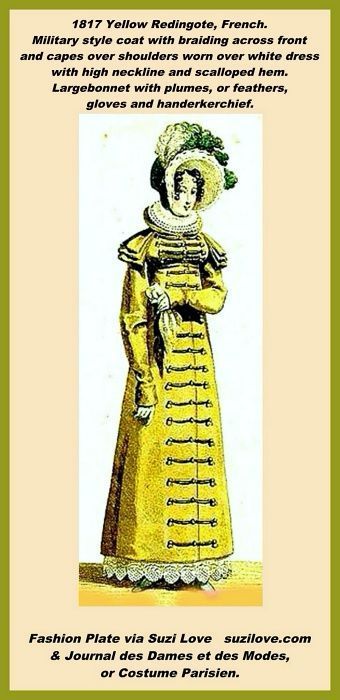
1817 Yellow Redingote, or Pelisse, or Walking Dress, French. Yellow military style pelisse with braiding across the front and capes across the shoulders and worn over a white dress with a high neckline and a scalloped hem. Large and high bonnet with plume, or feathers, and green flowers, gloves and a handkerchief. Although this is a French fashion plate, similar styles were worn everywhere and Jane Austen would have worn a Pelisse like this before her death on the 18th July, 1817. Fashion Plate via Journal des Dames et des Modes, or Costume Parisien.
The ongoing years of wars followed by the victories of Wellington’s armies brought the military into fashion in England and there was a rush of fashion articles named after him e.g. Wellington hat, Wellington bonnet, Wellington jacket and Wellington Boot. In other European countries, military headwear was copied from military helmets and hats and frogging and epaulettes added a further patriotic touch to women’s clothing. And as always, fashions were copied and spread around the world, despite the battles being fought.
Definition Redingote Or Coat Or Pelisse: Long fitted outdoor coat worn over other garments for warmth. French word developed from English words, riding coat. French fashion plates call these coats a Redingote and English plates call them a Pelisse, Or Walking Dress, or Carriage Costume.
1817 Yellow Redingote, or Pelisse, or Walking Dress, French. Yellow military style pelisse with braiding across the front and capes across the shoulders and worn over a white dress with a high neckline and a scalloped hem. Large and high bonnet with plume, or feathers, and green flowers, gloves and a handkerchief. Fashion Plate via Journal des Dames et des Modes, or Costume Parisien. Fashion Women 1815-1819 History Notes Book 28 What did Jane Austen wear? . D2D_HN_28_https://books2read.com/SuziLoveFashionWomen1815-1819
19th Century Early Reticule, Or Bag, New England, England or U.S.A. Septagonal, or four sided, with embroidery and silk tassels. White satin embroidered with polychrome silks, silver threads, silver sequins. On front, in center of wreath of roses tied with blue bow, is written VALUE THE TRIFLE. On back, in similar wreath, is FRIENDSHIP. On sides are floral motifs, one of sweetpeas and the other of pansies. On all sides a border of silver threads in chain motif entwined with curling brown vine. Primarily worked in satin stitch. Thirteen silk tassels attached. White ribbon ties. via Museum of Fine Arts, Boston, U.S.A. mfa.org
Definition Reticule Or Ridicule Or Bag or Purse: Often with a drawstring to pull closed and usually made of cloth or covered cardboard and often decorated with beading or embroidery. A reticule, or purse, or handbag, was usually carried by a woman during the Regency period to carry all their daily necessities. Earlier, women used pockets that tied at the waistline and were hidden in the folds of their skirts. Empire style, or early 1800s, high-waisted dresses made it impossible to either sewn in a pocket or to tie on a pocket. So women began carrying small, decorated bags called Reticules, or ridicules, which generally pulled close at the top with a drawstring.
1815 Pink Dress, French. Cashmere dress with white underdress showing the sleeves, decorated hem, turban of tulle and satin, diamond pointed hem, slippers and shawl. Fashion Plate via Journal des Dames et des Modes, or Costume Parisien. https://books2read.com/SuziLoveFashionWomen1815-1819
Definition Aigret, aigrette, egret: Plume of feathers or jeweled ornament in shape of feathers worn on head or hats. During the early 19th century., or Jane Austen’s lifetime, the favorite feathers were osprey and heron.
Definition Empire Style: Named after the First Empire in France, by 1800 Empire dresses had a very low décolleté, or neckline and a short narrow backed bodice attached to a separate skirt. Skirts started directly under the bust and flowed into the classical relaxed wide styles of Greece and Rome. This style of dress is associated with Jane Austen and her contemporaries as a simple cotton high-waisted dress was worn most days and accessorized according to the importance of the occasion.
Fashion Women 1815-1819 History Notes Book 28 What did Jane Austen wear? . D2D_HN_28_https://books2read.com/SuziLoveFashionWomen1815-1819
1819 Pink Redingote, French. Also called a Walking Dress or Pelisse in England. Vertical front has pink satin bows, high white collar, matching pink satin hat and pink slippers. Short puffed sleeves over long straight, as was the fashion in 1819 across Europe. The type of outfit young Regency Era ladies would have worn if they were out shopping on Bond Street, walking in a park, or taking a carriage ride through Hyde Park. Fashion Plate via Journal des Dames et des Modes, or Costume Parisien. https://books2read.com/SuziLoveFashionWomen1815-1819
Definition Redingote Or Pelisse Or Walking Dress Or Coat: French word developed from English words, riding coat. Long fitted outdoor coat worn over other garments for warmth. Often left open at the front to show off the dress underneath. Sometimes cut away in front. Originally made with several capes and trimmed with large buttons. French fashion plates call these coats Redingotes and they are designed for women, men and children. English fashion plates call them a Pelisse, a walking dress, Promenade dress, or Carriage dress.
1819 Pink Redingote, French. Also called a Walking Dress or Pelisse in England. Vertical front has pink satin bows, high white collar, matching pink satin hat and pink slippers.Fashion Plate via Journal des Dames et des Modes, or Costume Parisien.
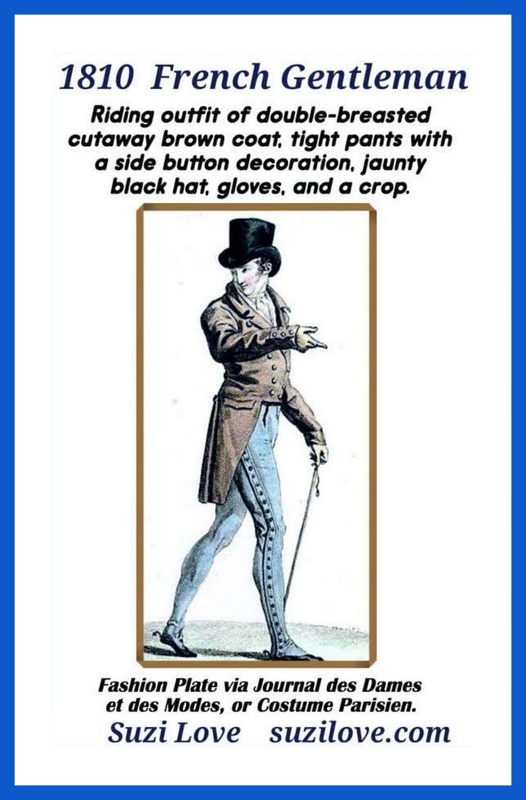
1810 French Gentleman. Riding outfit of double-breasted brown coat, tight pants with a side button decoration, jaunty black hat, gloves, and a crop. As Worn by Gentleman in the Bridgerton and Jane Austen Families. Fashion Plate via Journal des Dames et des Modes, or Costume Parisien.
Pantaloons: When tailcoats lengthened, breeches extended below the knees to accommodate the longer tails and were gradually replaced with slimmer fitting, longer pants, or pantaloons, that ended at the ankle. Pantaloons were close-fitting and sometimes buttoned all the way down the leg. To make them hug the leg tighter, knitted fabrics were used, or fabrics like nankin and kerseymere were cut on the bias.
In the early 1800s, men no longer wore complicated styles and extravagant fabrics. Men’s fashion simplified and became more conservative. A well cut tailcoat, vest, pantaloons and an immaculate cravat of beautiful white linen in the style of George Bryan, or Beau, Brummell. Clothes were a status symbol and indicated a man’s social position. These clothing items were the sort worn by Jane Austen’s male family and friends.
1810 Riding Outfit French DoubleBreastedBrownCoat Fashion Plate via Journal des Dames et des Modes, or Costume Parisien.HN_23_D2D_Fashion Men 1800-1819 History Notes Book 23
https://books2read.com/SuziLoveFashionMen1800-1819
I love Pinterest for keeping thousands of historical images in some sort of order.And I love using Pinterest Boards as inspiration for my romance books.What about you? Do you use Pinterest for planning something, or just for fun?Need more hints for what to do with your boards and pins? Take a look at these fascinating articles on Pinterest. if you want even more Pinterest information and tips for becoming a power user, check out my Suzi Love Pinterest Boards