The finger prodded her chest again. Gently yet insistently. But his voice softened. “And I, the man, and the duke, choose you. You, Lady Rebecca. Do you think I can’t decide for myself, for my family, for you and me, what’s best?”
“But that’s what I’ve always done. It’s always been up to me to work out the best plan for everyone and then make it happen.” “In the past, that’s what happened.”
“But even now, it’s up to me to keep everyone safe. You said yourself that neither my family, nor the society, could go on without my making these types of decisions. I’m always the one with the clear head. In time, you’ll see that I’m right to walk away from you when this is finished.”
“No, no. This isn’t finished by a long shot, sweetheart. There has to be some consolation in my life for taking on control of Julia and my brothers, for assuming the family titles and topping up our coffers.”
“I know how hard you’re working to succeed. But it’ll never work if you have someone like me in your life.” “I don’t want someone like you, Becca. I want you.” This time his kiss was tinged with desperation. “Answer me one thing.” Her eyes widened. “Do you love me, minx? Do I still hold your heart?”
“Stop! It’s unfair to ask me that. Leave, please, just leave.” Turning away, Becca wished him gone before he glimpsed the fat tears collecting in her eyes. It was crucial that she remain strong. Even if it broke her heart to do so.As he reached the door, Becca heard Cayle mutter, “I will have you, Rebecca Jamison. I will not stop until I find a way.” She didn’t know whether it made her happy, or if it simply terrified her.
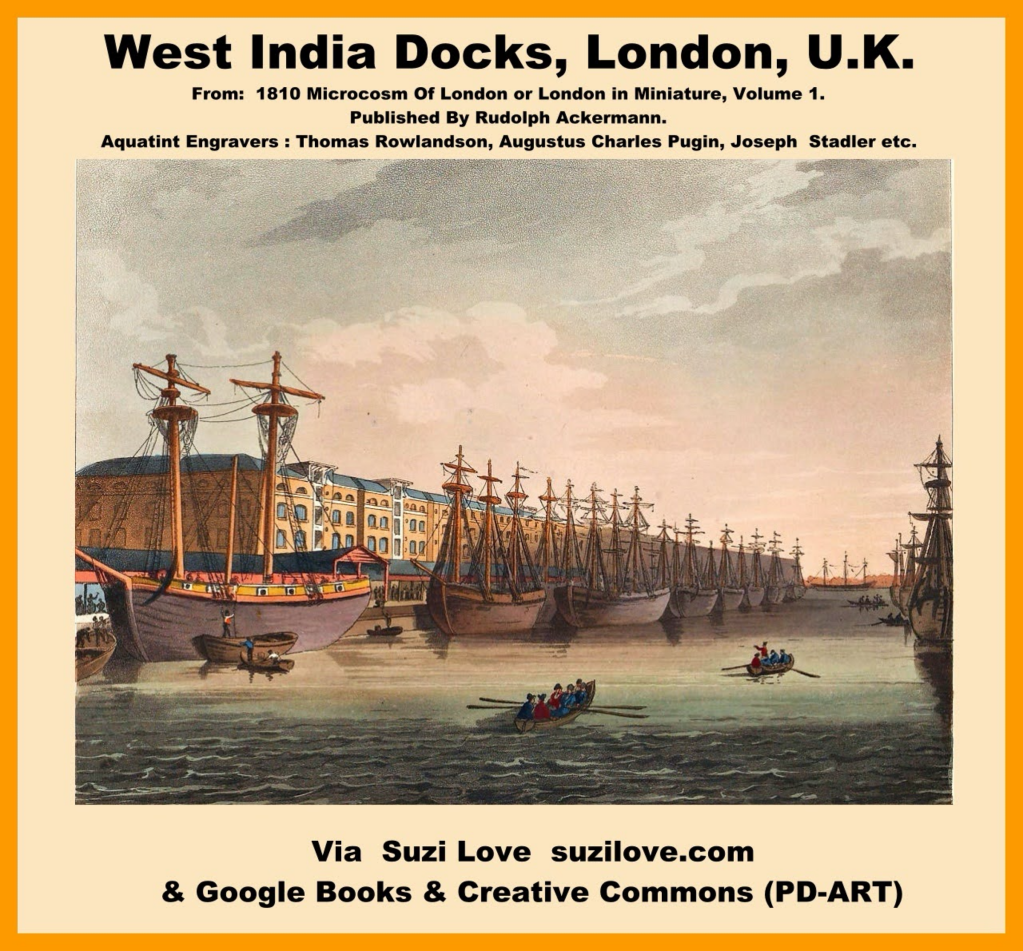
1810 January 1st. West India Docks, London. By Thomas Rowlandson and Augustus Charles Pugin. Printed in 1810 By Rudolph Ackermann in Microcosm Of London, or London In Miniature. Volume 1. Aquatint showing warehouses at quayside and several West Indiamen moored alongside. Warehouses held thousands of tons of cargo, including sugar, rum, molasses, coffee, spices and hardwood. Docks were constructed by powerful group of businessmen led by Robert Milligan, wealthy merchant and ship-owner outraged at losses suffered due to theft and delay at riverside wharves. via National Maritime Museum, Greenwich, London, U.K. ~ collections.rmg.co.uk
East and West India Docks London’s Historic Places
The East India Docks was a group of docks in Blackwall, east London, north-east of the Isle of Dogs. In 1607, the East India Company decided to build its own ships and leased a yard in Deptford. In 1614 the East India Company ordered William Burrell to begin work on a bigger yard for repair, construction and loading of out-going ships. The site selected was at Blackwall, which was further down river and had deeper water, allowing laden ships to moor closer to the dock. During the early 17th century, the site was enlarged repeatedly. Later in the 17th century, the East India Company reverted to its practice of hiring vessels, although many owners who chartered their vessel to the East India Company had them built at Deptford and Blackwall.
Before 1800, the Thames river was overcrowded with ships. They carried cargoes of tea, china and cloth in their lower parts along with casks of water, salted meat, beer, wine and rum for their crews. Brandy, wine, and tobacco were also shipped and stored in the warehouses. In 1800, the London Dock Company was formed and the planned docks in Wapping went ahead in 1801. The first was the West India Dock. In 1806, the East India Company opened their own docks to the north-east of the West India Docks after deciding that the Brunswick Dock at Blackwall, where ships were fitted out, was unsuitable for storing cargo.
The Brunswick Dock, which had originally been connected directly to the Thames to the south, became the Export Dock. To the north the company built a larger 18-acre (7.3 ha) Import Dock. Both were connected to the Thames via an eastern entrance basin. The number of ships discharged in the docks rose from 354 in 1804, to 598 in 1808, and to 641 in 1810. In 1808, the warehouses were full, as blockades prevented the re-export of goods. The dock company calculated that the almost total prevention of theft made possible by the building of the docks was saving West India merchants almost £400,000, and the Exchequer about £150,000 each year. During the 1840s and early 1850s, shipping and tonnage handled at the East and West India docks increased so much that dividends of 5 and 6 per cent were paid.
The East India Docks didn’t have many warehouses because cargoes were taken straight to their warehouses in the City. So instead of building warehouses, the company built private toll roads like Commercial Road and East India Dock Road to carry traffic to and from the docks.
The company made large profits on tea, spices, indigo, silk and Persian carpets. The tea trade alone was worth £30m a year. Spice merchants and pepper grinders set up around the dock to process goods. Although the East India docks were smaller than the West India Docks, they handled up to 250 ships at one time and East Indiamen of 1000 tons but larger ships and steam power reduced the importance of the dock.
The West India Docks were a series of three docks, quaysides, and warehouses built to import goods from, and export goods and occasionally passengers to the British West Indies. In 1802, the first dock opened on the Isle Of Dogs. When they closed for commerce in 1980, the Canary Wharf development was built around the wet docks by narrowing some of their broadest tracts.
The docks were constructed in two phases. The two northern docks were constructed between 1800 and 1802 for the West India Dock Company and were the first commercial wet docks in London. For 21 years, all vessels in the West India trade using the Port Of London had to use the West India docks by a clause in the act of Parliament that had enabled their construction.
In 1838 the East and West India companies merged. The southern dock, the South West India Dock, later known as South Dock, was constructed in the 1860s and in 1909 the Port Of London Authority took over the West India Docks,
The docks played a key role in the Second World War as a location for constructing the floating Mulberry harbours used by the Allies to support the D-Day landings in France. Following the Second World War, in which all the docks were badly damaged, the East India Docks were confined to occasional Channel Islands traffic and to the maintenance of dredger equipment.
The docks were the first London docks to close, in 1967. Today the docks have been mostly filled in. Only the entrance basin remains, as a wildlife refuge and an attractive local amenity. The area is predominantly residential with several major developments around it.
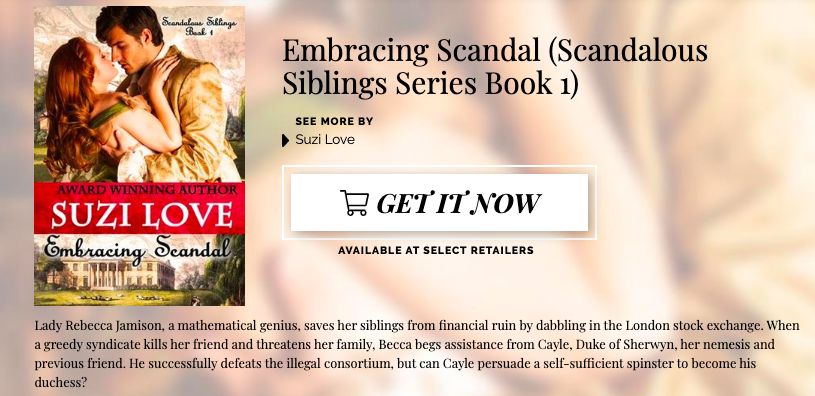
“Two nights ago,” Lady Rebecca Jamison said, “the woman we engaged at the Women’s Betterment Society to tally the Stock Exchange ledgers — our friend — was murdered. The killer was still inside Peggy’s house when I arrived. Her slayer stopped at the back door and stared directly at me, memorizing my features.”
Her pronouncement was flat-voiced, deadly calm.
“Thankfully, his immediate concern was escaping with our two accounting books. But when the cache identifies me as the woman who saw their lackey’s face, I am certain they will send him to dispose of me as well. They are peers, titled and wealthy, and cannot risk being exposed as members of an illegal group. If we cannot stop these men, brutes who employ cold-blooded assassins to do their dirty work, I will certainly be the next to die.”
The Duke of Sherwyn’s chilled blood turned to ice.
The Viscount’s Pleasure House. Irresistible Aristocrats Book 1 By Suzi Love. Three naive country ladies coerce their way into London’s most infamous brothel and the last Sultan’s gala. Disenchanted Viscount tutoring three Regency Ladies. What could go wrong?
The Viscount’s Pleasure House allows Justin, the most notorious Viscount in London, to fund his search for his missing mother and sisters. But after three years catering to the sordid whims of the perpetually bored Upper Ten Thousand in early Victorian times, the Virile Viscount announces his retirement.
Justin plans to sell his exotically themed brothel and cease all Arabian Nights held on his estate, a desperate attempt to cleanse his blackened soul and perhaps revive his deadened sexual interest. So when Lady Chrissie Wellsby begs Justin to tutor her two friends in the amorous arts in exchange for information about his family, Justin is torn. For though he’ll do anything to discover the whereabouts of his family, including teaching three naive ladies how to act like well-schooled courtesans, he loathes being forced into this last performance as a sex God served by his harem.
Having Chrissie willingly act as his sex slave stirs the world-weary viscount into the wildest performance ever given at the Sultan’s tent, but does little to convince Chrissie that he has fallen head over heels in love with her and put his rakish ways behind him. Justin enjoys a wonderful reunion with his family but feels cheated of his chance at love until Chrissie’s friends encourage her to trust the newly reformed viscount.
Chrissie organizes one final gala at the Pleasure House, an erotic night of lovemaking for two to prove her love for Justin and show him she longs to be his wife. https://books2read.com/suziloveTVPH The Viscount’s Pleasure House. Irresistible Aristocrats Book 1 By Suzi Love.
Want a HOT historical romance for the holidays? Disenchanted Viscount tutoring three naive ladies in seduction. What could go wrong? #christmas #holidays #RegencyRomance #EroticRomance #HistoricalMystery https://books2read.com/suziloveTVPH
Want a HOT Regency Romance for the holidays? “You want me to be your mistress?” The Countess of Dorchester’s sculpted brow rose in an exaggerated show of disbelief. #christmas #holidays #RegencyRomance #HistoricalMystery #EroticHistoricalRomance books2read.com/suziloveFTAV
1808 Christie’s Auction Room, London, U.K. From: Microcosm of London By Rudolph Ackermann. The Microcosm of London was published in three volumes between 1808 and 1810 and was coordinated by German born printseller, Rudolph Ackermann, from his Repository of Arts at 101 The Strand, London, U.K. and included numerous contributors. Visitors to London in Jane Austen’s time would go to all the important buildings. https://books2read.com/suziloveROver
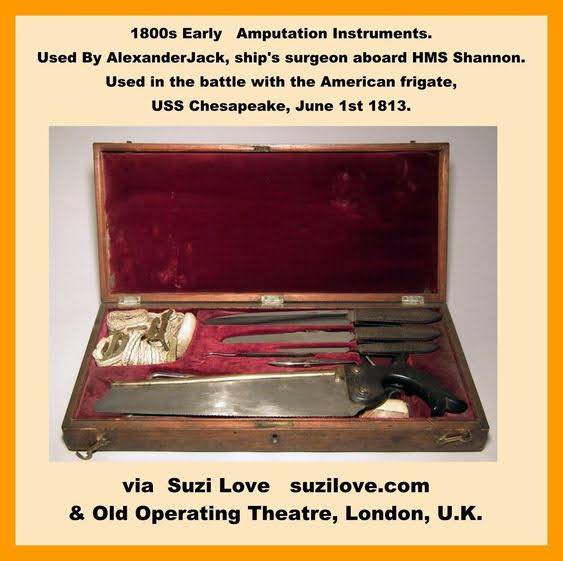
1800s Early Amputation Instruments used by Alexander Jack in Jane Austen’s times. Jack was a ship’s surgeon aboard H.M.S. Shannon and used by him in the battle between the Shannon & the American frigate the USS Chesapeake on June 1st, 1813, during the War of 1812. via Old Operating Theatre, London.
Jane Austen’s brother, Francis William Austen, was appointed Admiral of the Fleet in the British Royal Navy on 27 April, 1863. He had been a Royal Navy Captain from 1799 to 1830, age 25 to 56, Rear Admiral in 1838, age 64, Full Admiral in 1848, age 74. This is the type of medical instruments found on all of his ships.
In Jane Austen’s time, amputations were carried out frequently to prevent infections that could kill.