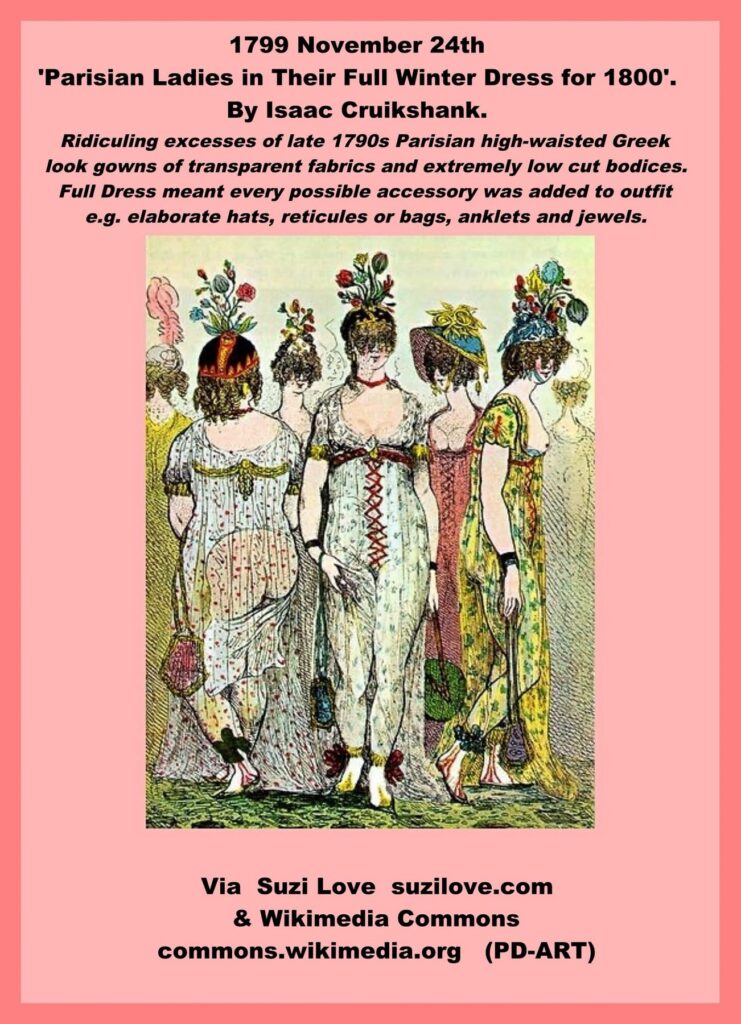
1799 November 24th ‘Parisian Ladies in Their Full Winter Dress for 1800’. By Isaac Cruikshank. Ridiculing excesses of late 1790s Parisian high-waisted Greek look gowns of transparent fabrics and extremely low cut bodices.Full Dress meant every possible accessory was added to outfits.g. elaborate hats, reticules or bags, anklets and jewels. Via British Museum, London, UK. britishmuseum.org (PD-Art)
1799 November 24th ‘Parisian Ladies in Their Full Winter Dress for 1800’. By Isaac Cruikshank. Ridiculing excesses of late 1790s Parisian high-waisted Greek look gowns of transparent fabrics and extremely low cut bodices.Full Dress meant every possible accessory was added to outfits.g. elaborate hats, reticules or bags, anklets and jewels. Via Suzi Love – suzilove.com & British Museum, London, UK. britishmuseum.org (PD-Art)1799 November 24th 'Parisian Ladies in Their Full Winter Dress for 1800'. Caricature By Isaac Cruikshank. #GeorgianEra #Cartoon #BritishHistory books2read.com/suziloveFashWomen1700s Share on XHN_1 Fashion Women Late 1700s History Notes Book 1 by Suzi Love.
What was fashionable for women in the late 1700s? Extravagant colors and fabrics and outrageous styles were all seen in these flamboyant fashions.
books2read.com/suziloveFashWomen1700s
This book shows how body wraps, stays, and corsets were worn to create a variety of fashionable silhouettes through past centuries. Corsets flattened breasts and accentuated rounded hips or pushed up breasts and showed off the bust line depending on the fashions of the time and the desired silhouette. Includes corsets through the Georgian, Regency, Victorian and Edwardian Eras and Jane Austen’s lifetime. Overview of corsets through history, including the Georgian, Regency, Victorian and Edwardian Eras and Jane Austen’s lifetime. History Notes Book 14.
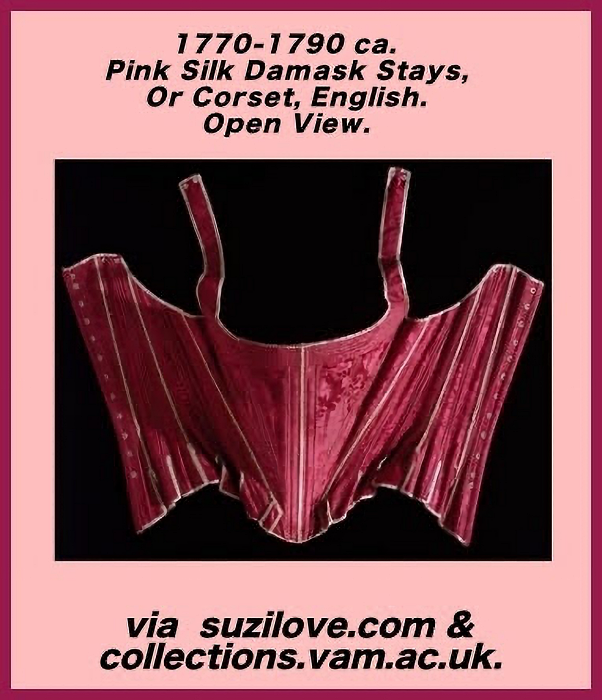
1770-1790 ca. Stays, or Corset, English. Pink silk damask, lined with linen, reinforced with whalebone, fingers spread over hips. via Victoria and Albert Museum, London, UK. collections.vam.ac.uk. https://books2read.com/SuziLoveCorsetBook15
1770-1790 ca. Front View. Pink Silk Damask Stays, Or Corset, English. via Victoria and Albert Museum, London, UK.
collections.vam.ac.uk.1770-1790 ca. Side View. Pink Silk Damask Stays, Or Corset, English. via Victoria and Albert Museum, London, UK.
collections.vam.ac.uk.1770-1790 ca. Back View. Pink Silk Damask Stays, Or Corset, English. via Victoria and Albert Museum, London, UK.
collections.vam.ac.uk.1770-1790 ca. Open View. Pink Silk Damask Stays, Or Corset, English. via Victoria and Albert Museum, London, UK.
collections.vam.ac.uk.1770-1790 ca. Side and Back Views. Pink Silk Damask Stays, Or Corset, English. via Victoria and Albert Museum, London, UK.
collections.vam.ac.uk.1770-1790 ca. Collage View. Pink Silk Damask Stays, Or Corset, English. via Victoria and Albert Museum, London, UK.
collections.vam.ac.uk.1770-1790 Pink Silk Damask Stays, Or Corset, English. #Georgian #Corset #BritishHistory1770-1790 Pink Silk Damask Stays, Or Corset, English. #Georgian #Corset #BritishHistory https://books2read.com/SuziLoveCorsetBook15 Share on XHN_15_D2D_Corsets 1700-1790
https://books2read.com/SuziLoveCorsetBook15
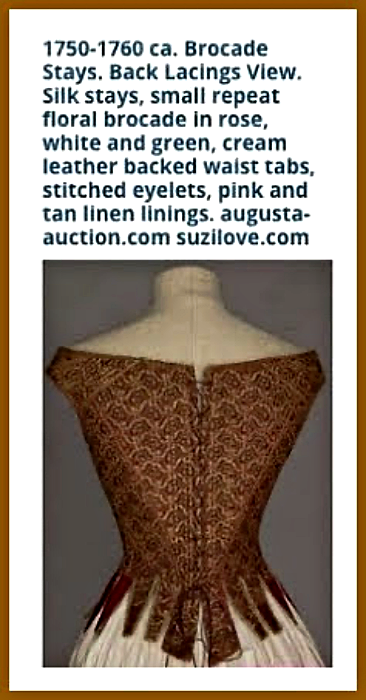
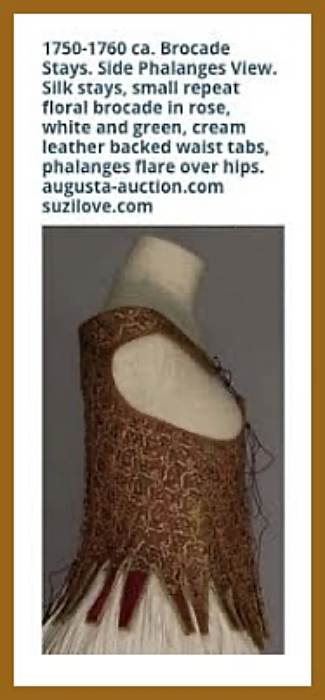
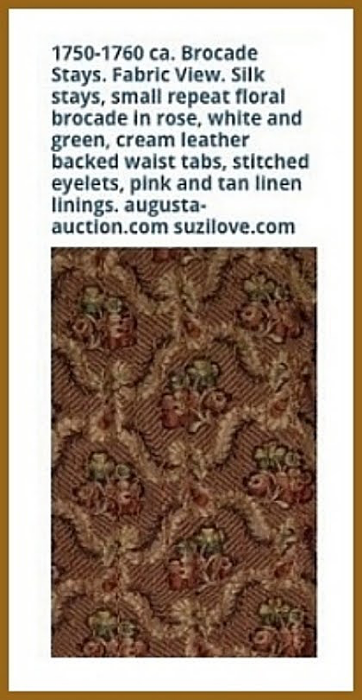
1750-1760 ca. Brown Silk Brocade Stays With Both Front and Back Lacings.
These silk stays have a small repeat floral brocade in rose, white, and green. There are cream, leather-backed waist tabs, stitched eyelets, and pink and tan linings. These stays, or corset, are unusual because they have both front and back lacings. This means that a lady could step in and out of her stays and then tighten the front lacing herself, thereby eliminating the need for assistance from a maid or dresser.
Women of the middle and lower classes needed to be able to dress themselves as they have no one to assist in tightening their lacings when they dressed. Most upper class ladies would be able to call upon a maid to help and would therefore generally use back lacing stays.
1750-1760 ca. Brown Silk Brocade Stays With Front and Back Lacings. Front Lacing View. via Augusta Auctions. augusta-auction.com1750-1760 ca. Brown Brocade Stays With Front and Back Lacings. Back Lacing View. via Augusta Auctions. augusta-auction.com1750-1760 ca. Brown Silk Brocade Stays With Front and Back Lacings. Side View. via Augusta Auctions. augusta-auction.com1750-1760 ca. Brown Silk Brocade Stays With Front and Back Lacings. Eyelet View. via Augusta Auctions. augusta-auction.com1750-1760 ca. Brown Silk Brocade Stays With Front and Back Lacings. Fabric View. via Augusta Auctions. augusta-auction.com1750-1760 ca. Brown Silk Brocade Stays With Both Front and Back Lacings #Georgian #History #Corset https://books2read.com/SuziLoveCorsetBook15 Share on X Corsets 1700-1790 History Notes Book 15 By Suzi Love ~ Award Winning Writer and Researcher. https://books2read.com/SuziLoveCorsetBook15
1790-1810 ca. Linen and Metal Corset, American Or European. Front Lacing. #Corset #RegencyEra #GeorgianEra #JaneAusten. https://books2read.com/SuziLoveCorsetBook16
Fashion Must Haves In Jane Austen’s Times: Reticules, Spencers, Redingotes. History Notes Series Books 3, 4, and 5.
Reticule Or Bag: Purse, often with a drawstring to pull closed and usually made of cloth or covered cardboard and often decorated with beading or embroidery. Carried by a woman during the Regency period to carry all their daily necessities. in the place of pockets.
Spencer: Short jacket, cropped at the waist, worn over a dress, or gown. Delicate and regency dresses provided so little protection from the cold, so over garments were essential for warmth, modesty and good health.
Pelisse Or redingote Or Walking Dress: Coat worn over clothing of both sexes for warmth and protection from the elements.
1795-1810 ca. Woman’s Shoes, Or Slippers, English. Kid leather and linen, pointed toes, no heel. via Los Angeles County Museum of Art, California, USA.
1795-1810 ca. Roller Printed Dress, English. Empire style, high-waisted, roller printed dress with skirt gathered at the back to create a full skirt and with simple V-necked bodice and long sleeves. Sleeves are closed with a narrow band of fabric which fastens with a hook and eye. via Victoria and Albert Museum, London, UK. 1810 ca. Sewing of Gown. 1795-1799 ca. Fabric Block Printing. Pattern of floral trails blends influences from Indian-painted and printed textiles, and woven silks, a style which remained popular until the end of18th century.
The pattern of floral trails seen on the printed fabric of this gown exhibits a blend of influences from Indian-painted and printed textiles, and woven silks, a style which remained popular until the end of the 18th century. The sleeves of this gown are closed with a narrow band of fabric, which fastens with a hook and eye.
The dress is styled with a high-waisted , fitted bodice, which fastens centrally. The neck, which is trimmed with a 1″ frill of matching material, is rounded a the back and V-shaped at the front. The bodice is lined with white cotton which extends 1/3 of the way down the full length tapered sleeves. A trimming decorations is attached to the wrist of the right sleeve (made from the same material and lined with white cotton), which fastens with a metal hook and eye at the hip. The skirt has an ‘apron’ style front with fastening tapes attached to either side, in addition to this there are vertical pocket slits situated at either side of the skirt measuring 11″. The front and rear sides of the skirt are constructed from one width of fabric – 39.5″ wide. The waistline at the back of the skirt is gathered a the centre and is constructed from two pieces of material measuring 46″ wide.
The cotton has blue threads in the selvedges denoting English origin, and is block printed in a polychrome palette with pencilled blue on a white ground. The design consists of an all-over pattern of delicate floral trails of carnations, pinks an other stylised flowers interspersed by vertical arborescent meanders bearing exotic fruits and stylised flowers. The pattern repeat measures 10.5″ by 10″.
18th Century Early. Silk, Leather, and Linen Mules, European. Embroidered in the Florentine Style, a type of flame stitch canvas work with varied stitch lengths often in subdued tones. via Metropolitan Museum, NYC, U.S.A.