How did people travel in Jane Austen and Bridgerton years? What did they take with them to make their long journeys easier? Travel by road, ship, canal, or railway all took a long time and had dangers so people learned to prepare. And then, in the nineteenth century, road improvements, inventions, and scientific developments made travel more pleasurable. Travel and Luggage By Suzi Love History Notes Book 10 books2read.com/SuziLoveTravel
Horse Power To Steam. Various alternatives to horse power were tested in London’s streets during the 19th century. Steam powered road engines and trams proved too heavy and damaged the roads. Stationary steam engines were used to haul trams attached to a cable but these were only really effective on hills that we too steep for horses. There were also experiments with trams driven gas engines and battery electric power. but was successfully developed. Petrol engines were still primitive and unreliable in the 1890s. In 1900 the reliable horse still dominated the streets of London but new technology was to revolutionize road transport.
Travel and Luggage By Suzi Love History Notes Book 10. How did people travel in Jane Austen’s times. In past centuries? What did they take with them to make their long journeys easier? Travel by road, ship, canal, or railway all took a long time and had dangers so people learned to prepare. And then, in the nineteenth century, road improvements, inventions, and scientific developments made travel more pleasurable. books2read.com/SuziLoveTravel HN_10_D2D_RetailerBuyLink_Travel and Luggage By Suzi Love History Notes Book 10 #History #travel How did people travel in past centuries? What did they take with them to make their long journeys easier? books2read.com/SuziLoveTravel
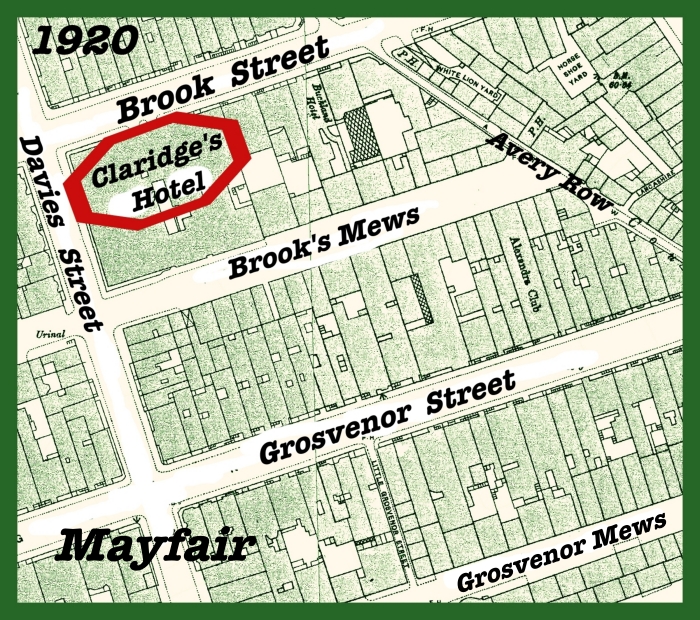
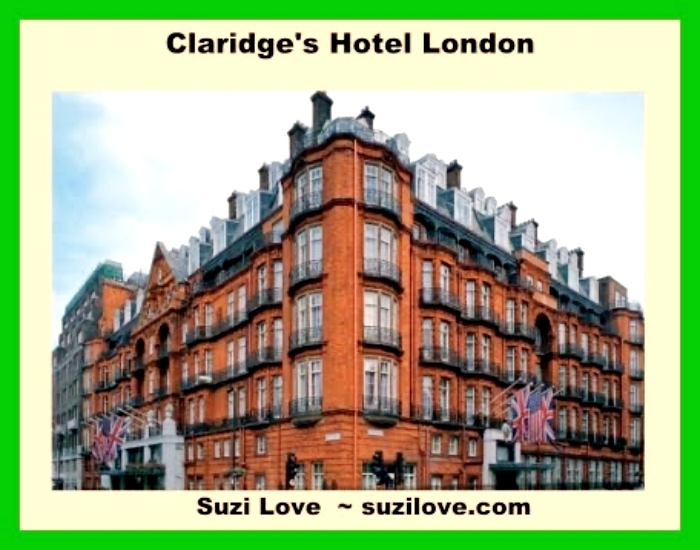
Claridge’s Hotel – London’s Historic Places Claridge’s was founded in 1812, during the Regency Era, as Mivart’s Hotel at 51 Brook Street, Mayfair, London, UK.
Lord William Beauclerk leased the terrace house from the Grosvenor Estate with permission to turn it into a hotel run by James Edward Mivart, the anglicized name for French chef Jacques Mivart. By 1838, the hotel grew to buy five consecutive houses along Brook Street, knocking down the walls to create one large hotel and Mivart prospered by introducing English county families to subtle French cooking to replace their traditional stodgy fare. Mivart designed the hotel for guests who wished to stay longer, so apartments were let by the month to foreign royalty and nobility who enjoyed the ambiance of the well-run hotel yet had the privacy of their own suites. The Prince Regent, who succeeded to the throne as King George IV in 1820, had a suite of rooms permanently reserved for him so he could discreetly carry on his playboy lifestyle.
In 1827, The Morning Post noted that Mivart’s was the fashionable rendezvous for the high Corps Diplomatique. In 1854, the hotel was sold to Mr and Mrs Claridge who ran a separate hotel at 49 Brook Street. They combined the two operations to trade as “Mivart’s at Claridge’s” until, after Mivart’s death, the hotel changed its name to Claridge’s in 1856, adding “late Mivart’s” underneath.
In 1860, Queen Victoria and Prince Albert visited the Empress Eugènie of France, who had made Claridge’s her winter quarters, and Queen Victoria was so impressed that she wrote to her uncle, Leopold I, King of the Belgians, in glowing terms of Claridge’s. The hotel became so connected to royalty it was called an “extension to Buckingham Palace”.including the Grand Duke Alexander of Russia and King William III of the Netherlands, until by 1853, The Times decided London had just three first-class hotels- Mivart’s, The Clarendon in Bond Street and Thomas’s in Berkeley Square.
In 1881, William Claridge’s failing health forced them to sell to a consortium, but the hotel consisted of several private houses and couldn’t be upgraded to compete with purpose built hotels cropping up all over London. The Savoy for example, built in 1889, offered lifts to all floors, electricity, en suite bathrooms and the best chef in Europe, Auguste Escoffier. So in 1894, Richard D’ Oyly Carte, founder of the rival Savoy Hotel, purchased Claridge’s and commissioned CW Stephens, designer of Harrods, to rebuild the hotel from the ground up. The new Claridge’s opened in November 1898.
1897 Claridge’s Hotel, Mayfair, London, U.K. A perspective view of the new building showing the front entrance in Brook Street and the return front in Davies Street. Drawn by C. W. Stephens, architect.
After World War I, Claridge’s flourished due to demand from aristocrats who no longer maintained a London house and Carte’s son, Rupert D’ Oyly Carte, added a new extension. During World War II, Peter II of Yugoslavia and his wife spent their exile at Claridge’s until on 17th June 1945, suite 212 was ceded by the UK to Yugoslavia for a single day to allow their heir, Crown Prince Alexander, to be born on Yugoslav soil.
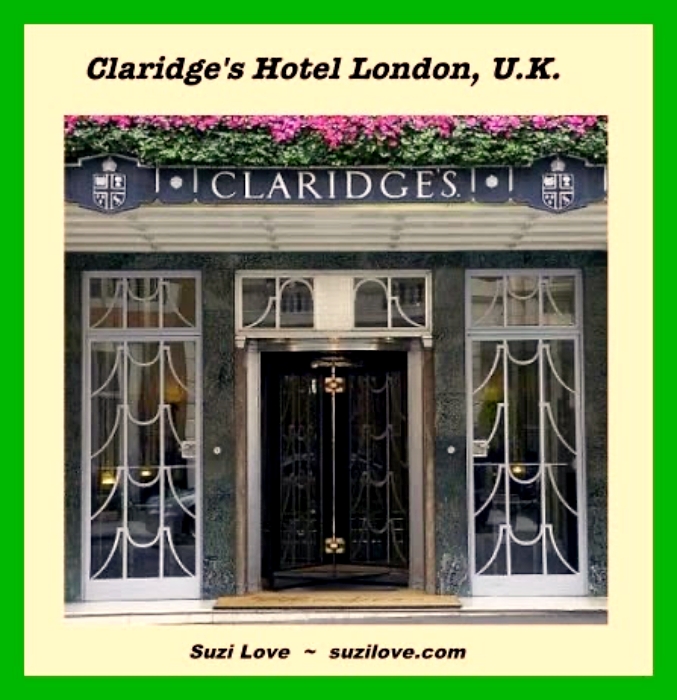
Claridge’s Hotel, Mayfair, London, during Bridgerton and Jane Austen years. #Bridgerton #janeausten #London #BritishHistory #ClaridgesHotel #travel https://books2read.com/suziloveROver
Music history from the 17th, 18th, and 19th Centuries. Pianos, pianofortes, harps, viols, violins played during Jane Austen’s times. Musical Instruments were so important in most of the more affluent households in history that large industries grew all around the world to manufacture instruments, musical accessories, and to print sheet music. Musical instruction and encouragement could be found everywhere and both young ladies and gentlemen were encouraged to have musical appreciation. And of course, playing music was on the list of social requirements for all young ladies desirous of becoming a wife and homemaker.
London became Europe’s leading centre for the manufacture of scientific instruments and this led to the manufacture of more musical instruments as well as factories developed and rail transport helped the faster distribution of goods to regional areas. One of the first places that music was used to tell stories and to share enjoyment was in Christmas music. Because music was such an integral part of households, music was always a feature in Magazines. There were advertisements everywhere for musical instruments for sale, for sheet music, and for music lessons. And of course, of most interest to the ladies were the hundreds of fashion plates included in magazines where people were depicted with their musical instruments.
19th Century Late. Sterling Silver Five Piece Writing or Desk Set, Peru (under German Company). Hinged cut crystal inkwell with beveled edges, wheel cut starburst at base, wax seal with blank matrix, blotter, dip pen and letter opener. Each with guilloche enamel featuring yellow rose with lush green leaves on pale blue background, trimmed with a lighter shade of blue enamel. Dip pen with allover pale blue guilloche enamel, pen nib marked 14k Gold Plated.
HN_13_D2D_WritingTools Book 13 What did the lady of the house use to pen notes? What sat on the desk of the man of the house when managing his accounts? #History #Nonfiction #travel books2read.com/SuziLoveWritingTools
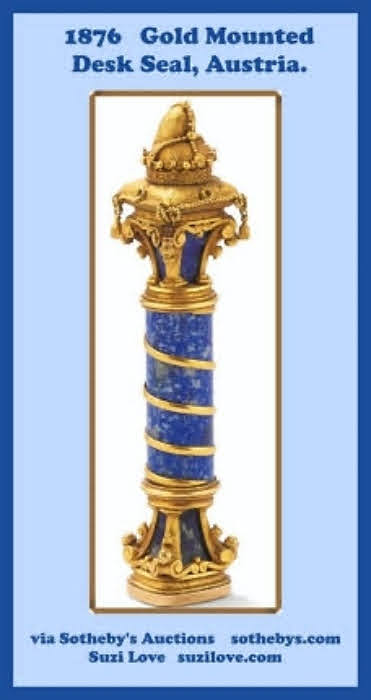
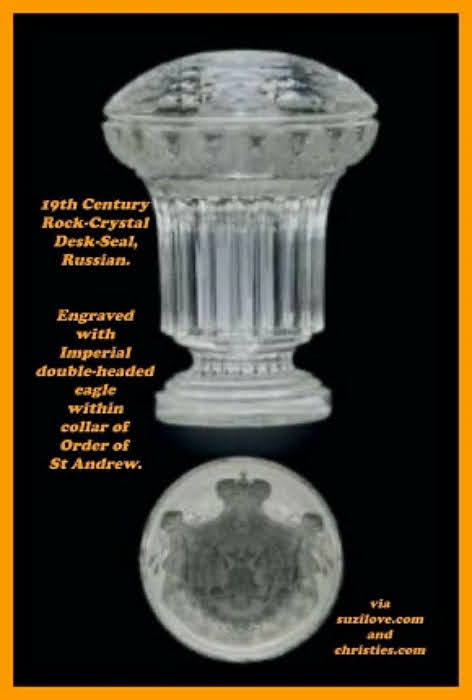
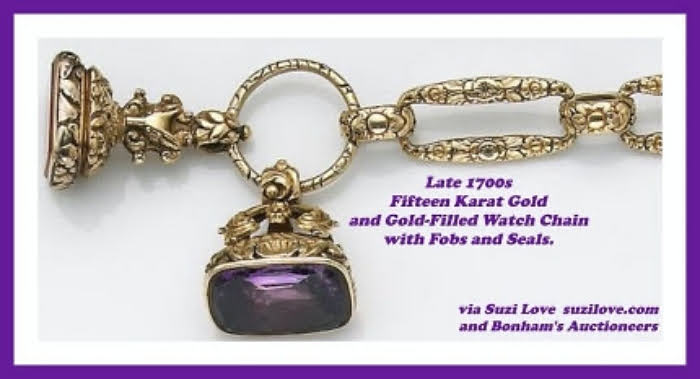
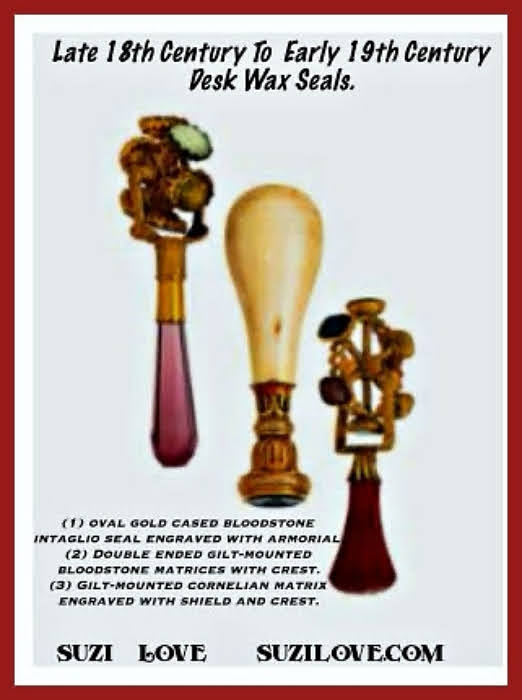
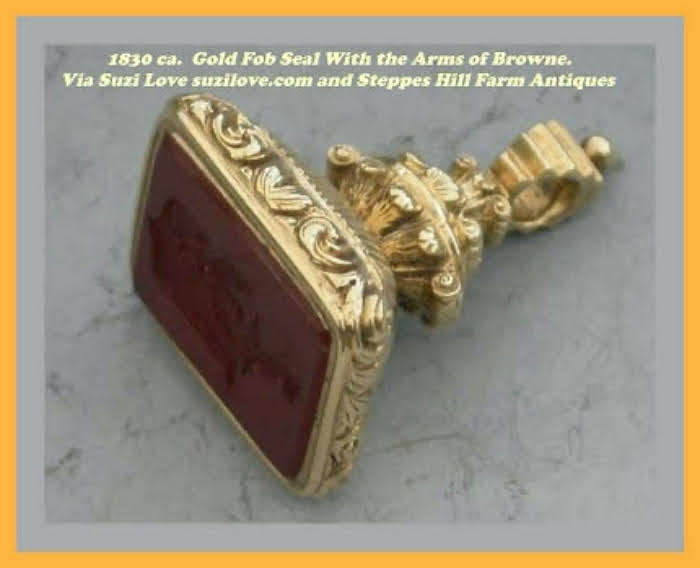
18th – 19th Century Seals For Letters and Posting. Used to seal hand written letters in the 18th and 19th centuries.
Definition: Wax Seals: Pressed onto a letter or envelope to show that a document is unopened or to verify the sender’s identity. A signet ring or was seal is pressed into a dollop of hot wax to seal a letter or envelope closed.
HN_13_D2D_WritingTools Book 13 What did the lady of the house use to pen notes? What sat on the desk of the man of the house when managing his accounts? #History #Nonfiction #travel books2read.com/SuziLoveWritingTools
What did the lady of the house use to pen notes in Bridgerton and Jane Austen’s years? What sat on the desk of Jane Austen’s male contemporaries when they managed household and estate accounts? books2read.com/SuziLoveWritingTools. Writing Tools, History Notes Book 13.
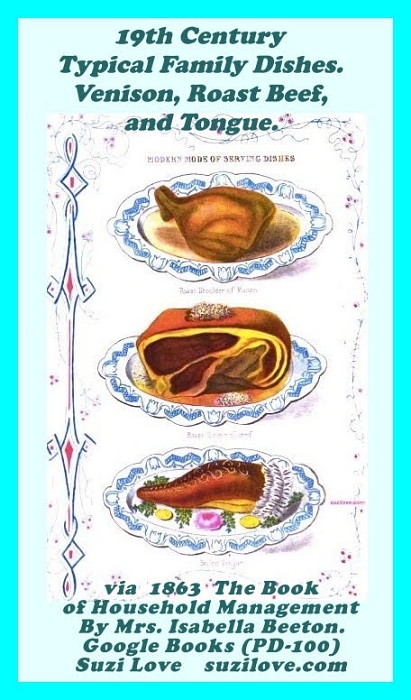
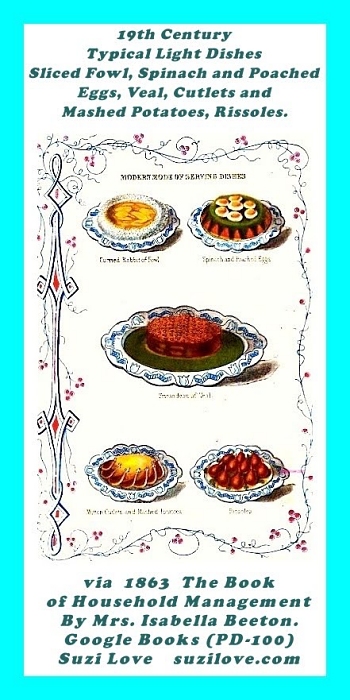
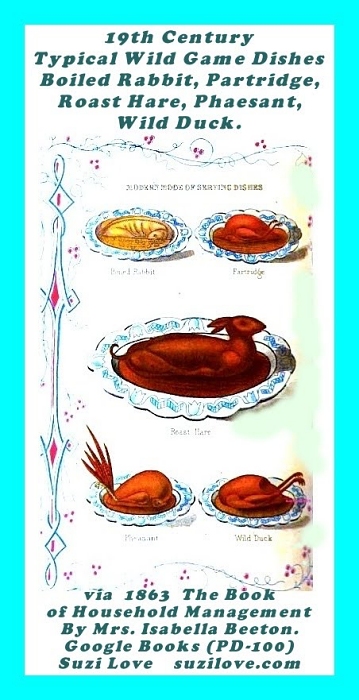
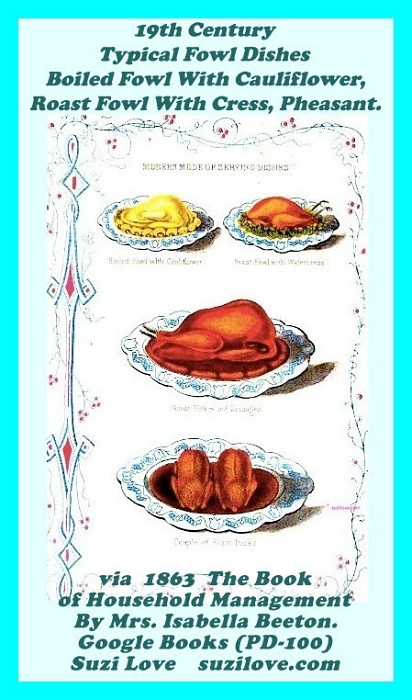
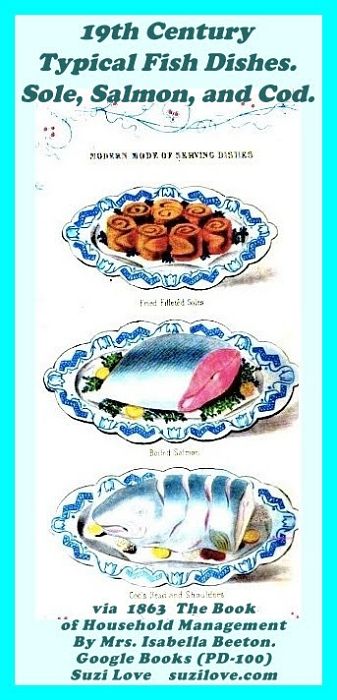
19th Century Food For The Upper Classes In Bridgerton and Jane Austen Times.
Typical Meals Served for the upper classes in the Georgian and Regency Eras. For the Upper classes in the 18th and through to the end of the 19th century, meals were elaborate affairs. and served by well-trained staff anticipated their every need. Women prided themselves on hosting dinners for 50-60 people which often consisted of numerous courses, and all served with the best wines and followed, for the men at least, by expensive port.
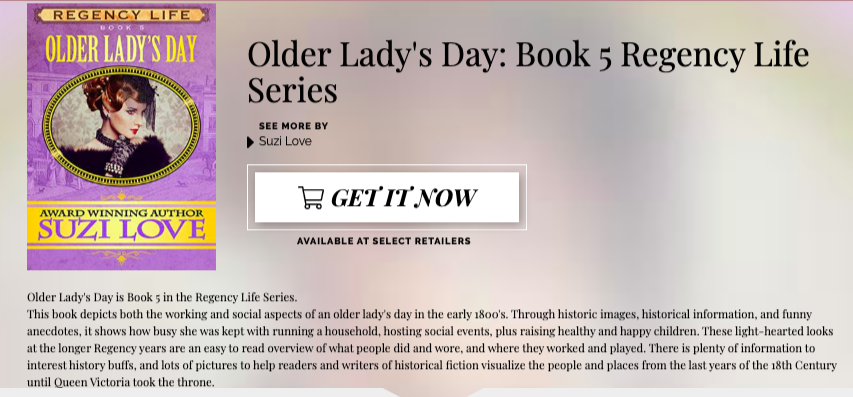
An older lady usually controlled the servants and the serving of meals. For more about this, take a look at Older Lady’s Day Regency Life Series Book 5 by Suzi Love. Overview of what an older lady did, wore, and how she lived in the early 19th Century. Information for history buffs and pictures for readers and writers of historical fiction. books2read.com/suziloveOLD
1800s Typical Puddings and Pastries.These are the sort of puddings and pastries Jane Austen’s family would have eaten on a regular basis during the early 1800s, or Regency Era. Open Apple Tart, Galette, Apricot Fritters, Pancakes and Apricot Jam, Charlotte Russe, Macaroni Cheese, Cherry Tart, Mince Pies, Almond Puddings, Tartlets, Compote Of Fruit, Fruit Pudding, Fruit Tart, Christmas Plum Pudding, Milk Pudding and Roly Poly Jam Pudding. From: 1850s- 1860s Mrs. Beeton’s Books of Household Management. via Google Books (PD-150). 1800s Typical Puddings and Pastries Served In Households Like Jane Austen’s. https://books2read.com/suziloveOLD
Covent Garden is within the London boroughs of Westminster and Camden, and the parliamentary constituencies of Cities of London and Westminster and Holborn and St Pancras. The district is divided by the main thoroughfare of Long Acre, north of which is given over to independent shops centred on Neal’s Yard and Seven Dials, while the south contains the central square with its street performers and most of the elegant buildings, theatres and entertainment facilities, including the Theatre Royal, Drury Lane, and the London Transport Museum.
In 1552, the land was seized by Henry VIII and granted to the Earls of Bedford. The 4th Earl commissioned Inigo Jones to build fine houses to attract wealthy tenants. It was the first modern square in London, with Italian arcades and a flat, open space or piazza with low railings. This layout was copied in other new estates in London.
1555 John Russell, 1st Earl Of Bedford. By a follower of John Bettes. Given land of Covent Garden by Herny VIII after the dissolution of the Monasteries.
1650 The piazza of Covent Garden about 1650, as engraved by Wenceslaus Hollar. Courtesy University of Toronto.
1721-1789 ca. St. Paul’s Church, Covent Garden, London, U.K. From between two arches of the plaza. Watercolor with grey wash. By Thomas Sandy. Via British Museum, London, UK. britishmuseum.org
1800s Early Covent Garden Market, London, U.K.
In 1654, an open-air fruit and vegetable market grew on the south side of the fashionable square but over time the market and the surrounding area fell into disrepute. Taverns, theatres, coffee-houses and brothels opened up, the gentry moved away, and rakes, wits and playwrights moved in.
By the 18th century Covent Garden had become a well-known red-light district, attracting notable prostitutes such as Betty Careless and Jane Douglas. Descriptions of the prostitutes and where to find them were provided by Harris’s List of Covent Garden Ladies, the “essential guide and accessory for any serious gentleman of pleasure”.
Covent Garden’s market was always disorderly, the buildings in bad shape, and overcrowded with stalls, donkeys, carts, and peddlers. The small number of passageways into the piazza were small and with bottle necks of carts moving goods and market sellers fighting for right of way. The markets supplied fruits and vegetables, mostly homegrown but with imported goods increasing. Many sellers missed paying tolls for selling in the piazza or refused to pay them so the owner, the Earl of Bedford, took many people to court for not paying tolls. He realized the markets were in such poor condition that he couldn’t charge sellers until he improved them. In 1830, a new market hall was built with sections dividing the kind of goods sold which did improve things, but the markets remained chaotic. By 1890, people were again complaining about the narrow streets and congestion. The market hall provided a more permanent trading centre and Charles Fowler’s neo-classical building was erected to cover the market. As the market grew, the prostitutes moved on. The Houses of Parliament were the centre of Britain’s political world. But there was also an abundance of grand mansions and other buildings of interest in the City.
Covent Garden’s flower girls attracted attention by shouting:
“Two bundles a penny, primroses!”
“Sweet violets, penny a bunch!”
In 1851, Henry Mayhew wrote London Labour and the London Poor describing two types of flower girl. The young girls, or waifs, sold flowers to feed the family. The other type of flower girl stayed out late, doubled as prostitutes, and had bad reputations.
In 1913, Herbrand Russell, 11th Duke of Bedford agreed to sell the Covent Garden Estate for £2 million to the MP and land speculator Harry Mallaby-Deeley, who sold his option in 1918 to the Beecham family for £250,000.
1809 View Of the New Covent Garden Theatre, London. From Hart Street, showing the King’s entrance. Watercolor drawn by James Winston. via British Museum.
1811 Bird’s Eye View of Covent Garden Market, London, UK. Main fruit, flower and vegetable market in London in early 19th century. Began here in 1656 with few temporary stalls in back garden of home of Earl of Bedford. Charles II granted market lease and in 1678 bought by Adam Piggot and others who built permanent stalls. By 1811, smelly, dirty, and overcrowded. Engraver J. Bluck. After Augustus Charles Pugin and Thomas Rowlandson published by Ackermann. Via British Museum, London, UK. britishmuseum.org
1827 Covent Garden Market, Westminster, London, U.K. By Frederick James Havell.
1835 Covent Garden Watch House, London, UK. Next to the church of St. Paul’s Church, Covent Garden. Two story white building with ‘Watch House’ painted on its upper floor is shown with a lively street scene in the foreground. via Museum of London.
1852 J.M.W. Turner’s birthplace in Maiden Lane, Covent Garden. Brick terraced house at night with a figure in top hat walking past and two figures with a candlelight in the doorway. Watercolour with body color over graphite. Drawn by John Wykeham Archer.
In 1913,Herbrand Russell, 11th Duke of Bedford agreed to sell the Covent Garden Estate for £2 million to the MP and land speculator Harry Mallaby-Deeley, who sold his option in 1918 to the Beecham family for £250,000. By the end of the 1960s, traffic had become congested until in 1974 the market relocated to the New Covent Garden Market about three miles (5 km) south-west at Nine Elms. In 1980, the central building re-opened as a shopping centre and then became a tourist location with cafes, pubs, small shops, a craft market called the Apple Market, and another market in the Jubilee Hall.
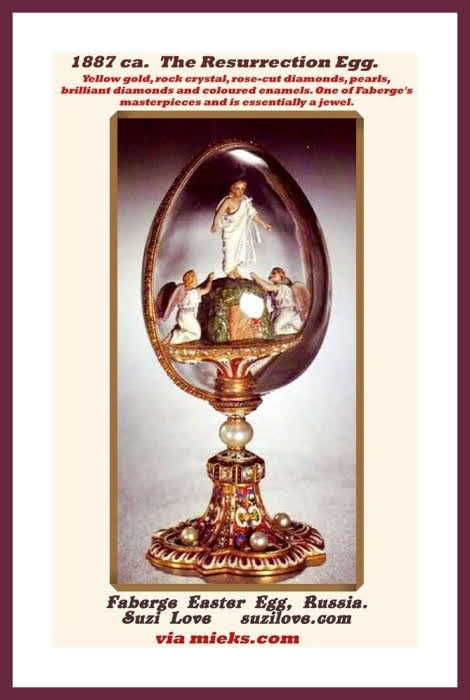
1887 Resurrection Imperial Faberge Egg. Yellow gold, rock crystal, rose-cut-diamonds, pearls, brilliant diamonds and various colored enamels. One of Faberge’s masterpieces and is essentially a jewel.









![19th Century Late SterlingSilverFivePieceWritingorDeskSetPeru_Dippenwithpaleblueguillocheenamel_pennib14kGoldPlatedbatch.jpg ]
19th Century Late. Sterling Silver Five Piece Writing or Desk Set, Peru (under German Company). Hinged cut crystal inkwell with beveled edges, wheel cut starburst at base, wax seal with blank matrix, blotter, dip pen and letter opener. Each with guilloche enamel featuring yellow rose with lush green leaves on pale blue background, trimmed with a lighter shade of blue enamel. Dip pen with allover pale blue guilloche enamel, pen nib marked 14k Gold Plated.](https://suzilove.files.wordpress.com/2021/06/writing_19th_century_late_writing-and-desk-setperu_lge-1_lge_sml.jpg?w=554)