1816. June Blue Merino wool riding dress with high waist and embroidered and ornamented round the bust and cuffs and fastens on the back of the shoulder. Double ruff of fine Vandyke lace is separated from shirt collar by a Chinese silk handkerchief of blue and white. Small round hat made of fine beaver or moss silk, the half boots are of blue kid with Limerick gloves worked and seamed with blue and she is carrying a riding whip. These riding habits were usually designed by men and were in two pieces, a jacket and a skirt, worn over a shirt but this is in one piece and the full skirt falls from directly under the bust. Fashion Plate via John Belle’s La Belle Assemblée or, Bell’s Court and Fashionable Magazine, London. https://books2read.com/SuziLoveFashionWomen1815-1819
Typical of the riding costumes worn by Jane Austen’s female contemporaries. The style is still in the Empire fashion of a high-waist with the full skirt falling from just under the bust and with a frill and small decorations on the wrists and shoulders to make it look unique.
Fashion Women 1815-1819 History Notes Book 28 What did Jane Austen wear? . D2D_HN_28_https://books2read.com/SuziLoveFashionWomen1815-1819
1820 Brown Evening Dress Of Figured Silk Muslin With Brown Gauze Trim. An evening dress of tobacco coloured figured silk muslin, warp float, small sprig repeat design. Shallow, round neckline, short puffed sleeves, high, empire-style waistline and long tubular skirt. Bodice has narrow cream lace trim above a band of self fabric edged with cream silk braid and brown silk taffeta piping. Bodice front has brown silk gauze joined on at side seams with 3 van dyke points down sides of centre front. Edges of points bound with silk taffeta and trimmed with ball buttons covered in brown silk floss.
Centre front panel has brown silk cord lacing through 17 handworked eyelets bordered by 2 v-shaped strips of same silk taffeta rouleaus. Self fabric waistband is trimmed with cream braid and piping, with two van dyke points either side of centre back. Bodice laced at back from neck to waistband while gauze overlay from front forms a band tucked over the waist, which extends over skirt to form a narrow peplym, also van dyke pointed and bound with taffeta. Two self fabric epaulettes attached at sleeve seams and trimmed with brown silk passmenterie tassel, at shoulder and with same braid and piping. Short sleeves overlaid with brown silk gauze ruched between rouleaux bands stitched to lining. Cuff bands piped and braided and cut into 8 van dyke points above overlay. Points are trimmed with braid, piping and silk covered ball buttons. Skirt of dress falls to the ground, trained at back, and flounce of satin striped silk gauze falling from corded seam. Bodice lined with cream cotton. Via Powerhouse Museum, Sydney, Australia. collection.maas.museum.
Passementerie: Art of making elaborate trimmings or edgings (in French, passements) of applied braid, gold or silver cord, embroidery, colored silk, or beads for clothing or furnishings.Styles of passementerie include the tassel, fringes, ornamental cords, galloons, pompons, rosettes, and gimps, as well as other forms. Tassels, pompons, and rosettes are point ornaments, and the others are linear ornaments.
Fashion Women 1815-1819 History Notes Book 28 https://books2read.com/SuziLoveFashionWomen1815-1819
1805 Typical Regency Era, or Early 1800s, Muslin Dress. Long sleeves, square neckline, and decorated with Palm Tree embroidery. via Whitaker Auction whitakerauction.smugmug.com Typical of the Empire dresses worn by Jane Austen and her contemporaries. Square necklines, long sleeves, and skirts that started directly under the bust and flowed into the classical relaxed wide styles of Greece and Rome. These high-waisted dresses were worn most days and cotton, silk or taffeta were the popular fabrics.
Fashion Women 1805-1809 History Notes Book 26 What did Jane Austen and friends wear? https://books2read.com/SuziLoveFashionWomen1805-1809
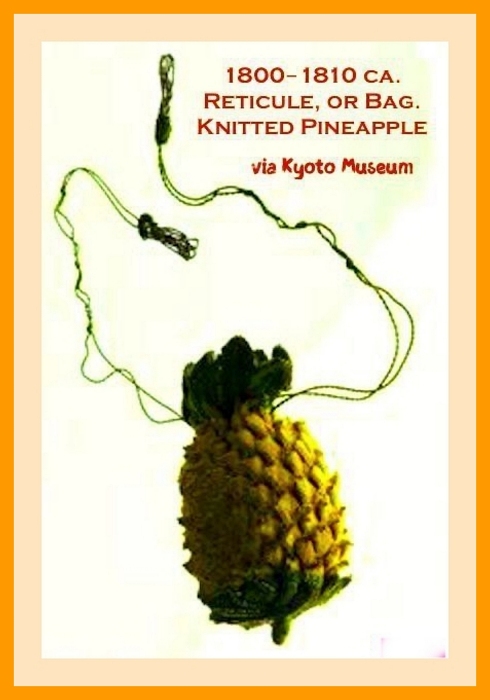
1800-1810 ca. Pineapple Reticule, or Bag. A knitted pineapple with long strings. In Jane Austen’s times, pineapples were a luxury imported item that most people in Great Britain had never seen, let alone tasted. When more pineapples were imported from hotter countries, or English gardeners started to grow some, pineapples became a much desired novelty and an exotic experience. Pineapple motifs appeared on dresses, furniture, household goods etc. Knitting pineapple reticules was part of this obsession with pineapples. via Kyoto Museum, Japan.
Definition Ridicule, Reticule, Indispensable, or Handbag: From the late 1700s, pockets could no longer be sewn into gowns, as skirts fell from just under the bust and were full and flowing. Instead, women began carrying small bags, known at first as ridicules and later as reticules, to keep necessary items on their person e.g. handkerchiefs, coins, vinaigrettes, calling cards, glasses etc. http://books2read.com/suziloveReticules
1800-1810 ca. Reticule, or Bag. A knitted pineapple with long strings. via Kyoto Museum, Japan.
In the early nineteenth century, reticules started to look like future handbags as they were often made from rigid card or molded mâché or card into a variety of shapes. Early bags were circular and with a drawstring but as women wanted their reticules to look individual they could be made with two halves and a hinged metal closure or with concertina sides. Materials varied from silk, cotton and string and shapes were round, hexagonal or lozenge shapes with shell shaped bags becoming very popular during the Regency and Romantic Eras.
1800s magazines were written for well bred women who could read, so they gave plenty of ideas for how ladies could make and embellish reticules for their own use and as pretty gifts. Needlework was highly encouraged as a pastime for a lady so bags were frequently embroidered or decorated with beading. By the 1820s, reticules became more like our modern handbags using soft leather gathered at the top or hard leather with a rigid fastener and metal chain for carrying.
1825 Brown stays with center front busk, back lacing, hip shaping, breast gussets, widely spaced straps, cotton embroidered in ivory silks with hearts. via Kerry Taylor Auctions. kerrytaylorauctions.com https://books2read.com/SuziLoveCorsetBook17
The main purpose of corsets was to support and shape the breasts. Though they still slimmed the midriff, this was not the prime purpose of a corset in the 1820s. The waistline of dresses had lowered to below the bust line and nearer to the true waist so corsets were longer and were given added shaping by stitching and cording and by shaping the breasts with pleated or gathered cups.
1800-1830 ca. Reticule, or Bag, American. Bottom of bag shaped like basket and made of stiff deep cream colored mohair with minute blue figure, two panels of light blue painted silk moiré, upper part of bag of deep cream colored figured silk, blue silk ribbon, drawstring and bows trimming lower part of bag. via Museum of Fine Arts, Boston, U.S.A. mfa.org
Definition Reticule Or Ridicule Or Bag or Purse: Often with a drawstring to pull closed and usually made of cloth or covered cardboard and often decorated with beading or embroidery. A reticule, or purse, or handbag, was usually carried by a woman during the Regency period to carry all their daily necessities. Earlier, women used pockets that tied at the waistline and were hidden in the folds of their skirts. Empire style, or early 1800s, high-waisted dresses made it impossible to either sewn in a pocket or to tie on a pocket. So women began carrying small, decorated bags called Reticules, or ridicules, which generally pulled close at the top with a drawstring.
1800-1830 ca. Reticule, or Bag, American. Bottom of bag shaped like basket and made of stiff deep cream colored mohair with minute blue figure, two panels of light blue painted silk moiré, upper part of bag of deep cream colored figured silk, blue silk ribbon, drawstring and bows trimming lower part of bag. via Museum of Fine Arts, Boston, U.S.A. mfa.orgD2D_RetailerBuyLink_HN_3 http://books2read.com/suziloveReticules
1817 January Carriage Costume, English. Red velvet pelisse trimmed with ermine to match muff, tops of sleeves caught up à la Mancheron with military silk chain work, Russian hussar cap of ermine with gold military chain, Limerick gloves and matching kid half-boots.
The ‘General Observations on Fashion and Dress’ describes this fashion plate as, ‘The truly elegant and costly carriage costume of which we have given so beautiful a specimen in our Plate, while it confers the highest honor on the taste of the inventress, is likely to be a most prevailing out-door covering for the carriage amongst ladies of wealth and fashion, being particularly adapted for the open barouche, as the manner in which it is made, with warm hussar cap of light and valuable fur, shields the fair wearer from all the severity of the pinching frost or cutting north wind.’
The Fashion Plate was invented by Mrs. Bell, a relative of the publisher, John Bell, and most likely also the writer of the general observations. Fashion Plate via John Belle’s La Belle Assemblée or, Bell’s Court and Fashionable Magazine, London.
Definition: Coat or Redingote Or Pelisse: Long fitted outdoor coat worn over other garments for warmth. French word developed from English words, riding coat.
Definition Sleeve à la Mancheron: An ornamented trimming or puff attached to the upper sleeve.
Fashion Women 1815-1819 History Notes Book 28 https://books2read.com/SuziLoveFashionWomen1815-1819
1817 November Cambric Muslin Walking Dress, English. As would have been worn by Jane Austen and her female contemporaries when out walking. Row of pointed work forms a narrow pelerine, high on the bosom, and ends in a point in front. The skirt has a deep muslin flounce beneath a row of soft muslin bouffone. Brown Spencer of gros de Naples has figured buttons which are intermixed with an elegant trimming. Sleeves ends are like the hem with a double row of buttons and trimming. The newly fashionable epaulette is edged and finished with buttons on the shoulder. Autumnal bonnet has a large front, low crown, and ties under the chin with a large bow. Swansdown muff, lilac sandals and pale lemon kid gloves finish the ensemble. ‘We have been favored this month with both our dresses by a lady, one of our subscribers, who purchased them, we understand, at Mrs. Bell’s in St. James’s Street.’ Fashion Plate via Rudolph Ackermann’s ‘The Repository of Arts’.
1817 November. Walking Dress, English. Brown Spencer over a white Empire style, high-waisted, walking dress with frilled hem, large white muff, brown bonnet with ruffles and ribbon to match. Fashion Plate via Rudolph Ackermann’s ‘The Repository of Art Fashion Women 1815-1819 History Notes Book 28 https://books2read.com/SuziLoveFashionWomen1815-1819
How did people travel in past centuries? What did they take with them to make their long journeys easier? Travel by road, ship, canal, or railway all took a long time and had dangers so people learned to prepare. And then, in the nineteenth century, road improvements, inventions, and scientific developments made travel more pleasurable. Travel and Luggage By Suzi Love History Notes Book 10 books2read.com/SuziLoveTravel
Horse Power To Steam. Various alternatives to horse power were tested in London’s streets during the 19th century. Steam powered road engines and trams proved too heavy and damaged the roads. Stationary steam engines were used to haul trams attached to a cable but these were only really effective on hills that we too steep for horses. There were also experiments with trams driven gas engines and battery electric power. but was successfully developed. Petrol engines were still primitive and unreliable in the 1890s. In 1900 the reliable horse still dominated the streets of London but new technology was to revolutionize road transport.
Travel and Luggage By Suzi Love History Notes Book 10 #History #travel How did people travel in past centuries? What did they take with them to make their long journeys easier? books2read.com/SuziLoveTravelHN_10_D2D_RetailerBuyLink_Travel and Luggage By Suzi Love History Notes Book 10 #History #travel How did people travel in past centuries? What did they take with them to make their long journeys easier? books2read.com/SuziLoveTravel
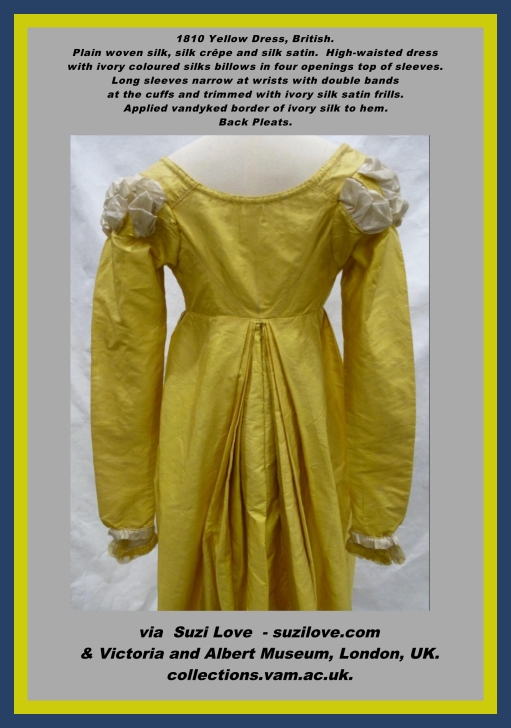
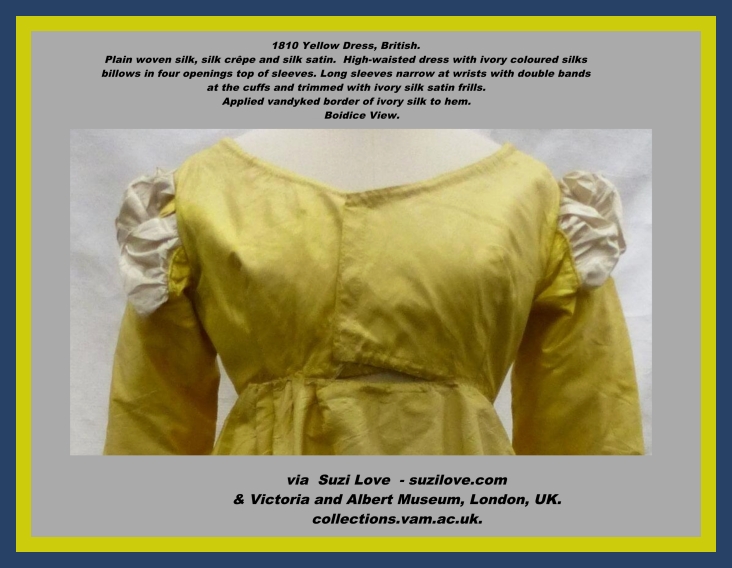
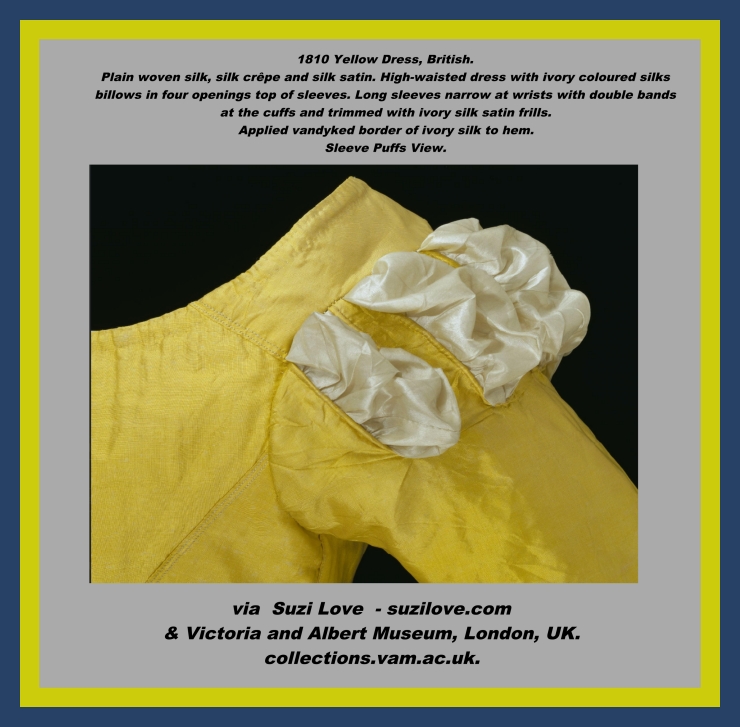
1810 Yellow Dress, British. Plain woven silk, silk crêpe and silk satin. High-waisted dress of yellow silk, ivory colored silks billow out of four openings at sleeve tops. The puffed trimmings are inspired by the fashionable slashing of garments in the Renaissance period when the top fabric was cut to reveal a colored lining or garment worn underneath. A long rectangular strip of ivory silk on inside of sleeve head and excess gathered into pudds through openings. The 19th-century version of slashing is much more controlled by cut, stitching and piped edges, rather than the raw cuts in fabric seen in the 16th century.
Long sleeves narrow at wrists with double bands at cuffs and trimmed with ivory silk satin frills, yellow silk crêpe, cream ribbon and cording. Trimming around lower hem of skirt of applied vandyked border of ivory silk.
Length center back neckline to hem of train length: 158cm Front length shoulder to hem length: 139cm
1810_YellowSilkDressBritish_Plain wovensilk, silk crêpe and silk satin. High-waisted dress with shoulder decoration and contrasting hem trim_HemView_vam.ac.ukHN_27_D2D_fashwomen1810-1814
https://books2read.com/SuziLoveFashion1810-1814