19th Century. Seven Piece Desk Set, French. Empire Style Desk Set, Napoleon III Era, French Empire Revival style, Baccarat crystal, glass, gilt, bronze ormolu writer’s desk set, including ink well and roller. The type of writing set that most households would have in Jane Austen’s and Bridgerton’s times for writing letters and keeping track of estate matters. via Ruby Lane Antiques ~ rubylane.com
HN_13_D2D_WritingTools Book 13 What did the lady of the house use to pen notes? What sat on the desk of the man of the house when managing his accounts? #History #Nonfiction #travel books2read.com/SuziLoveWritingTools
1810 Silk Brocade Waistcoat. Cream silk twill with a polychrome floral brocade stripe having narrow double breast, fold-down collar and wide lapel, black wool-covered buttons, straight pockets, cotton back and lining. The gentlemen of Jane Austen’s acquaintance would have worn waistcoats like this. via Christie’s Auction Rooms. christies.com
1800s Early Women’s Half Boots, British, as worn by Jane Austen and her family and the Bridgerton ladies. Walking was encouraged for women so lace-up half-boots became a popular replacement for flimsy slippers for outdoor wear. Made of nankeen, a durable, yellow-colored, natural cotton from China or from colored leather. via Victoria and Albert Museum, London, UK. collections.vam.ac.uk
In Bridgerton and Jane Austen years, people were encouraged to partake in outdoor pursuits to maintain good health so walking became a daily pastime. Fragile slippers were worn for balls and evening events but for walking sturdier shoes were needed, In the early 1800s, these were typically made of leather, had a very small heel, slightly rounded toes and were laced up on the top.
An overview of women’s fashions in the first twenty years of the 19th century. What was fashionable for women in Jane Austen’s times, or the early 1800s. Wars were being fought around the globe so women’s fashion adopted a military look in support of soldiers. In Britain, the Prince Regent ruled instead of his father, King George III, so fashions, like the lifestyle, became more extravagant and accessories went from pretty to opulent.
Reader Or Writer of Regency Era? Love Jane Austen and Bridgerton fashions? What was fashionable for women in Jane Austen’s times, or 1800s, or Regency Era. High-waisted dresses were extravagantly accessorized and hats, shoes, parasols and bags were added. Set includes History Notes Books 12, 25, 26, 27 and 28. https://books2read.com/SuziLoveFashionWomenBoxSet
Ladies clothing in the early 1800’s featured a high waist line called an Empire Line, or Empire style dress, with a waist line just under the natural bust line and much higher than the natural waist. The high-waisted, or short-bodied, Regency styles shifted focus away from the natural waist and so left the natural waist unconstricted, in direct contrast to previous and future styles. Britain took these simple European styles and progressively made them more elaborate by adding more and more complicated embroidery onto white fabrics to create the white on white look popular for many years.
The empire look of fine muslin dresses left women more exposed than in the Georgian Era when fabrics had been thicker and styles bulkier. Women, especially in England, preserved their modesty by adding lace, frills, flounces, ruches, and fabric plaits to dresses to adequately cover any parts that might inadvertently be exposed. Outer layers, such as Spencers, Redingotes or Pelisses or coats, and shawls, were also added for warmth and to brighten outfits. This Empire fashion was totally dependent on a supply of fine, translucent cotton muslin – at first imported from India, then later, less exclusive imitations often woven and printed or embroidered in Britain. Fabrics were soft and lightweight and muslins and other cotton fabrics from India and other Asian countries were in high demand.
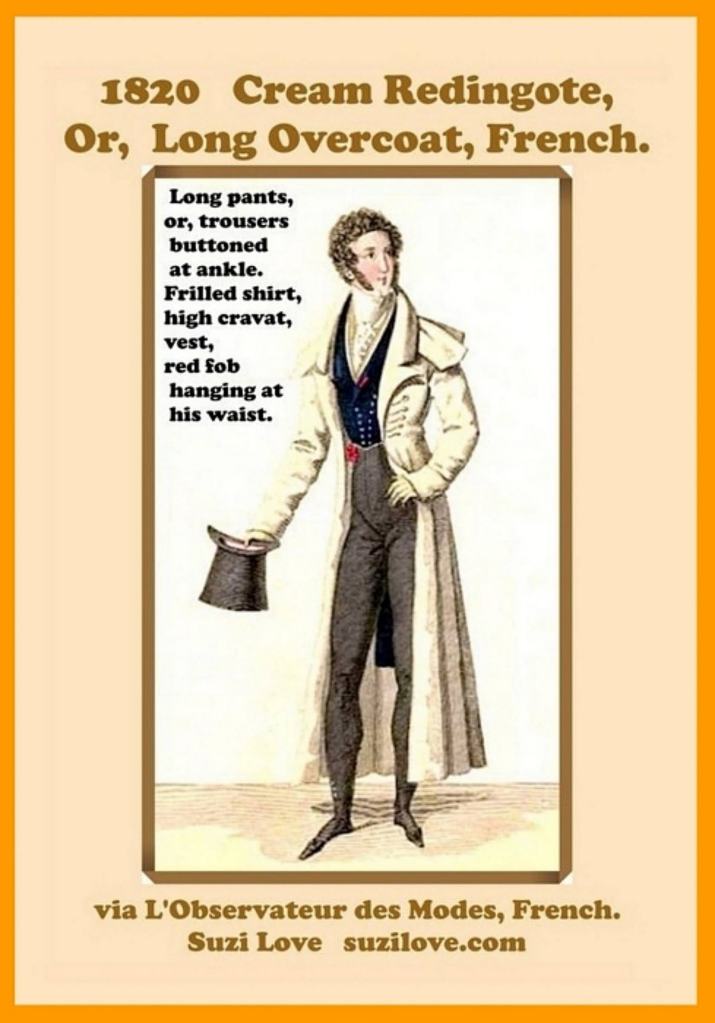
1820 Gentleman’s Cream Redingote, Or Long Overcoat, French. Long pants, or trousers, buttoned at the ankles, frilled shirt, high cravat, vest, red fob hanging at his waist. via L’Observateur des Modes, French.
1810-1829 ca. Green Silk Street Shoes, Probably British. As Worn by Jane Austen and her contemporaries and the Bridgerton family. Heavier sole than ordinary day shoes, although the silk fabric meant they were only worn for easy promenades. Rounded toe means prior to 1830, when toes became square. Strong colors in shoes complimented fashionable colorful garments of the time. via Metropolitan Museum, NYC, U.S.A. metmuseum.org
1815 Blue Dress Bodice, French. Layers of frills on dress back. Hairstyle and Various Bonnets as Jane Austen would have worn. Fashion Plate via Journal des Dames et des Modes, or Costume Parisien.
Fashion Women 1815-1819 History Notes Book 28 https://books2read.com/SuziLoveFashionWomen1815-1819
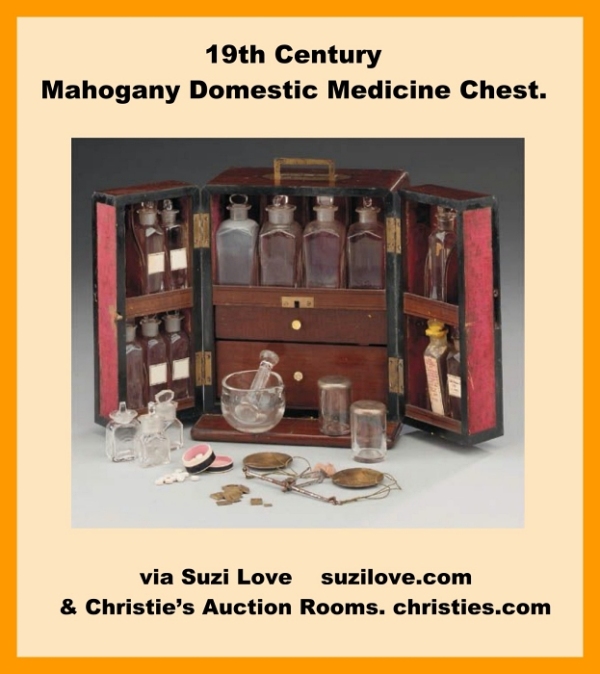
19th Century Mahogany Domestic Medicine Chest as would have been used in Regency England in the lifetime of Jane Austen and the Bridgerton family. via Christie’s Auction Rooms. christies.com
19th Century Mahogany Domestic Medicine Chest. via Christie’s Auction Rooms. christies.com suzilove.com
By 1700’s, a metal jeweled ornament hung from pockets, attached to belts, or by hooks into skirt waistbands
During 1800’s, women wore large collections of tools hung from chains
Young girls sewed and did needlework and needed to carry sewing notions eg scissors, thimbles
Worn by women of all classes, from workers to nobility
Varied depending on class and finances.
Made of silver, brass, steel, leather, or fabric
During 19th century, fashionable dresses often had no waist and nowhere to hang chatelaines
Chatelaines became decorative brooches
Often given as a wedding present from a husband to bride
Later became fashion accessories
D2D_RetailerBuyLink_HN_9. Chatelaines and Chains History Notes Book 9 By Suzi Love. #regency Women in charge of houses wore long chains holding important household items around their waist e.g. keys, pen, notebook, sewing. books2read.com/SuziLoveChatelaines
19th Century Early Women’s Cotton Caps. Worn as morning caps, night caps, or under other hats. With lappets, hanging ties, or tails, which were also called ‘follow me lads’, or ‘flirtation ribbons’. via Museum of Fine Arts, Boston, U.S.A. mfa.org. via Museum of Fine Arts, Boston, U.S.A. mfa.org
Definition Caps: Worn as morning caps, night caps, or under other hats. Jane Austen and her family and female friends would have worn caps like these, sometimes during the morning at home, to bed to keep their long hair from becoming knotted, or under a bonnet to hold a hairstyle in place. Caps sometimes had hanging ties, or tails, were also called ‘follow me lads’, or ‘flirtation ribbons’.
Definition Lappets: Two long strips of material, often lace, hanging from top of head down back or over shoulders. Sometimes extensions of a headdress and a requirement for court dress.
Fashion Women 1815-1819 History Notes Book 28 https://books2read.com/SuziLoveFashionWomen1815-1819