1805-1810 ca. Double Breasted Tailcoat, South Carolina, U.S.A. Cotton, plain-woven (tabby woven), partly lined with cotton, plain-woven (tabby). Cutaway at the front waist and with a notched collar. via Colonial Williamsburg, USA. history.org
Tailcoat: A Regency Era, or early 1800s, gentleman was outfitted in more practical fabrics, such as wool, cotton and buckskin rather than the fussy brocades and silks of the late 1700s.
I love Pinterest for keeping thousands of historical images in some sort of order. And I love using Pinterest Boards as inspiration for my romance books. What about you? Do you use Pinterest for planning something, or just for fun? Need more hints for what to do with your boards and pins? Take a look at these fascinating articles on Pinterest. if you want even more Pinterest information and tips for becoming a power user, check out my Suzi Love Pinterest Boards
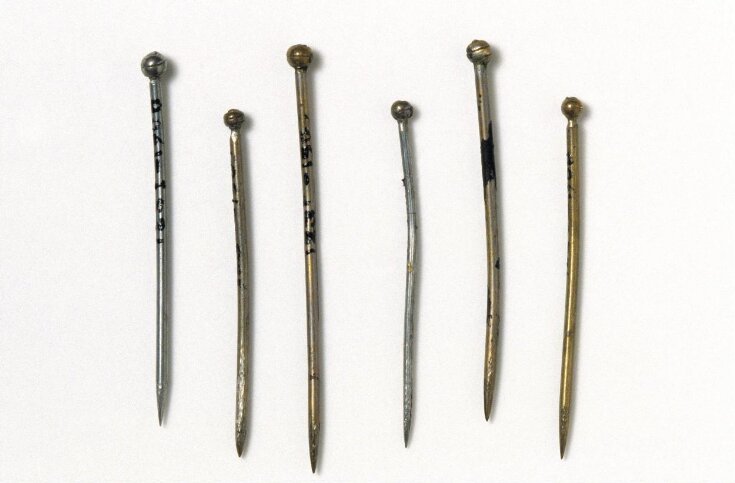
1620-1635 ca. Pin For Fastening Clothing, Made In Gloucestershire, England, U.K. Pins were a necessity for the fastening of clothing and the arrangement of dress accessories in the 16th and 17th centuries. Their importance for women as a personal requirement and expense is reflected in the term pin-money, the sum originally allocated to meet this essential cost. Ordinary people would have a small number of pins, the wealthy thousands.Pins were carefully looked after and sharpened periodically. They were extracted after use so as not to tarnish the fabric and placed in a pincushion.
Places Before the mid-16th century the finest pins were imported from France, but their manufacture in England was encouraged under Henry VIII, and an Act for the True Making of Pynnes was passed in 1543, controlling their quality and price. Gloucestershire and London became the main centres of the pin-making industry.
Materials & Making As the industry developed in the 16th century the major advance in the manufacture of pins came with the use of a steel draw-plate with a graduated series of holes. Wire, which was usually brass, could be drawn through this to any gauge, permitting standardisation of the size of the pins. The heads were made from fine coils of wire that were soldered in place.
Enormous quantities of pins were used for the fastening of clothing. Elizabeth I was supplied with 24,000 ‘pynnes of diverse sorts’ just for her coronation. Pins secured the petticoat in a ruffle above the farthingale (hoops that supported a skirt), and held the curves of the ruff in place around the neck. Several dozen might be used for one ensemble. Such a quantity required large pincushions. These pins were found in written documents that were dated between 1620 and 1635.
HN_1 Fashion Women Late 1700s History Notes Book 1 by Suzi Love.
What was fashionable for women in the late 1700s? Extravagant colors and fabrics and outrageous styles were all seen in these flamboyant fashions.
books2read.com/suziloveFashWomen1700s