1860 Corset, American. Cotton, metal, and bone. Manufacturer: Langdon Batcheller and Company, A1851-1860 ca. Blue Ribbed Silk Corset, English. Front and Back. Front hooks and back lacing. via Museum of London, UK. museumoflondon.org.uk


1860 Corset, American. Cotton, metal, and bone. Manufacturer: Langdon Batcheller and Company, A1851-1860 ca. Blue Ribbed Silk Corset, English. Front and Back. Front hooks and back lacing. via Museum of London, UK. museumoflondon.org.uk


As some of my historical romance books are set in a house in Grosvenor Square, its history fascinates me. How about you? Do you love the history associated with Grosvenor Square? The Jamison family in Embracing Scandal and Scenting Scandal live in Grosvenor Square.
Grosvenor Square - Pronounced ˈɡrovna’, is a large garden square in the exclusive Mayfair district and the centrepiece of the Mayfair property of the Duke of Westminster and takes its name from their surname, “Grosvenor”.
In 1710, Sir Richard Grosvenor obtained a licence to develop Grosvenor Square and the surrounding streets and development started around 1721. Grosvenor Square became one of the most fashionable residential addresses in London from its construction until the Second World War, with numerous leading members of the aristocracy in residence. The early houses had five or seven bays, basement, three main stories, and an attic. Colen Campbell produced a design for a palatial east side to the square featuring thirty Corinthian columns but this was not carried out and in the end most of the houses were built to individual designs. There were mews behind all four sides. Many houses were rebuilt later and acquired an extra storey. Number 23 (later 26) was rebuilt in 1773–74 for the 11th Earl of Derby by Robert Adam and shows how grandeur of effect and sophisticated planning might be achieved on a confined site. It was demolished and rebuilt again in the 1860s.
Nearly all of the older houses were demolished during the 20th century and replaced with blocks of flats in a neo-Georgian style, hotels and embassies. The central garden was originally reserved for the occupants of the houses but is now a public park managed by The Royal Parks. Grosvenor Square. Grosvenor Square has been the traditional home of the official American presence in London since John Adams established the first American mission to the Court of St. James’s in 1785. Adams lived, from 1785 to 1788, in the house which still stands on the corner of Brook and Duke Streets. During World War II, Eisenhower established a military headquarters at 20 Grosvenor Square, and during this time the square was nicknamed “Eisenhower Platz”.
The former American Embassy of 1938–1960 on the square was purchased by the Canadian government and renamed Macdonald House. In 1960, a modern USA Embassy was built on the western side of Grosvenor Square and caused controversy in the mainly Georgian and neo-Georgian area. In 2008, the United States Government chose a site for a new embassy in the Nine Elms area, south of the River Thames with with relocation completed by 2016 or 2017. In October, 2009, English Heritage granted Grade II listed status to the building which means new owners will not be allowed to change the facade.
Grosvenor Square in Literature In Little Dorrit by Charles Dickens the Barnacles are said to live at “four Mews Street Grosvenor” which “was not absolutely Grosvenor Square itself but it was very near it”. Caroline Bingley makes a comment regarding the local dance in Pride and Prejudice ”We are a long way from Grosvenor Square, are we not, Mr Darcy”. It appears in the title of several novels including The Lonely Lady of Grosvenor Square by Mrs. Henry De La Pasture (1907) and The House in Grosvenor Square by Linore Rose Burkard (2009) In Oscar Wilde’s play Lady Windermere’s Fan, the Duchess of Berwick says, “I think on the whole that Grosvenor Square would be a more healthy place to reside in. There are lots of vulgar people live in Grosvenor Square, but at any rate there are no horrid kangaroos crawling about.”


19th Century Early Caroline Bonaparte Murat, Wife and Queen Consort Of Joachim, King Of Naples. Wearing a Grand Parure, or jewelry set of tiara, necklace, earrings etc, of red coral, pearls and diamonds. By Salomon-Guillaume Counis, after Nicholas-Francois Dun.


1700 ca. Chess and Backgammon Box, Augsburg. Decorated in violet wood veneer, ebony and ivory. Ivory checkers and chess pieces, hinges and push button lock in gilded brass, two horn goblets, two ivory dice, thirty-none checkers’ pawns stamped both sides with effigies of cities, Munich, Vienna, Nuremberg, Prague, Danzig, of kings and queens, Prussia, England, Scotland, Poland, and various scenes. Via AnticStore.com


1805-1810 ca. India Muslin Dress, English. Slight train, embroidered panel down centre between two lines of drawn-thread work, embroidery of cotton in chikan stitch and knots in scrolls and plume design. Elbow length sleeves with two insertions of embroidery in leaf pattern. via Manchester Art Gallery
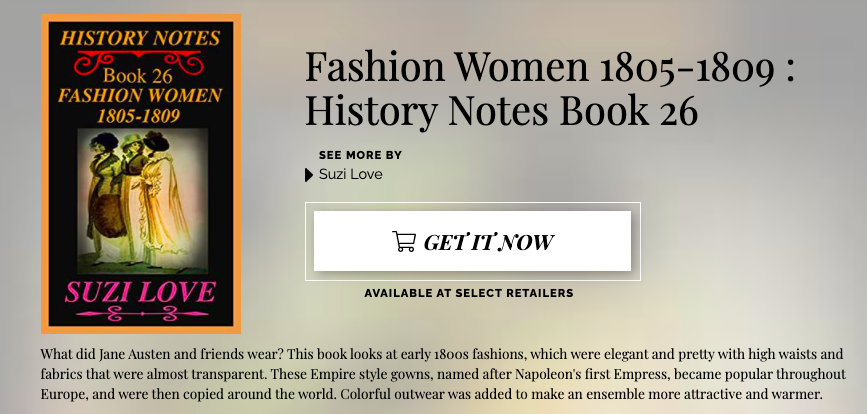
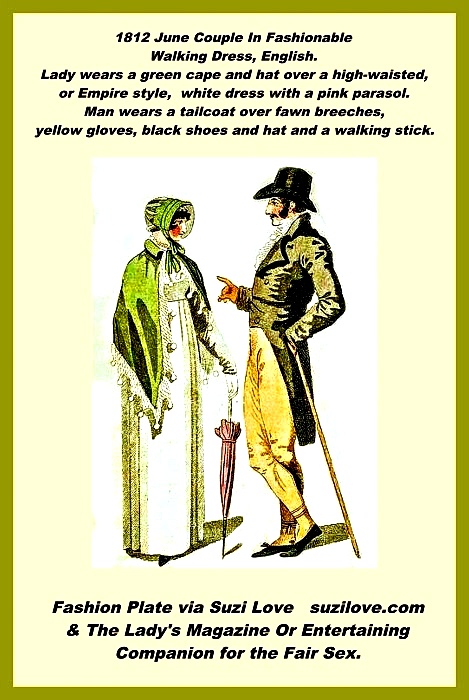
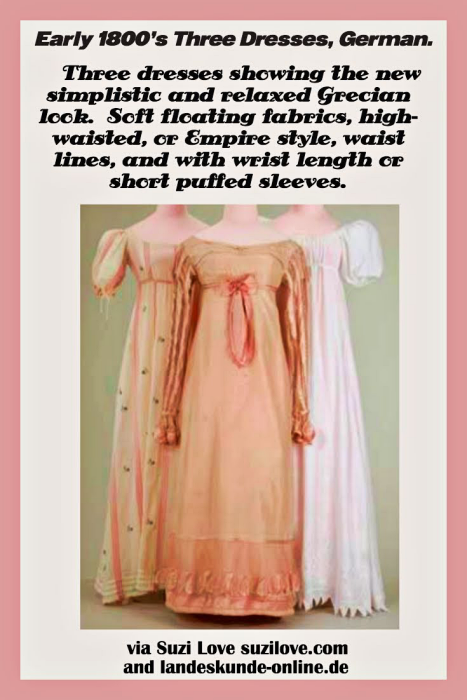
Definition Empire Style: Named after the First Empire in France, by 1800 Empire dresses had a very low décolleté, or neckline and a short narrow backed bodice attached to a separate skirt. Skirts started directly under the bust and flowed into the classical relaxed wide styles of Greece and Rome. This style of dress is associated with Jane Austen and her contemporaries as a simple cotton high-waisted dress was worn most days and accessorized according to the importance of the occasion.


1816-1817 ca. Man’s Linen Shirt, American. High collar, ruffles down front opening, fullness from gathered shoulders and sleeves for unrestricted movement. Beautifully created and monogrammed by Elizabeth Wild Hitchings for her husband, Benjamin Hitchings, a sea captain. Wives or servants regularly hand stitched shirts from 1800s-1840s, before sewing machines, but handiwork rarely recorded.
From The Creator: This shirt was created, from the linen fiber to the finished garment, by the donor’s great-grandmother, Elizabeth Wild Hitchings, for her husband Benjamin Hitchings, a sea captain, in 1816. It was common practice for a wife or servant to hand stitch family members’ shirts prior to the mid-19th century, but rarely was such handiwork recorded, making this case rare and intriguing. In addition, its elegant stitching makes it a perfect example of the familial care taken in sewing prior to the common possession and use of the sewing machine. via Metropolitan Museum, N.Y.C., U.S.A. metmuseum.org


George, Prince of Wales (1762-1830), later George IV. By Mather Byles Brown (1761-1831) via Royal Collection, London, U.K.
The decision to make Prince George the Regent took a lot of political debate. After nearly two and a half months of political wrangling, the British government agreed to grant the title of Prince Regent on George. The Act of Parliament was finally passed by a commission in the House of Lords on February 5th 1811 and the Prince was formally sworn in as Regent at Carlton House the next day. He continued to rule as Regent until 1820 when, on his father’s death, he assumed the title George IV and reigned until his own death in 1830.
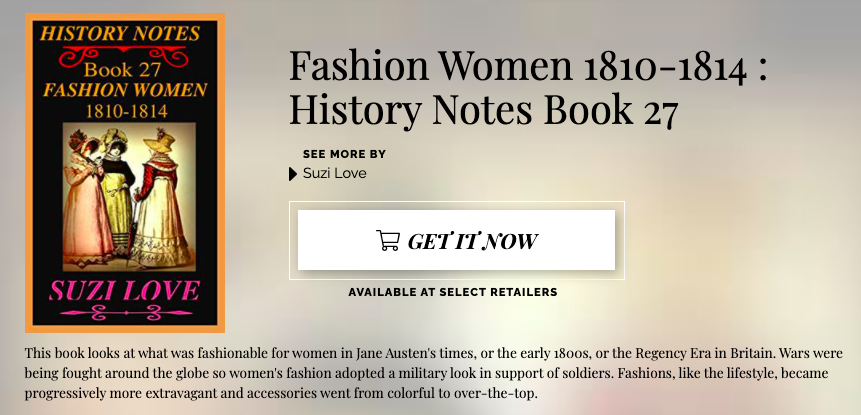
The British Regency was the period from 1811-1820. King George III was deemed mad and unfit to rule so his son became his proxy, the Prince Regent, or Prinny to his close friends. This was the situation when Jane Austen was alive. The Regency Era was famous for its beautiful clothing as well as the magnificent buildings erected and furnished in the ‘Regency Style’ under orders from the extravagant Prince Regent.


“Laugh as much as you choose, but you will not laugh me out of my opinion.” Jane Austen Pride and Prejudice Quote. (1813) #JaneAusten #Quote


Corsets 1880-1900 History Notes Book 20. This book shows how a fashionable silhouette became of paramount importance and how a well-fitted corset became a fashion essential. As well as a decorative fashion item, tight lacing gave a narrow waist and the desired feminine form under clothing.
https://books2read.com/SuziLoveCorsetBook20


Quote Jane Austen: “Dress is at all times a frivolous distinction, and excessive solicitude about it often destroys its own aim.” Northanger Abbey (1817) #JaneAusten #Quote #RegencyEra https://books2read.com/SuziLoveFashionWomen1815-1819
Continue reading →