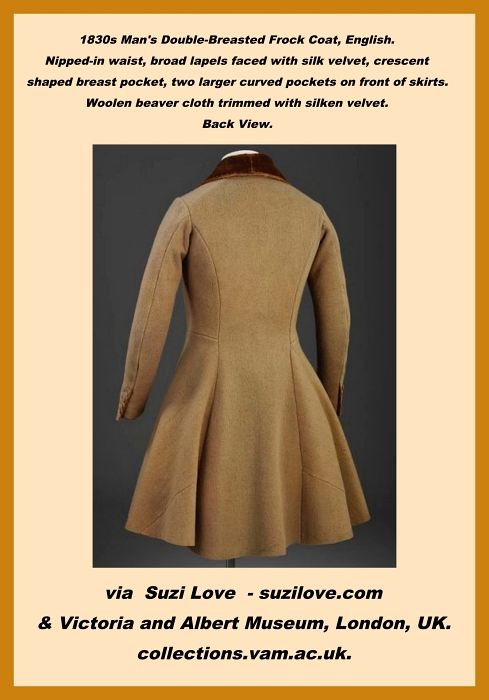
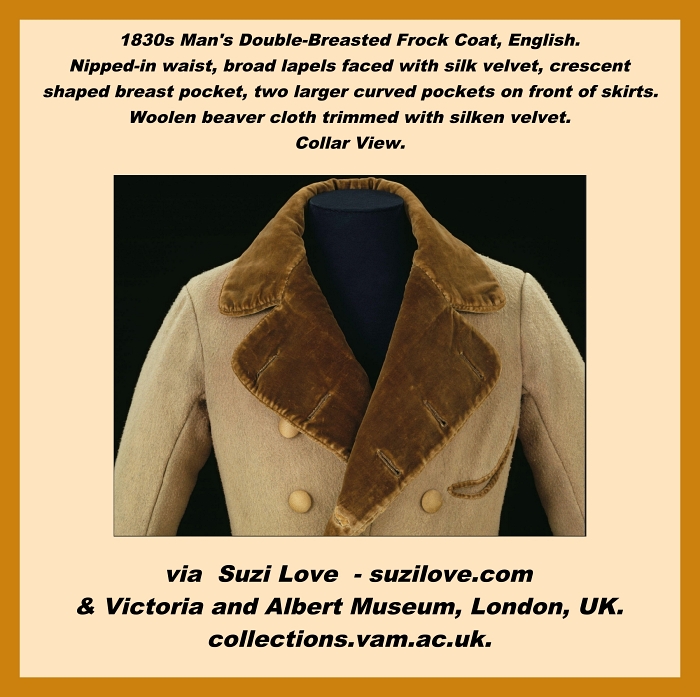
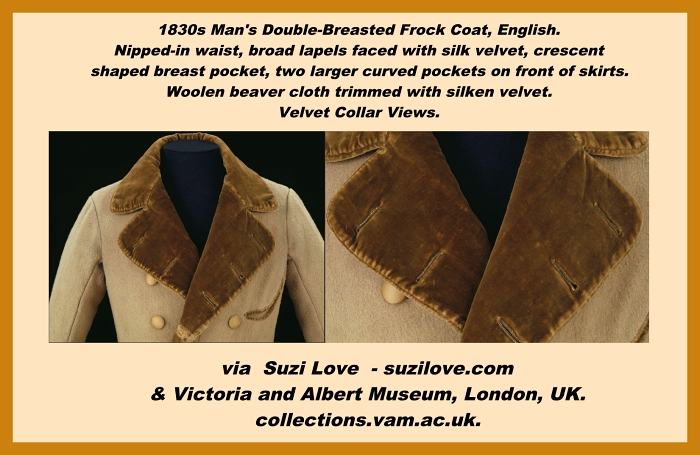
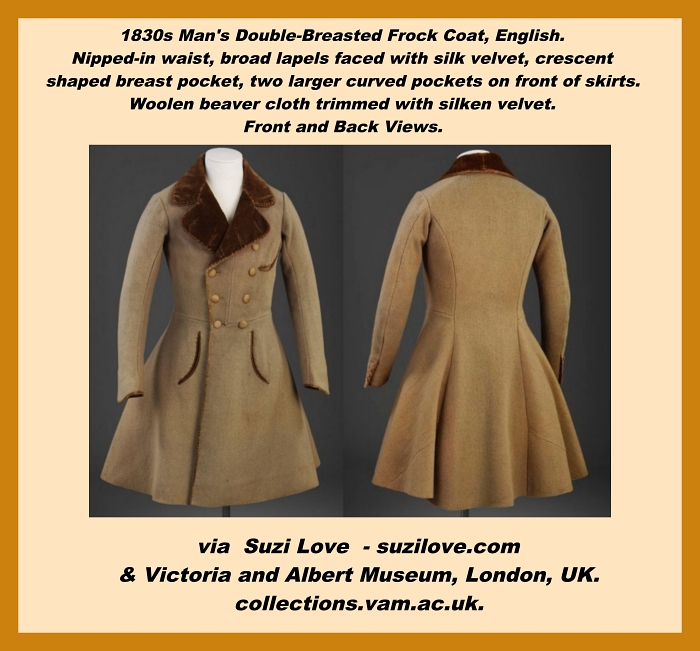
1830s Man’s Double-Breasted Frock Coat, English. Double-breasted frock coat with a nipped-in waist. The broad lapels are faced with silk velvet. This gentleman’s frock coat has a crescent-shaped breast pocket and two larger curved pockets on the front of the skirts. Woolen beaver cloth trimmed with silken velvet.
The waisted frock coat came into fashion in about 1816 and became an enduring style. Typically it had a narrow waist and full skirts hanging vertically in front. The frock coat was worn for everyday purposes such as morning dress, usually with a top hat, cane and trousers. By 1830 frock coats were made in a variety of designs according to taste, fashion or type of activity. This example has an out-breast pocket, a feature which appeared on coats during the 1830s. This coat was given by Messrs Harrods Ltd. Victoria and Albert Museum, London, UK. collections.vam.ac.uk.
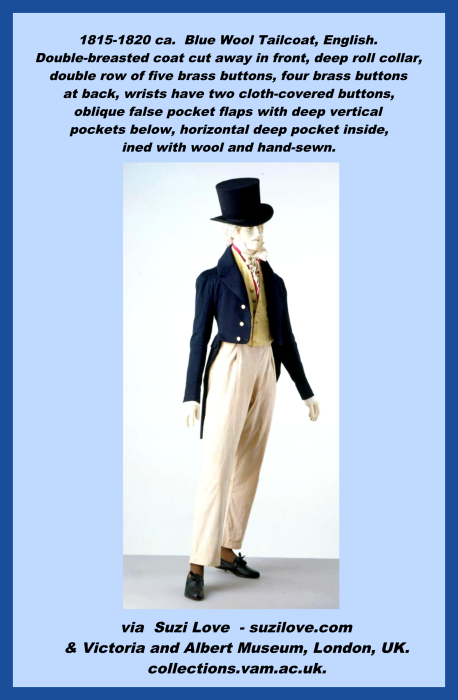
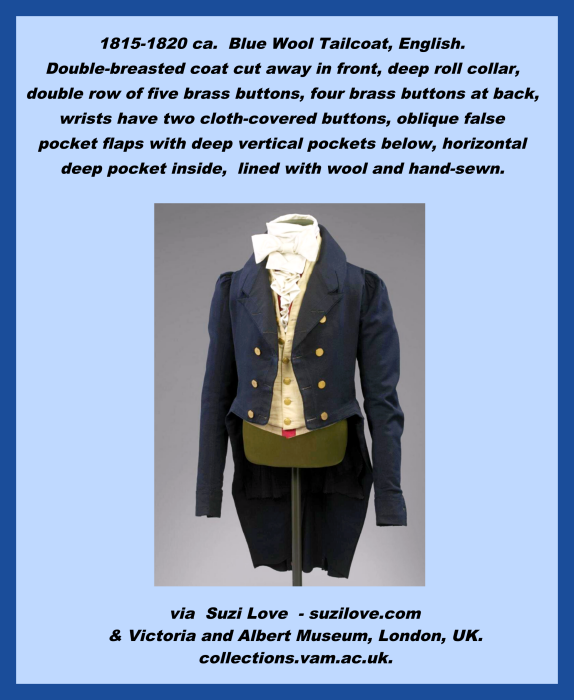
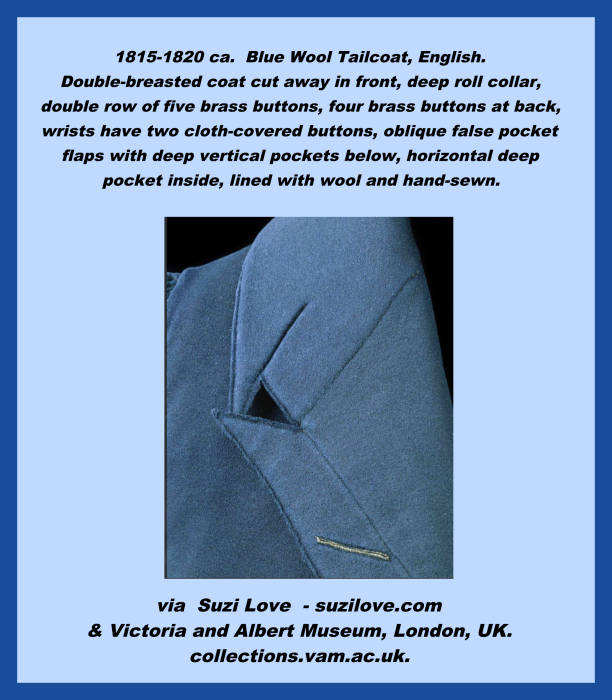
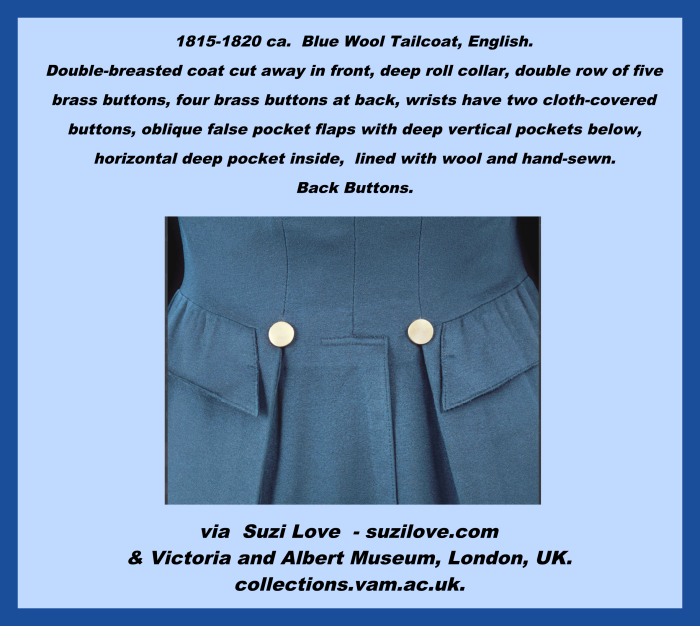
1815-1820 ca. Blue Wool Tailcoat As Worn By Bridgerton Gentlemen and the Men In Jane Austen’s Life.
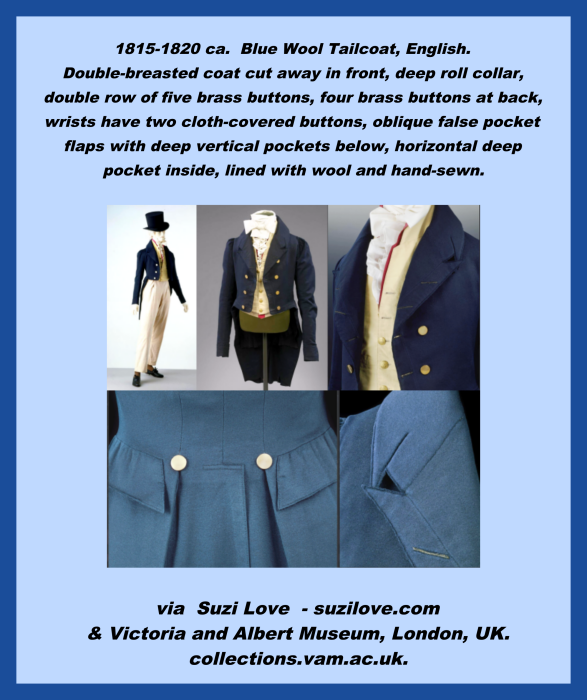
1815-1820 ca. Man’s Blue Wool Tailcoat, English. Chest View. Blue wool, lined with wool, brass buttons, and hand sewn. Double-breasted coat of blue wool, cut away in the front. With a fairly deep roll collar, a double row of five brass buttons, and four further brass buttons at the back. The wrists fasten with two cloth-covered buttons. With oblique false pocket flaps, one on each side, with deep pockets below them entered vertically, and another deep pocket inside entered horizontally. Lined with wool. Hand-sewn. Marks and Inscriptions: ‘Hammond Turner & Sons, Extra Superfine’ (Stamped behind the brass buttons) The cut-away coat remained formal daywear for men until the 1850s. This example has long tight sleeves, puffed at the shoulder, a style typical of the period 1815-1820. The roll collar has an M-shape notch, introduced about 1803, and a waist seam. via Victoria and Albert Museum, London, UK. Given by Lady Osborn.
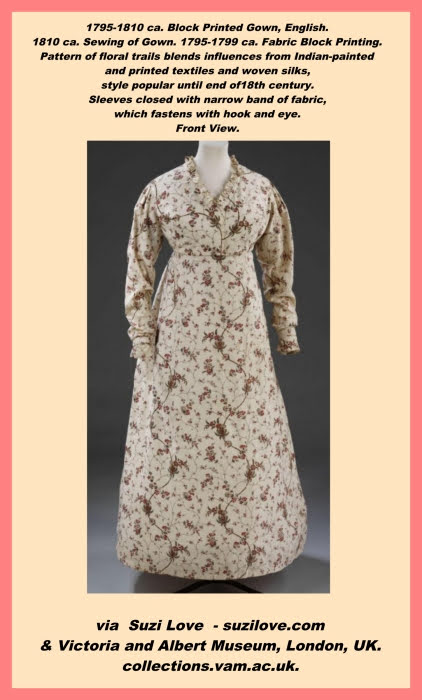
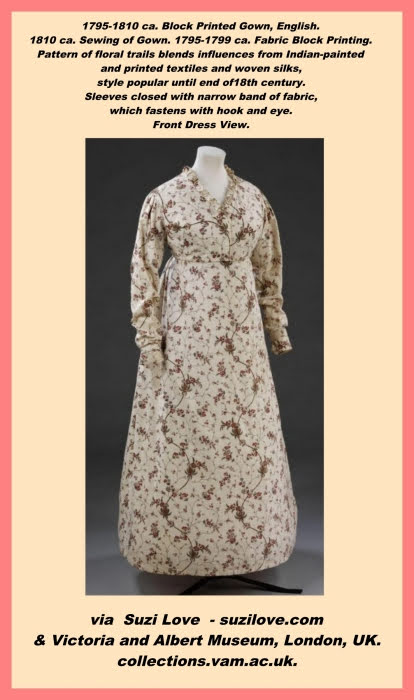
1795-1810 ca. Roller Printed Dress, English. Empire style, high-waisted, roller printed dress with skirt gathered at the back to create a full skirt and with simple V-necked bodice and long sleeves. Sleeves are closed with a narrow band of fabric which fastens with a hook and eye. via Victoria and Albert Museum, London, UK. 1810 ca. Sewing of Gown. 1795-1799 ca. Fabric Block Printing. Pattern of floral trails blends influences from Indian-painted and printed textiles, and woven silks, a style which remained popular until the end of18th century.
The pattern of floral trails seen on the printed fabric of this gown exhibits a blend of influences from Indian-painted and printed textiles, and woven silks, a style which remained popular until the end of the 18th century. The sleeves of this gown are closed with a narrow band of fabric, which fastens with a hook and eye.
The dress is styled with a high-waisted , fitted bodice, which fastens centrally. The neck, which is trimmed with a 1″ frill of matching material, is rounded a the back and V-shaped at the front. The bodice is lined with white cotton which extends 1/3 of the way down the full length tapered sleeves. A trimming decorations is attached to the wrist of the right sleeve (made from the same material and lined with white cotton), which fastens with a metal hook and eye at the hip. The skirt has an ‘apron’ style front with fastening tapes attached to either side, in addition to this there are vertical pocket slits situated at either side of the skirt measuring 11″. The front and rear sides of the skirt are constructed from one width of fabric – 39.5″ wide. The waistline at the back of the skirt is gathered a the centre and is constructed from two pieces of material measuring 46″ wide.
The cotton has blue threads in the selvedges denoting English origin, and is block printed in a polychrome palette with pencilled blue on a white ground. The design consists of an all-over pattern of delicate floral trails of carnations, pinks an other stylised flowers interspersed by vertical arborescent meanders bearing exotic fruits and stylised flowers. The pattern repeat measures 10.5″ by 10″.
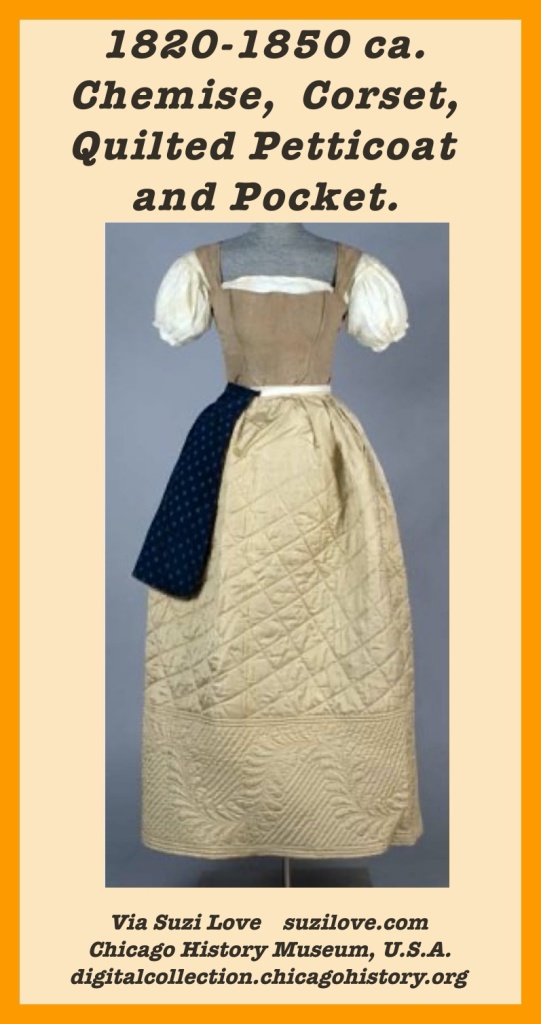
1820-1850 ca. Chemise, Corset, Quilted Petticoat and Pocket. Gift of Mary S. Belden. Corset About 1820-1830 ca. CHS Collection. Pocket About 1820-1840 ca. Chemise About 1839-1850 ca. via Chicago History Museum, U.S.A.
Chemise Or Shift: Sleeveless, mid-calf length garment of white cotton or muslin was worn next to the skin under stays or corset. Called ‘Shift’ from early Georgian (1700-1750) until Late Georgian (1750-1790) to replace ‘Smock’. By 1800, name shift was replaced by ‘Chemise’.
Corset: French term for stays. Structured bust supporting or body shaping foundation garment. Tightened by laces and often with reinforcing e.g. boning, cording and flossing.
From the Curator Victoria and Albert Museum, London: Quilting was a popular form of decoration for a variety of garments including pockets. However, hand-quilting was a time-consuming method of decoration. The increased demand for quilted petticoats, waistcoats and pockets led to the invention of woven quilting.
1840s Opera Boots, British. Black leather with suede leg and silk bow, hand and machine sewn. via Victoria and Albert Museum, London, UK. collections.vam.ac.uk.
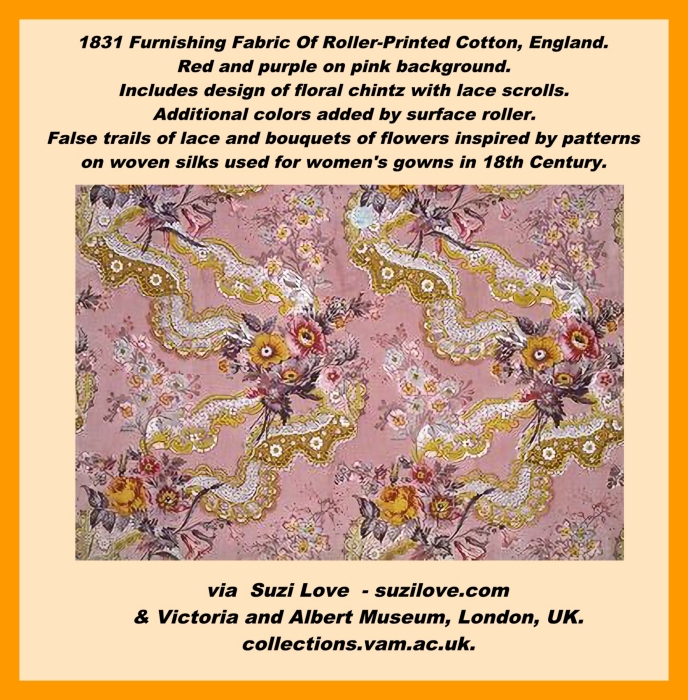
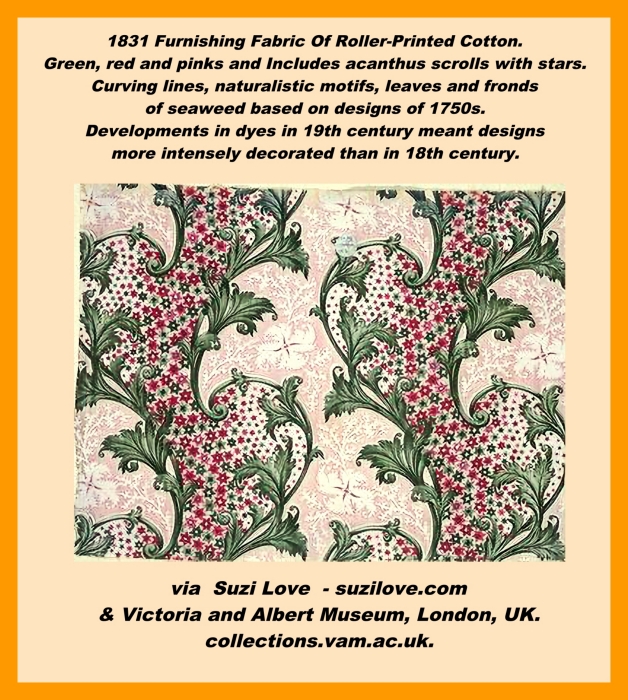
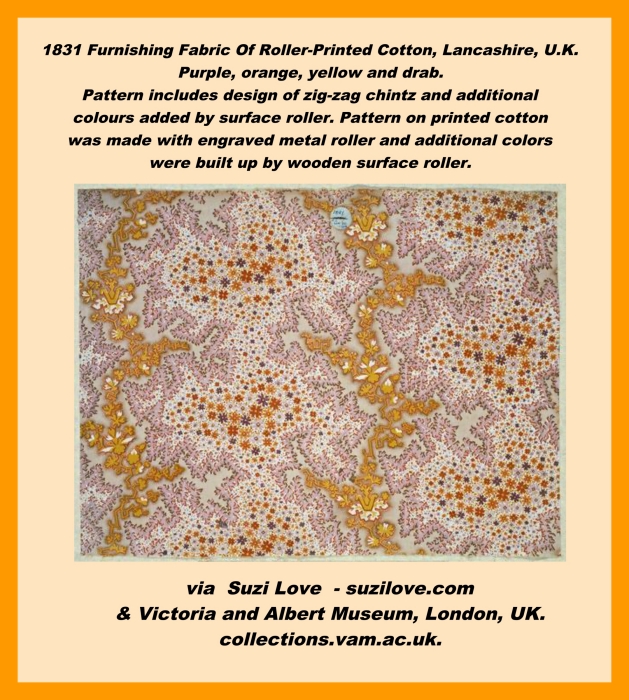
Between 1820 and 1840 textile printers began to produce designs that were based on the woven silk dress fabrics of the 1750’s. Designs showing curving trails of lace or ribbons between bouquets of flowers became as popular in the 1830s as they had been in the 18th century.
Roller Printed Cotton.
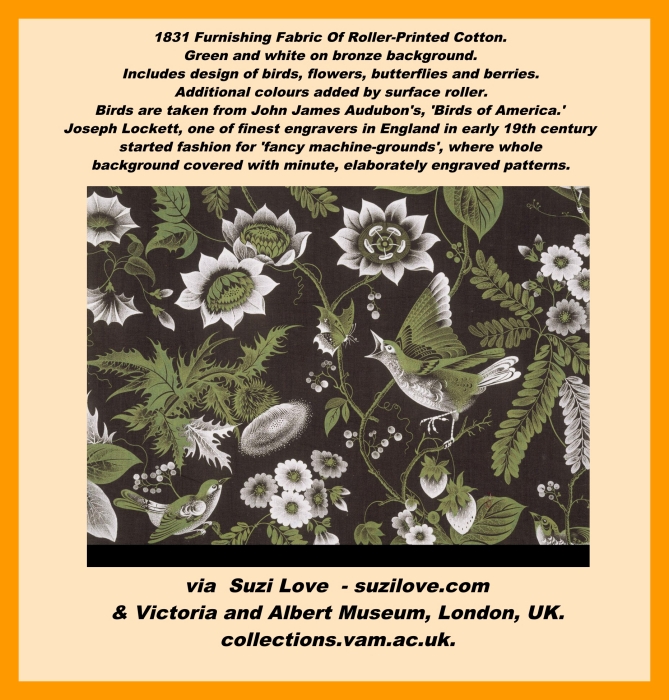
The pattern on printed cotton was made with an engraved metal roller and additional colors were built up by wooden surface roller. Roller printing on textiles was introduced in the late 18th century and at first used mainly for small-patterned dress fabrics. By the 1830s, roller printing was highly mechanized process and had largely replaced block printing for fashionable furnishings.
Materials and Making The development of roller printing coincided with a radical transformation in the dyestuffs available for printing on cotton. Until the beginning of the 19th century printing had been based on the use of vegetable dyes. In Britain, France and Germany new chemical processes were developed and mineral colors produced that transformed the palette of colors available to the printer and made combinations such as shades of pink and orange possible.
Design and Designing The false trails of lace and bouquets of flowers in the fabric are inspired by the patterns of woven silks from nearly a century earlier. Changing taste made this design suitable for furnishing a room in the 1830s, while the 18th-century silk that was its inspiration would have been intended for a woman’s gown.
Time The styles considered fashionable in 1830s furnishings were widely diverse. Among the more recognisable historical references were Rococo, Elizabethan and Gothic. A design such as this seems to be relying on novelty of effect for its success.
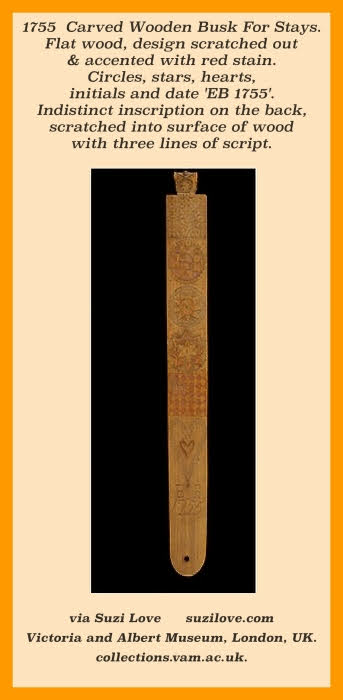
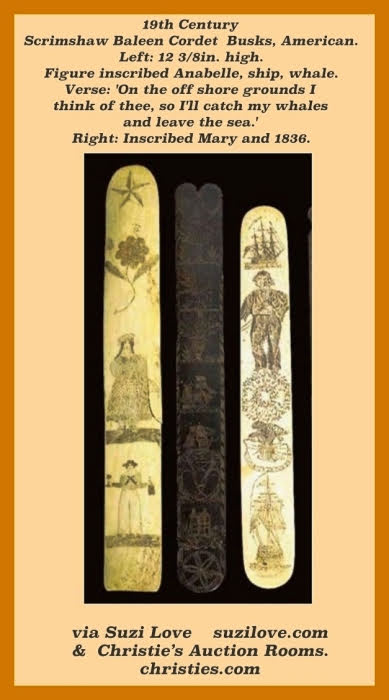
Busks shaped and reinforced the centre front of stays, or corsets. They were made from whalebone, wood, and bone, and were often inscribed with names, dates, and symbols of love because they were positioned close to the heart. The corsets worn in Jane Austen’s later years and by women in Bridgerton times often had busks to stiffen the corset and support the breasts.
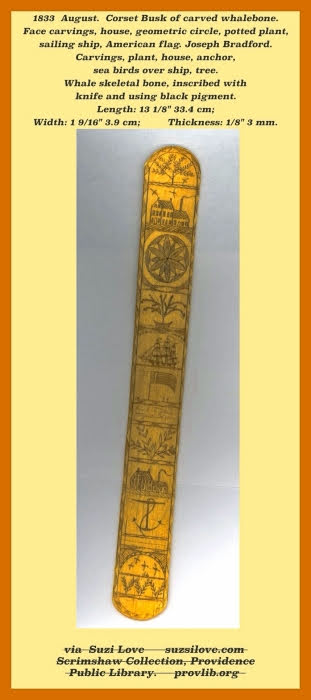
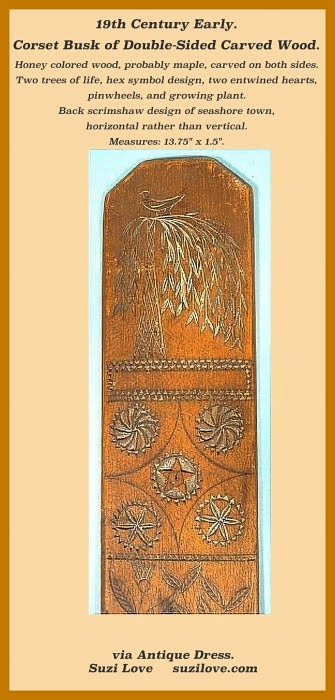
1755 Wooden Busk For Stays, English. Flat piece of wood with design scratched or picked out, and accented with red stain. Design comprises of circles, stylized geometric stars, heart motifs, and the initials and date ‘EB 1755’. Indistinct inscription on the back, scratched into the surface of the wood with three lines of script.1800-1840 ca. Scrimshaw Corset Busk, American. Designs are of a ship and the places the sailor visited. Sailors made these as gifts to be worn close to the heart by their loved ones. Dimensions (inches) 12.5 (L) , 1.3 (W). Dimensions (centimeters). 31.7 (L) , 3.3 (W) via Winterthur Museum Collection.19th Century. Scrimshaw Baleen Corset Busks, American. The first with figure inscribed Annabelle, ship, whale, and verse On the off shore grounds I think of thee, so I’ll catch my whales and leave the sea; the second inscribed Mary and 1836 12 3/8in. high the longest. via Christie’s Auction Rooms. 1833 August. Corset Busk of carved whalebone. Face carvings, house, geometric circle, potted plant, sailing ship, American flag. Joseph Bradford. Carvings, plant, house, anchor, sea birds over ship, tree. Whale skeletal bone, inscribed with knife and using black pigment. Length: 13 1/8″ 33.4 cm; Width: 1 9/16″ 3.9 cm; Thickness: 1/8″ 3 mm.Busks shaped and reinforced front of corsets. Made from whalebone, wood and bone. Often inscribed with names, dates and symbols of love because they were positioned close to the heart. Via Hereford Museum. 1771 Wooden Corset Busk, American. Carved Maple wood. Via Winterthur Museum. 19th Century Early. Corset Busk of Double-Sided Carved Wood. Honey colored wood, probably maple, carved on both sides. Two trees of life, hex symbol design, two entwined hearts, pinwheels, and growing plant. Back has delicate scrimshaw-look design of seashore town, chapel, homes, lighthouse and ships, horizontal rather than front vertical. Measures: 13.75″ x 1.5″. via Antique Dress.18th Century Wooden Busk for Stays, European. Via metmuseum.org18th Century Late – 19th Early Carved Maple Wood Busk, American. Spirals top & bottom, two hearts meet at center, “PC” carved on reverse. Worn by member of Robbins family, inherited by Ellen A. Stone. Via Fine Arts Museum Of Boston, USA.
1750-155 ca. Writing Cabinet, Probably by Michael Kimmel, Germany. Veneered in kingwood, marquetry of mother-of-pearl, ivory and brass on pine, stained alder or birch. Mounted in gilt brass and with giltwood, carving of cypher of Augustus III. via suzilove.com Victoria and Albert Museum, London, UK. collections.vam.ac.uk.
HN_13_D2D_WritingTools Book 13 What did the lady of the house use to pen notes? What sat on the desk of the man of the house when managing his accounts? #History #Nonfiction #travel books2read.com/SuziLoveWritingTools
18th Century Late. Inkstand, Sheffield, England. Square, resting on four ball feet, the top pierced with four circular holes into which fit two inkwells, a pounce box and a box for wafers. Silver inkstands appeared in Britain in 17th century and included pot, or well, for ink, plus another pot with pierced cover held ‘pounce’ or sand, which writers scattered over paper to fix ink. Wafers to seal finished letter and tray to hold pens or quills. collections.vam.ac.uk