1845-1865 ca. Black Faille Evening Slippers, French. Designed By Melnotte for Department Store J. Petit. Black slippers, which went with anything, were an essential for mid 1800s fashionable ladies. Generally made of satin so dull faille fabric is unusual so possibly for mourning. Label written largely in French of London shop, exclusive agent, plus other fashionable imported Parisian accessories. via Metropolitan Museum, NYC, U.S.A. metmuseum.org
1800-1810 ca. Flat Silk Slippers With Ankle Ties Worn By Empress Josephine Bonaparte and As Worn By Jane Austen And friends. #Regency #Shoes #JaneAusten #France
Shoes in the early 1800s were flat or low heeled and occasionally decorated with a bow or floral embellishments and it wasn’t until the 1820s that square, rather than rounded or pointed toes became fashionable. Made of soft kid or cloth, these delicate shoes were flimsy and wore out quickly. There was often no difference between a left or right shoe, so when one slipper had a hole it was easily replaced. Slippers were often bought in multiples at a time so there were spares.
1817 White Percale Dress, French. Dress has layers of decoration above hem, black velvet Spencer, or jacket, wide brimmed straw hat trimmed in blue, neck scarf and walking shoes. Fashion Plate via Journal des Dames et des Modes, or Costume Parisien.
Definition Spencers: Short jackets worn for warmth over the high-waisted Empire style gowns said to have originated when Earl Spencer tore the tails off his coat in a hunting accident. In support of military men fighting wars everywhere, fashions for Spencers leaned towards military style embellishments, such as loops, buttons, and braids. Puffed sleeves over long straight sleeves were also very popular. Jane Austen and her friends and family wore Spencers over their high-waisted dresses.
Definition Empire Style Dress: Named after the First Empire in France. Empire dresses had a low neckline and skirts started directly under the bust and flowed into the classical relaxed wide styles of Greece and Rome. This style of dress is associated with Jane Austen and her contemporaries as a high-waisted dress was worn most days. Cotton, silk or taffeta were the popular fabrics. Only the very wealthy could afford white dress in this style as the cottons were imported from India and had to be carefully cleaned, usually by a lady’s maid.
Fashion Women 1815-1819 History Notes Book 28 https://books2read.com/SuziLoveFashionWomen1815-1819
1815 July Seaside Walking Dress. A high dress, of short walking length, made of French cambric or jaconot muslin, trimmed at the feet with treble flounces of French work, gathered into a rich bead heading, and laid upon the dress, at a suitable distance, one above the other, the body made with open fronts, worn with a full ruff of the French work, corresponding to the trimming at the feet; a long sleeve, drawn alternately across the arm, terminates with a broad wristband, worn plain over the hand. French bonnet of white satin, edged and tied under the chin with satin ribbon of celestial blue; ornamented with a rich plume of white feathers, edged to correspond. French mantle of the twilled silk en suite, richly embroidered at the ends in shaded silks, composing roses or lilies of the valley. Patent silk stockings. Slippers, or half-boots, or blue kid, or primrose colour. Gloves to correspond.
The bodies of the morning and promenade costume continue to be worn with cross or handkerchief fronts, and are generally trimmed, agreeably to the texture of the dress, with quilled tull or ribbon. The quilled ribbon is also predominant in single rows at the feet of all dresses composed of silk, bombazeen, or fancy prints. The prevailing colours are primrose, celestial blue, and evening primrose; the waist short, and the fullness of the petticoat carried to the back. Ruffs of French work are universally worn, except in full dress. The length of the petticoat continues not to exceed meeting the top of the boot and the color of the latter corresponds with the glove, mantle, and trimming of the bonnet.
via Rudolph Ackermann’s ‘The Repository of Arts’.
Fashion Women 1815-1819 History Notes Book 28 https://books2read.com/SuziLoveFashionWomen1815-1819
1809 September. Garden Promenade Dresses. Empire style gowns, shawls, hats, and parasols for walking in the park, to see and be seen, in London or at fashionable resorts. More elegant than walking dresses, which are usually morning dresses with outerwear and more elaborate headdresses. These are the sort of ensembles that Jane Austen and her family and friends would have gone walking in. Foreground lady has a silk shawl mantelet trimmed with an amber silk fringe and fastened on the bosom with a pebble brooch, amber hoop earrings, white Morocco leather shoes, York tan gloves and a blue parasol with a fringe. Straw hat with flowers. Background lady wears a Nun’s hood that falls over her shoulders and holds a purple parasol. Fashion Plate via John Belle’s La Belle Assemblée or, Bell’s Court and Fashionable Magazine, London.
Fashion Women 1805-1809 History Notes Book 26 What did Jane Austen and friends wear? https://books2read.com/SuziLoveFashionWomen1805-1809
1808 Gentleman’s Ball Outfit, French. Long tailcoat, black knee breeches, white stockings, high white cravat, white stockings, black shoes and gloves. Fashion Plate via Journal des Dames et des Modes, or Costume Parisien. Typical Gentleman’s outfit as worn by men to balls and evening events in Jane Austen’s Times.
From the finish of the 18th century until 1820, men’s fashions in European and European-influenced countries moved away from the formal wear of brocades, lace, wigs and powder to more informal and relaxed styles. Focus was on undress rather than formal dress. Typical menswear in the early 1800s included a tailcoat, a vest or waistcoat, either breeches, pants, or the newer trousers, stockings, shoes or boots, all worn with an overcoat and hat. This basic ensemble was accessorized with some form of neckcloth or cravat, gloves, walking stick, cane or riding crop, handkerchief, fobs, watch and perhaps a quizzing glass or eye glass.
Skirted coats were replaced with short-fronted, or cutaway, tailcoats worn over fitted waistcoats and plain, white linen shirts. Knee breeches were gradually replaced by tight-fitting pantaloons and later trousers, decorative shoes with buckles were replaced with a variety of boot styles, and fussy and ruffled neckwear gave way to intricately tied, white linen neck cloths. A Regency Era, or early 1800s, gentleman was outfitted in more practical fabrics, such as wool, cotton and buckskin rather than the fussy brocades and silks of the late 1700s.
1805-1810 ca. Blue Silk Slippers With Silk Bow and Ribbon Ankle Ties. Woven square pattern and round toes. via Manchester City Galleries, UK.
Shoes in the early 1800s were flat or low heeled and occasionally decorated with a bow or floral embellishments and it wasn’t until the 1820s that square, rather than rounded or pointed toes became fashionable. Made of silk, soft kid or cloth, these delicate shoes were flimsy and wore out quickly. There was often no difference between a left or right shoe, so when one slipper had a hole it was easily replaced. Slippers were often bought in multiples at a time so there were spares.
Fashion Women 1805-1809 History Notes Book 26 What did Jane Austen and friends wear? https://books2read.com/SuziLoveFashionWomen1805-1809
1807 June Couple In Morning Dress, English. Lady in white dress with lemon cape and an interesting white hat with a tassel. Gentleman in black tailcoat, white shirt and cravat, breeches tucked into high black boots with tan tops, fob and watch chain at his waist, black top hat and cane. via Le Beau Monde, or Literary and Fashionable Magazine, London, U.K.
Definition Morning Dress: Comfortable outfits worn either at home, out shopping, or for walking in the park or country. Presentable but not overly accessorized. For women it was often an Empire style, high-waisted, gown made from sprigged or plain muslin, cotton, or wool and either a Spencer or a coat to cover it for warmth, plus shoes and a bonnet. For men it was breeches or trousers, shirt, cravat, coat, boots and hat. This couple is dressed as a lady and gentleman of Jane Austen’s acquaintance would dress for a morning outing to a village, for shopping, or visiting friends.
Fashion Women 1805-1809 History Notes Book 26
What did Jane Austen and friends wear? This book looks at early 1800s fashions, which were elegant and pretty with high waists and fabrics that were almost transparent. These Empire style gowns, named after Napoleon’s first Empress, became popular throughout Europe, and were then copied around the world. Colorful outwear was added to make an ensemble more attractive and warmer.
https://books2read.com/SuziLoveFashionWomen1805-1809
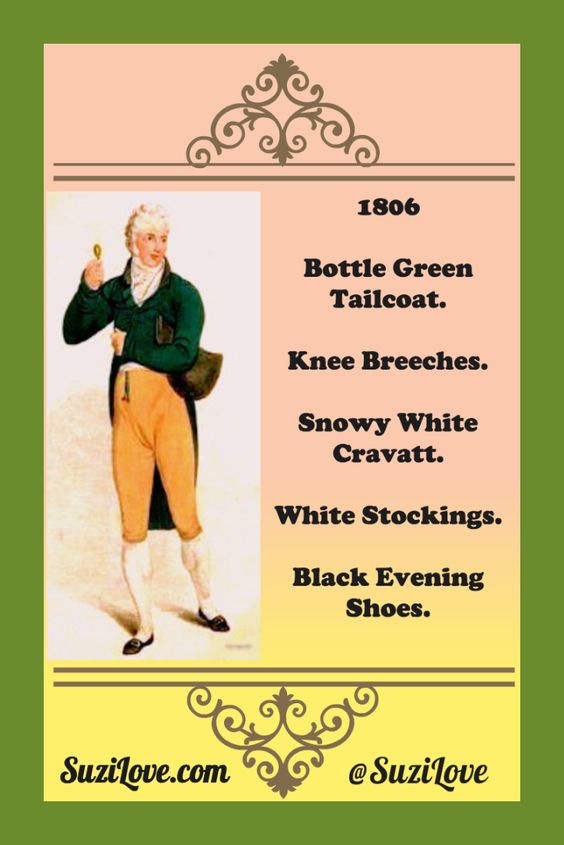
1806 Gentleman’s Daily Outfit, French. Bottle green tailcoat, knee breeches, snowy white cravat, white stockings, flat black shoes. Fashion Plate via Journal des Dames et des Modes, or Costume Parisien. French fashions and Georgian and Regency Era fashions from Great Britain were copied around the world. This is the normal daily outfit for a gentleman in the early 1800s, or in the times of Jane Austen, for daily city and country life. https://books2read.com/SuziLoveFashionMen1800-1819
1817 September Glengary Riding Habit, English, as would have been worn during Bridgerton and Jane Austen’s times. Pale blue cloth, richly ornamented with frogs and braiding, front braided on each side and fastens under the body of the habit, which slopes down on each side to define the figure. Epaulettes and jacket are braided to correspond with the front as is the bottom of the sleeve which is braided nearly half-way up the arm. Habit shirt is of cambric with a high standing collar and trimmed with lace. Cravat of soft muslin is richly worked at ends, tied in a bow, narrow lace ruffles at the wrists. Headdress is a Glengary cap of blue satin, trimmed with plaited ribbon of various shades of blue and a plume of feathers. Blue kid gloves are worn and half-boots. Fashion Plate via Rudolph Ackermann’s ‘The Repository of Arts’.
Male tailors made most women’s riding habits during the Regency years and they were constructed similarly to men’s riding outfits. Generally in two pieces, a jacket and a skirt, and with a shirt with a frilled collar or front opening underneath. The trains of a habit could be caught up for walking, usually with a button and loop, and unhooked and let down so that the skirt flowed over the woman’s legs when she rode side saddle. Due to the numerous wars during the early 1800s, it was seen as patriotic for women to add military style touches to outfits in support of military men. The shoulder and cuff trims resemble the epaulettes and coat trims of a military uniform.
1817 September Glengary Riding Habit, English. Pale blue cloth, richly ornamented with frogs and braiding, front braided on each side and fastens under the body of the habit, which slopes down on each side to define the figure. Headdress is a Glengary cap of blue satin, trimmed with plaited ribbon of various shades of blue and a plume of feathers. Blue kid gloves are worn and half-boots. Fashion Plate via Rudolph Ackermann’s ‘The Repository of Arts’. Fashion Women 1815-1819 History Notes Book 28 https://books2read.com/SuziLoveFashionWomen1815-1819