1814 Couple In Walking Ensembles, French. Gentleman in a brown tailcoat with a notched collar and back pockets, vest, white breeches tied under his knees, red fob at the waist, white stockings, high white shirt collar, white cravat, top hat and cane. Lady in adorable pink Redingote with capes.
1818-1823 ca. Turban, London, U.K. Silk, silk thread, paper, cotton, wire,and hand-sewn. Cap is gathered and full to mimic the shape of a turban which became popular evening wear around 1820 when ‘exotic’ was fashionable.
Silk, silk thread, paper, cotton, wire and hand-sewn. A full cap of white satin gathered into a headband in imitation of a turban. The crown is inset with white net embroidered in circles with white silk thread. The headband is of white satin with three horizontal tucks and edged with white silk plush. Trimmed on one side with artificial flowers made of wired green paper leaves and white muslin rosebuds. via Victoria and Albert Museum, London, U.K.
Early 19th-century etiquette required a lady’s head to be covered at all times, even with evening dress. A cap such as this one, gathered and full to suggest the shape of a turban, was popular for evening wear about 1820. The Romantic movement created an interest in the dress of non-European countries, particularly North Africa and the Middle East. Decorative motifs and accessories were borrowed to make current fashions more ‘exotic’. Although knowledge of the proper proportions and construction of a turban was not available to British milliners, the overall shape was approximated for the most fashionable headwear.
Fashion Women 1815-1819 History Notes Book 28 https://books2read.com/SuziLoveFashionWomen1815-1819
1810-1820 ca. Pantaloons, Probably Military, British. The type of pants worn by men in Jane Austen’s times when wars were being fought all over the world, especially in Europe. Machine-knitted white cotton decorated with cream silk braid on sides and fronts as seen on Hussar uniforms. Cut to fit the leg and button bottom at waist with three buttons. Front fall buttons over five buttoned fly, two horizontal pockets at front below waistband and fob pocket in waistband. Four metal buttons for braces, two front and two back. Cotton ‘puff’ centre back waist and two linen tapes for waist adjustment. via Victoria and Albert Museum, London, UK. collections.vam.ac.uk.
Pair of men’s pantaloon trousers made of machine-knitted white cotton and decorated with cream silk braid applied down the sides and on the fronts. This imitates the hussar uniforms of the period and appeared on fashionable men’s dress. The pantaloons are cut to fit the leg and button at the bottom with three buttons. The pantaloons fasten at the front with front falls buttoning over a five buttoned fly. There are two horizontal pockets at the front below the waistband and a fob pocket in the waistband. There are four metal buttons for braces, two at the front and two at the back. These probably are original. There is a cotton ‘puff’ at the centre back waist and two linen tapes for waist adjustment.
Pantaloons also brought the glamour of military uniform into men’s fashionable dress, especially when teamed with Hessian boots. Uniforms worn by the various armies during the Napoleonic Wars (1793-1815) were often very colourful and lavishly adorned with braid and tassels. It is hardly surprising that some of these attractive trimmings should have infiltrated fashion, particularly when nationalistic feelings ran high. Civilian pantaloons were often ornamented with military-style braid that was applied in a vertical band of topside Russia braiding. They were not, however, generally decorated on the front, which suggests that this pair was for military use. The silk braid is applied in the form of an Austrian knot, which was a popular motif on pantaloons of the light cavalry such as the hussars and light dragoons.
HN_23_D2D_Fashion Men 1800-1819. https://books2read.com/SuziLoveFashionMen1800-1819
1815 May. Walking Dress, or Pelisse, or Redingote, English. Purple walking dress with wide collar, high white lace neck frill, and white trim down the vertical opening, white reticule, and a high white plumed hat. Fashion Plate via Rudolph Ackermann’s ‘The Repository of Arts’. Google Books (PD-180) suzilove.com Fashion Plate via Rudolph Ackermann’s ‘The Repository of Arts’.
Definition: Walking Dress Or Pelisse Or Redingote Woman’s long, fitted coat often worn open in front to show off the dress underneath. Walking Dress Or Pelisse are the terms used in English fashion plates, while Redingote is seen in European fashion plates, especially the French one, Journal des Dames et des Modes, or Costume Parisien.
Fashion Women 1815-1819 History Notes Book 28 https://books2read.com/SuziLoveFashionWomen1815-1819
1775-1825 ca. Bridgerton and Jane Austen Style Black Silk Breeches, American or European. #Bridgerton #JaneAusten #GeorgianEra #RegencyFashion books2read.com/SuziLoveFashionMen1800-1819
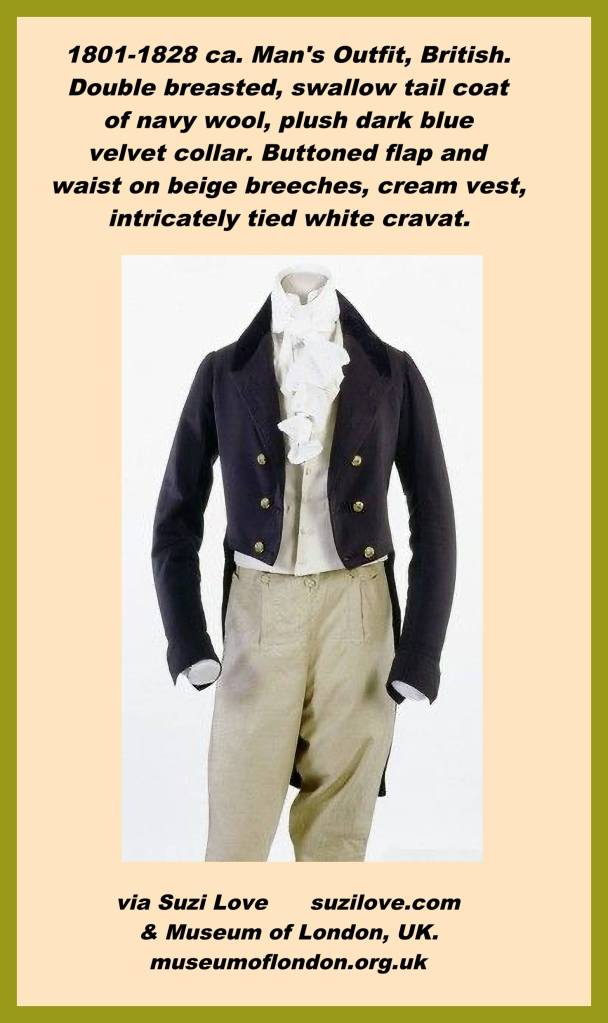
1801-1828 ca. Man’s Outfit, British. Double breasted, swallow tailcoat of navy wool, plush dark blue velvet collar. Buttoned flap and waist beige breeches, cream vest, intricately tied white cravat. via museumoflondon.com
In the early 1800s, men no longer wore complicated styles and extravagant fabrics. Men’s fashion simplified and became more conservative. A well cut tailcoat, vest, pantaloons and an immaculate cravat of beautiful white linen in the style of George Bryan, or Beau, Brummell. Clothes were a status symbol and indicated a man’s social position. These clothing items were the sort worn by Jane Austen’s male family and friends.
From the finish of the 18th century until 1820, men’s fashions in European and European-influenced countries moved away from the formal wear of brocades, lace, wigs and powder to more informal and relaxed styles. Focus was on undress rather than formal dress. Typical menswear in the early 1800s included a tailcoat, a vest or waistcoat, either breeches, pants, or the newer trousers, stockings, shoes or boots, all worn with an overcoat and hat. This basic ensemble was accessorized with some form of neckcloth or cravat, gloves, walking stick, cane or riding crop, handkerchief, fobs, watch and perhaps a quizzing glass or eye glass.
Skirted coats were replaced with short-fronted, or cutaway, tailcoats worn over fitted waistcoats and plain, white linen shirts. Knee breeches were gradually replaced by tight-fitting pantaloons and later trousers, decorative shoes with buckles were replaced with a variety of boot styles, and fussy and ruffled neckwear gave way to intricately tied, white linen neck cloths. A Regency Era, or early 1800s, gentleman was outfitted in more practical fabrics, such as wool, cotton and buckskin rather than the fussy brocades and silks of the late 1700s.
19th Century Early Jane Austen and Bridgerton Style Gold Silk Spencer With Puffed Shoulder. With V-shaped rouleaux trim to the bodice and puffed shoulder detail. via Christie’s Auction Rooms. christies.com
HN_4_Spencers Or Regency Jackets.
books2read.com/suziloveSpencers
1805-1815 ca. Capote, Or Bonnet, Netherlands. Black quilted bonnet with black ribbon chin ties. Jane Austen and her family and friends would have worn this style of bonnet. via Rijks Museum, Amsterdam, Netherlands. rijksmuseum.nl
Fashion Women 1805-1809 History Notes Book 26
What did Jane Austen and friends wear? This book looks at early 1800s fashions, which were elegant and pretty with high waists and fabrics that were almost transparent. These Empire style gowns, named after Napoleon’s first Empress, became popular throughout Europe, and were then copied around the world. Colorful outwear was added to make an ensemble more attractive and warmer.
https://books2read.com/SuziLoveFashionWomen1805-1809
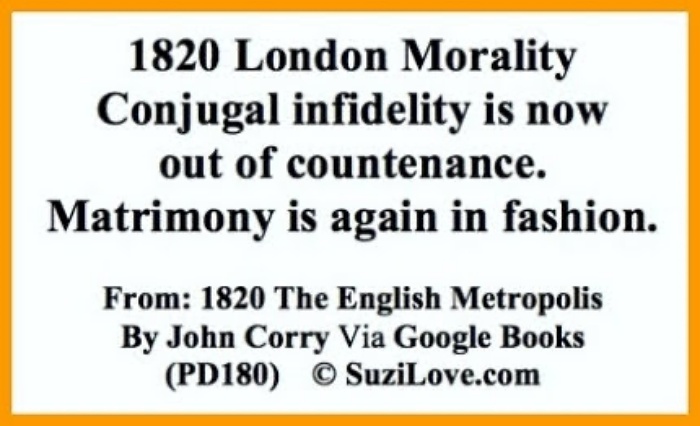
Regency London 1820 The English Metropolis By John Corry Via Google Books (PD-180)
This great metropolis is sixty miles distant from the sea; it is built on the banks of the river Thames; is about seven miles in length, from east to west, but of an irregular breadth, being in some parts two miles, in others three, and at the broadest part four miles. Its three distinct and municipal divisions are, the city of London, the city of Westminster, and the borough of Southwark, which, with their extensive suburbs, cover a space of more than twenty miles in circumference. According to the Population Return of 1811, this metropolis then contained 149,430 houses, including those building and uninhabited; and since that period there have been but few new houses built, so that the real number is probably not more than 150,000.
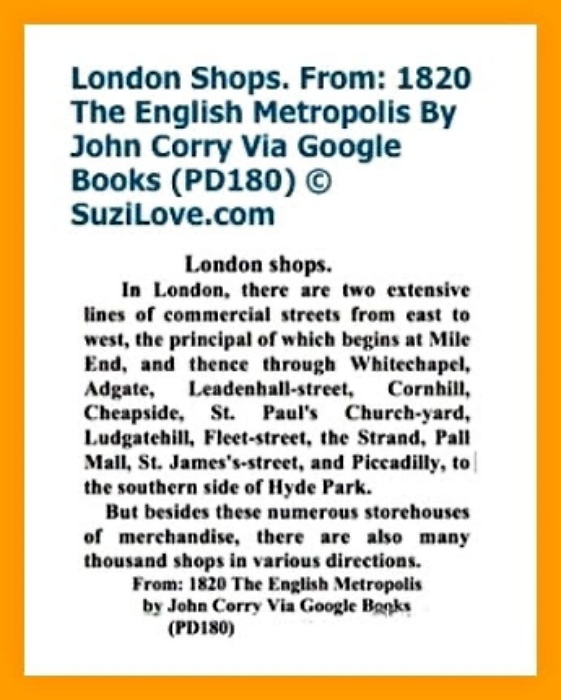
In the year 1801, the population of London was ascertained to be 900,000. The number in 1811, amounted to 1,009,546. Beneath the pavement large arched sewers communicate with the houses by smaller ones, with the street by small openings covered with iron grating, and with the Thames, which contributes much to the cleanliness and health of the inhabitants of this populous place. Houses on each side of these streets are lofty, spacious, and commodious, generally four stories high, and chiefly occupied by tradesmen, whose shops present the most beautiful and perfect productions of nature and art for the general accommodation of man, There are two extensive lines of commercial streets from east to west, the principal of which begins at Mile End, and thence through Whitechapel, Aldgate,Leadenhall-street, Cornhill, Cheapside, St. Paul’s Church-yard,Ludgatehill, Fleet-street, the Strand, Pall Mall, St. James’s-street, and’ Piccadilly, to the southern side of Hyde Park. But besides these numerous storehouses of merchandise, there are also many thousand shops in various directions. Ample supplies of water afforded by the Thames And New River Water-works, are essentially conducive to the health and comfort of the inhabitants.
St. Paul’s Church is the most magnificent. It is situated near the northern bank of the Thames, and when viewed from Blackfriar’s Bridge in the vicinity, presents one of the noblest ornaments of superb architecture ever beheld by the human eye. This beautiful cathedral is built of Portland stone, in the form of a. cross, adorned in the central part by a lofty dome, on the summit of which is a light and elegant lantern, ornamented with Corinthian columns, and surrounded by a balcony. Next to St. Paul’s cathedral for magnificence, and even greater in extent, is that fine monument of gothic architecture Westminster Abbey, or the collegiate church of St. Peter.Among the modern churches that of St. Mary-le-Bone is remarkable for a spacious and stately portico composed of eight columns and two pilasters of Portland stone, in the Corinthian order. This church is built north and south, and the northern front, which is opposite the Regent’s Park.
The Tower of London, which has been the scene of many a tragic and affecting event, is the only fortress in the city. It is situated on the northern bank of the Thames, eastward of London Bridge, contains the Jewel Office, Mint, three armouries, and the royal train of artillery. The menagerie, near the west entrance, has for ages been a principal object of attraction to rustic visitors, who on their arrival considered it indispensable to see the lions.
1817 White Percale Dress, French. Dress has layers of decoration above hem, black velvet Spencer, or jacket, wide brimmed straw hat trimmed in blue, neck scarf and walking shoes. Fashion Plate via Journal des Dames et des Modes, or Costume Parisien.
Definition Spencers: Short jackets worn for warmth over the high-waisted Empire style gowns said to have originated when Earl Spencer tore the tails off his coat in a hunting accident. In support of military men fighting wars everywhere, fashions for Spencers leaned towards military style embellishments, such as loops, buttons, and braids. Puffed sleeves over long straight sleeves were also very popular. Jane Austen and her friends and family wore Spencers over their high-waisted dresses.
Definition Empire Style Dress: Named after the First Empire in France. Empire dresses had a low neckline and skirts started directly under the bust and flowed into the classical relaxed wide styles of Greece and Rome. This style of dress is associated with Jane Austen and her contemporaries as a high-waisted dress was worn most days. Cotton, silk or taffeta were the popular fabrics. Only the very wealthy could afford white dress in this style as the cottons were imported from India and had to be carefully cleaned, usually by a lady’s maid.
Fashion Women 1815-1819 History Notes Book 28 https://books2read.com/SuziLoveFashionWomen1815-1819