1813 April Carriage Dress, English. Green coat over white Empire style dress of jaconet or cambric muslin, plaited bodice, long sleeve, deep frill, with a vandyke of needle-work. Russian mantle is made of Pomona or spring green sasnet, lined with white satin, trimmed with a rich frog fringe and closed with a cord or tassel. Close-fitting cottage slouch bonnet of the same material and edged with scalloped lace, tied on the left under the chin with ribbon, and decorated with a small cluster of spring flowers. Reticule, or bag, of the sam fabric, slippers of green kid, and gloves of primrose kid. Fashion Plate via Rudolph Ackermann’s ‘The Repository of Arts’.
1860–1870 ca. Pink Silk Bag, Or Reticule, Italian. Two layers of contrasting pink silk with tassels and a drawstring. via Metropolitan Museum New York City, U.S.A. metmuseum.org
Definition Ridicule, Reticule, Indispensable, or Handbag: From the late 1700s, pockets could no longer be sewn into gowns, as skirts fell from just under the bust and were full and flowing. Instead, women began carrying small bags, known at first as ridicules and later as reticules, to keep necessary items on their person e.g. handkerchiefs, coins, vinaigrettes, calling cards, glasses etc. http://books2read.com/suziloveReticules
The term ‘ridicule’ derived from the Latin ‘ridiculum’ and first used in France during the 17th century and meant subjecting something or someone to mockery. As women’s tiny bags were mocked, or ridiculed, for being a useless fashion accessory carried outside when they were first used in the late 1700s, it’s likely this is how the name ‘ridicule’ started. The later term ‘reticule’ derived from the Latin reticulum, meaning ‘netted bag’ and was applied when bags became larger and often made from netting. In the late 1700s and early 1800s, they were also known as indispensables as they carried all the personal items a lady needed upon her person every day. They were easily made by ladies, easy to carry and became an indispensable fashion accessory.
In the early nineteenth century, reticules started to look like future handbags as they were often made from rigid card or molded mâché or card into a variety of shapes. Early bags were circular and with a drawstring but as women wanted their reticules to look individual they could be made with two halves and a hinged metal closure or with concertina sides. Materials varied from silk, cotton and string and shapes were round, hexagonal or lozenge shapes with shell shaped bags becoming very popular during the Regency and Romantic Eras.
1800s magazines were written for well bred women who could read, so they gave plenty of ideas for how ladies could make and embellish reticules for their own use and as pretty gifts. Needlework was highly encouraged as a pastime for a lady so bags were frequently embroidered or decorated with beading. By the 1820s, reticules became more like our modern handbags using soft leather gathered at the top or hard leather with a rigid fastener and metal chain for carrying.
1860–1870 ca. Pink Silk Bag, Or Reticule, Italian. Two layers of contrasting pink silk with tassels and a drawstring. via Suzi Love suzilove.com andMetropolitan Museum New York City, U.S.A. metmuseum.org
HN _3_D2D_RetailerBuyLink_HN_3
Light-hearted look at Young Lady in Jane Austen’s times, or early 1800s. A glimpse into both the frivolous and more serious occupations filling a young lady’s day in the lifetime of Jane Austen, or the Regency Era, or the early 19th Century. Historic images and historical information show her fashions and frolics. https://books2read.com/suziloveYLD
1811 August Walking Dress for a Mother and a child, English. Mother wears a typical Regency or Jane Austen style high round robe with full long sleeve trimmed with Van Dyke lace at the throat and cuffs and ornamented around the bottom with a Tuscan border in needlework. Short capuchin cloak of buff shot sarsenet fastened with broaches on shoulders and trimmed with deep Chinese silk fringe. Moorish turban bonnet gathered into a broach in centre of the forehead. Purple ridicule, or bag, with gold snap and tassels. Buff kid half boots, parasol with deep Indian awning. Child wears a short sleeved Spanish vest and trousers in one, which looks like a skeleton suit, a tight coat or jacket buttoned to a pair of high-waisted trousers. An Indian dimity waistcoat with long sleeves and collar trimmed with a narrow border of muslin, high shoes of purple morocco and a college cap of purple velvet with a crimson band and carries a parasol. via Rudolph Ackermann’s ‘The Repository of Arts’.
Definition Skeleton Suit: Shirt and trousers made as one connecting piece, often buttoned together, and were one of the earliest fashions designs made especially for children and were worn from the 1790s to the 1820s.
What did the Bridgerton ladies and Jane Austen use to carry her personal items? Ridicule, Reticule, Or Handbag? Call them what you like: purses, bags, handbags, reticules, ridicules, clutches, or pocket replacements. They all did the same job and they changed greatly with the prevailing fashions of time. books2read.com/suziloveReticules
Definition Of A Reticule; Bag or purse, often with a drawstring to pull closed and usually made of cloth or covered cardboard and often decorated with beading or embroidery. A reticule, or purse, or handbag, was usually carried by a woman during the Regency period to carry all their daily necessities. Earlier, women used pockets that tied at the waistline and were hidden in the folds of their skirts. Empire style, or early 1800s, high-waisted dresses made it impossible to either sewn in a pocket or to tie on a pocket, so women began carrying small, decorated bags called Reticules, or ridicules, which generally pulled close at the top with a drawstring. These Reticules, or bags, were the forerunners of our modern day purses.
The term ‘ridicule’ derived from the Latin ‘ridiculum’ and first used in France during the 17th century and meant subjecting something or someone to mockery. As women’s tiny bags were mocked, or ridiculed, for being a useless fashion accessory carried outside when they were first used in the late 1700s, it’s likely this is how the name ‘ridicule’ started. The later term ‘reticule’ derived from the Latin reticulum, meaning ‘netted bag’ and was applied when bags became larger and often made from netting. In the late 1700s and early 1800s, they were also known as indispensables as they carried all the personal items a lady needed upon her person every day. They were easily made by ladies, easy to carry and became an indispensable fashion accessory.
In the early nineteenth century, reticules started to look like future handbags as they were often made from rigid card or molded mâché or card into a variety of shapes. Early bags were circular and with a drawstring but as women wanted their reticules to look individual they could be made with two halves and a hinged metal closure or with concertina sides. Materials varied from silk, cotton and string and shapes were round, hexagonal or lozenge shapes with shell shaped bags becoming very popular during the Regency and Romantic Eras.
1800s magazines were written for well bred women who could read, so they gave plenty of ideas for how ladies could make and embellish reticules for their own use and as pretty gifts. Needlework was highly encouraged as a pastime for a lady so bags were frequently embroidered or decorated with beading. By the 1820s, reticules became more like our modern handbags using soft leather gathered at the top or hard leather with a rigid fastener and metal chain for carrying.
Fashion Must Haves In Jane Austen’s Times: Reticules, Spencers, Redingotes. History Notes Series Books 3, 4, and 5.
Reticule Or Bag: Purse, often with a drawstring to pull closed and usually made of cloth or covered cardboard and often decorated with beading or embroidery. Carried by a woman during the Regency period to carry all their daily necessities. in the place of pockets.
Spencer: Short jacket, cropped at the waist, worn over a dress, or gown. Delicate and regency dresses provided so little protection from the cold, so over garments were essential for warmth, modesty and good health.
Pelisse Or redingote Or Walking Dress: Coat worn over clothing of both sexes for warmth and protection from the elements.
Do you need more factual and visual information for your historical fiction? Try History Notes Books 1-13. Non-fiction Series: Fashion, music and social manners in the 18th and 19th centuries e.g.
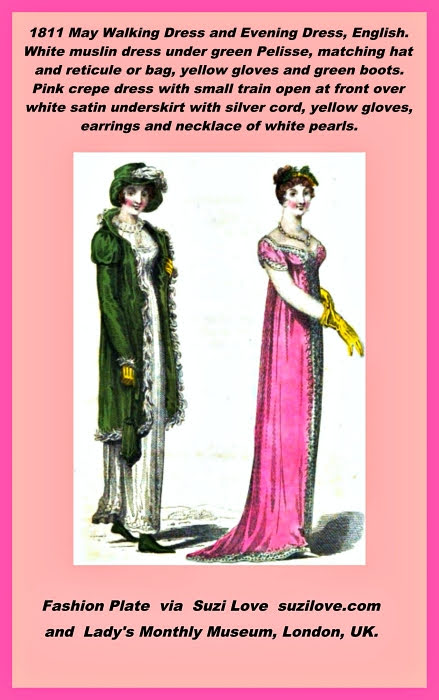
1811 May Walking Dress and Evening Dress, English. White muslin dress under green Pelisse, matching hat and reticule or bag, yellow gloves and green boots. Pink crepe dress with small train open at front over white satin underskirt with silver cord, yellow gloves, earrings and necklace of white pearls. Fashion Plate via The Lady’s Monthly Museum, London, UK.
Definition Walking Dress: Worn out shopping, walking in a city park or the country estate. Presentable and warm, more fashionable than Morning Dress but not overly accessorized.
Definition Evening Dress: Minute distinctions between ball, dinner, evening and opera gowns meant different quality of fabrics and designs.