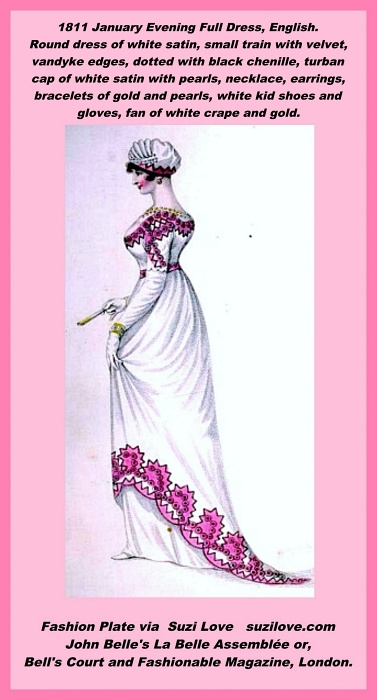
1811 January Evening Full Dress, English. Round dress of white satin, small train with pink velvet, vandyke edges, dotted with black chenille, turban cap of white satin with pearls, necklace, earrings, bracelets of gold and pearls, white kid shoes and gloves, fan of white crape and gold. Fashion Plate via John Belle’s La Belle Assemblée or, Bell’s Court and Fashionable Magazine, London.
Definition Van Dyke Points: V-shaped lace and trims named after a 17th Century Flemish painter, Sir Anthony Van Dyck, known for painting V-shaped lace collars and scalloped edges on sitters.
Definition Velvet or Velour: Silk with short, dense and smooth pile produced by pile warp raised in loops above ground weave through introduction of rods during the weaving.
Covent Garden is within the London boroughs of Westminster and Camden, and the parliamentary constituencies of Cities of London and Westminster and Holborn and St Pancras. The district is divided by the main thoroughfare of Long Acre, north of which is given over to independent shops centred on Neal’s Yard and Seven Dials, while the south contains the central square with its street performers and most of the elegant buildings, theatres and entertainment facilities, including the Theatre Royal, Drury Lane, and the London Transport Museum.
In 1552, the land was seized by Henry VIII and granted to the Earls of Bedford. The 4th Earl commissioned Inigo Jones to build fine houses to attract wealthy tenants. It was the first modern square in London, with Italian arcades and a flat, open space or piazza with low railings. This layout was copied in other new estates in London.
1555 John Russell, 1st Earl Of Bedford. By a follower of John Bettes. Given land of Covent Garden by Herny VIII after the dissolution of the Monasteries.1650 The piazza of Covent Garden about 1650, as engraved by Wenceslaus Hollar. Courtesy University of Toronto.1721-1789 ca. St. Paul’s Church, Covent Garden, London, U.K. From between two arches of the plaza. Watercolor with grey wash. By Thomas Sandy. Via British Museum, London, UK. britishmuseum.org1800s Early Covent Garden Market, London, U.K.
In 1654, an open-air fruit and vegetable market grew on the south side of the fashionable square but over time the market and the surrounding area fell into disrepute. Taverns, theatres, coffee-houses and brothels opened up, the gentry moved away, and rakes, wits and playwrights moved in.
By the 18th century Covent Garden had become a well-known red-light district, attracting notable prostitutes such as Betty Careless and Jane Douglas. Descriptions of the prostitutes and where to find them were provided by Harris’s List of Covent Garden Ladies, the “essential guide and accessory for any serious gentleman of pleasure”.
Covent Garden’s market was always disorderly, the buildings in bad shape, and overcrowded with stalls, donkeys, carts, and peddlers. The small number of passageways into the piazza were small and with bottle necks of carts moving goods and market sellers fighting for right of way. The markets supplied fruits and vegetables, mostly homegrown but with imported goods increasing. Many sellers missed paying tolls for selling in the piazza or refused to pay them so the owner, the Earl of Bedford, took many people to court for not paying tolls. He realized the markets were in such poor condition that he couldn’t charge sellers until he improved them. In 1830, a new market hall was built with sections dividing the kind of goods sold which did improve things, but the markets remained chaotic. By 1890, people were again complaining about the narrow streets and congestion.
Covent Garden’s flower girls attracted attention by shouting:
“Two bundles a penny, primroses!”
“Sweet violets, penny a bunch!”
In 1851, Henry Mayhew wrote London Labour and the London Poor describing two types of flower girl. The young girls, or waifs, sold flowers to feed the family. The other type of flower girl stayed out late, doubled as prostitutes, and had bad reputations.
In 1913, Herbrand Russell, 11th Duke of Bedford agreed to sell the Covent Garden Estate for £2 million to the MP and land speculator Harry Mallaby-Deeley, who sold his option in 1918 to the Beecham family for £250,000.
1809 View Of the New Covent Garden Theatre, London. From Hart Street, showing the King’s entrance. Watercolor drawn by James Winston. via British Museum. 1811 Bird’s Eye View of Covent Garden Market, London, UK. Main fruit, flower and vegetable market in London in early 19th century. Began here in 1656 with few temporary stalls in back garden of home of Earl of Bedford. Charles II granted market lease and in 1678 bought by Adam Piggot and others who built permanent stalls. By 1811, smelly, dirty, and overcrowded. Engraver J. Bluck. After Augustus Charles Pugin and Thomas Rowlandson published by Ackermann. Via British Museum, London, UK. britishmuseum.org
1827 Covent Garden Market, Westminster, London, U.K. By Frederick James Havell.
In 1830, Charles Fowler’s neo-classical building was erected to cover the market and as the market grew, the prostitutes moved on. The Floral Hall and Charter Market were added and the Jubilee Market in 1904.
1835 Covent Garden Watch House, London, UK. Next to the church of St. Paul’s Church, Covent Garden. Two story white building with ‘Watch House’ painted on its upper floor is shown with a lively street scene in the foreground. via Museum of London.
1852 J.M.W. Turner’s birthplace in Maiden Lane, Covent Garden. Brick terraced house at night with a figure in top hat walking past and two figures with a candlelight in the doorway_Watercolour with body color over graphite. Drawn by John Wykeham Archer.
In 1913,Herbrand Russell, 11th Duke of Bedford agreed to sell the Covent Garden Estate for £2 million to the MP and land speculator Harry Mallaby-Deeley, who sold his option in 1918 to the Beecham family for £250,000. By the end of the 1960s, traffic had become congested until in 1974 the market relocated to the New Covent Garden Market about three miles (5 km) south-west at Nine Elms. In 1980, the central building re-opened as a shopping centre and then became a tourist location with cafes, pubs, small shops, a craft market called the Apple Market, and another market in the Jubilee Hall.
This book shows how corsets changed to both provide support and also fit well under clothing to give a fashionable silhouette. Corsets started being a fashion item, rather than simply underclothing to be hidden. Romantic Era women’s fashionable corsets. Corsets worn from 1830-1850, or the Romantic Era of fashion. https://books2read.com/SuziLoveCorsetBook18 Corsets 1830-1850 History notes Book 18
1800 ca. Sleeveless Chemise or Nightgown of white cotton and lace. Length just below knee. Gathered back and front onto yoke of lace and gathered fabric inserts. Gathers around neck by tape in casing. ‘Blanche’ embroidered centre front. Waist up to 50 in or more. via National Trust Collections, UK. nationaltrustcollections.org.uk
Definition Chemise Or Shift: Sleeveless, mid-calf length garment of white cotton or muslin was worn next to the skin under stays or corset. Called ‘Shift’ from early Georgian (1700-1750) until Late Georgian (1750-1790) to replace ‘Smock’. By 1800, name replaced by ‘Chemise’. Sometimes doubled as a nightshift, or nightrail. From around 1700, women wore a long garment, like a man’s shirt, next to their skin, day and night. ‘Costume In England’ describes this as originally a shirt or smock and adopted by women as an undergarment.
This undergarment fell from their shoulders to calves, and was called a chemise, shift, or vest. During the day, it was worn under stays, or a corset, and at night it could be worn as a nightshirt. Wealthier women could afford specific bedroom attire, but lower and working class women wouldn’t have had this luxury and so wore a chemise as both an undergarment and as sleepwear. The rich and the upper classes wore embroidered and otherwise decorated versions of this simple linen or cotton shift. Other classes of women wore a very simple version with little or no decoration as they had no time for decorative embroidery and no money to buy silk threads.
Want To Know More About Georgian Era Men’s Fashions? Try History Notes Book 2 By Suzi Love. Fashion Men 1700s Late. books2read.com/suziloveFashMen1700 What was fashionable for men in the late 1700s? Extravagant colors and fabrics and outrageous styles. Take a look at their suits, hats, accessories and bedroom fashions.
What was fashionable for men in the late 1700s? Extravagant colors and fabrics and outrageous styles. Take a look at their suits, hats, accessories and bedroom fashions. Strictly speaking, the Georgian Era might include all the years that a ‘King George’ ruled in England, but for the purposes of this book the ‘Georgian Era’ is primarily the late 1700s when mad King George III ruled. His son became Prince Regent in the early 1800s, therefore creating the years known as the Regency, and became George IV on the death of his father.
The Georgian years officially ended with the death of King George IV in 1830.
1840 ca. The York To London Royal Mail. By A. Anson Martin. Mailcoach in the village of Bedale, Yorkshire, U.K. Church at the end of the wide country road and thatched cottages behind the coach. Signed and Inscribed ‘(All Right)’. Via British Postal Museum, London, U.K. ~ postal museum.org
The dreadful condition of British roads caused great apprehension to all classes of travelers. Making a journey anywhere in the country was a big undertaking and often a gentleman composed his last will and testament before his departure. Traveling in vehicles was only possible during the day or on the nights with very bright moonlight with few vehicles attempting road travel in winter and any travel on a Sunday was frowned upon. books2read.com/SuziLoveTravel
Description of Stage Coach Travel in England. via 1815 Journal Tour of Great Britain. “The gentlemen coachmen, with half-a dozen great coats about them, immense capes, a large nosegay at the button-hole, high mounted on an elevated seat, with squared elbows, a prodigious whip, beautiful horses, four in hand, drive in a file to Salthill, a place about twenty miles from London, and return, stopping in the way at the several public-houses and gin-shops where stage-coachmen are in the habit of stopping for a dram, and for parcels and passengers on the top of the others as many as seventeen persons. These carriages are not suspended, but rest on steel springs, of a flattened oval shape, less easy than the old mode of leathern braces on springs. Some of these stage coaches carry their baggage below the level of the axletree.”
1810-1820 ca. Double Breasted Red Hunting Coat, English.
1810-1820 ca. Red Hunting Coat, English. Hunting was both a popular sport and an essential part of social success. Double-breasted tailcoat of woolen superfine, lined with sateen and cotton, M-notch lapels, nine gold buttons with heraldic crest, cuffs with three smaller matching buttons. via Collection from Castle Howard, Yorkshire, U.K. Victoria and Albert Museum, London, UK. Hunting coats, or colors, often red coats called pinks, were worn by hunt masters and hunters. In Bridgerton and Jane Austen times, or the early 1800s, gentlemen wore red coats like this while riding to the hounds.
Historically, hunt members wore ‘colors’ to distinguish between types of hunters and their level of experience. Traditional red coats were worn by huntsmen, masters, former masters, whippers-in, regardless of sex, while other hunt staff members and male members invited by masters wore colors and hunt buttons as a mark of appreciation for their involvement in the organization and running of the hunt. After the Hunting Act in England and Wales, only Masters and Hunt Servants wore red coats or hunt livery. Gentleman subscribers usually wore black coats, with or without hunt buttons and in some countries, women wore colored collars on their black or navy coats to help them stand out from the rest of the field. Some hunts, including most harrier and beagle packs, wear green rather than red jackets, and some hunts wear other colors such as mustard.
1770-1790 ca. Child’s Stays, American. Linen plain weave, baleen, or whalebone, silk braided tape. Dimensions: Center Front Length: 5 3/4 inches (14.6 cm) Waist: 18 inches (45.7 cm). Made in United States of America. This pair of stays is only eighteen inches around, and might have been worn by a small child of eighteen months to two years old. Putting stays on young girls and boys was not seen as harsh, but rather as insurance that their figures would develop the correct form, with chest out and shoulders down. While boys usually wore stays only in early childhood, they were considered essential for females throughout their lives. via Philadelphia Museum of Art philamuseum.org Accession Number: 1988-15-1Credit Line: Purchased with the Bloomfield Moore Fund, 198
19th Century Mid-Late Five Desk Seals. L-R Carnelian seal with silver mounts set with colored stones; malachite urn seal: gilt-bronze seal with winged cherub heads: Silver-gilt seal eagle, Silver-gilt seal as eagle’s leg below a blue glass ball. via Sotheby’s Auctions. sothebys.com
In the Bridgerton family, or Jane Austen’s household, and during the Regency Era, sealing wax was not only impressed onto the back of a letter with a seal to protect against tampering, but also to identify the sender of the letter. People, especially aristocrats, kept personal and family seals to be used for many different purposes e.g. A letter to a government official would be sealed with an aristocrat’s crest or title. Personal seals for identification have been since early civilizations. The rubber stamps and embossers we use today serve the same purpose, identifying the sender.
Definition: Wax Seals: Pressed onto a letter or envelope to show that a document is unopened or to verify the sender’s identity. A signet ring or was seal is pressed into a dollop of hot wax to seal a letter or envelope closed.