19th Century Typical Meals and Table Settings for the Family and For Guests. This is typical of the food that would have been served at Jane Austen’s meal times. Historic food from 1860s Mrs. Beeton’s Household Management.




I'm an Australian author of contemporary and historical romances, plus history non-fiction. My books range from sexy to erotic, late 1700s to the mid 1800s, and with a dash of Australia thrown into the mix. My heroes and heroines challenge tradition and my stories often expose the seamier levels of life. I now live in a sunny part of Australia after spending many years in developing countries in the South Pacific. My greatest loves are traveling, anywhere and everywhere, meeting crazy characters, and visiting the Australian outback. I hope my books bring history alive and you have fun adventuring with my roguish heroes and feisty heroines.
19th Century Typical Meals and Table Settings for the Family and For Guests. This is typical of the food that would have been served at Jane Austen’s meal times. Historic food from 1860s Mrs. Beeton’s Household Management.
1808 Christie’s Auction Room, London, U.K. From: Microcosm of London By Rudolph Ackermann. The Microcosm of London was published in three volumes between 1808 and 1810 and was coordinated by German born printseller, Rudolph Ackermann, from his Repository of Arts at 101 The Strand, London, U.K. and included numerous contributors. Visitors to London in Jane Austen’s time would go to all the important buildings. https://books2read.com/suziloveROver


What did ladies do and wear in Jane Austen’s time, or early 1800s? #Regency #History #nonfiction Books 4 and 5 Regency Life Series. Young Lady’s Day and Older Lady’s Day in Books 4 and 5 in the Regency Life Series.
These books depict the often-frivolous life and fashions of ladies in the early 1800’s, or during the lifetime of Jane Austen, but also gives a glimpse into the more serious occupations ladies may undertake. Through historic images, historical information, and funny anecdotes, they show how a lady fills her day, where she is permitted to go, and who she spends time with. These light-hearted looks at the longer Regency years are an easy to read overview of what people did and wore, and where they worked and played. There is plenty of information to interest history buffs, and lots of pictures to help readers and writers of historical fiction visualize the people and places from the last years of the 18th Century until Queen Victoria took the throne. Young Lady’s Day ~ Older Lady’s Day

1818 ca. Elegant black evening dress as would have been worn in the times of Jane Austen when attending evening events, such as dinners, concerts, musical evenings or the opera. British, Empire style, or high-waisted dress of machine-made silk net, embroidered with silk, trimmed at the hem with padded black satin rouleaux and rosettes, long straight sleeves under shoulder puffs. Machine-made net was a very popular background for embroidery and laces in early 1800s and the airy texture suited loose and flowing Empire style fashions. Victoria and Albert Museum, London, UK.
collections.vam.ac.uk.


1805-1810 ca. High-waisted evening gown, French, and shawl. Typical of the dresses and shawls in the wardrobe of every woman in the times of Jane Austen. Evening dress of white muslin, embroidered all over in white cotton in French knots, with collar, hem, and centre stripe in chain stitch, low square neck adjusted with draw-cord, high waist, skirt gathered at back, short sleeves with vandyke trim.
Typical Neo-classical dress imitating Greek and Roman sculptures, white muslin fabric either
imported from India or made in Europe to imitate Indian materials. Scarf of knitted silk printed in
similar pattern to popular Indian cashmere shawls. via Victoria and Albert Museum, London, UK. collections.vam.ac.uk.


17th Century Late – 18th Century Early. Purse, French. Silk and Metal. via Metropolitan Museum, N.Y.C., U.S.A. metmuseum.org


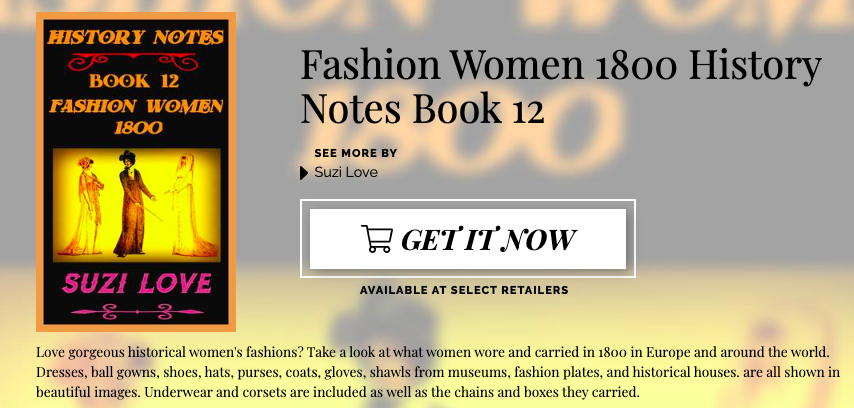
19th Century Early Men’s Trousers as worn by the men in Jane Austen’s family and life. Textured cotton woven with small dash motif. Wide waistband double row five ivory bone buttons, fall front bone buttons plus button centre front, two large pockets, full width flap with buttonholes and with wide legs. via Meg Andrews, Costumes and Textiles. Meg-andrews.com


1800s Pascalie Hosten, Comtess d’Arjuzon, Playing Guitar. Possibly by Achille-Louis Martinet (1806 – 1877). Brush and watercolor on white wove paper. Via Wikimedia Commons commons.wikimedia.org (PD-ART)
Music was a constant in the life of Jane Austen and her contemporaries, with many households having multiple musical instruments and many members of the family being able to play them.


1784-1826 ca. Woman’s Under Dress. White high-waisted underdress with drawstrings at neck and waist, narrow shoulder straps, back tie closure, embroidered with large scale scrolling floral motifs with meandering vine and bands of dots along the bottom edge. The type of underdress worn by Jane Austen’s female friends and family. via Museum of Fine Arts, Boston, U.S.A. mfa.org

1820 ca. Collection of Reticules, or Purses. Silk silver gauze, netting, fine crochet. Bags have drawstrings, chains and tassels. via Ruby Lane Auctions.
Definition Of A Reticule; Bag or purse, often with a drawstring to pull closed and usually made of cloth or covered cardboard and often decorated with beading or embroidery. A reticule, or purse, or handbag, was usually carried by a woman during the Regency period to carry all their daily necessities. Earlier, women used pockets that tied at the waistline and were hidden in the folds of their skirts. Empire style, or early 1800s, high-waisted dresses made it impossible to either sewn in a pocket or to tie on a pocket, so women began carrying small, decorated bags called Reticules, or ridicules, which generally pulled close at the top with a drawstring. These Reticules, or bags, were the forerunners of our modern day purses.
