↓
 

Suzi Love

Making history fun, one year at a time.

Header_
  • Home
  • Newsletter
  • Pre order form
  • Shop
    • Cart
    • Checkout
    • My account
    • Refund and Returns Policy
  • Blog
  • BOOKS
    • History Events
    • Kelly’s Justice
    • Outback Arrival
    • Irresistible Aristocrats
    • History Notes
    • Scandalous Siblings
    • Love After Waterloo
    • Regency Life Series
  • Privacy Policy
  • EVENTS
Home » Europe » Page 30 << 1 2 … 28 29 30 31 32 … 49 50 >>

Category Archives: Europe

Post navigation

← Previous Post
Next Post→

Riding For Ladies During the Regency and Early Victorian years. #regencyera #victorianera #riding #googlebooks

Suzi Love Posted on January 8, 2026 by Suzi LoveJanuary 8, 2026

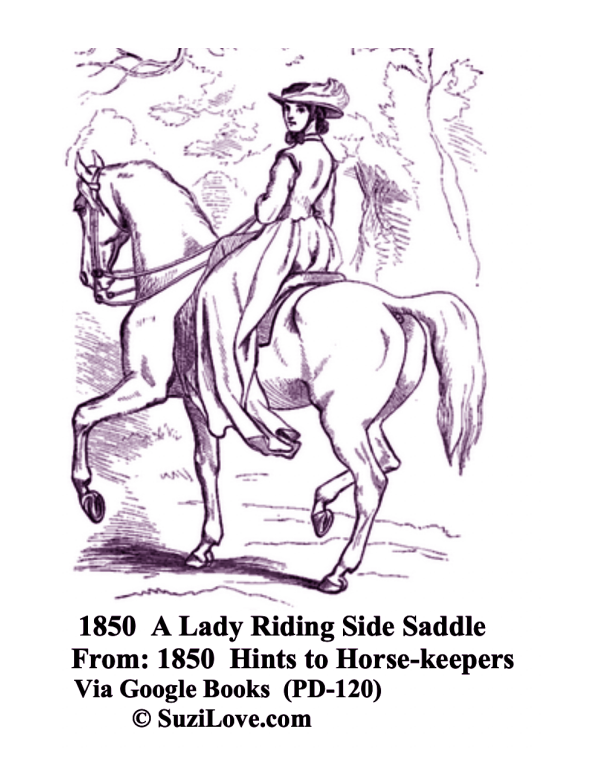
Riding For Ladies During the Regency and Early Victorian years.  How did they ride sidesaddle?   What did their saddles look like?  What did they wear?

From 1850 Hints To Horsekeepers By Henry William Herbert via Google Books (PD150)

Why Every Lady should learn to ride: EVERY lady should learn to ride; not at a mature age, when her frame has become exhausted by a sedentary life and consequent ill health; nor even when, her school-days being over, she is thought to have leisure for wholesome exercise; but in childhood, when her will is strong and her body obedient to it. Particularly in our large cities, too little care is given to the physical culture of young girls. Their minds are engaged, not often with energetic mental work, but with idle thought for dress and show, while no other exercise is taken than a measured daily walk, and occasional dancing and waltzing.

‘Where household labor is disdained, and no opportunity can be afforded for floriculture or any other agreeable out-door occupation, there is no substitute so good as horseback riding. But for the country girl it becomes indispensable. Not her health, perhaps, but her happiness demands it. No woman ever rides so well as one who from childhood has loved her pet colt. She has chased him, perhaps, for hours around a ‘ten-acre lot:’ and when, his frisky mood over, she has been able to take him  coaxingly by the inane and lead him to a mounting place, great was the triumph of her wild ride. And no training or care can give the freedom and skill of this youthful practise.
RIDING CLOTHING

Few ladies know how to dress for horse exercise. A head dress should shade form the sun but fit well enough that it needs no adjustment, as the hands are needed for the reins. The Whip, an essential element of the lady’s riding outfit, should be stiff and substantial, without being heavy.

The hair should be arranged in the firmest manner possible. If suited to the style of the lady, it may be plaited at the back and looped across, in a manner which will support the hat and present a very comely appearance. Or it may be found pleasanter to turn all of the back hair to the top of the head, where a high hat is used. All loose arrangements of the hair, except short curb, when they are natural, should be avoided. But few hair-pins should be used, and those long and firmly woven into the hair. The recent fashions of wearing the plumes or feathers of the ostrich, the cock, the pheasant, the peacock, and the kingfisher, in the riding hats of young ladies, are highly to be commended.

Ladies habits are usually made too long and become cumbersome. A foot longer than an ordinary skirt will be sufficient if the material is suitable. Light Cloth will be found the most appropriate for the skirt, if the color be becoming and sufficiently dark. The fashion of a waistcoat of light material for summer, revived from the fashion of the last century, is a decided improvement, and so is the over-jacket, of cloth or seal-skin, for rough weather. It is the duty of every woman to dress in as becoming and attractive a manner as possible; there is no reason why pretty young girls should not indulge in picturesque riding costume so long as it is appropriate.

Many ladies entirely spoil the set of the skirts by retaining the usual impedimenta of petticoats. The best dressed horsewomen wear nothing more than a flannel chemise with long, colored sleeves, under their trousers. If ladies prefer, a quilted skirt, not too full, may be worn. It should be lined with silk or glazed muslin, and will be found no impediment. Long boots are a great comfort and protection in riding long distances.

All ladies who desire that riding should be to them a healthful exercise, must take great care that their dress be perfectly easy in every part, particularly over the chest and around the ribs. Let the boots be easy, and their gloves, which should be leather gauntlets, large and soft, and all elastic bands very loose.

Ladies’ trousers should be of the same material and color as the habit, and if full, flowing like a Turk’s and fastened with an elastic band round the ankle, they will not be distinguished from the skirt. In this costume, which may be made amply warm by the folds of the trousers, plaited like a highlander’s kilt, fastened with an elastic band at the waist, a lady can sit down in a manner impossible for one encumbered by two or three short petticoats. It is the chest and back which require double folds of protection during, and after, strong exercise.

LADY MOUNTING A HORSE

    The lady in mounting should be assisted by two persons, one to hold the horse, standing directly in front of him, and holding by the check pieces of the bridle, above the bit, and the other to assist her to her seat.

    Having taken the reins and whip in the right hand, she will stand with her face towards the horse’s head, and with her right hand on the left pommel or the saddle. In the left hand she will hold her skirt, in such a manner as to enable her to raise it clear of the ground. The gentleman will stand, facing her, and opposite to the horse’s shoulder, with his left hand holding by his mane, this steadies the horse when the lady springs. The gentleman will now stoop and take the lady’s left foot, which has been raised fifteen inches from the ground, in his right hand, clasping it firmly under the instep. The skirt having been raised to clear the foot, is now dropped, and the lady places her left hand on the gentleman’s right shoulder, giving a spring to straighten the left knee.

During this spring the gentleman will simply keep his hand still, supporting the lady’s weight, but not raising her until the knee is fairly straightened, when he may lift her to the required height, but without trying to push her over on to the saddle. She will find her seat more easily without such assistance, which would often tend to throw her over the horse, rather than on his back. Being seated with her right hand still on the pommel, the lady will, with her left hand, adjust the folds of her skirt. She will then remove her hand from the pommel, and place her right knee over it; when the gentleman will place her foot in the stirrup, and then aid her in taking proper hold of the reins and whip. When this is accomplished, the attendant at the horse’s head steps out of the way, and the lady assumes the control. Fortunately, the operation is less tedious than its description.

LADY DISMOUNTING A HORSE

A lady dismounts with perfect ease. After the groom has taken his place in front of the horse and secured him, by releasing her hold upon the bridle and stirrup and lifting her right leg over the pommel, which she now holds with the right hand, while the left, on the shoulder, or in the hand of her gallant, affords her sufficient support in slipping to the ground.

THE SEAT IN THE SIDESADDLE.

The lady should, by exercises similar to those recommended for gentlemen, endeavor to acquire a perfect independence of the rein-hold in the security of her seat She should be able to lean far to the right or to the left, or lie back on the horse’s haunches, or forward on his neck, and to regain her position without disturbing her seat in the saddle, and without holding by the reins. With the use of the leaping-horn it will be more easy for her to attain perfection, in this respect, than it will be for the man, who must depend in a great measure on the clip of his legs. The rider should be erect, directly over the horse’s spine, the shoulders at an equal height. and the elbows near the sides.
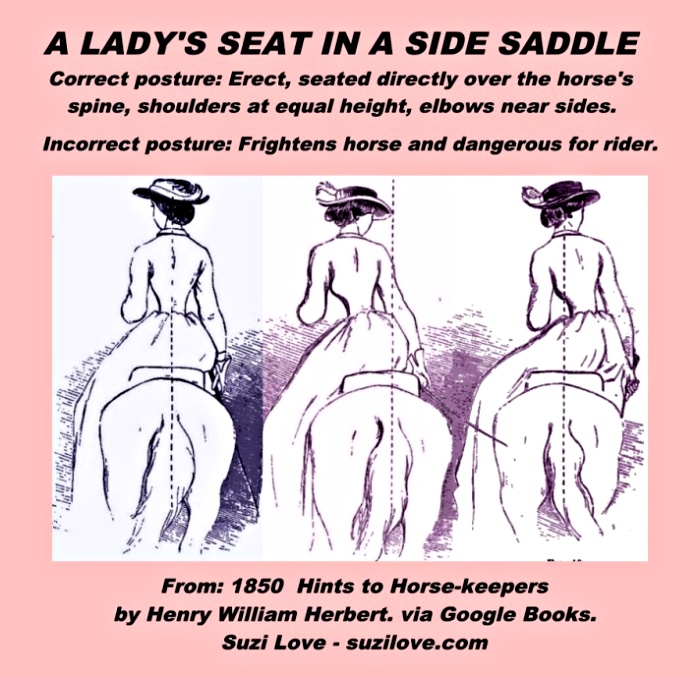
1850_ridng_A LADY'S SEAT IN A SIDE SADDLE

Correct posture: Erect, seated directly over the horse's
spine, shoulders at equal height, elbows near sides. 
Incorrect posture: Frightens horse and dangerous for rider.

Ladies, particularly those with very small hands, will often find it burdensome to hold their reins both in one hand, as is universally taught in our riding-schools. The best way for a lady is, if her hand be light, to knot up the snaffle and let it rest within her reach, in case of accident to the other rein. Or, if her touch be not delicate enough for the curb, let her hold it lightly and depend on the snaffle. The Whip and the Left Heel are valuable aids to a lady in the saddle. By a proper use of them she is enabled to retain a much freer hold upon her reins. Particularly in stopping and turning they are invaluable. Also, in starting.

ACCIDENTS.

Ladies, of course, should never ride horses which are in any manner vicious. But the best animals are not faultless, nor the most sure-footed always reliable. The lady should therefore be prepared for critical situations. Remember that with a long skirt about her feet, and with little experience in such exercise, it is always unsafe for lady to leap from her saddle. She may disengage herself quickly, but carefully. In a runaway, her place is close down in the saddle, holding the four reins low on either side, and giving an alternate tension to the curb and snaffle, steadying her horse in the road and saving her strength to force him to run long after he would gladly stop.
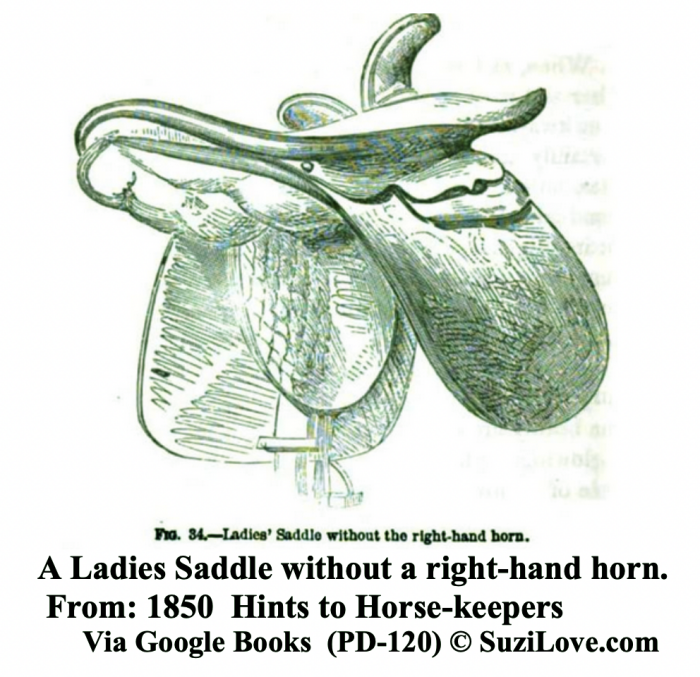
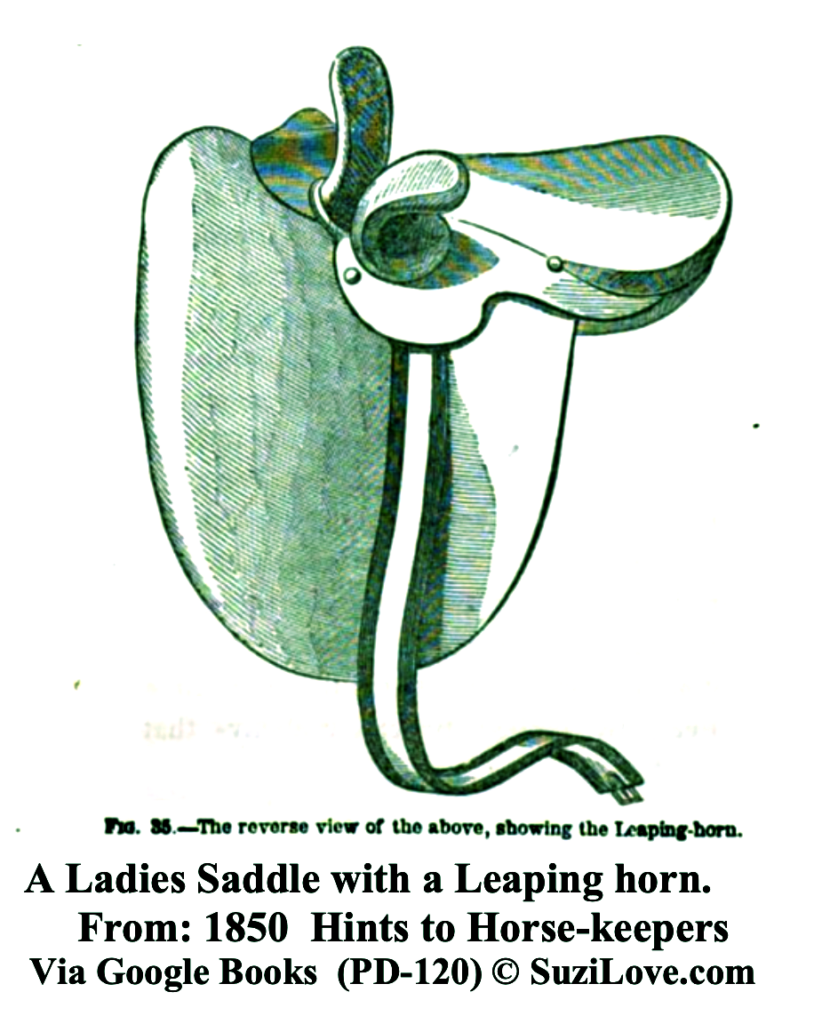
1850_LadiesSaddle with leaping horn
D2D_RL_4_YLD_Young Lady's Day Regency Life Series Book 4 by Suzi Love. A light-hearted look at the longer Regency years and an easy to read view of what a young lady did, wore, and lived. https://books2read.com/suziloveYLD

Posted in 1800s, 1800s women's fashion, Bridgerton, Canada, Dress Or Robe, England, Europe, Jane Austen, Regency Era, riding, Romantic Era, Victorian Era, Victorian Fashion | Tagged Bridgerton, google books, Jane Austen, Regency Era, Regency Fashion, riding, Victorian Era | Leave a reply

1787 December Yellow Striped Dress, Red Hat and Large Fur Muff, French. #Georgian #Fashion #France

Suzi Love Posted on January 8, 2026 by Suzi LoveJanuary 7, 2026

1787 December Yellow striped dress, red hat with a white feather and a large fur muff, French. via Magasin des Modes.

1787 December Yellow striped dress, red hat with a white feather and a large fur muff, French. via Magasin des Modes.
HN_1_D2D_Fashion Women 1700s
books2read.com/suziloveFashWomen1700s
HN_1 Fashion Women Late 1700s History Notes Book 1 by Suzi Love. What was fashionable for women in the late 1700s? Extravagant colors and fabrics and outrageous styles were all seen in these flamboyant fashions. books2read.com/suziloveFashWomen1700s
Posted in 1700s, 1700s Womens Fashion, Dress Or Robe, Europe, fashion accessories, France, Georgian Era, Georgian Fashion, hats, Spencer, Suzi Love Images | Tagged 1700s Women's Fashion, Dress Or Gown, fashion accessories, Fashion Plate, Georgian Fashion, Hats And Hair, Magasin des Modes, muff, Shoes | Leave a reply

Weird Historical Pants for Men. #regencyera ##regencyfashion #breeches

Suzi Love Posted on January 7, 2026 by Suzi LoveJanuary 7, 2026

Weird Historical Pants for Men.  No wonder men needed valets!  It wasn’t just women struggling into tight fitting clothing!

And no wonder it took both sexes so long to dress every day, often  changing clothes four or five times a day!

Early on were Breeches – Short, close-fitting trousers that fastened just below the knees or above the ankles, with a horizontal front flap called the ‘fall’ and were worn with stockings. Boys of 3 – 6 years stopped wearing loose dress-type children’s garments and went into short pants instead, and were considered ‘breeched. In Regency times, breeches were worn tighter to show off a manly physique.  

Then of course we had Pantaloons

By the late 1810s and beyond, these became popular and eventually they evolved into full length trousers. Originally pantaloons were made to suit shorter Hessian boots that fell below the typical knee-breech level and they were worn very form-fitting.

Buckskins – Fashionable trousers made from deer skin also showed off every curve of the man’s figure. How could ladies not want to peek? Oooh, what a display of fine, manly figure!! Swoon!   

And so to more modern Trousers – The word Trouser came into usage in the late 1600?s,  so we’ve had trousers around for a long time. But at first, they were mostly for lower classes. Revolutionary France started a trend for sans-culottes, which meant trousers or pantaloons instead of culottes, or knee breeches, which were associated with the aristocracy.

The styles of the revolution moved across to England and were taken up by those who either sided with revolutionary ideals or who took them up as part of a protest against the establishment set.

Early trousers looked strange because they were generally a bit looser than pantaloons or breeches, and ended at the ankles with slits on the side for foot access. They often needed under-the-foot straps to fix them in place.

Now here’s a couple of insider tips from a gentleman’s valet for you to remember –

– False calves can be created by padding so that a master’s calves fill out his stockings and make him look more muscular, especially when he is wearing knee-breeches. Every woman’s dream!

– For rotund gentlemen, tightly pulled corsets help keep the paunch to a minimum and enhance his figure.

– To keep trousers in place and prevent disgrace, braces( suspenders) can be worn under vests.

Even in cases of his master’s over-imbibing, or just plain clumsiness, a valet can ensure his lordship remains correctly clothes at all times when representing the household in public by taking a few early precautions.

Imagine the poor valet’s work if – a gentleman rode before breakfast   – changed to join the family– spent the morning boxing with friends in looser attire – changed for lunch at his club with peers – changed for afternoon calls or a drive in the park with the women-  changed for dinner with friends –  changed into evening dress for a formal ball- arrived home just before daylight to change into his banyan( robe) to smoke his cheroot before bed – then rose 3 hours later expecting his clothes laid out so he could do it all over again.!!

No, I seriously do not want to go back in time and become either a lady’s maid or a gentleman’s valet

       – although, if I had the choice… 

Hmmmm….being in a gentleman’s bedroom…. does hold a certain appeal.

Suzi Love

1775-1825 ca. Black Silk Breeches, American or European. via Metropolitan Museum, N.Y.C., U.S.A. metmuseum.org
1775-1825 ca. Black Silk Breeches, American or European. via Metropolitan Museum, N.Y.C., U.S.A.
metmuseum.org
1806 Young French Gentleman. Short Brown Castorine Coat Over Blue Tailcoat, White Cashmere breeches, yellow gloves, black top Hat. Fashion Plate via Journal des Dames et des Modes, or Costume Parisien.
pants_1804-1814 ca. Collage View. Breeches, French. Cream silk and linen. Buttoned waist, drop down front flap, or fall, extra fullness in the back for ease of movement, ties at the knees to keep in place. via Suzi Love ~ suzilove.com & Metropolitan Museum, N.Y.C., U.S.A. metmuseum.org
1804-1814 ca. Collage View. Breeches, French. Cream silk and linen. Buttoned waist, drop down front flap, or fall, extra fullness in the back for ease of movement, ties at the knees to keep in place.
via Suzi Love ~ suzilove.com
& Metropolitan Museum, N.Y.C., U.S.A. metmuseum.org
1801_gentlemanssuitfrench_bluetailcoatwithbrassbuttons_taupebreechestiedbeneaththeknees_whitestockings_blackha_cp_sml
1812-1813 ca. A man with a hat shaped as a balloon, green coat, white breeches, colored cravat. Hand-colored etching. 1812-1813 Le Chapeau en Ballon Series: Le Bon Genre Plate 51. Via British Museum, London, UK.
1807-1817 ca. Man's Leather Breeches, American. Drop front buttoned flap at the waist, a drawstring at the back waist to adjust waist size, and drawstrings and buttons at the calves to keep the breeches secure when worn with high boots. via Metropolitan Museum New York City, U.S.A. metmuseum.org
1807-1817 ca. Man’s Leather Breeches, American. Drop front buttoned flap at the waist, a drawstring at the back waist to adjust waist size, and drawstrings and buttons at the calves to keep the breeches secure when worn with high boots. via Metropolitan Museum New York City, U.S.A. metmuseum.org
1807 Pale Blue Tailcoat, French. White frilled shirt with extra high collar and cravat, vest, white knee breeches, white stockings, black shoes, gloves, bicorn hat and a curly hairstyle. Fashion Plate via Journal des Dames et des Modes, or Costume Parisien.
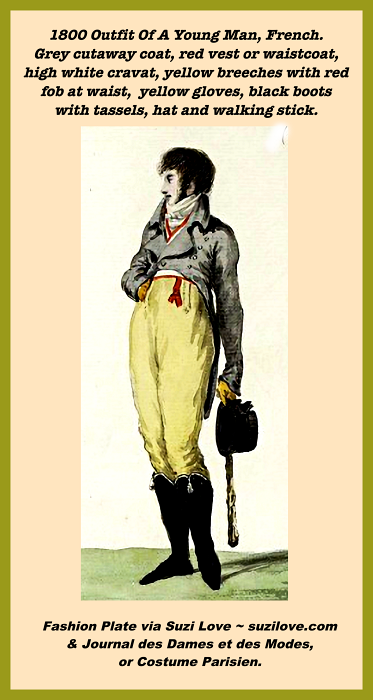
1800 Outfit Of A Young Man, French. Grey cutaway coat, red vest or waistcoat, high white cravat, yellow breeches with red fob at waist, yellow gloves, black boots with tassels, hat and walking stick. Fashion Plate via Journal des Dames et des Modes, or Costume Parisien.
1805 ca. Leather Breeches, French. Buttoned and adjustable waist, back waist gusset for ease of movement, front fall flap, two tone fitted cuffs on legs with many buttons to fasten and hold in place on the legs. via Metropolitan Museum New York City, U.S.A. metmuseum.org
1805 ca. Collage Leather Breeches, French. Buttoned and adjustable waist, back waist gusset for ease of movement, front fall flap, two tone fitted cuffs on legs with many buttons to fasten and hold in place on the legs. via Metropolitan Museum New York City, U.S.A. metmuseum.org
1790 British Consul's Tan Leather Pants, Boston. Tan buckskin, fall front, brass and self covered buttons, breeches have leather ties at waist and at leg hems. via Augusta Auction
1790 British Consul’s Tan Leather Pants, Boston. Tan buckskin, fall front, brass and self covered buttons, breeches have leather ties at waist and at leg hems. via Augusta Auction
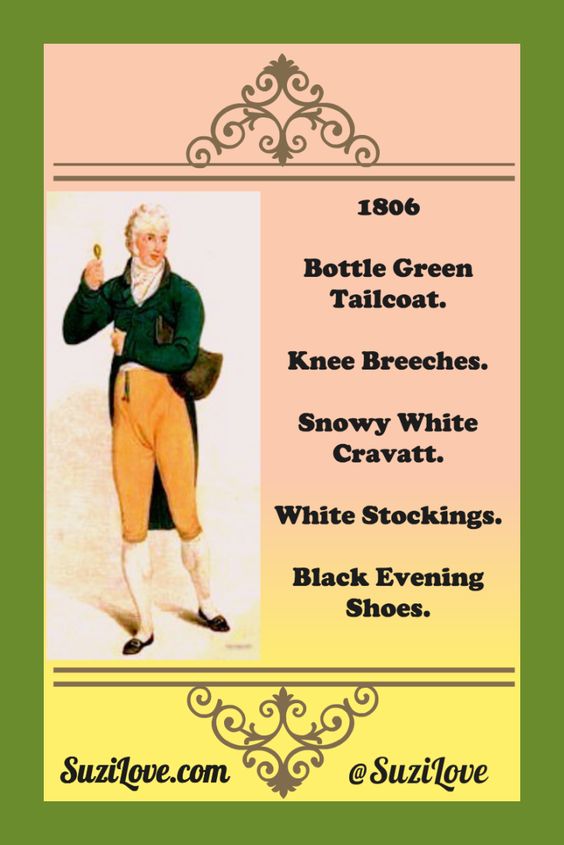
1806 Gentleman's Daily Outfit, French. Bottle green tailcoat, knee breeches, snowy white cravat, white stockings, flat black shoes. Fashion Plate via Journal des Dames et des Modes, or Costume Parisien.
1806 Gentleman’s Daily Outfit, French. Bottle green tailcoat, knee breeches, snowy white cravat, white stockings, flat black shoes. Fashion Plate via Journal des Dames et des Modes, or Costume Parisien.
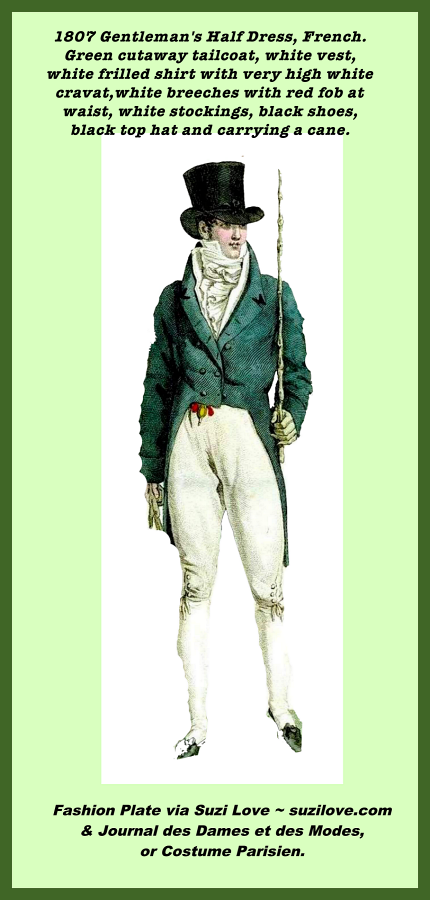
1807 Gentleman's Half Dress, French. Green cutaway tailcoat, white vest, white frilled shirt with very high white cravat, white breeches with red fob at waist, white stockings, black shoes, black top hat and carrying a cane. Fashion Plate via Journal des Dames et des Modes, or Costume Parisien.
1807 Gentleman’s Half Dress, French. Green cutaway tailcoat, white vest, white frilled shirt with very high white cravat, white breeches with red fob at waist, white stockings, black shoes, black top hat and carrying a cane. Fashion Plate via Journal des Dames et des Modes, or Costume Parisien.
HN_23_D2D_Fashion Men 1800-1819
https://books2read.com/SuziLoveFashionMen1800-1819
Posted in 1700s, 1700s Mens fashion, 1800s, 1800s Mens Fashions, England, Europe, Georgian Era, Georgian Fashion, pants, Regency Era, Regency Fashion | Tagged 1700s Mens Fashion, 1800s men fashion, breeches, Georgian Fashion, pants, Regency Fashion

What did an older lady do and wear in Jane Austen and Bridgerton Years? Information and pictures for readers and writers of regency history. #christmas #JaneAusten #Bridgerton #RegencyEra

Suzi Love Posted on January 4, 2026 by Suzi LoveJanuary 4, 2026

What did an older lady do and wear in the Regency Era? Information & pictures for readers and writers of early 1800s history, nonfiction and fiction. books2read.com/suziloveOLD

The older lady’s day usually started with her toilette in her bedroom, where her maid helped her dress for the day and styled her hair. After that, she would join her family downstairs for breakfast unless she preferred a tray with either tea or hot chocolate in her bedroom as she prepared for her busy day. Her day would be made up of speaking with the housekeeper and the cook about the week’s menus, assuring that the servants were all available that day and no one was ill, and checking the list of foods needed. She would also enquire if the laundry was up to date and that they had enough good linen to make up all the beds before extended family members and guests arrived. If she was in the country and hosting a weekend house party, she would assign rooms to the guests on her lists and query that all was in readiness for their arrival.

Xmas_RL_5
RL_5_D2D_RetailerBuyLink_RL_5_2
https://books2read.com/suziloveOLD

Posted in 1800s, 1800s women's fashion, art, Box Or Container, Bridgerton, cartoon, Chatelaine, Christmas, Coat or Pelisse Or Redingote, Corset, Customs & Manners, Dress Or Robe, England, Europe, fashion accessories, Food and Drink, Google Books, hats, History, household, Jane Austen, London, medical, mourning, Music, Regency Era, Regency Fashion, Regency Life Series, Reticule or Bag, sewing, shoes, Spencer, Suzi Love Books, underclothing | Tagged 1800s women's fashion, Book 5, Bridgerton, Christmas, Dress Or Gown, fashion accessories, Fashion Plate, Food, gloves, Hats And Hair, household, Jane Austen, pastimes, Regency Era, Regency Fashion, Regency Life Series, Regency London, Shoes, Suzi Love Books

Have You Read Suzi Love’s Books? Romance, Mystery, Military and History? #Romance #ReadARegency #HistoricalRomance #EroticRomance #Reading #Nonfiction

Suzi Love Posted on January 4, 2026 by Suzi LoveJanuary 3, 2026

Have you read Suzi Love’s Books? Romance, Mystery, Military and History. Regency, historical and contemporary romance. Plus non-fiction history and writing.

Amazon

Goodreads

BookBub

Have You Read Suzi Love's Books: Romance, Mystery, Military and History?https://www.amazon.com/stores/author/B00AFSU7JQ

The Viscount’s Pleasure House Book 1 Irresistible Aristocrats  Disenchanted Viscount tutoring three Regency Ladies. What could go wrong? #Regency Erotic https://books2read.com/suziloveTVPH

Four Times A Virgin Book 2 Irresistible Aristocrats: The countess will do anything to prevent her younger sisters being forced into sordid marriages like hers, even if it means joining forces with the Duke of Stirkton and revealing the horrors of their intertwined pasts. books2read.com/suziloveFTAV

Pleasure House Ball Book 3 Irresistible Aristocrats: Lord Mallory attends his first courtesan’s ball in ten years to appease his concerned friends, though he’d rather stay home and read to his motherless daughters. Though mortified that Brenton unmasks her at a scandalous ball, Lady Lillian Armstrong doesn’t regret their night together. books2read.com/suzilovePHB

Petunia and the Pearl Diver  Book 4 Irresistible Aristocrats Series: The pearl diver needs a working girl to rouse his body. Petunia needs money to save her family. A night at a London brothel could be the solution to both problems. But walking away is impossible when one night leaves them craving more…and more. https://books2read.com/suzilovePetPD

Loving Lady Katharine Book 5 Irresistible Atistocrats: When Lady Katharine Montgomery flees London after her scandalous husband was murdered, the Pacific islands of the New Hebrides (Vanuatu) become her haven. Her life changes when Lord Alexander St. John, British ship’s captain and trader, sails into Port Vila. https://books2read.com/suzi

Embracing Scandal Book 1 Scandalous Siblings: Lady Rebecca Jamison saves her family from financial ruin by investing in railways, but when a greedy syndicate murders her friend, Becca is forced to beg assistance from Cayle St. Martin, the new Duke of Sherwyn. https://books2read.com/suziloveES

Scenting Scandal Book 2 Scandalous Siblings Series: Richard, Earl of Winchester, may not know it yet, but he’s Lady Laura Jamison’s perfect match. Lady Laura Jamison believes her extraordinary olfactory senses will sniff out her perfect match, but will Richard prove her theory wrong? https://books2read.com/suziloveSS

December Scandal Book 3 Scandalous Siblings: The Jamison family joins the Duke of Sherwyn and the St. Martin clan at the duke’s country estate, but guest numbers double when early December snowfalls make roads impassable. #HistoricalRomance https://books2read.com/suziloveDS

Love After Waterloo: When Lady Melton and son join antagonistic Captain Belling and the last group of wounded British soldiers evacuating Waterloo, she anticipates hardship and trouble with deserters. Not her relationship with a belligerent Captain. #RegencyRomance #military books2read.com/suziloveLAW

Self Publishing: Absolute Beginner’s Guide.
Information, contacts, and checklists steer you towards professionally produced books. Helps both fiction and non-fiction authors and available in digital and paperback.
Co-Authored by two Australians: multi-published Imogene Nix and best-selling and award winning Suzi Love. http://books2read.com/selfpublishing

History Notes Books 1-28: Do you need more factual and visual information for your historical fiction? Non-fiction Series: Fashion, music and social manners in the 18th and 19th centuries books2read.com/suziloveFashWomen1700s

Regency Life Series Books 1-5: Historic images, historical information, and funny anecdotes give an overview of life in the early 1800s, or the Jane Austen and Bridgerton years. Information for history buffs and pictures to help readers and writers of historical fiction visualize the people and places of the long Regency period. https://books2read.com/suziloveROver
  books2read.com/suziloveROver books2read.com/suziloveYGD books2read.com/suziloveOGD

Suzi Love Book Bub https://www.bookbub.com/profile/suzi-love
Posted in Australia, Bridgerton, Canada, England, Europe, History Notes, History Of Christmases Past, Irresistible Aristocrats, Jane Austen, Love After Waterloo, Regency Life Series, Royalty, Scandalous Siblings Series, Self Publishing, South Pacific, Suzi Love Books, U.S.A | Tagged 1700s Mens Fashion, 1700s Women's Fashion, 1800s men fashion, 1800s women's fashion, Bridgerton, Erotic Romance, fiction, Georgian era, Historical Mystery, historical romance, History Notes, Irresistible Aristocrats, Jane Austen, military romance, nonfiction, Regency Era, Regency Fashion, romance, Scandalous Siblings Series, Victorian Era

Bridgerton and Jane Austen fan? Mourning, riding, daytime, evening fashions plus underclothing. #christmas #RegencyEra #JaneAusten #HistoricalFashion

Suzi Love Posted on January 4, 2026 by Suzi LoveJanuary 3, 2026

What was fashionable for women in Jane Austen’s times? Mourning, riding, daytime, evening clothing, plus underclothing, corsets and accessories. Fashion Women 1810-1814 History Notes Book 27 This book looks at what was fashionable for women in Jane Austen’s times, or the early 1800s, or the Regency Era in Britain. Wars were being fought around the globe so women’s fashion adopted a military look in support of soldiers. Fashions, like the lifestyle, became progressively more extravagant and accessories went from colorful to over-the-top. https://books2read.com/SuziLoveFashion1810-1814

The Lady’s Magazine said of the basis of women’s fashion that was popular for the first twenty years of the 1800s, ‘White is still the prevailing color for robes. For morning dresses, linen gowns, in large diamonds or squares, are fashionable. Indian muslins, plain or embroidered, are preferred to Florence and satins. The designs of embroidery for shawls are of infinite variety. Long gloves, which reach above the elbow, are not yet laid aside. Medallions are hung around the neck from crossed chains and some of these medallions are shaped like the bags, called ridicules. These reticules are of the lozenge or hexagon shape, with a small tassel at each angle. Reticules, or ridicules, are in lozenge or hexagon shapes with a small tassel at each angle. In capotes, or hats, and ribbands, the violet and dark green prevail over jonquil. Bracelets in hair, pear-shaped ear-rings, medallions on square plates, saltiers of colored stones, are still in fashion.’

HN_27_D2D_fashwomen1810-1814
https://books2read.com/SuziLoveFashion1810-1814
HN_27_D2D_fashwomen1810-1814 https://books2read.com/SuziLoveFashion1810-1814
Posted in 1800s, 1800s women's fashion, Australia, bedroom fashion, Bridgerton, Canada, cartoon, Chatelaine, Christmas, Coat or Pelisse Or Redingote, Corset, Customs & Manners, dancing, Dress Or Robe, England, Europe, fashion accessories, France, hats, History, History Notes, Jane Austen, London, mourning, Regency Era, Regency Fashion, Reticule or Bag, riding, Russia, sewing, shoes, Spencer, Suzi Love Books, Suzi Love Images, U.S.A, underclothing, weddings | Tagged 1800s women's fashion, Book 27, Bridgerton, Corset, Dress Or Gown, fans, fashion accessories, Fashion Plate, Fashions Of London and Paris, gloves, google books, Hats And Hair, History Notes, Jane Austen, jewelry, Journal des Dames et des Modes, La Belle Assemblee, mourning, parasol, Regency Fashion, reticule or bag, riding, shawls, Shoes, stockings, Suzi Love Books, The Lady's Magazine, The Lady's Monthly Museum, The Repository Of Arts, underclothing

Christmas: Boxing Day History #Christmas #holidays #BritishHistory

Suzi Love Posted on December 26, 2025 by Suzi LoveDecember 20, 2025

The 26th December was St. Stephen’s Day, the first Christian martyr and patron saint of horses, so Boxing Day became associated with horse racing and sports. It was also when the English churches alms boxes were opened and the contents given to the poor of the parish. In the song Good King Wenceslas, the king gave the poor man meat, wine and wood “on the feast of Stephen.” Written by John Mason Neale and first published in 1853, the lyrics celebrate the spirit of Boxing Day which was generosity. King Wenceslas watches a poor man “gath’ring winter fuel. and he then brings the peasant food and logs for his fire.  In parts of Europe, St. Stephen’s Day is considered the second day of Christmas.

On the Boxing Day holiday, servants, apprentices, and the poor were presented with gifts. The origin of the holiday is unknown, but was probably first observed in the Middle Ages and the name may come from the opening of alms boxes that had been placed in churches over the holidays for distribution to the poor. It may also be because servants opened their gift boxes on the day after Christmas because on Christmas Day they were busy cooking and serving a large festive meal for their employers. December 26th is also the feast day of St. Stephen, the first Christian martyr and patron saint of horses, so Boxing Day has now become associated with horse racing and sports.

One of the earliest records of these box gifts dates from 1663. In an entry in his diary, English Parliamentarian Samuel Pepys writes that he sent a coach and messenger to his shoemaker to deliver “something to the boys’ box against Christmas” in addition to funds to cover his bill. During Queen Victoria’s reign, Boxing Day became a chance for church parishioners to deposit donations into a box that was put out for the purpose by the clergyman. The money in the boxes was given to the poor.

Some villages followed the custom of the Hunting of the Wren, where small boys captured a wren, killed it, and then mounted it on a pole and carry to every house in the village while singing a song. Money collected was used for a village dance. In London, and in many other parts of Europe, large families and establishments keep regular lists of tradesman’s servants, apprentices, and other persons, who come about making a sort of annual claim on them for a Christmas box on this day.’

‘The custom of annual donations at Christmas, and on New Year’s-day, is very ancient, being copied by the Christians from the Polytheists of Rome, at the time the public religion was changed. These presents, now-a-days, are more commonly made on the morrow of Christmas. From this circumstance the festival of St. Stephen has got the nickname of Christmas Boxing-day, and by corruption, Boxing-day.’ From:- The Lady’s Monthly Museum, Vernor & Hood: Christmas-boxes, 1824.

‘On the day after Christmas, tradespeople are visited by persons in the employment of their customers for a “Christmas-box,” and every man and boy who thinks he is qualified to ask, solicits from those on whom he calculates as likely to bestow.
A writer, in 1731, describes Boxing-day at that time from his own experience. ” By that time I was up, my servants could do nothing but run to the door. Inquiring the meaning, I was answered, the people were come for their Christmas-box : this was logic to me; but I found at last, that, because I had laid out a great deal of ready-money with my brewer, baker, and other tradesmen, they kindly thought it my duty to present their servants with some money for the favor of having their goods.
This provoked me a little; but being told it was ‘ he custom,’ I complied. These were followed by the watch, beadles, dustmen, and an innumerable tribe; but what vexed me the most was the clerk, who has an extraordinary place, and makes as good an appearance as most tradesmen in the parish; to see him come a boxing, alias begging, I thought was intolerable: however I found it was ‘ the custom’ too, so I gave him half-a-crown; as I was likewise obliged to do to the bellman, for breaking my rest for many nights together.’ From The Every-day book and table book by William Hone, 1839

Boxing Day is one of the many customs and traditions associated with Christmas that is featured in History of Christmases Past (Book 1 History Events) by Suzi Love.

Xmas_Boxing Day

Posted in Australia, Canada, Christmas, Customs & Manners, England, Europe, Food and Drink, Google Books, Suzi Love Images | Tagged British history, Christmas, Customs and Traditions, drinks, Food, household, Suzi Love Images

Christmas: Yule Log

Suzi Love Posted on December 24, 2025 by Suzi LoveDecember 24, 2025

Christmas: Yule Log

Pagans burned a great log and a mammoth candle on the 21st of December, the shortest day in the year, because it was seen as the turning-point in the conflict between the contending forces of winter and spring.

From Harpers Bazaaar “The Yule-block, or Christmas-log, with its warm welcome, extending even to the poor and the stranger as they gathered around the hospitable board is being gradually supplanted by the Christmas-tree.”

Formerly the Yule-log, a huge section of the birch, was cut from a tree selected on Candlemas-day, which so late as the time of Queen Elizabeth was the last day of the Christmas holidays. On the following Christmas-eve it was dragged in and placed upon the hearth with great ceremony, the merry-makers pulling with a will, and singing the while the modernized Christmas carol commencing,

“Come, bring with a noise,

My merrie, merrie boys,

The Christmas-log to the firing.”

It was then kindled with a brand from last year’s Christmas fire, which, if it was not thus kept continually burning, still linked the merrymaking of one Christmas-time to that of another.

In Ramsgate, Kent, and the Isle of Thanet, the custom styled “hodening” is still in vogue. The “hoden,” which appears to be a cross between the “white horse” and the Klapperbock of the Germans, is accompanied by a number of youths in fantastic dress, who go round from door to door ringing bells and singing Christmas carols.

Xmas_Yule Log
Posted in 1700s, 1800s, 1900s, Australia, Canada, Christmas, Customs & Manners, Edwardian Era, England, Europe, Georgian Era, History Of Christmases Past, Regency Era, Romantic Era, South Pacific, U.S.A, Victorian Era | Tagged Christmas, Customs and Traditions, holidays, household, Jane Austen, Regency Era

Christmas: ‘A Visit from St. Nicholas’. Poem By By Clement Clarke Moore. #Christmas #holidays #Customs #StNicholas

Suzi Love Posted on December 24, 2025 by Suzi LoveDecember 14, 2025

Christmas: Saint Nicholas Visits On Christmas Eve

A Visit from St. Nicholas By Clement Clarke Moore

‘Twas the night before Christmas, when all through the house

Not a creature was stirring, not even a mouse;

The stockings were hung by the chimney with care,

In hope that St. Nicholas soon would be there;

The children were nestled all snug in their beds,

While visions of sugar-plums danced in their heads:

And mamma in her kerchief, and I in my cap,

Had just settled our brains for a long winter’s nap,

When out on the lawn there arose such a clatter,

I sprang from my bed to see what was the matter.

Away to the window I flew like a flash,

Tore open the shutters and threw up the sash.

The moon, on the breast of the new-fallen snow,

Gave a lustre of midday to objects below;

When what to my wondering eyes should appear,

But a miniature sleigh and eight tiny reindeer,

With a little old driver, so lively and quick

I knew in a moment it must be St. Nick.

More rapid than eagles his coursers they came,

And he whistled and shouted and called them by name;

“Now, Dasher! now, Dancer! now, Prancer and Vixen!

On, Comet! on, Cupid! on, Donder and Blitzen!

To the top of the porch, to the top of the wall!

Now, dash away, dash away, dash away all!”

As dry leaves that before the wild hurricane fly,

When they meet with an obstacle, mount to the sky,

So, up to the house-top the coursers, they flew,

With a sleigh full of toys, —and Saint Nicholas, too.

And then in a twinkling I heard on the roof

The prancing and pawing of each little hoof.

As I drew in my head and was turning around,

Down the chimney Saint Nicholas came with a bound.

He was dressed all in fur from his head to his foot,

And his clothes were all tarnished with ashes and soot;

A bundle of toys he had flung on his back,

And he looked like a pedlr just opening his pack.

His eyes how they twinkled! His dimples how merry!

His cheeks were like roses, his nose like a cherry;

His droll little mouth was drawn up like a bow,

And the beard on his chin was as white as the snow.

The stump of a pipe he held tight in his teeth,

And the smoke it encircled his head like a wreath.

He had a broad face and a little round belly

That shook when he laughed, like a bowl full of jelly.

He was chubby and plump, —a right jolly old elf—

And I laughed when I saw him, in spite of myself.

A wink of his eye and a twist of his head

Soon gave me to know I had nothing to dread.

He spoke not a word, but went straight to his work,

And filled all the stockings; then turned with a jerk,

And laying his finger aside of his nose,

And giving a nod, up the chimney he rose.

He sprang to his sleigh, to his team gave a whistle,

And away they all flew like the down of a thistle;

But I heard him exclaim, ere he drove out of sight:

“Merry Christmas to all, and to all a good night!”

By Clement Clarke Moore
Posted in 1800s, Christmas, Customs & Manners, England, Europe, Quotations, Suzi Love Images, U.S.A, Victorian Era | Tagged Christmas, Customs and Traditions, europe, Quotations, Suzi Love Images

Christmas: 24th December Or Christmas Eve #christmas #holidays #customs

Suzi Love Posted on December 24, 2025 by Suzi LoveDecember 22, 2025

Christmas: 24th December Or Christmas Eve. The evening leading up to Christmas Day is filled with excitement, last-minute preparations, and religious services. In many cultures, especially European countries, gifts are exchanged on Christmas Eve, while in other places, this happens on Christmas morning.  http://books2read.com/suziloveHOCP.

Xmas_24th December
Xmas_24th December
Xmas_24th December
Xmas_24th December
Xmas_24th December
Xmas_24th December
Posted in 1800s, 1900s, Australia, Canada, children, Christmas, Customs & Manners, England, Europe, South Pacific, U.S.A | Tagged children, Christmas, Customs and Traditions, holidays

Post navigation

← Previous Post
Next Post→

SUBSCRIBE TO SUZI LOVE'S NEWSLETTER.

Recent Posts

  • 1830-1839 ca. Black Silk Evening Slippers Made By East Of London. #RomanticEra #Shoes #BritishHistory
  • 1816 May Jane Austen and Bridgerton Style Full Evening Dress Of White Lace Dress Over a Satin Slip. #Bridgerton #RegencyEra #JaneAusten #HistoricFashion
  • Scenting Scandal: Lady Laura Jamison believes her extraordinary olfactory senses will sniff out her perfect match, but will the Earl prove her wrong? #HistoricalRomance #RomCom #RegencyRomance
  • 1800s Early Robert Stephenson’s Innovative Steam Locomotives in Bridgerton and Jane Austen years. #Bridgerton #JaneAusten #Railway #BritishHistory
  • 1730-1760 ca. Yellow Silk Folk Embroidery Bag, Russian. #GeorgianEra #Russia #reticule #Sewing

Recent Comments

  1. Suzi Love on Book Hooks: Petunia and the Pearl Diver. Petunia was too well spoken for a brothel worker. #Regencyromance #historicalromance #London #mfrw
  2. Bianca White on Book Hooks: Petunia and the Pearl Diver. Petunia was too well spoken for a brothel worker. #Regencyromance #historicalromance #London #mfrw
  3. Suzi Love on Book Hooks: Petunia and the Pearl Diver. Petunia was too well spoken for a brothel worker. #Regencyromance #historicalromance #London #mfrw
  4. Suzi Love on Book Hooks: Petunia and the Pearl Diver. Petunia was too well spoken for a brothel worker. #Regencyromance #historicalromance #London #mfrw
  5. Suzi Love on Book Hooks: Petunia and the Pearl Diver. Petunia was too well spoken for a brothel worker. #Regencyromance #historicalromance #London #mfrw

Login

  • Log in

Archives

  • November 2026
  • October 2026
  • September 2026
  • August 2026
  • July 2026
  • June 2026
  • May 2026
  • April 2026
  • March 2026
  • February 2026
  • January 2026
  • December 2025
  • November 2025
  • October 2025
  • September 2025
  • August 2025
  • July 2025
  • June 2025
  • May 2025
  • April 2025
  • March 2025
  • February 2025
  • January 2025
  • December 2024
  • November 2024
  • October 2024
  • September 2024
  • August 2024
  • July 2024
  • June 2024
  • May 2024
  • April 2024
  • March 2024
  • February 2024
  • January 2024
  • November 2023
  • October 2023
  • September 2023
  • August 2023
  • June 2022
  • April 2022

Categories

  • 1700s
  • 1700s Mens fashion
  • 1700s Womens Fashion
  • 1800s
  • 1800s Mens Fashions
  • 1800s women's fashion
  • 1900s
  • art
  • Australia
  • Bath
  • bedroom fashion
  • Book Hooks
  • Box Or Container
  • Bridgerton
  • Bus Trips
  • Canada
  • Carriage
  • cartoon
  • Celebrity
  • Chatelaine
  • children
  • Children
  • Christmas
  • Coat or Pelisse Or Redingote
  • Contemporary
  • Corset
  • Couple
  • Customs & Manners
  • dancing
  • December Scandal
  • Decorative Item
  • Dress Or Robe
  • Easter
  • Edwardian Era
  • Embracing Scandal
  • England
  • Ester In Images
  • Europe
  • Events
  • Fashion
  • fashion accessories
  • Food and Drink
  • Four Times A Virgin
  • France
  • furniture
  • Georgian Era
  • Georgian Fashion
  • Google Books
  • Grand Tour
  • Group
  • hats
  • History
  • History Events
  • History Notes
  • History Of Christmases Past
  • household
  • Hygiene
  • Irresistible Aristocrats
  • Jane Austen
  • Keanu Reeves
  • Kellys Justice
  • Legal
  • London
  • Love After Waterloo
  • Loving Lady Katharine
  • medical
  • military
  • money
  • mourning
  • Music
  • Outback Arrival
  • pants
  • Pastimes
  • peerage
  • People
  • Petunia and Pearl Diver
  • Places
  • Pleasure House Ball
  • postal
  • Queensland
  • Quotations
  • Regency Era
  • Regency Fashion
  • Regency Life Series
  • Reticule or Bag
  • riding
  • Romantic Era
  • Royalty
  • Russia
  • Scandalous Siblings Series
  • Scenting Scandal
  • Self Publishing
  • sewing
  • Shirt
  • shoes
  • Shopping
  • South Pacific
  • Spencer
  • sports
  • Suit
  • Sunday Snippet
  • Suzi Love
  • Suzi Love Books
  • Suzi Love Images
  • Suzi Love Writing
  • Swain Cove
  • THe Viscount's Pleasure House
  • travel
  • U.S.A
  • underclothing
  • Vest or Waistcoat
  • Victorian Era
  • Victorian Fashion
  • weapons
  • weddings
  • Writing Tools

1800s men fashion 1800s women's fashion antiques Bridgerton British history Cartoons Corset cravat decorative Dress Or Gown England europe fashion accessories Fashion Plate France Georgian era Georgian Fashion gloves google books Hats And Hair historical romance History Notes household Jane Austen jewelry Journal des Dames et des Modes London Metropolitan Museum NYC pants Redingote Or Pelisse Or Coat Regency Era Regency Fashion Regency London reticule or bag riding Romantic Era sewing shawls Shoes Suzi Love Books Suzi Love Images Tailcoat The Repository Of Arts underclothing Vest or Waistcoat

©2026 - Suzi Love - Weaver Xtreme Theme Privacy Policy
↑