1807 Regency Couple, French.Dressed As In Jane Austen’s times.Back view of a lady’s white dress with a cute back bow, long draping scarf with knotted ends, and straw bonnet with a blue ribbon and bows. Gentleman in a long grey coat, orange vest, extremely high collar of a ruffled shirt, tight taupe pants tucked into topped boots, and with a fashionable short curly hairstyle. Fashion Plate via Costume Parisien.
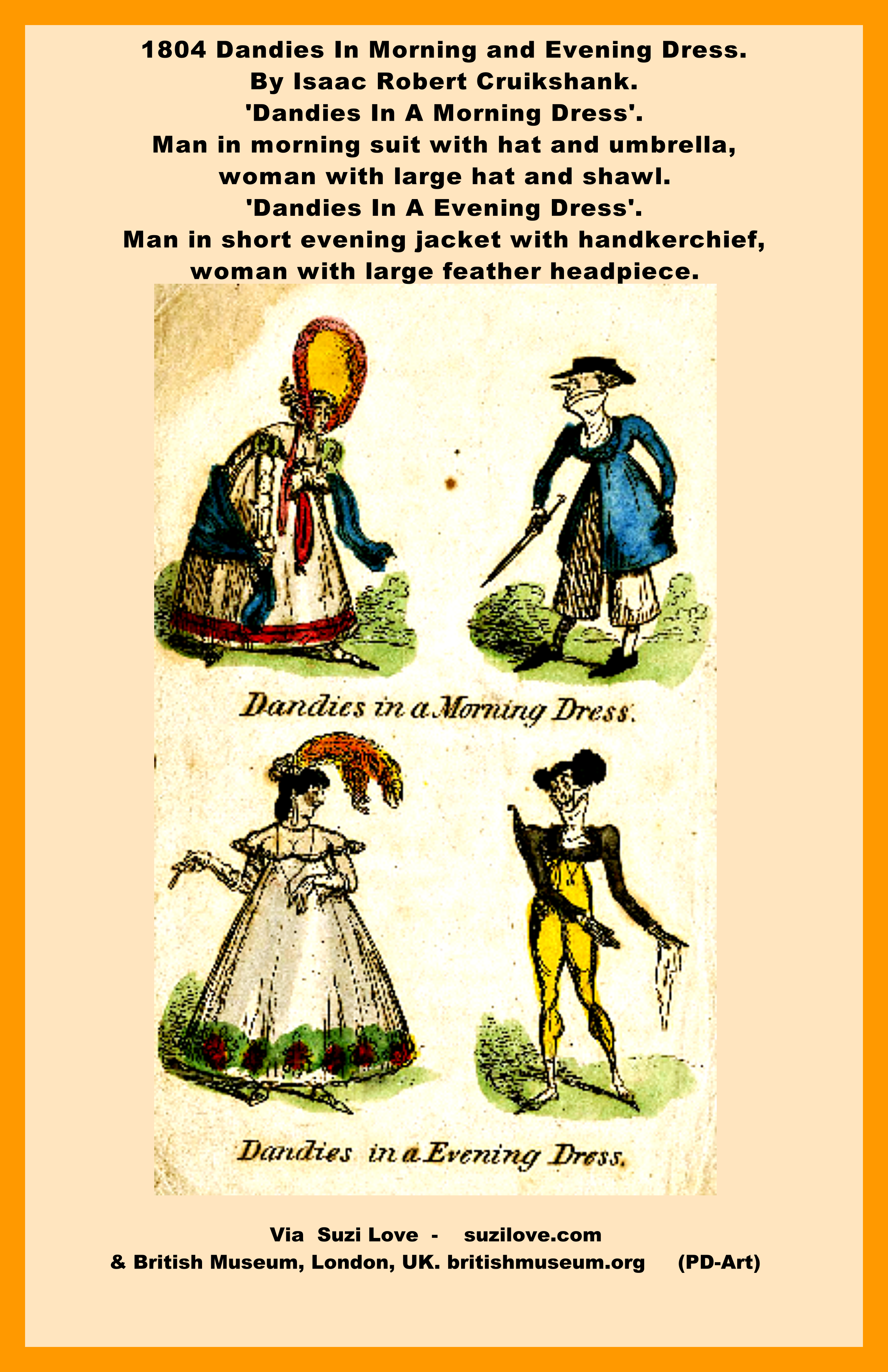
1804 Dandies In Morning and Evening Dress. By Isaac Robert Cruikshank. ‘Dandies In A Morning Dress’. Man in morning suit with hat and umbrella, woman with large hat and shawl. ‘Dandies In A Evening Dress’. Man in short evening jacket with handkerchief, woman with large feather headpiece. Via British Museum, London, UK. britishmuseum.org (PD-Art)
1817 April Ladies’ Voucher for all the Wednesday balls at Almack’s Assembly Rooms, London, U.K. in April 1817. The voucher is for the Marchioness of Buckingham to attend the balls at Almack’s “on the Wednesdays in April 1817.” There are initials in the lower right hand corner marked, “MD”. These initials might be for Mary Marchioness of Downshire who may briefly have been a patroness ca. 1816-1817. The red wax seal is also intact on the front. “Pall Mall” is written on the back of the card.Via Huntington Museum, California, U.S.A. https://hdl.huntington.org/digital/collection/p15150coll7/id/10672/
Subscribers to Almack’s were allowed to bring a guest to a Ball, if they were approved first. They called at the Rooms in person and were either granted a Strangers Ticket of admission or were banned. Rooms were open for supper, gaming dancing lasting the night. At eleven o’clock, doors were closed and no one, not even celebrities were admitted. Once a young lady making her debut during the London Season had been granted a ticket to Almack’s, her social standing was assured. The Patronesses introduced the debutante to people of importance and selected her dance partners.
1808 Lady In A High-Waisted White Dress Reading A Book Outdoors, French. Dress has short puffed sleeves and is worn under a frilled Pelerine, or shoulder cape, long tan gloves, walking shoes and a white country style hat with a blue bow. The lady is leaning on a post and reading a book. Fashion Plate via Journal des Dames et des Modes, Costume Parisien.
Empire Style Dress: Named after the First Empire in France. Empire dresses had a low neckline and skirts started directly under the bust and flowed into the classical relaxed wide styles of Greece and Rome. This style of dress is associated with Jane Austen and her contemporaries as a high-waisted dress was worn most days. Cotton, silk or taffeta were the popular fabrics.
Definition Pelerine: Tippet or shoulder cape, usually waist-length, with long, pointed ends in front. Popular in England and colonial America.
Fan of Regency London in the times of Jane Austen and Bridgertons? Regency Overview Book 1 Regency Life Series #JaneAusten #RegencyEra #Bridgerton #Nonfiction #amwriting https://books2read.com/ROver
1805-1810 ca. High-Waisted White Muslin Evening Dress, Possibly Made in France. Embroidered in white cotton in French knots, with collars, border, and vertical stripe in chain stitch with a design down the front of vine tendrils and acorns. Low square neck with draw-cord, ‘stomacher’ front closing over inner lining flaps. Straight cut skirt gathers at back and fastens with tape tie. Long oval train, short sleeves with ‘vandyke’ trimming. An evening ensemble typical of the early 19th century love of Neo-classical where this high-waisted dress with short sleeves copies Greek and Roman shape and dress as seen in sculptures from the time. White muslin fabric was usually imported from India but in the case, made in Europe to imitate Indian materials. via Victoria and Albert Museum, London, UK. collections.vam.ac.uk. https://books2read.com/SuziLoveFashionWomen1805-1809
Definition Van Dyke Points: V-shaped lace and trims named after a 17th Century Flemish painter, Sir Anthony Van Dyck, known for painting V-shaped lace collars and scalloped edges on sitters.
Definition Empire Style: Named after the First Empire in France, by 1800 Empire dresses had a very low décolleté, or neckline and a short narrow backed bodice attached to a separate skirt. Skirts started directly under the bust and flowed into the classical relaxed wide styles of Greece and Rome. This style of dress is associated with Jane Austen and her contemporaries as a simple cotton high-waisted dress was worn most days and accessorized according to the importance of the occasion.
Travel and Luggage By Suzi Love History Notes Book 10. How did people travel in Bridgerton’s and Jane Austen’s times? What did they take with them to make their long journeys easier? Travel by road, ship, canal, or railway all took a long time and had dangers so people learned to prepare. And then, in the nineteenth century, road improvements, inventions, and scientific developments made travel more pleasurable. books2read.com/SuziLoveTravel
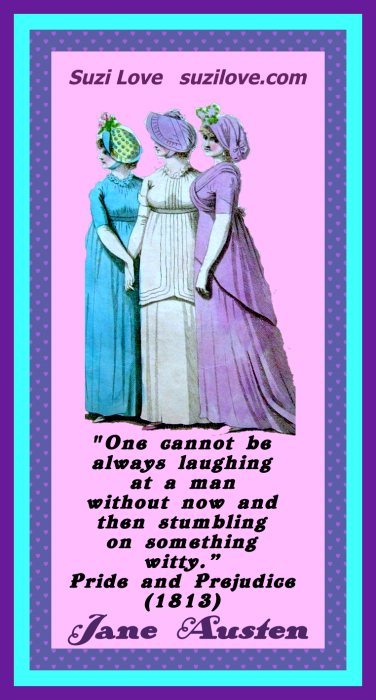
“One cannot be always laughing at a man without now and then stumbling on something witty.” Jane Austen Pride and Prejudice (1813) #JaneAusten #Quote #Regency
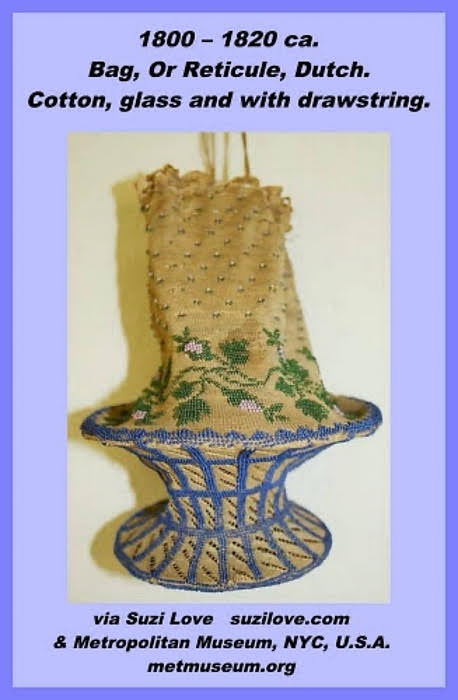
1800 – 1820 ca. Bag, Or Reticule, Dutch. Cotton, glass and with drawstring. via Metropolitan Museum New York City, U.S.A. metmuseum.org http://books2read.com/suziloveReticules Because reticules were so popular, Jane Austen and her family and friends and the Bridgerton family would have made reticules for each other for gifts and carried these small purses with them whenever they went out.
From Historic Dress In America: ‘Reticules were so universally carried during the first part of the nineteenth century that they were called Indispensables, and a few years later ridicules. Miss Southgate describes one in a letter in 1802, ‘Martha sent me a most elegant Indispensable, white lute-string spangled with silver…’
Definition Reticule Or Bag or Purse: Often with a drawstring to pull closed and usually made of cloth or covered cardboard and often decorated with beading or embroidery. A reticule, or purse, or handbag, was usually carried by a woman during the Regency period to carry all their daily necessities. Earlier, women used pockets that tied at the waistline and were hidden in the folds of their skirts. Empire style, or early 1800s, high-waisted dresses made it impossible to either sewn in a pocket or to tie on a pocket. So women began carrying small, decorated bags called Reticules, or ridicules, which generally pulled close at the top with a drawstring.
• Beadwork: Attaching beads to one another by stringing with a needle and thread or thin wire, or sewing them to cloth. Includes loom weaving, stringing, bead embroidery, bead crochet, and bead knitting.
• Embroidery: Decorating fabrics with a needle and thread, or cloth, such as a needlepoint picture of a house or hand sewn initials.