This book shows how body wraps, stays, and corsets were worn to create a variety of fashionable silhouettes through past centuries. Corsets flattened breasts and accentuated rounded hips or pushed up breasts and showed off the bust line depending on the fashions of the time and the desired silhouette. Includes corsets through the Georgian, Regency, Victorian and Edwardian Eras and Jane Austen’s lifetime. Overview of corsets through history, including the Georgian, Regency, Victorian and Edwardian Eras and Jane Austen’s lifetime. History Notes Book 14.
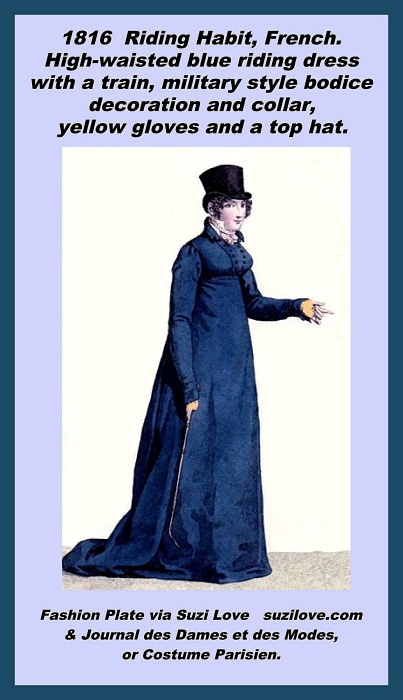
1816 Blue Riding Habit, French. High-waisted blue riding dress with a train, the long full skirt being necessary to cover a lady’s legs and preserve her modesty when riding side saddle. These riding habits were usually designed by men and were in two pieces, a jacket and a skirt, worn over a shirt. A military style bodice decoration, high pointed collar and a knotted pink dotted cravat worn underneath that imitate male styles, or even Dandy fashion. Sleeves are very long as was the trend in French riding habits. Yellow gloves and a masculine style beaver hat. This print was designed by Horace Vernet and engraved by Pierre Baquoy. Fashion Plate via Journal des Dames et des Modes, or Costume Parisien. Although, there are very similar riding habit fashion plates in other magazines.
The type of outfit Jane Austen and her friends would have worn when they went horse riding. https://books2read.com/SuziLoveFashionWomen1815-1819
1800s Typical Cold Collation Dishes served during the 1800s. These are the sort of dishes Jane Austen’s family would have eaten on a regular basis. Pigeon Pie, Raised Game Pie, Cutlets and Peas, Prawn Bouquet, Creamed Chicken, Plover’s Eggs, Lamb Cutlets, Stuffed Larks, Piped Ham, Boned Capon. From: 1860 Mrs. Isabella Beeton’s Book of Household Management.
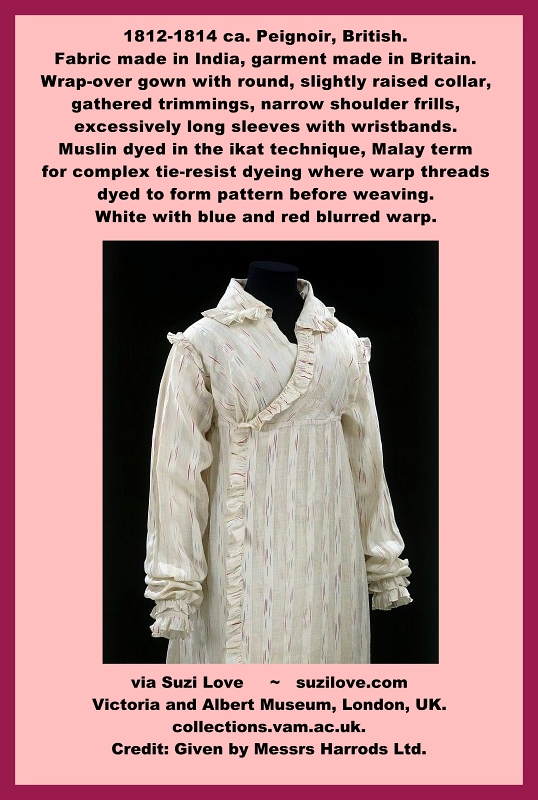
1812-1814 Ca. White Muslin Peignoir Or Dressing Gown, British. The sort of robe Jane Austen would have worn. Fabric made in India, Garment made in Britain. Wrap-over gown with round, slightly raised collar, gathered trimmings, narrow shoulder frills, excessively long sleeves with wristbands. Muslin dyed in the ikat technique, Malay term for complex tie-resist dyeing where warp threads dyed to form pattern before weaving. White with blue and red blurred warp.
via Victoria & Albert Museum, London, UK. collections.vam.ac.uk Credit: Given by Messrs Harrods Ltd.
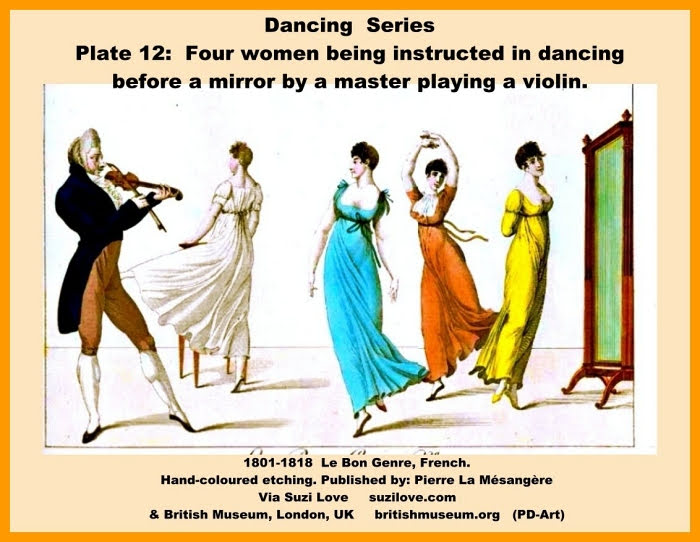
1802-1812 ca. Dancing Or La Dansomanie Series. Four women being instructed in dancing before a mirror by a master playing a violin. Le Bon Genre Description Plate 12. Via British Museum, London, UK. britishmuseum.org (PD-Art)
1817 December Black Walking Mourning Dress, English. Black bombazine dress with a black crepe hem, with tight bodice wrapping across to the right side, trimmed with a piping of black crape that looks like braiding and finished by rosettes of crape, in the center of each of which is a small jet ornament. Long sleeves trimmed similarly at the wrists, half-sleeve of a new form trimmed with crape, high standing collar displaying a mourning ruff. Claremont bonnet, named because it is the same shape as one worn by the Princess, whose home with her husband, Prince Leopold, was called Claremont. Black crape over black sarsnet and lined with double white crape. Low crown but large front and tastefully finished by black crape with a bunch of crape flowers on one side. Black shamois gloves, and black shoes. “We have again to acknowledge our obligations to the lady who favored us last month; and we understand that the dresses from which our prints this month have been taken were also purchased from Mrs. Bell of St. James’s-street.” Fashion Plate via Rudolph Ackermann’s ‘The Repository of Arts’.
Mrs. Bell ‘invented’ fashion plates and as well as publishing in La Belle assemblee, she also sold them to other magazines. Hence the crossover we often see where the same plate, or a similar version, appears in different magazines.
1805 Breeches, part of the Royal Naval Uniform of surgeon Joshua Horwood , who served as surgeon’s mate in HMS ‘Prince’ at Trafalgar, and was promoted to surgeon in 1807. via Royal Museums Greenwich, London, U.K. collections.rmg.co.uk
19th Century Late. Sterling Silver Five Piece Writing or Desk Set, Peru (under German Company). Hinged cut crystal inkwell with beveled edges, wheel cut starburst at base, wax seal with blank matrix, blotter, dip pen and letter opener. Each with guilloche enamel featuring yellow rose with lush green leaves on pale blue background, trimmed with a lighter shade of blue enamel. Dip pen with allover pale blue guilloche enamel, pen nib marked 14k Gold Plated.
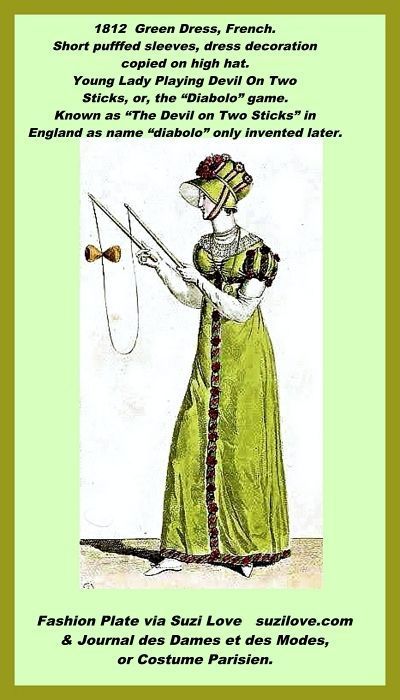
1812 Young Lady Playing Devil On Two Sticks, or, the “diabolo” game. The game was known as “The Devil on Two Sticks” in England at the time as the name “diabolo” was only invented later. Green dress with short puffed sleeves, dress decoration copied on high hat. Fashion Plate via Journal des Dames et des Modes, or Costume Parisien.
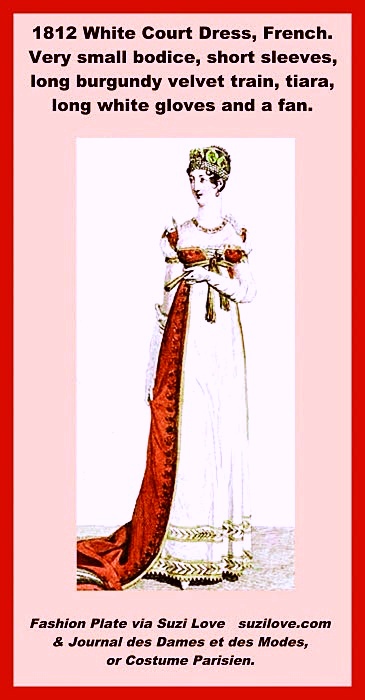
1812 White Court Dress, French. Very small bodice, short sleeves, long burgundy velvet train, tiara, long white gloves and a fan. Fashion Plate via Journal des Dames et des Modes, or Costume Parisien.
Definition Court Dress: Usually, the difference between a court dress and a ball dress was in the quality of fabrics used, how elaborate the design, and the number and quality of the accessories. Plus, in England in the early 1800s court dresses were required by Queen Charlotte to have hoops and in France and other European countries court dresses a long train, usually expensively decorated. During the Regency Era, white cotton dresses were considered suitable for many evening events, but definitely not for an evening event in a palace.








![19th Century Late SterlingSilverFivePieceWritingorDeskSetPeru_Dippenwithpaleblueguillocheenamel_pennib14kGoldPlatedbatch.jpg ]
19th Century Late. Sterling Silver Five Piece Writing or Desk Set, Peru (under German Company). Hinged cut crystal inkwell with beveled edges, wheel cut starburst at base, wax seal with blank matrix, blotter, dip pen and letter opener. Each with guilloche enamel featuring yellow rose with lush green leaves on pale blue background, trimmed with a lighter shade of blue enamel. Dip pen with allover pale blue guilloche enamel, pen nib marked 14k Gold Plated.](https://suzilove.files.wordpress.com/2021/06/writing_19th_century_late_writing-and-desk-setperu_lge-1_lge_sml.jpg?w=554)