18th Century Late – 19th Century Early Gloves as worn by women in Jane Austen’s and Bridgerton’s years, French. Silk embroidered with silk. via Museum of Fine Arts, Boston. mfa.org


18th Century Late – 19th Century Early Gloves as worn by women in Jane Austen’s and Bridgerton’s years, French. Silk embroidered with silk. via Museum of Fine Arts, Boston. mfa.org
1800s Typical Puddings and Pastries.These are the sort of puddings and pastries Jane Austen’s family would have eaten on a regular basis during the early 1800s, or Regency Era. Open Apple Tart, Galette, Apricot Fritters, Pancakes and Apricot Jam, Charlotte Russe, Macaroni Cheese, Cherry Tart, Mince Pies, Almond Puddings, Tartlets, Compote Of Fruit, Fruit Pudding, Fruit Tart, Christmas Plum Pudding, Milk Pudding and Roly Poly Jam Pudding. From: 1850s- 1860s Mrs. Beeton’s Books of Household Management. via Google Books (PD-150). 1800s Typical Puddings and Pastries Served In Households Like Jane Austen’s. https://books2read.com/suziloveOLD


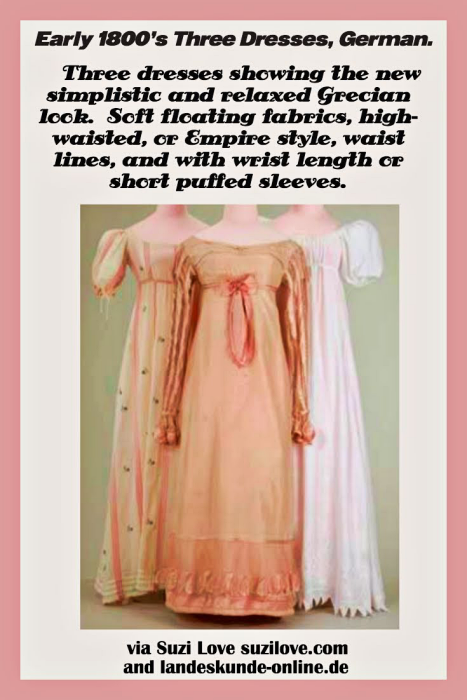
Early 1800’s Three Dresses, German. Three dresses showing the new simplistic and relaxed Grecian look. Soft floating fabrics, high- waisted, or Empire style, waist lines with wrist length or short puffed sleeves. Via landeskunde-online.de.
Definition Empire Style: Named after the First Empire in France, by 1800 Empire dresses had a very low décolleté, or neckline and a short narrow backed bodice attached to a separate skirt. Skirts started directly under the bust and flowed into the classical relaxed wide styles of Greece and Rome. This style of dress is associated with Jane Austen and her contemporaries as a simple cotton high-waisted dress was worn most days and accessorized according to the importance of the occasion.
1814 Jane Austen, Mansfield Park. “Give a girl an education and introduce her properly into the world, and ten to one but she has the means of settling well, without further expense to anybody.”


What shoes did the Bridgertons and Jane Austen wear? Gray Slippers, American, with long ankle ties.
Typical Regency Era women’s footwear as worn by Jane Austen and her contemporaries and by the Bridgerton family were shoes that had low heels, slightly rounded toes, embellished with a bow and with ribbon ties for the ankles. Shoe styles and shapes were generally very plain but then shoes began to be made in bright colors to match the colorful Empire style, or high-waisted, gowns. Plus, as gowns were lighter and floatier, glimpses could be had of these new pretty shoes. Ribbons, rosettes and other decorative. embellishments allowed ladies to personalize shoes.


“Happiness in marriage is entirely a matter of chance.” #JaneAusten #Regency
Jane Austen’s Pride and Prejudice (1813)


1806 Short-Sleeved White Muslin Dress With Train. Bodice and sleeves have ribbon decoration, evening flowered headdress, half parure of necklace and ear bobs, and gorgeous Indian hand-loomed green shawl. Fashion Plate via Journal des Dames et des Modes, or Costume Parisien.
Definition Half Parure: A Parure is a matched set of jewelry, including a necklace, bracelet, earrings, pin etc. A half Parure didn’t include a jewelled headdress, or tiara.
Definition Shawls: The shawl started off in India as a fine wool garment for men that could be worn as a scarf, turban or as a mantle: the word comes from the Persian shäl. Originally imported from the East, European Kashmir shawls were made first in Norwich and Edinburgh in Britain in the late 18th century. Shawls were an essential item in the early 1800s to cover the thin gowns women wore. They were made of muslin, gauze, silk, wool, and velvet, though cashmere shawls were the softest and most prized.

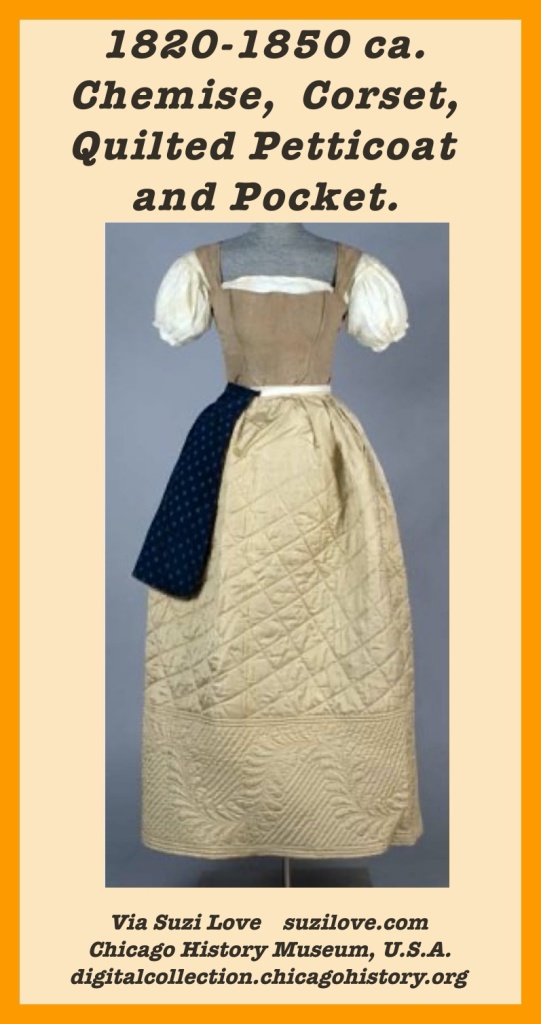
1820-1850 ca. Chemise, Corset, Quilted Petticoat and Pocket. Gift of Mary S. Belden. Corset About 1820-1830 ca. CHS Collection. Pocket About 1820-1840 ca. Chemise About 1839-1850 ca. via Chicago History Museum, U.S.A.
Chemise Or Shift: Sleeveless, mid-calf length garment of white cotton or muslin was worn next to the skin under stays or corset. Called ‘Shift’ from early Georgian (1700-1750) until Late Georgian (1750-1790) to replace ‘Smock’. By 1800, name shift was replaced by ‘Chemise’.
Corset: French term for stays. Structured bust supporting or body shaping foundation garment. Tightened by laces and often with reinforcing e.g. boning, cording and flossing.
From the Curator Victoria and Albert Museum, London: Quilting was a popular form of decoration for a variety of garments including pockets. However, hand-quilting was a time-consuming method of decoration. The increased demand for quilted petticoats, waistcoats and pockets led to the invention of woven quilting.

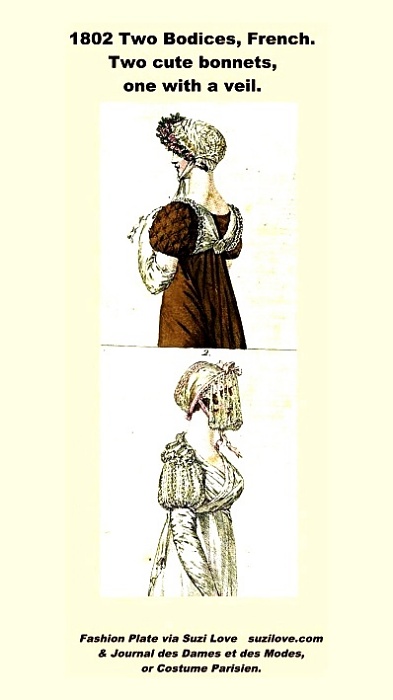
1802 Two Bodices, French. Two bonnets, one with a veil. Fashion Plate via Journal des Dames et des Modes, or Costume Parisien. https://books2read.com/SuziLoveFashionWomen1801-1804

“There is a stubbornness about me that never can bear to be frightened at the will of others. My courage always rises at every attempt to intimidate me.” Jane Austen Pride and Prejudice (1813) #JaneAusten #RegencyEra #Quote https://books2read.com/SuziLoveFashion1810-1814
