1880 ca. Travelling Inkwell, English. Red Leather and Heart Shaped. via Ruby Lane Antiques. rubylane.com



1880 ca. Travelling Inkwell, English. Red Leather and Heart Shaped. via Ruby Lane Antiques. rubylane.com
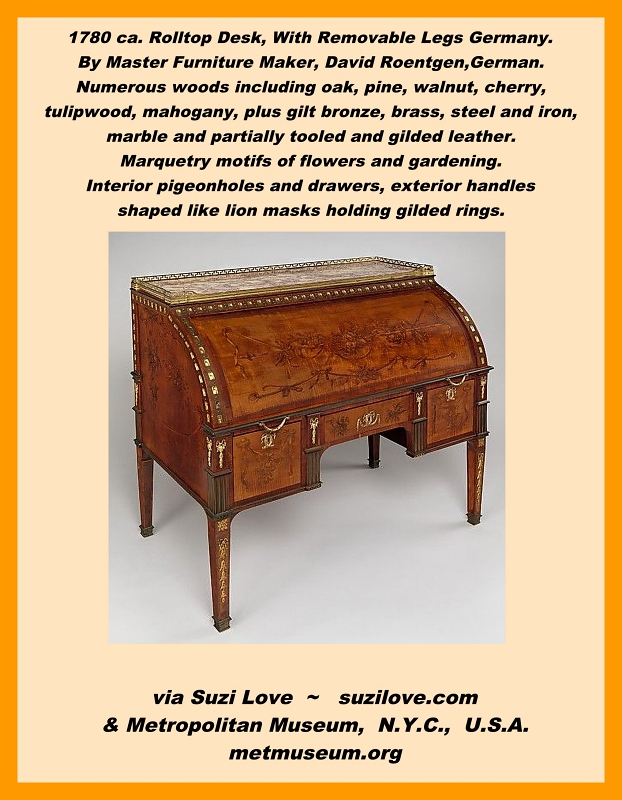
1780 Rolltop Desk, With Removable Legs Germany. By Master Furniture Maker, David Roentgen,German. Numerous woods including oak, pine, walnut, cherry, tulipwood, mahogany, plus gilt bronze, brass, steel and iron, marble and partially tooled and gilded leather. Marquetry motifs of flowers and gardening. Interior pigeonholes and drawers, exterior handles shaped like lion masks holding gilded rings. via Metropolitan Museum, N.Y.C., U.S.A. metmuseum.org
1774-1775 ca. Gold Etui, Or Decorative Container, For Holding Sealing Wax, French. #GeorgianEra #Europe #Antiques #writingtools. https://www.suzilove.com/wp-admin/books2read.com/SuziLoveWritingTools
Continue reading →I love Old Stuff! How about you? Take a look at Suzi Love’s Pinterest Boards. pinterest.com/suziloveoz
Fashion women 1800- 1820 http://pinterest.com/suziloveoz/fashion-women-1800-1820/
Fashion Women 1820- 1850 http://pinterest.com/suziloveoz/fashion-women-1820-1850/
Fashion Men 1800- 1820 http://pinterest.com/suziloveoz/fashion-men-1800-1820/
Fashion Accessories 1800- 1850 http://pinterest.com/suziloveoz/fashion-accessories1800-1850/
Books – Jane Austen http://pinterest.com/suziloveoz/books-jane-austen/


https://au.pinterest.com/suziloveoz/_created
19th Century Mid-Late Five Desk Seals. L-R Carnelian seal with silver mounts set with colored stones; malachite urn seal: gilt-bronze seal with winged cherub heads: Silver-gilt seal eagle, Silver-gilt seal as eagle’s leg below a blue glass ball. via Sotheby’s Auctions. sothebys.com
In the Bridgerton family, or Jane Austen’s household, and during the Regency Era, sealing wax was not only impressed onto the back of a letter with a seal to protect against tampering, but also to identify the sender of the letter. People, especially aristocrats, kept personal and family seals to be used for many different purposes e.g. A letter to a government official would be sealed with an aristocrat’s crest or title. Personal seals for identification have been since early civilizations. The rubber stamps and embossers we use today serve the same purpose, identifying the sender.
Definition: Wax Seals: Pressed onto a letter or envelope to show that a document is unopened or to verify the sender’s identity. A signet ring or was seal is pressed into a dollop of hot wax to seal a letter or envelope closed.

Do you need more factual and visual information for your historical fiction? History of fashion, music, peerage and customs in 18th and 19th centuries. Non-fiction series full of gorgeous pictures and engraved fashion plates. A visual history of fashion, music, peerage, social manners and customs from late 1700s to late 1800s, or 18th and 19th centuries.


1800 ca. Writing Box, British, as would have been used by people in Jane Austen’s times, or, the Regency Era. Small brass bound solid mahogany writing box of dovetail construction. Green baize sloping writing surface with compartments for storing papers beneath. Small size may be designed for private intimate correspondence. Drop down carrying handles on two sides are early form of handle. Side drawer pulls out after retaining brass pin is taken out. via hygra.com


1800-1870 ca. Stocking Purses, British. Beaded stocking purses crocheted in silk and steel beads,
with steel rings with tassels and fringes. via Victoria and Albert Museum, London, UK. collections.vam.ac.uk.
Definition Miser or Long or Stocking or Ring Purses: Long, narrow, tubular shape, often wider at ends and narrow in middle, which had a short slit opening. Popular in England and France from the mid-18th century through the early 20th century.
From the Curator Victoria and Albert Museum, London: Stocking purses are also known as misers’ or wallet purses. The majority were netted, but some were knitted or crocheted, like this one. Once worked, the elongated tube was put on an expandable purse stretcher to shape it. It was then sewn up, leaving a central opening, and squeezed through a pair of rings known as sliders, which were used to secure and separate the different coins stored at either end. It could be carried in the hand, bag or pocket, or tucked over a belt. Many stocking purses were made as presents, and were thought a suitable object to give to a gentleman.
Crochet is a type of needlework with an open, lacy appearance, which is formed with a hook and single length of thread making a series of loops, chains and knots. The technique developed out of ‘tambouring’, a type of embroidery, after the tambour hook began to be used to create series of loops, free from a ground fabric. This could then be used as a separate trimming, like lace, or made to form items like this purse. Crochet was thus added to the varieties of fancy needlework available to ladies, and instructions for making it can be found in manuals from the 1820s onwards.

1800-1870 ca. Beaded Stocking Purses, British #RegencyFashion #RomanticEra #HistoricFashion books2read.com/suziloveReticules

1562-1575 ca. Wine Cooler With a Pageant Battle with Elephants, Italian.
Maiolica, or tin-glazed earthenware, from the workshop of the Fontana family. 1553-1580.
Coolers were set near the table on a credenza or sideboard, visible to diners and within easy reach of servants. They are designed to be viewed from any side, but especially from above when empty. When not in use, coolers remained in place to convey the owner’s refined taste and, due to the relatively inexpensive medium, personal modesty. via Metropolitan Museum New York City, U.S.A. metmuseum.org

Suzi Love – Romance and history author.
suzilove.com
19th Century Late Mechanical Tantalus, French. Ormolu, Bronze, Crystal, and Gilt with a lock and key to open. Earlier versions of this type of small drinks cabinet would have been used in most households during Jane Austen’s times, unless the householders were teetotalers. via 1st Dibs Auctions 1stdibs.com
Tantalus: A small wooden cabinet containing drink decanters. The box has a lock and key to keep unauthorised people from drinking the contents e.g. servants and younger sons, yet still allowing the decanters of drinks to be on show. The word, Tantalus, is a reference to the unsatisfied temptations of the Greek mythological character Tantalus. Patented in the UK in 1881 by George Betjemann, a cabinet maker from the Netherlands, whose workshop was on Pentonville Road, London from the 1830s.


