↓
 

Suzi Love

Making history fun, one year at a time.

Header_
  • Home
  • Newsletter
  • Pre order form
  • Shop
    • Cart
    • Checkout
    • My account
    • Refund and Returns Policy
  • Blog
  • BOOKS
    • History Events
    • Kelly’s Justice
    • Outback Arrival
    • Irresistible Aristocrats
    • History Notes
    • Scandalous Siblings
    • Love After Waterloo
    • Regency Life Series
  • Privacy Policy
  • EVENTS
Home » History » Page 8 << 1 2 … 6 7 8 9 10 … 50 51 >>

Category Archives: History

Post navigation

← Previous Post
Next Post→

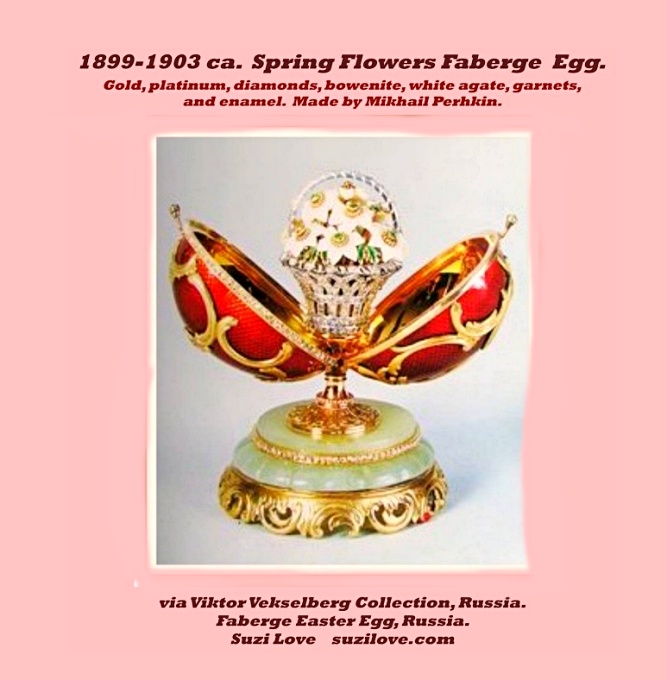
1899-1903 ca. Spring Flowers Imperial Surprise Faberge Easter Egg, Russia. #easter #faberge #russia #easteregg

Suzi Love Posted on March 26, 2026 by Suzi LoveMarch 26, 2026

1899-1903 ca. Spring Flowers Imperial Surprise Faberge Easter Egg. Gold, platinum diamonds, bowenite, white agate, demantoid, garnets, and enamel. By Mikhail Perhkin. Via Viktor Vekselberg Collection in Russia. Faberge Easter Egg, Russia. Faberge Easter Egg, Russia.

egg_1899-1903_SpringFlowers_Faberge Easter Egg, Russia.
1899-1903 ca. Spring Flowers Imperial Surprise Faberge Easter Egg. #easter #faberge #russia #easteregg https://books2read.com/suziloveEaster Share on X
Posted in 1900s, Decorative Item, Easter, Ester In Images, household, Royalty, Russia | Tagged decorative, Easter, easter egg, Easter in Images, Faberge, household, Russia

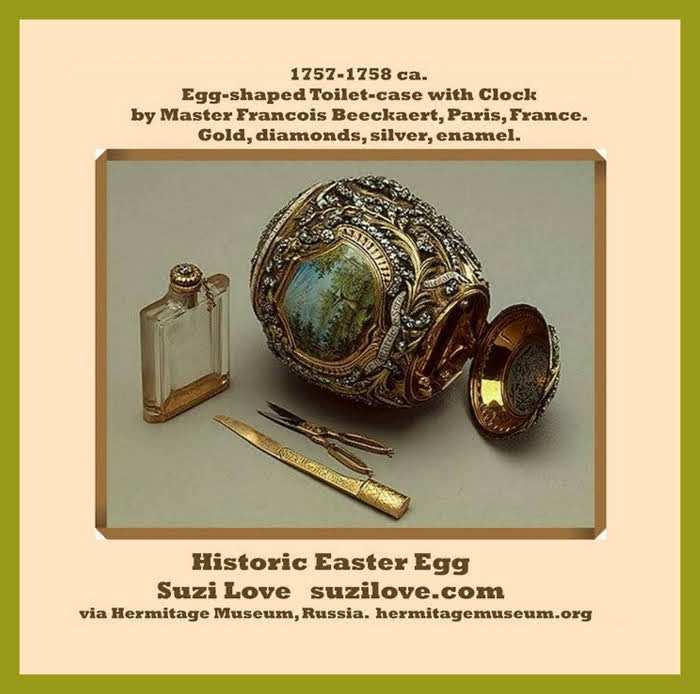
1757-1758 ca. Egg Shaped Toilet Case With Clock, Paris, France. #Easter #France #Clock

Suzi Love Posted on March 26, 2026 by Suzi LoveMarch 26, 2026

1757-1758 ca. Egg Shaped Toilet Case With Clock. By Master Francois Beeckaert, Paris, France. Gold, diamonds, silver, enamel. via Hermitage Museum, Russia.

1757-1758 ca. Egg Shaped Toilet Case With Clock.
1757-1758 ca. Egg Shaped Toilet Case With Clock, Paris, France. #Easter #France #Clock. https://books2read.com/suziloveEaster Share on X
Posted in 1700s, Box Or Container, Decorative Item, Easter, France, Georgian Era, History, Suzi Love Books, Suzi Love Images | Tagged 1700s Or Georgian Era, antiques, Box Or Container, decorative, Easter, Easter in Images, France | Leave a reply

1811-1820 British Regency Era. Jane Austen wrote her books during years when King George III deemed dad and son appointed Prince Regent. #JaneAusten #RegencyEra #London #BritishRoyalty

Suzi Love Posted on March 26, 2026 by Suzi LoveJanuary 25, 2026

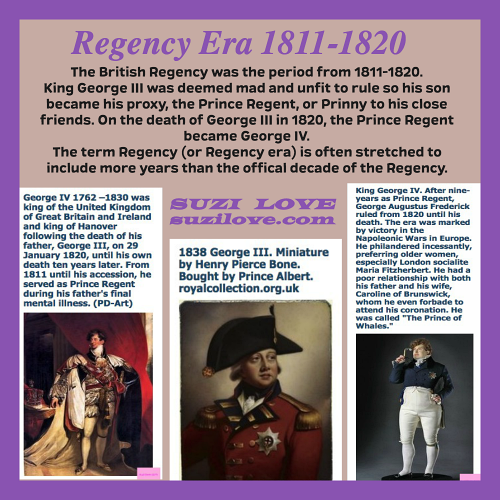
1811-1820 Regency Era Overview. The British Regency was the period from 1811-1820. King George III was deemed mad and unfit to rule so his son became his proxy, the Prince Regent, or Prinny to his close friends. This was the era during which Jane Austen wrote her books. Books that are still read and discussed today.

As a period in Britain’s official history, the Regency lasted less than ten years, although scholars apply the term Regency to a much longer period. It began in 1811, when George Ill was declared mad and the Prince of Wales was appointed Regent. It ended in 1820 when the King finally died and the Regent was crowned George IV. However, the Regency was a period in Britain’s history that had an effect on the social and cultural life for four decades, from the start of the French Revolution in 1789 to the passing of Britain’s Great Reform Act in 1832.

The decision to make George IV the Regent took a lot of political debate. After nearly two and a half months of political wrangling, the British government agreed to grant the title of Prince Regent on George. The Act of Parliament was finally passed by a commission in the House of Lords on February 5th 1811 and the Prince was formally sworn in as Regent at Carlton House the next day. He continued to rule as Regent until 1820 when, on his father’s death, he assumed the title George IV and reigned until his own death in 1830.

During the Regency, royalty and upper class ladies and lords, or the Beau Monde, lived elegant and extravagant lives that also allowed excesses and depravity. Britain was united behind exceptional heroes in long wars against France, but internally divided by class distinction and political agitation. The foundations of a modem industrial nation were laid by engineers, inventors and scientists. while Romantic poets and visionary artists dreamt of escape to earlier times and more ideal worlds. From: Queen’s Gallery, London, U.K.

1811-1820 Regency Era Overview.  The British Regency was the period from 1811-1820. King George III was deemed mad and unfit to rule so his son became his proxy, the Prince Regent, or Prinny to his close friends.
1811-1820 British Regency Era. Jane Austen wrote her books during years when King George III deemed dad and son appointed Prince Regent. #JaneAusten #RegencyEra #London #BritishRoyalty https://books2read.com/suziloveROver Share on X
RL_1_D2D_Regency Overview RetailerLinks
https://books2read.com/suziloveROver
RL_1_D2D_Regency Overview RetailerLinks https://books2read.com/suziloveROver
Posted in 1800s, 1800s Mens Fashions, England, Google Books, History, Jane Austen, London, Regency Era, Royalty, Suzi Love Images | Tagged British history, King George IV, London, peerage, Prince Regent, Regency Life, Regency London, Regency Royalty

Floris London: Perfume and Toiletries in Jane Austen’s and Bridgerton’s London. #Bridgerton #RegencyEra #JaneAusten #Floris

Suzi Love Posted on March 26, 2026 by Suzi LoveMarch 1, 2026

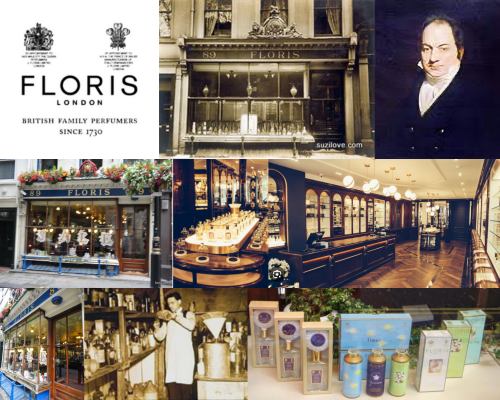
While writing about perfumes and oils, a favourite subject of mine, for my book, Scenting Scandal, I sniffed out some fascinating snippets on the history of early perfume suppliers in London. I have a nose for these things ( He He!) as in my past life I also blended oils and perfumes.  One name stood out in historic London- Juan Floris.

He opened his shop at 89 Jerym St. in the elegant quarter of St. James’ London soon after his arrival from the Mediterranean in 1730. After starting as a barber and comb-maker, he missed the aromas of his Mediterranean youth and began blending oils, essences and fixatives, from Europe, into the first Floris fragrances.

‘ Purveyors of The Finest Perfumes & Toiletries to the Court of St James’ Since the Year 1730.’

In the same manner that Fortnum & Mason held Royal Warrants to supply groceries to the Royals, Floris held Royal Warrants to supply perfumes, shaving items and toiletries.

The first Royal Warrant granted to J.Floris Ltd was in 1820 as ‘Smooth Pointed Comb-makers’ to the then newly appointed King George IV. Then, the social elite followed the court until the Floris ledgers held accounts for an array of public figures, including practically every European Royal. Combs, tooth brushes and mouth washes were greatly valued by the company’s elite clientele.

These days, and at the same premises, Floris still supplies royalty and world celebrities with an array of fragrances and bathroom accessories.

The Floris archives hold letters from famous customers detailing their preferences and their thanks, including the following examples:

  • Winston Churchill, according to records held by Floris, purchased Special No. 127 Eau de Toilette and Stephanotis in 1934.
  • Marilyn Monroe was also known to have purchased from Floris on at least one occasion, having made a purchase of Rose Geranium while staying at the Beverly Hills Hotel, California in 1959.
  • Florence Nightingale wrote a 25 July 1863 letter thanking Mr Floris for his ‘sweet-smelling nosegay’.
  • Mary Shelley, whilst abroad, sent friends instructions to purchase her favourite combs and toothbrushes from Floris.
  • Beau Brummell in the early 19th century would discuss his current fragrances at length with Mr Floris.
Floris London: Perfume and Toiletries in Jane Austen's and Bridgerton's London. #Bridgerton #RegencyEra #JaneAusten #Floris
Floris London: Perfume and Toiletries in Jane Austen's and Bridgerton's London. #Bridgerton #RegencyEra #JaneAusten #Floris books2read.com/suziloveOLD Share on X
RL_5_D2D_RetailerBuyLink_RL_5_2
https://books2read.com/suziloveOLD
Posted in 1700s, 1800s, 1900s, Bridgerton, Celebrity, Decorative Item, Edwardian Era, Georgian Era, household, Hygiene, Jane Austen, London, Regency Era, Romantic Era, Victorian Era | Tagged Bridgerton, celebrity, hygiene, Jane Austen, King George IV, lndon, Regency Era, Regency London, Regency Royalty, shopping

1818-1831 Roller Printed Cotton Furnishing Fabrics, English. #RomanticEra #Fabric #RegencyEngland

Suzi Love Posted on March 26, 2026 by Suzi LoveMarch 24, 2026

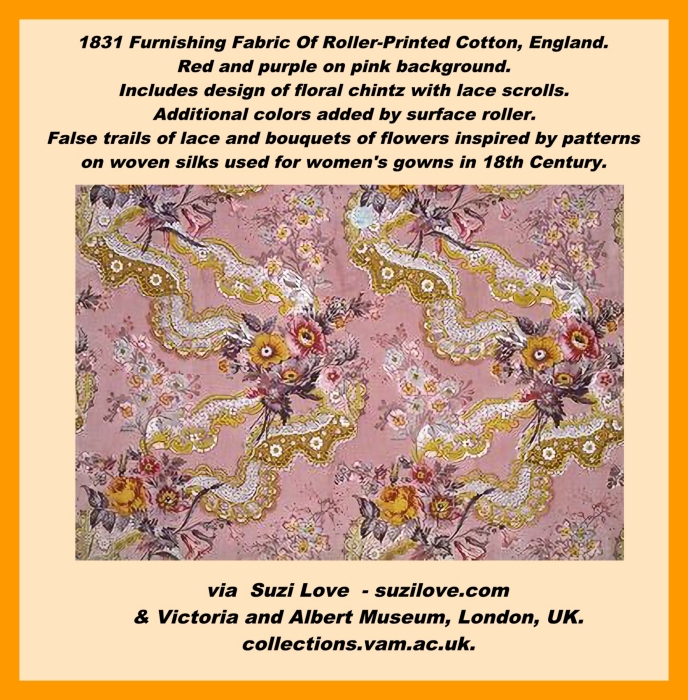
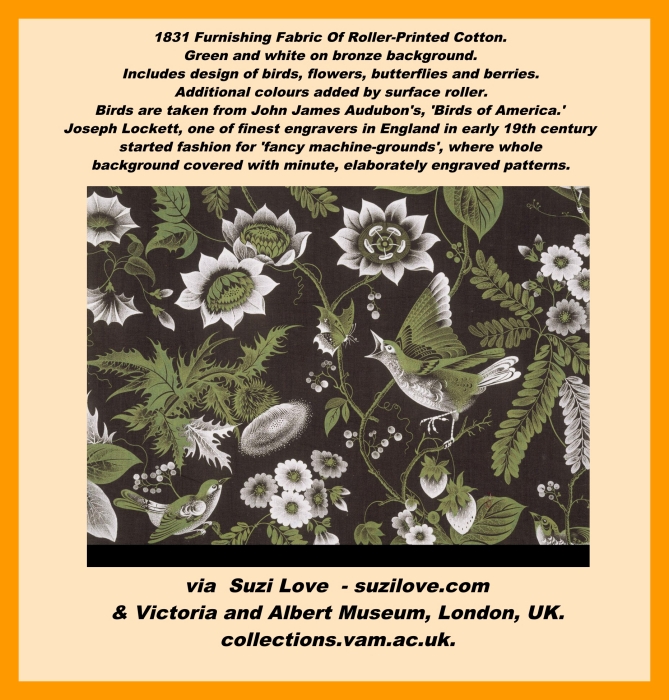
1818-1831 Roller Printed Cotton Furnishing Fabrics, English.

Between 1820 and 1840 textile printers began to produce designs that were based on the woven silk dress fabrics of the 1750’s. Designs showing curving trails of lace or ribbons between bouquets of flowers became as popular in the 1830s as they had been in the 18th century.

Roller Printed Cotton.

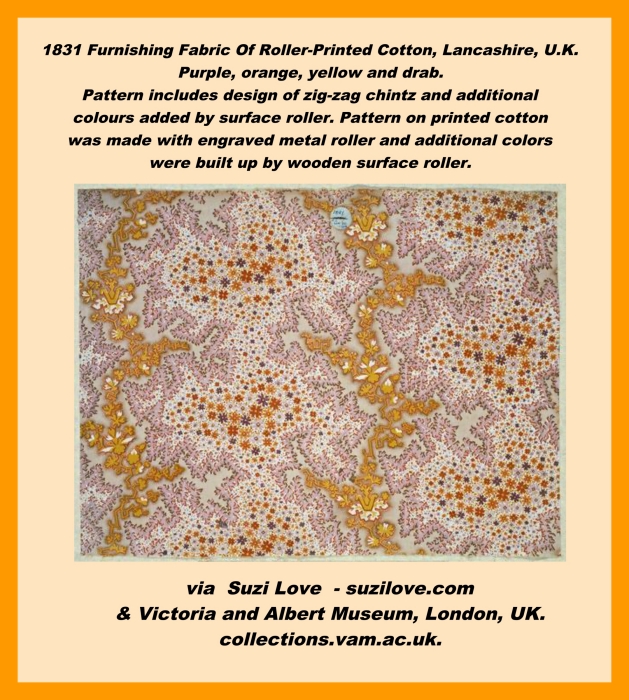
The pattern on printed cotton was made with an engraved metal roller and additional colors were built up by wooden surface roller. Roller printing on textiles was introduced in the late 18th century and at first used mainly for small-patterned dress fabrics. By the 1830s, roller printing was highly mechanized process and had largely replaced block printing for fashionable furnishings.

Materials and Making
The development of roller printing coincided with a radical transformation in the dyestuffs available for printing on cotton. Until the beginning of the 19th century printing had been based on the use of vegetable dyes. In Britain, France and Germany new chemical processes were developed and mineral colors produced that transformed the palette of colors available to the printer and made combinations such as shades of pink and orange possible.

Design and Designing
The false trails of lace and bouquets of flowers in the fabric are inspired by the patterns of woven silks from nearly a century earlier. Changing taste made this design suitable for furnishing a room in the 1830s, while the 18th-century silk that was its inspiration would have been intended for a woman’s gown.

Time
The styles considered fashionable in 1830s furnishings were widely diverse. Among the more recognisable historical references were Rococo, Elizabethan and Gothic. A design such as this seems to be relying on novelty of effect for its success.

Information via Curator of Victoria and Albert Museum, London, UK. collections.vam.ac.u Victoria and Albert Museum, London, UK. 

Household_1831 Furnishing Fabric, English. Roller-printed cotton in red and purple_pink background_VAM__sml

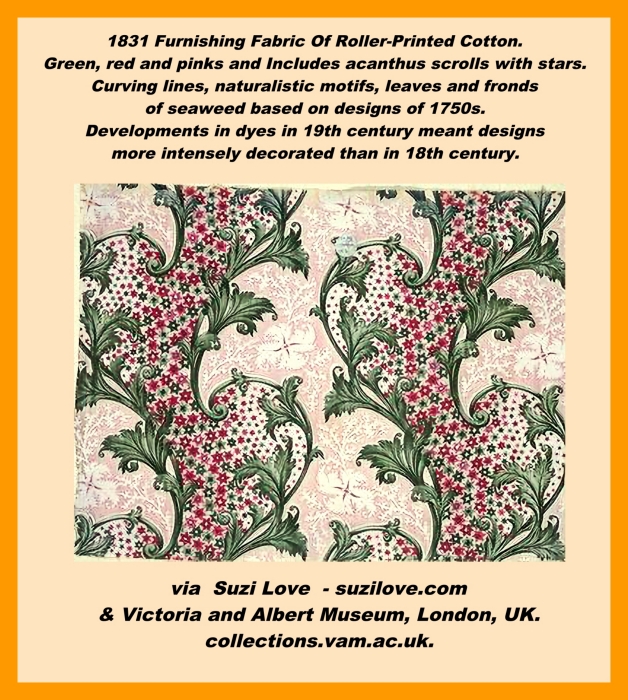
1831 Furnishing Fabric Of Roller-Printed Cotton. Green, red and pinks and Includes acanthus scrolls with stars. Curving lines, naturalistic motifs, leaves and fronds of seaweed based on designs of 1750s. Developments in dyes in 19th century meant designs more intensely decorated than in 18th century. via Suzi Love - suzilove.com & Victoria and Albert Museum, London, UK. collections.vam.ac.uk.
1831 Furnishing Fabric, English. Roller-printed cotton in green, red and pink. Pattern includes design of acanthus scrolls with stars. collections.vam.ac.uk suzilove.com
1831 Furnishing Fabric Of Roller-Printed Cotton, Lancashire, U.K. Purple, orange, yellow and drab. Pattern includes design of zig-zag chintz and additional colors added by surface roller. Pattern on printed cotton was made with engraved metal roller and additional colors were built up by wooden surface roller. via Suzi Love - suzilove.com & Victoria and Albert Museum, London, UK. collections.vam.ac.uk.
1818-1831 Roller Printed Cotton Furnishing Fabrics. Seen in Jane Austen and Bridgerton years. #Bridgerton #JaneAusten #RomanticEra #Fabric #RegencyErahttps://books2read.com/suziloveROver Share on X
RL_1_D2D_Regency Overview RetailerLinks
https://books2read.com/suziloveROver
RL_1_D2D_Regency Overview RetailerLinks https://books2read.com/suziloveROver
Posted in 1800s, Bridgerton, Decorative Item, England, furniture, household, Jane Austen, Regency Era, Romantic Era, sewing | Tagged Bridgerton, England, fabric, furniture, household, Jane Austen, Regency Era, Romantic Era, sewing, Victoria and Albert Museum

1911 Orange Tree, or, Bay Tree Faberge Imperial Easter Egg. #Easter #EasterEgg #christianity #russia #faberge

Suzi Love Posted on March 25, 2026 by Suzi LoveMarch 25, 2026

1911 Orange Tree, or, Bay Tree Faberge Imperial Easter Egg. Gift to Maria from her son. Automaton nightingale emerges and sings when the correct orange is turned. Gold, jade, diamonds, vitrines, amethysts, rubies, pearls, agates, and bird has feathers. Faberge Easter Egg, Russia.

The name Faberge is associated with the Russian Imperial family for whom most of the world’s most famous eggs were created. In 1870, Faberge inherited his father’s jewelry business and quickly became known for his brilliant designs. A display of his work and the gold medal he was awarded in Moscow’s Pan-Russian Exhibition of 1882 brought him to the attention of the Russian nobility.In 1885, Faberge was commissioned by Tsar Alexander III of Russia to create an Easter egg for his wife, the Empress Maria Fedorovna. This became known as The Hen Egg, the first Imperial Faberge Egg, and is made of gold. The Empress was so happy with the gift that Alexander appointed Fabergé a ‘Goldsmith by Special Appointment to the Imperial Crown’ and the following year commissioned another egg. From then on, Faberge was given complete freedom with future Imperial designs which become even more elaborate every year. A famous Fabergé egg is one of sixty eight jeweled eggs made by Fabergé and his assistants for the Russian Tzars and private collectors between 1885 and 1917.After the Russian Revolution, the House of Faberge was nationalized by the Bolsheviks and the Faberge family fled to Switzerland where Peter Carl Faberge died in 1920. Several of the Faberge Imperial eggs are still missing.

egg_1911_OrangeTreeEasterEgg
1911 Orange Tree, or, Bay Tree Faberge Imperial Easter Egg. #Easter #EasterEgg #christianity #russia #faberge https://books2read.com/suziloveEaster Share on X
Posted in 1900s, Customs & Manners, Decorative Item, Easter, Ester In Images, household, Royalty, Russia, Suzi Love Books | Tagged decorative, Easter, easter egg, Easter in Images, Edwardian Era, Faberge, household, Royalty, Russia
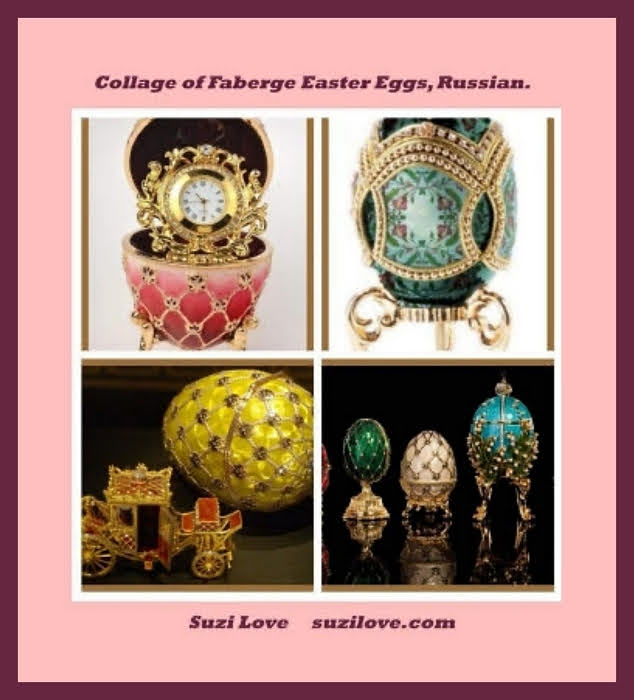
easter-collage_fabergeeaster-eggsbeautiful_collage_sml

1900s Early Gorgeous Faberge Eggs From Russia. 2. #Easter #Faberge #Russia

Suzi Love Posted on March 25, 2026 by Suzi LoveMarch 26, 2026

The name Faberge is associated with the Russian Imperial family for whom most of the world’s most famous eggs were created. In 1870, Faberge inherited his father’s jewelry business and quickly became known for his brilliant designs. A display of his work and the gold medal he was awarded in Moscow’s Pan-Russian Exhibition of 1882 brought him to the attention of the Russian nobility.

In 1885, Faberge was commissioned by Tsar Alexander III of Russia to create an Easter egg for his wife, the Empress Maria Fedorovna. This became known as The Hen Egg, the first Imperial Faberge Egg, and is made of gold. The Empress was so happy with the gift that Alexander appointed Fabergé a ‘Goldsmith by Special Appointment to the Imperial Crown’ and the following year commissioned another egg. From then on, Faberge was given complete freedom with future Imperial designs which become even more elaborate every year. A famous Fabergé egg is one of sixty eight jeweled eggs made by Fabergé and his assistants for the Russian Tzars and private collectors between 1885 and 1917.

After the Russian Revolution, the House of Faberge was nationalized by the Bolsheviks and the Faberge family fled to Switzerland where Peter Carl Faberge died in 1920. Several of the Faberge Imperial eggs are still missing.

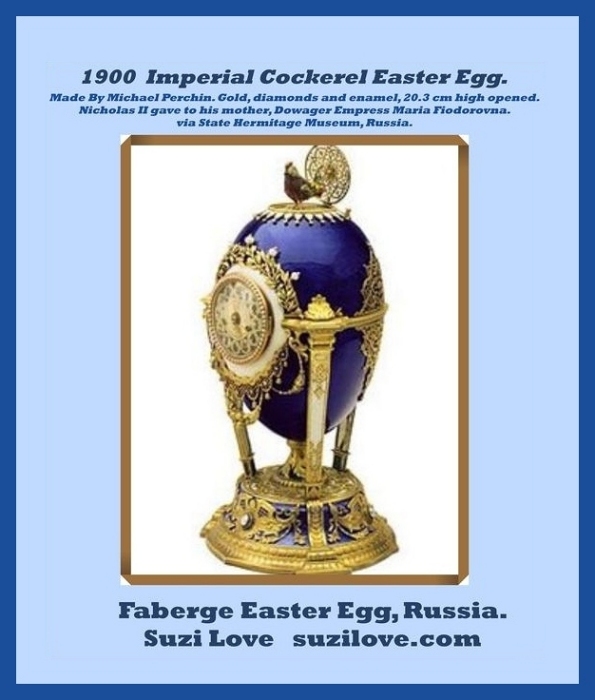
1900 Cockerel Faberge Easter Egg, or, Cuckoo Clock Egg was given by Tsar Nicholas II to Empress Maria Feodoronova. Mechanism on top rear enables its bird to come out and move. The egg is part of the Viktor Vekselberg Collection, owned by The Link of Times Foundation, and housed in the Fabergé Museum in Saint Petersburg, Russia. Faberge Easter Egg, Russia.

Easter_1900 Imperial Cockerel Faberge Easter Egg, or, Cuckoo Clock Egg was given by Tsar Nicholas II to Empress Maria Feodoronova. Mechanism on top rear enables its bird to come out and move. The egg is part of the Viktor Vekselberg Collection, owned by The Link of Times Foundation, and housed in the Fabergé Museum in Saint Petersburg, Russia. Faberge Easter Egg, Russia. Suzi Love suzilove.com
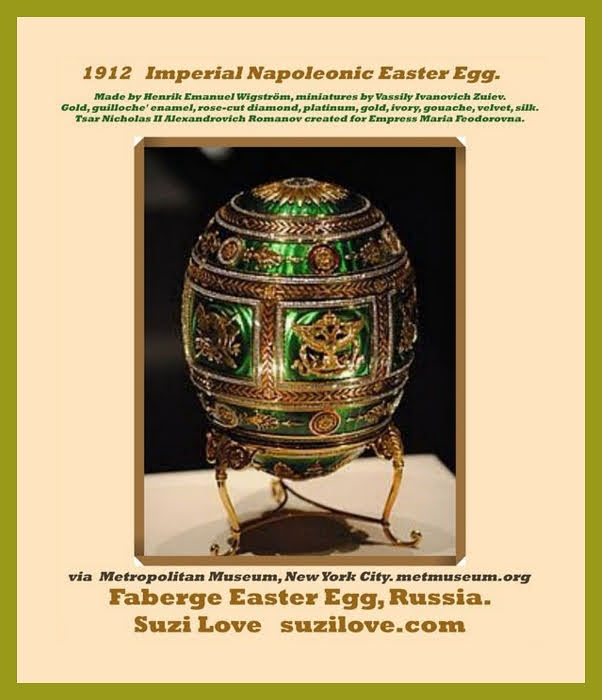
egg_1912_imperial_faberge-easter-egg-russia
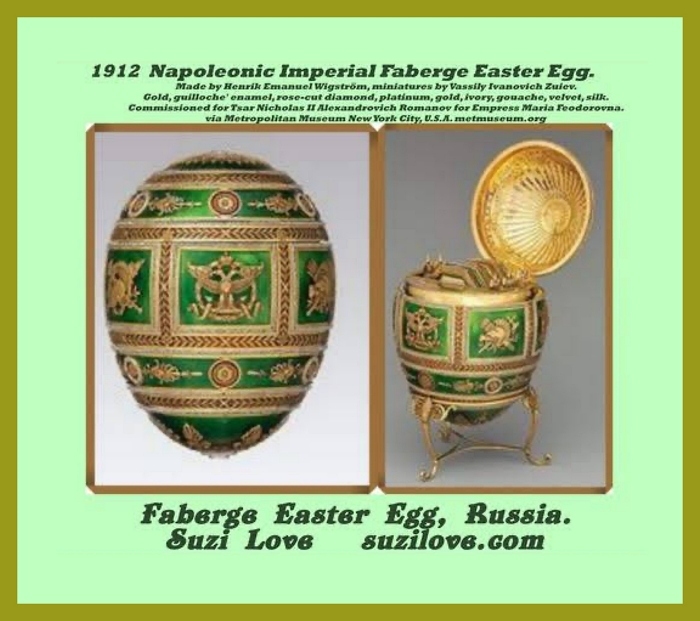
Easter_1912 Imperial Napoleonic Faberge Surprise Egg. Made by Henrik Emanuel Wigström, miniatures by Vassily Ivanovich Zuiev. Gold, guilloch enamel, rose-cut diamond, platinum, gold, ivory, gouache, velvet, silk. For Tsar Nicholas II Alexandrovich Romanov to give to Empress Maria Feodorovna. via suzilove.com and Metropolitan Museum New York City, U.S.A. metmuseum.org
1912 Imperial Napoleonic Faberge Surprise Egg. Made by Henrik Emanuel Wigström, miniatures by Vassily Ivanovich Zuiev. Gold, guilloch enamel, rose-cut diamond, platinum, gold, ivory, gouache, velvet, silk. For Tsar Nicholas II Alexandrovich Romanov to give to Empress Maria Feodorovna. via Metropolitan Museum New York City, U.S.A. metmuseum.org
1900s Early Gorgeous Faberge Eggs From Russia. 2. #Easter #Faberge #Russia. https://books2read.com/suziloveEaster Share on X

Posted in 1900s, Box Or Container, Decorative Item, Easter, Edwardian Era, Europe, History, Russia, Suzi Love Books, Suzi Love Images | Tagged 1900s, Easter, Easter in Images, Edwardian Era, Faberge, Russia, Suzi Love Books, Suzi Love Images | Leave a reply

1897 The Imperial Coronation Egg With A Surprise. #Easter #Faberge #Russia

Suzi Love Posted on March 24, 2026 by Suzi LoveMarch 19, 2026

1897 The Imperial Coronation Egg With A Surprise.Made By Mikhail Pushkin. Presented by Emperor Nicholas II to his wife Empress Alexandra Feodorovna as memento of entry to Moscow on May 26th, the day of the Coronation, in Uspensky Cathedral. Gold embellished with translucent yellow guilloché enamel.

Many Russian Easters were celebrated with Imperial monogramed eggs as the royals were very involved with both the religious celebrations of Easter and the family traditions. Fabergé eggs were jeweled eggs created by Peter Carl Fabergé  and his company in Russia from 1885 to 1917. The most famous of the eggs are the ones made for the Russian Tsars, Alexander III and Nicholas II, as Easter gifts for their wives and mothers, often called the ‘Imperial’ Fabergé eggs. The House of Fabergé made about 50 eggs and 43 have survived. Another two were planned for Easter 1918, but because of the Russian Revolution were not delivered. After the Revolution, the Fabergé family left Russia and the Fabergé trademark has been sold several times since then. Several companies have sold Easter egg merchandise using the Fabergé name. The trademark is now owned by Fabergé Limited, which makes egg-themed jewelry.

1897 The Imperial Coronation Egg With A Surprise. #Easter #Faberge #Russia https://books2read.com/suziloveEaster Share on X

Posted in 1800s, Box Or Container, Decorative Item, Easter, Ester In Images, Europe, History, History Events, Russia, Victorian Era | Tagged Easter, Easter in Images, europe, Faberge, Russia, Suzi Love Books

1795-1812 ca. Lord Nelson’s Vice-Admiral Undress Blue Tailcoat. #RegencyEra #Military #Nelson #JaneAusten

Suzi Love Posted on March 23, 2026 by Suzi LoveFebruary 17, 2026

1795-1812 ca. Lord Nelson’s Vice-Admiral Undress Coat. Blue cloth tail coat, double breasted, nine gilt buttons on each lapel., two rows gold lace each sleeve with three buttons between, three buttons below each pocket flap, two buttons on skirt pleats, narrow band of wool cloth and two eyelet holes on shoulders to attach epaulettes, fastened edge to edge with three hooks and eyes, four embroidered stars of Nelson’s orders on left, Order of the Bath, Order of St Ferdinand Merit, Order of Crescent, Order of San Joachim. This is Nelson’s Trafalgar Coat worn by Nelson (1758-1805) at Battle of Trafalgar with bullet hole on left shoulder, close to epaulette. Damage to epaulette and blood stains on tails and left sleeve. National Maritime Museum, Greenwich, London, U.K. www.rmg.co.uk

For most of Jane Austen’s life, Britain was involved in conflicts and wars across the world. The Napoleonic Wars only ended in 1815, just two and a half years before Austen died. During her childhood, Britain was fighting the American Revolutionary War and when she was 14 years old, the French Revolution upset traditional roles of the monarchy, aristocracy and landed gentry in Britain, France and many other European countries.

1795-1812 ca. Lord Nelson's Vice-Admiral Undress Coat. Blue cloth tail coat, double breasted, nine gilt buttons on each lapel., two rows gold lace each sleeve with three buttons between, three buttons below each pocket flap, two buttons on skirt pleats, narrow band of wool cloth and two eyelet holes on shoulders to attach epaulettes, fastened edge to edge with three hooks and eyes, four embroidered stars of Nelson's orders on left, Order of the Bath, Order of St Ferdinand Merit, Order of Crescent, Order of San Joachim. via National Maritime Museum, Greenwich, London, U.K. www.rmg.co.uk
1795-1812 ca. Lord Nelson's Vice-Admiral Undress Blue Tailcoat. #RegencyEra #Military #Nelson #JaneAusten https://books2read.com/SuziLoveFashionMen1800-1819 Share on X
HN_23_D2D_Fashion Men 1800-1819
https://books2read.com/SuziLoveFashionMen1800-1819
Posted in 1700s, 1800s, 1800s Mens Fashions, Coat or Pelisse Or Redingote, England, Georgian Era, Jane Austen, London, military, Regency Era, Regency Fashion, Suzi Love Images | Tagged 1800s men fashion, Georgian Fashion, Jane Austen, military, National Maritime Museum, Redingote Or Pelisse Or Coat, Regency Fashion, Tailcoat, uniform | Leave a reply

1806 Silver Vinaigrette Commemorating The Battle Of Trafalgar in the times of the Bridgertons and Jane Austen. #Bridgerton #RegencyEra #JaneAusten #FashionAccessory

Suzi Love Posted on March 23, 2026 by Suzi LoveJanuary 25, 2026

1806 Silver and silver-gilt vinaigrette, Birmingham, England. Commemorating the Battle of Trafalgar in 1805. Rectangular with a hinged lid and a suspension loop. Gilded, pierced inner cover depicts HMS ‘Victory’ in relief inscribed ‘VICTORY’, ‘TRAFALGAR OCT 21 1805’. Via National Maritime Museum, Greenwich, London, U.K.

Vinaigrettes were used from the late 18th century through the 19th Century to revive a person who had fainted, having the vapors, or to mask unsanitary odors. Small containers, often a silver hinged box, held a tiny sponge dipped in an aromatic substance which had been dissolved in vinegar. The sponge was held beneath a grill or perforated cover so, by a flick of the fingers, the container was opened and the restorative substance held directly beneath a person’s nose. Jane Austen and her family and friends would have been very familiar with the use of vinaigrettes because Regency Era ladies were noted for having the vapors or fainting in hot ballrooms or dramatic situations. Ladies in the Romantic and Victorian Eras would have used them when tightly laced corsets became popular and ladies fainted because they were unable to draw in enough oxygen.

Both men and women used vinaigrettes in the late 1700s when people encountered foul aromas on a daily basis, but by the 1820s vinaigrettes were mainly used by women.These tiny containers were carried in a pocket, a reticule or bag, or suspended from the waist by chains as part of a chatelaine. Their sterling silver interiors were gilded to prevent discoloration from the acetic acid. Birmingham produced 90% of England’s silver vinaigrettes. As gold wasn’t affected by vinegar, craftsmen created some elaborate and decorative boxes on the container’s exteriors.

1806 Vinaigrette, English. Small bottle or container for holding smelling salts. via National Maritime Museum, greenwich, London. books2read.com/suziloveBoxesCases
1806 Silver Vinaigrette Commemorating The Battle Of Trafalgar in the times of the Bridgertons and Jane Austen. #Bridgerton #RegencyEra #JaneAusten #FashionAccessory https://www.books2read.com/suziloveBoxesCases Share on X
HN_11_D2D_Craftsmen created containers of precious metals, leather, silks, and decorated them with jewels to make exquisite and expensive items as well as practical carrying cases. books2read.com/suziloveBoxesCases
Posted in 1800s, Box Or Container, Bridgerton, Decorative Item, England, fashion accessories, household, Jane Austen, London, medical, Regency Era, Regency Fashion, Suzi Love Images | Tagged 1800s men fashion, 1800s women's fashion, antiques, Box Or Container, Bridgerton, decorative, fashion accessories, Jane Austen, military, National Maritime Museum

Post navigation

← Previous Post
Next Post→

SUBSCRIBE TO SUZI LOVE'S NEWSLETTER.

Recent Posts

  • 1812 Young Lady Playing Devil On Two Sticks, French. #RegencyFashion #JaneAusten #HistoricalFashion
  • 1812 White Court Dress With Burgundy Velvet Train in Jane Austen style. #JaneAusten #RegencyFashion #France
  • 1812 April White Morning Walking Dress n Jane Austen style Under Green Military Style Coat. #RegencyFashion #JaneAusten #HistoricFashion
  • 1818 December Mourning Walking Dress As Worn In Bridgerton Times. #Bridgerton #RegencyFashion #Mourning
  • 1780 Red Wool Stays, Or Corset, and Panniers, British. #Georgian #Corset #Underclothing

Recent Comments

  1. Suzi Love on Book Hooks: “Help,” a voice yelled before all hell broke loose. #MilitarySuspense #ContemporaryRomance #kellysjustice #SouthPacific #Vanuatu
  2. Lisabet Sarai on Book Hooks: “Help,” a voice yelled before all hell broke loose. #MilitarySuspense #ContemporaryRomance #kellysjustice #SouthPacific #Vanuatu
  3. Suzi Love on Book Hooks: “Help,” a voice yelled before all hell broke loose. #MilitarySuspense #ContemporaryRomance #kellysjustice #SouthPacific #Vanuatu
  4. Suzi Love on Book Hooks: “Help,” a voice yelled before all hell broke loose. #MilitarySuspense #ContemporaryRomance #kellysjustice #SouthPacific #Vanuatu
  5. Jana Richards on Book Hooks: “Help,” a voice yelled before all hell broke loose. #MilitarySuspense #ContemporaryRomance #kellysjustice #SouthPacific #Vanuatu

Login

  • Log in

Archives

  • June 2026
  • May 2026
  • April 2026
  • March 2026
  • February 2026
  • January 2026
  • December 2025
  • November 2025
  • October 2025
  • September 2025
  • August 2025
  • July 2025
  • June 2025
  • May 2025
  • April 2025
  • March 2025
  • February 2025
  • January 2025
  • December 2024
  • November 2024
  • October 2024
  • September 2024
  • August 2024
  • July 2024
  • June 2024
  • May 2024
  • April 2024
  • March 2024
  • February 2024
  • January 2024
  • November 2023
  • October 2023
  • September 2023
  • August 2023
  • July 2023
  • June 2023
  • April 2023
  • March 2023
  • February 2023
  • June 2022
  • April 2022
  • March 2022

Categories

  • 1700s
  • 1700s Mens fashion
  • 1700s Womens Fashion
  • 1800s
  • 1800s Mens Fashions
  • 1800s women's fashion
  • 1900s
  • art
  • Australia
  • Bath
  • bedroom fashion
  • Book Hooks
  • Box Or Container
  • Bridgerton
  • Bus Trips
  • Canada
  • Carriage
  • cartoon
  • Celebrity
  • Chatelaine
  • children
  • Children
  • Christmas
  • Coat or Pelisse Or Redingote
  • Contemporary
  • Corset
  • Couple
  • Customs & Manners
  • dancing
  • December Scandal
  • Decorative Item
  • Dress Or Robe
  • Easter
  • Edwardian Era
  • Embracing Scandal
  • England
  • Ester In Images
  • Europe
  • Events
  • Fashion
  • fashion accessories
  • Food and Drink
  • Four Times A Virgin
  • France
  • furniture
  • Georgian Era
  • Georgian Fashion
  • Google Books
  • Grand Tour
  • Group
  • hats
  • History
  • History Events
  • History Notes
  • History Of Christmases Past
  • household
  • Hygiene
  • Irresistible Aristocrats
  • Jane Austen
  • Keanu Reeves
  • Kellys Justice
  • Legal
  • London
  • Love After Waterloo
  • Loving Lady Katharine
  • medical
  • military
  • money
  • mourning
  • Music
  • Outback Arrival
  • pants
  • Pastimes
  • peerage
  • People
  • Petunia and Pearl Diver
  • Places
  • Pleasure House Ball
  • postal
  • Queensland
  • Quotations
  • Regency Era
  • Regency Fashion
  • Regency Life Series
  • Reticule or Bag
  • riding
  • Romantic Era
  • Royalty
  • Russia
  • Scandalous Siblings Series
  • Scenting Scandal
  • Self Publishing
  • sewing
  • Shirt
  • shoes
  • Shopping
  • South Pacific
  • Spencer
  • sports
  • Suit
  • Sunday Snippet
  • Suzi Love
  • Suzi Love Books
  • Suzi Love Images
  • Suzi Love Writing
  • Swain Cove
  • THe Viscount's Pleasure House
  • travel
  • U.S.A
  • underclothing
  • Vest or Waistcoat
  • Victorian Era
  • Victorian Fashion
  • weapons
  • weddings
  • Writing Tools

1800s men fashion 1800s women's fashion antiques Bridgerton British history Cartoons Corset cravat decorative Dress Or Gown England europe fashion accessories Fashion Plate France Georgian era Georgian Fashion gloves google books Hats And Hair historical romance History Notes household Jane Austen jewelry Journal des Dames et des Modes London Metropolitan Museum NYC pants Redingote Or Pelisse Or Coat Regency Era Regency Fashion Regency London Regency Men reticule or bag riding sewing shawls Shoes Suzi Love Books Suzi Love Images Tailcoat The Repository Of Arts underclothing Vest or Waistcoat

©2026 - Suzi Love - Weaver Xtreme Theme Privacy Policy
↑