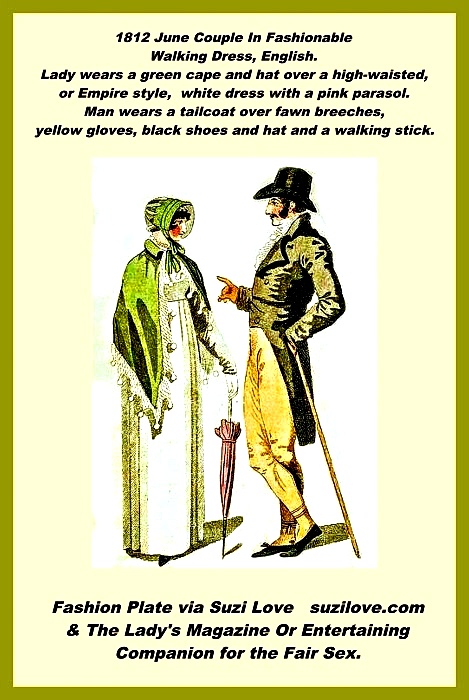
1812 June Couple In Fashionable Jane Austen style Walking Dress, English. Lady wears a green cape and hat over a high-waisted, or Empire style, white dress with a pink parasol. Man wears a tailcoat over fawn breeches, yellow gloves, black shoes and hat and a walking stick. Fashion Plate via The Lady’s Magazine Or Entertaining Companion for the Fair Sex.
By the end of the 18th century, tailored garments for both men and women were replaced by styles made for ease and comfort, resulting in the neoclassical style of the 1780s. Inspired in part by the statuary of ancient Greece and Rome, the new fashion was epitomized by light cotton gowns falling around the body in an unstructured way, held around the high waist with a simple sash and accompanied by a soft shawl draped around exposed shoulders. This style was ideal for the Indian imports like Kashmiri shawls and Bengali muslin, as used in this embroidered gown.
What did the lady of the house use to pen notes in Bridgerton and Jane Austen’s years? What sat on the desk of Jane Austen’s male contemporaries when they managed household and estate accounts? books2read.com/SuziLoveWritingTools. Writing Tools, History Notes Book 13.
1809 Messrs. Harding Howell and Co., London, UK. View of interior of Harding Howell and Co., draper’s shop on Pall Mall. Ladies examine latest fashions and fabrics which they could then request of their dressmakers. This house extended 150 feet from front to back and was divided by glass petitions into four departments, furs and fans, haberdashery, jewellery, ornaments and perfumes, and millinery. bl.uk
1809 Interior of Messrs. Harding Howell and Co. Draper’s Shop, Pall Mall, London, U.K.
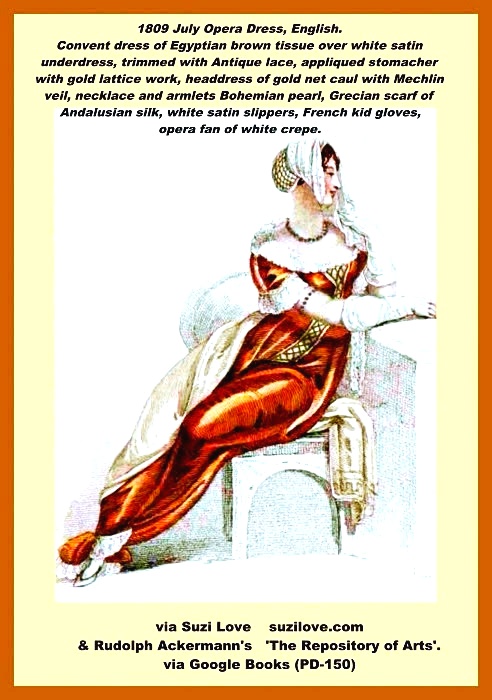
1809 July Opera Dress. I can picture aristocratic women wearing this sort of gorgeous outfit to the opera or an evening event.
Round convent robe of Egyptian brown tissue worn over white satin underdress, ornamented at feet, bosom and sleeves with broad Antique lace, out on full, and narrowing in front, white satin appliqued stomacher embellished with gold lattice work and continued in a straight line down to the hem. Headdress is a gold net caul, enclosing the hair at the back and finished in front with a Mechlin veil displaying the hair on the forehead and falling over the left shoulder. Necklace and armlets are a single row of Bohemian pearl with topaz or diamond snaps. Grecian scarf of rich Andalusian silk, contrasted with the robe and wrought at the ends in a deep Tuscan border of gold or colored silks. White satin slippers, trimmed with brown foil or gold, French kid gloves, opera fan of white crepe with a border of jessamine. Fashion Plate via Rudolph Ackermann’s ‘The Repository of Arts’.
Fashion Women 1805-1809 History Notes Book 26 What did Jane Austen and friends wear? https://books2read.com/SuziLoveFashionWomen1805-1809
Love the charming chatelaines and chains women wore in Jane Austen’s and Bridgerton’s times? Check out this fascinating read! #bridgerton #janeausten #chatelaine #suzilovebooks books2read.com:SuziLoveChatelaines
The Bridgerton women and Jane Austen and contemporaries carried keys, writing tools, sewing items and other personal necessities on their person by long chains, or a chatelaine, that hung from their waist. Early chatelaines were simple essentials but later chatelaines were decorative and expensive. http://books2read.com/SuziLoveChatelaines
Definition Chatelaine: The word Chatelaine is French and means the keeper of the keys. Chatelaine” derives from the Latin word for castle. In Medieval times, the chatelaine was in charge of the day-to-day running of the castle. Women in charge of households dangled long chains from their waists to keep essentials within easy reach e.g. keys, notebook and pen, watch, sewing items, vinaigrette or perfume, or magnifying glass. Early chatelaine were simple essentials. Later chatelaine were decorative and expensive.books2read.com/SuziLoveChatelaines
What did a chatelaine do? Most important task was keeper of the keys. Also ordered supplies, did bookkeeping, supervised servants, taught castle children, and organized guests.
1810 Couple In Walking Dress, French. Lady in a jade green Redingote, or coat, with paisley skirt, worn over a white dress with sleeves caught up, and hat tied under her chin. Man in a brown tailcoat, tight white pants that button down the sides, black hat and shoes and carrying a walking stick. Fashion Plate via Journal des Dames et des Modes, or Costume Parisien.
The sort of outfits a lady and gentleman in Jane Austen’s times would have worn while out walking, shopping, or going to visit friends.
Pelisse, or Walking Dress, or Redingote. The Fashion Dictionary description of a Redingote is (réd’ing-göt; red ing gote). Pronounced: red ing gote Woman’s long, fitted coat often cut Princess style and worn open in front to show off the dress underneath. Sometimes cut away in front. Originally made for men with several capes and trimmed with large buttons. French word developed from English words, riding coat. reefer. Single- or double-breasted, fitted, tailored, over-all coat usually made from sturdy fabric but in the British Regency Era a Pelisse was often made from a lighter fabric, such as cotton.
HN_23_D2D_Fashion Men 1800-1819 History Notes Book 23
https://books2read.com/SuziLoveFashionMen1800-1819
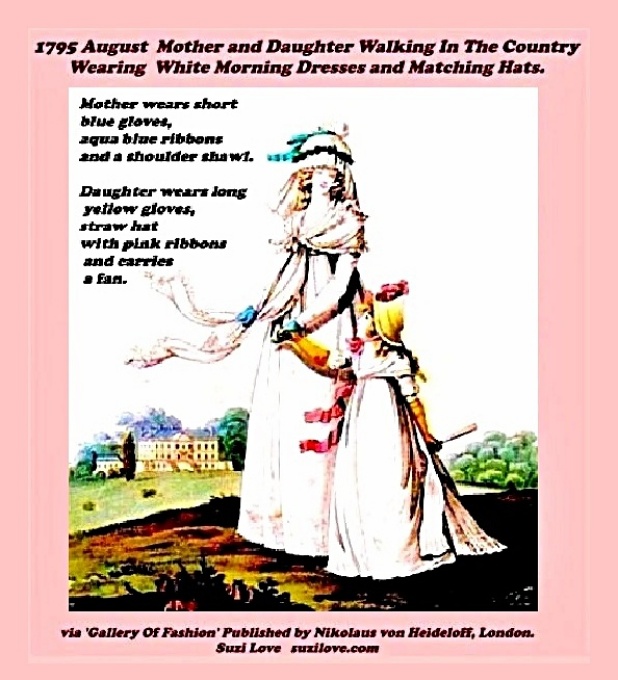
1795 August Mother and Daughter walking in the country wearing white morning dresses and matching hats. Mother wears short blue gloves, aqua blue ribbons and a shoulder shawl, or fichu. Daughter wears long yellow gloves, a straw hat with pink ribbons and carries a fan. via Nikolaus Heideloff’s Gallery of Fashion.
HN_1 Fashion Women Late 1700s History Notes Book 1 by Suzi Love.
What was fashionable for women in the late 1700s? Extravagant colors and fabrics and outrageous styles were all seen in these flamboyant fashions.
books2read.com/suziloveFashWomen1700s
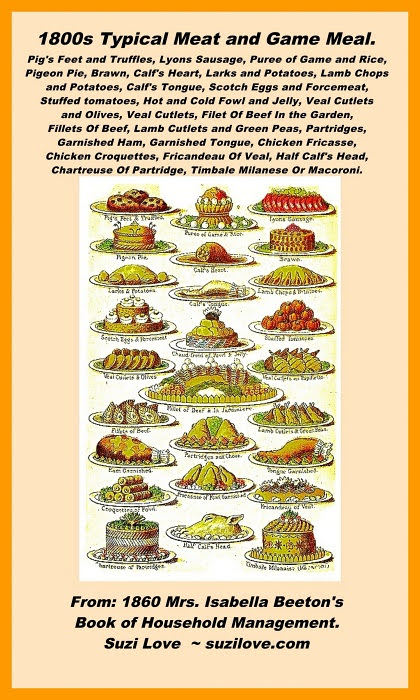
1800s Typical Meat and Game Meals served during the 1800s. These are the sort of dishes Jane Austen’s family and the Bridgertons would have eaten on a regular basis.
Pig’s Feet and Truffles, Lyons Sausage, Puree of Game and Rice, Pigeon Pie, Brawn, Calf’s Heart, Larks and Potatoes, Lamb Chops and Potatoes, Calf’s Tongue, Scotch Eggs and Forcemeat, Stuffed tomatoes, Hot and Cold Fowl and Jelly, Veal Cutlets and Olives, Veal Cutlets, Filet Of Beef In the Garden, Fillets Of Beef, Lamb Cutlets and Green Peas, Partridges, Garnished Ham, Garnished Tongue, Chicken Fricassée, Chicken Croquettes, Fricandeau Of Veal, Half Calf’s Head, Chartreuse Of Partridge, Timbale Milanese Or Macoroni.
From: 1860s Mrs. Beeton’s Book of Household Management. via Google Books (PD-150)
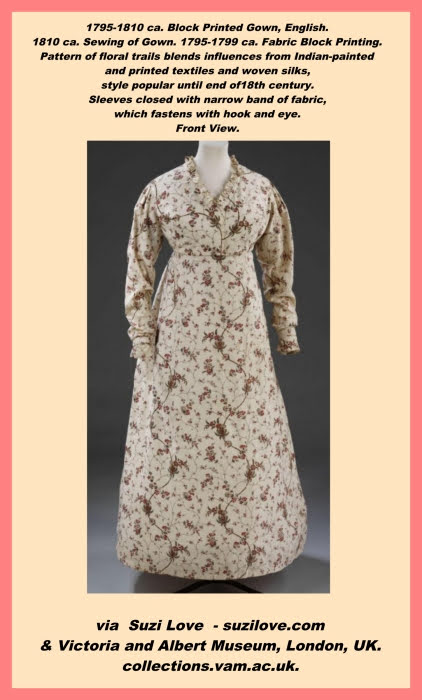
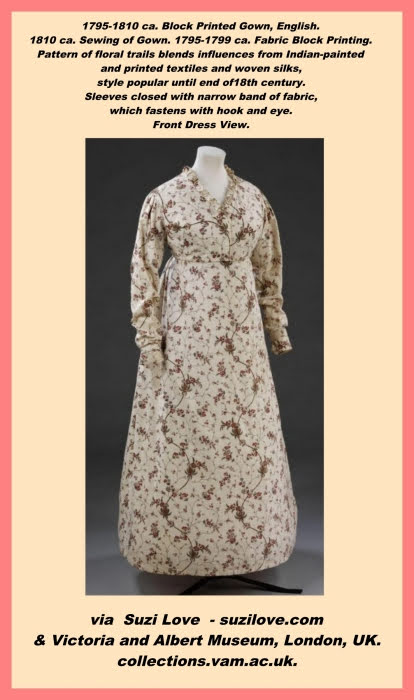
1795-1810 ca. Roller Printed Dress, English. Empire style, high-waisted, roller printed dress with skirt gathered at the back to create a full skirt and with simple V-necked bodice and long sleeves. Sleeves are closed with a narrow band of fabric which fastens with a hook and eye. via Victoria and Albert Museum, London, UK. 1810 ca. Sewing of Gown. 1795-1799 ca. Fabric Block Printing. Pattern of floral trails blends influences from Indian-painted and printed textiles, and woven silks, a style which remained popular until the end of18th century.
The pattern of floral trails seen on the printed fabric of this gown exhibits a blend of influences from Indian-painted and printed textiles, and woven silks, a style which remained popular until the end of the 18th century. The sleeves of this gown are closed with a narrow band of fabric, which fastens with a hook and eye.
The dress is styled with a high-waisted , fitted bodice, which fastens centrally. The neck, which is trimmed with a 1″ frill of matching material, is rounded a the back and V-shaped at the front. The bodice is lined with white cotton which extends 1/3 of the way down the full length tapered sleeves. A trimming decorations is attached to the wrist of the right sleeve (made from the same material and lined with white cotton), which fastens with a metal hook and eye at the hip. The skirt has an ‘apron’ style front with fastening tapes attached to either side, in addition to this there are vertical pocket slits situated at either side of the skirt measuring 11″. The front and rear sides of the skirt are constructed from one width of fabric – 39.5″ wide. The waistline at the back of the skirt is gathered a the centre and is constructed from two pieces of material measuring 46″ wide.
The cotton has blue threads in the selvedges denoting English origin, and is block printed in a polychrome palette with pencilled blue on a white ground. The design consists of an all-over pattern of delicate floral trails of carnations, pinks an other stylised flowers interspersed by vertical arborescent meanders bearing exotic fruits and stylised flowers. The pattern repeat measures 10.5″ by 10″.
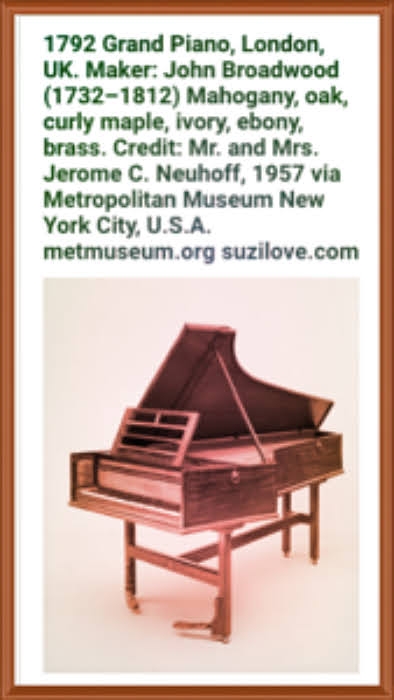
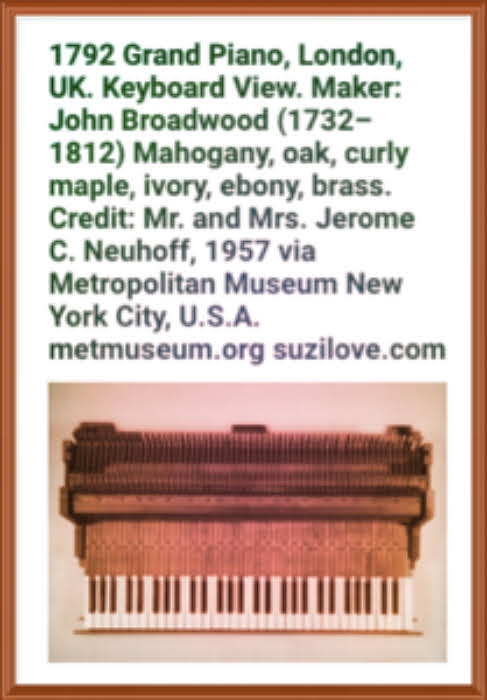
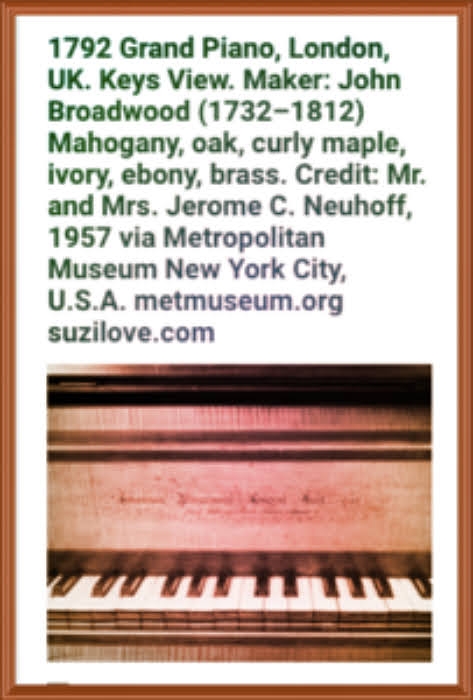
1792 Grand Piano, London, UK. Maker John Broadwood (1732–1812) Mahogany, oak, curly maple, ivory, ebony, brass. Credit: Mr. and Mrs. Jerome C. Neuhoff, 1957 via Metropolitan Museum New York City, U.S.A. metmuseum.org books2read.com/suziloveMusicPiano
HN_7 D2D Retailer Buy Link Music Piano History Notes