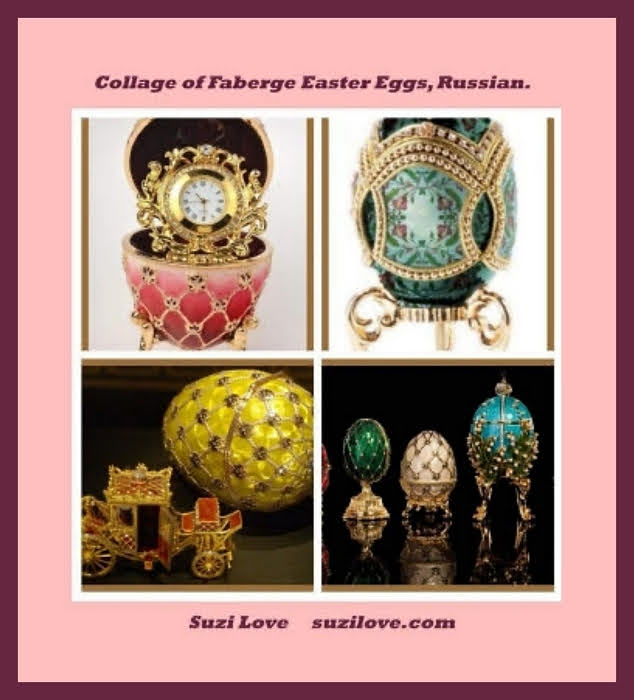
1911 Orange Tree, or, Bay Tree Faberge Imperial Easter Egg. Gift to Maria from her son. Automaton nightingale emerges and sings when the correct orange is turned. Gold, jade, diamonds, vitrines, amethysts, rubies, pearls, agates, and bird has feathers. Faberge Easter Egg, Russia.
The name Faberge is associated with the Russian Imperial family for whom most of the world’s most famous eggs were created. In 1870, Faberge inherited his father’s jewelry business and quickly became known for his brilliant designs. A display of his work and the gold medal he was awarded in Moscow’s Pan-Russian Exhibition of 1882 brought him to the attention of the Russian nobility.In 1885, Faberge was commissioned by Tsar Alexander III of Russia to create an Easter egg for his wife, the Empress Maria Fedorovna. This became known as The Hen Egg, the first Imperial Faberge Egg, and is made of gold. The Empress was so happy with the gift that Alexander appointed Fabergé a ‘Goldsmith by Special Appointment to the Imperial Crown’ and the following year commissioned another egg. From then on, Faberge was given complete freedom with future Imperial designs which become even more elaborate every year. A famous Fabergé egg is one of sixty eight jeweled eggs made by Fabergé and his assistants for the Russian Tzars and private collectors between 1885 and 1917.After the Russian Revolution, the House of Faberge was nationalized by the Bolsheviks and the Faberge family fled to Switzerland where Peter Carl Faberge died in 1920. Several of the Faberge Imperial eggs are still missing.
The name Faberge is associated with the Russian Imperial family for whom most of the world’s most famous eggs were created. In 1870, Faberge inherited his father’s jewelry business and quickly became known for his brilliant designs. A display of his work and the gold medal he was awarded in Moscow’s Pan-Russian Exhibition of 1882 brought him to the attention of the Russian nobility.
In 1885, Faberge was commissioned by Tsar Alexander III of Russia to create an Easter egg for his wife, the Empress Maria Fedorovna. This became known as The Hen Egg, the first Imperial Faberge Egg, and is made of gold. The Empress was so happy with the gift that Alexander appointed Fabergé a ‘Goldsmith by Special Appointment to the Imperial Crown’ and the following year commissioned another egg. From then on, Faberge was given complete freedom with future Imperial designs which become even more elaborate every year. A famous Fabergé egg is one of sixty eight jeweled eggs made by Fabergé and his assistants for the Russian Tzars and private collectors between 1885 and 1917.
After the Russian Revolution, the House of Faberge was nationalized by the Bolsheviks and the Faberge family fled to Switzerland where Peter Carl Faberge died in 1920. Several of the Faberge Imperial eggs are still missing.
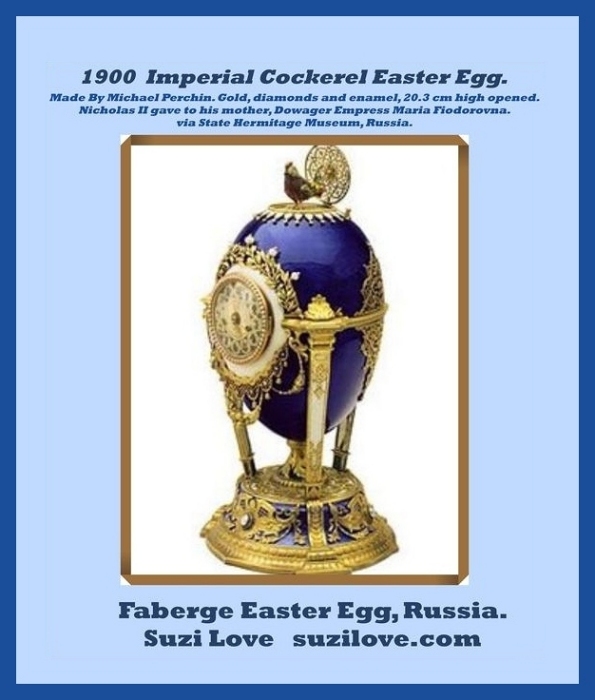
1900 Cockerel Faberge Easter Egg, or, Cuckoo Clock Egg was given by Tsar Nicholas II to Empress Maria Feodoronova. Mechanism on top rear enables its bird to come out and move. The egg is part of the Viktor Vekselberg Collection, owned by The Link of Times Foundation, and housed in the Fabergé Museum in Saint Petersburg, Russia. Faberge Easter Egg, Russia.
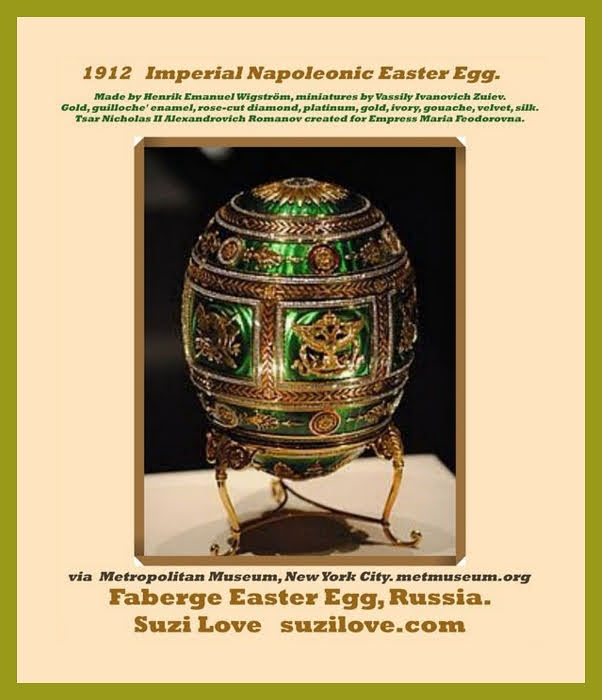
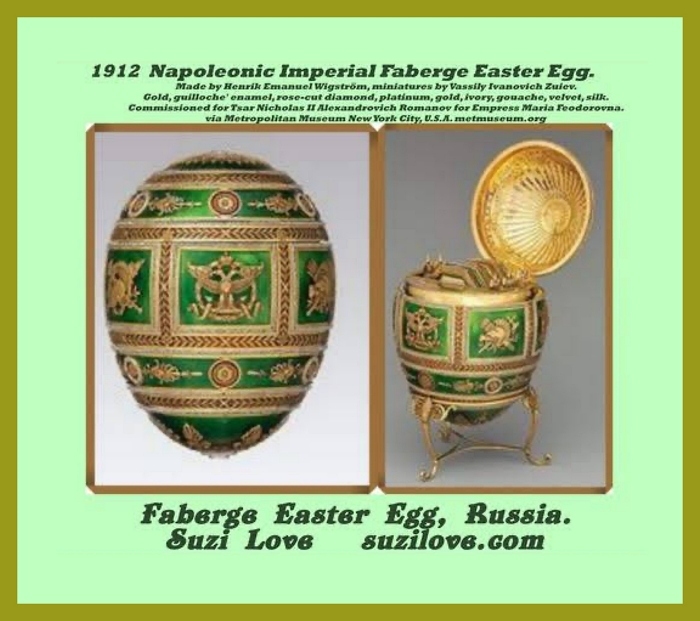
1912 Imperial Napoleonic Faberge Surprise Egg. Made by Henrik Emanuel Wigström, miniatures by Vassily Ivanovich Zuiev. Gold, guilloch enamel, rose-cut diamond, platinum, gold, ivory, gouache, velvet, silk. For Tsar Nicholas II Alexandrovich Romanov to give to Empress Maria Feodorovna. via Metropolitan Museum New York City, U.S.A. metmuseum.org
1897 The Imperial Coronation Egg With A Surprise.Made By Mikhail Pushkin. Presented by Emperor Nicholas II to his wife Empress Alexandra Feodorovna as memento of entry to Moscow on May 26th, the day of the Coronation, in Uspensky Cathedral. Gold embellished with translucent yellow guilloché enamel.
Many Russian Easters were celebrated with Imperial monogramed eggs as the royals were very involved with both the religious celebrations of Easter and the family traditions. Fabergé eggs were jeweled eggs created by Peter Carl Fabergé and his company in Russia from 1885 to 1917. The most famous of the eggs are the ones made for the Russian Tsars, Alexander III and Nicholas II, as Easter gifts for their wives and mothers, often called the ‘Imperial’ Fabergé eggs. The House of Fabergé made about 50 eggs and 43 have survived. Another two were planned for Easter 1918, but because of the Russian Revolution were not delivered. After the Revolution, the Fabergé family left Russia and the Fabergé trademark has been sold several times since then. Several companies have sold Easter egg merchandise using the Fabergé name. The trademark is now owned by Fabergé Limited, which makes egg-themed jewelry.
An overview of women’s fashions in the first twenty years of the 19th century. What was fashionable for women in Jane Austen’s times, or the early 1800s. Wars were being fought around the globe so women’s fashion adopted a military look in support of soldiers. In Britain, the Prince Regent ruled instead of his father, King George III, so fashions, like the lifestyle, became more extravagant and accessories went from pretty to opulent. This set includes books 12, 25, 26, 27 and 28.
What was fashionable for women in Jane Austen’s times, or 1800s, or Regency Era. High-waisted dresses were extravagantly accessorized and hats, shoes, parasols and bags were added. Set includes History Notes Books 12, 25, 26, 27 and 28.
Fashion Women 1800-1819 Box Set History Notes Book 24 An overview of the first twenty years of the 19th century. These books look at what was fashionable for women in Jane Austen’s times, or the early 1800s. Wars were being fought around the globe so women’s fashion adopted a military look in support of soldiers. In Britain, the Prince Regent ruled instead of his father, King George III, so fashions, like the lifestyle, became more extravagant and accessories went from pretty to opulent. This set includes books 12, 25, 26, 27 and 28. https://books2read.com/SuziLoveFashionWomenBoxSet
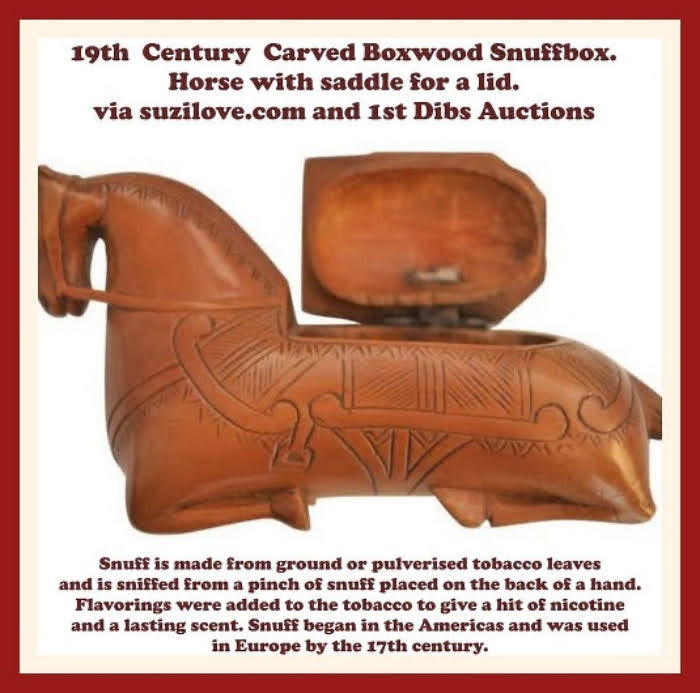
19th Century Snuff Boxes. Not only were boxes made to serve a purpose, but decorative boxes of all types were prized, especially in the 18th-19th Centuries when everything decorative and extravagant was in vogue and taking a pinch of snuff was fashionable. Snuff is made from ground or pulverized tobacco leaves and is sniffed from a pinch of snuff placed on the back of the hand.Flavorings were added to the tobacco to give a fast hit of nicotine and a lasting scent. Snuff began in the Americas and was used in Europe by the 17th Century.
Snuff became popular from the mid 1600s to the mid 1800s and was more popular than smoking. Inhaling snuff, or snuffing, was first seen by a European missionary in 1493 in Christopher Columbus’s new world within Haiti’s indigenous Taino. Until then, tobacco had been unknown to Europeans, but its use spread quickly throughout Europe during the 1500s. By the second half of the 17th century, ornate boxes started being produced to keep the precious powder dry and an entire industry making accessories blossomed around the fashion of taking snuff. Noblemen, and some women, carried extravagantly decorated snuff boxes with them at all times and would offer a pinch of their own particular blend to friends and family. Therefore, these boxes were always on display and so it became a competition to see who could have the most bejeweled or expensive box possible. By the mid 1800s, snuff taking was no longer popular so these exquisite and expensive snuff boxes became decorative, rather than functional.
19th Century Shoe Snuffbox. via 1st Dibs Auctions 1stdibs.com19th Century Engraved Horn Snuffbox. Heart surrounded by flowers and leaves, sides with dove, symbol of purity and peace, brass hinge and setting. via 1st Dibs Auctions19th Century Carved Boxwood Snuffbox. Horse with saddle for a lid. via 1st Dibs Auctions
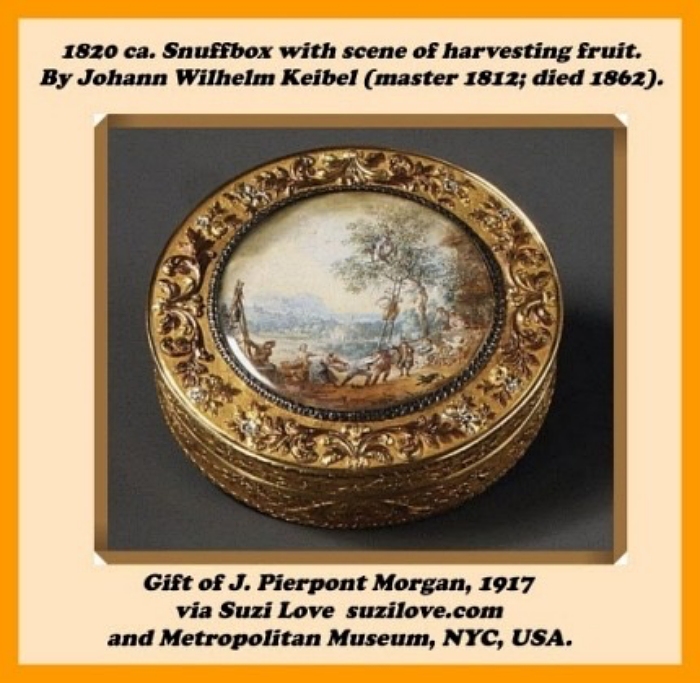
1804-1809 ca. Snuffbox in the Shape of A Lion, Moulinie, Bautte and Cie, Geneva, Switzerland.via Victoria and Albert Museum.1820 Snuffbox with scene of harvesting fruit. By Johann Wilhelm Keibel (master 1812; died 1862). via Metropolitan Museum New York City, U.S.A. metmuseum.org1810 ca. Jeweled Gold Snuff Box, Switzerland. Maker’s Mark Geneva. via Christie’s Auction Rooms. christies.com
Lover of Jane Austen and the Regency Era fashions? History Notes Book 25. #JaneAusten #RegencyFashion #HistoricalFashion books2read.com/SuziLoveFashionWomen1801-1804
1807 Game of Billiards By Louis Leopold Boilly, French. Ladies playing billiards as they did in Jane Austen’s time. via Heritage Museum, Russia ~ heritagemuseum.org
Fashion Women 1805-1809 History Notes Book 26 What did Jane Austen and friends wear? https://books2read.com/SuziLoveFashionWomen1805-1809
Writer Or Reader Of Regency Era?What did Jane Austen and friends wear? Women’s clothing changed dramatically in early 1800s. New silhouette copied simplistic styles of Greeks and Romans. High-waisted white dresses and flowing skirts with color and warmth added by outerwear and accessories. Fashion Women 1801-1804 History Notes Book 25 https://books2read.com/SuziLoveFashionWomen1801-1804
Definition Empire Style Dress: High-waisted white gowns defined women’s fashion during the Regency Era. ‘Empire’ is the name given to the period when Napoleon Bonaparte built his French Empire. High-waisted, loose gowns were adopted by the aristocracy as a symbol of turning away from the elaborate clothing worn in the 1700s. This sort of high-waisted dress would have been worn by Jane Austen and her contemporaries in England.
Definition Shawls: The shawl started off in India as a fine wool garment for men that could be worn as a scarf, turban or as a mantle: the word comes from the Persian shäl. Originally imported from the East, European Kashmir shawls were made first in Norwich and Edinburgh in Britain in the late 18th century. Shawls were an essential item in the early 1800s to cover the thin gowns women wore. They were made of muslin, gauze, silk, wool, and velvet, though cashmere shawls were the softest and most prized.