19th Century Second Half. Paper Mache Easter Egg, Russian.#Easter Resurrection of Christ, Cathedral of Christ the Savior. via Hermitage Museum, Russia. hermitagemuseum.org
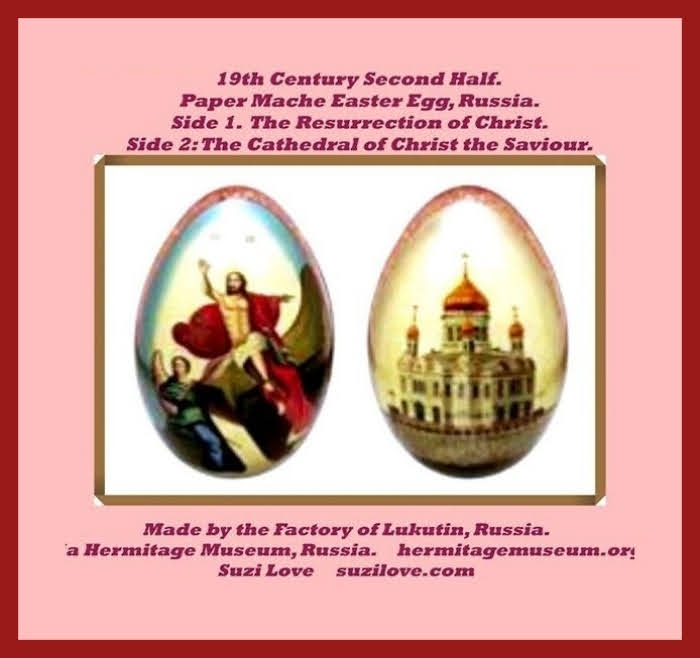


19th Century Second Half. Paper Mache Easter Egg, Russian.#Easter Resurrection of Christ, Cathedral of Christ the Savior. via Hermitage Museum, Russia. hermitagemuseum.org
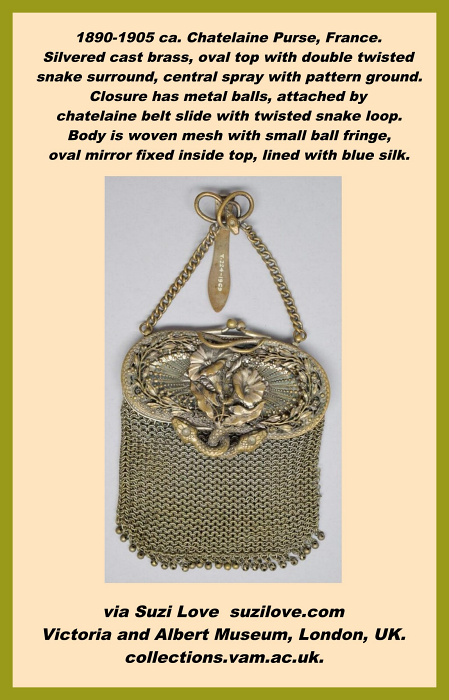
1890-1905 ca. Chatelaine Purse Of Silvered Cast Brass, English. #VictorianEra #EdwardianEra #Chatelaine #Antique books2read.com/SuziLoveChatelaines
1885 The Hen Egg, Imperial Faberge egg, Russia. Gold, rubies and enamel. Height: 6.4 cm. Made by The Fabergé firm, St Petersburg
An imperial Easter egg presented by Alexander III to his wife, Empress Maria Fiodorovna, for Easter 1885. The Hen, was made by Faberge at the behest of Emperor Alexander III for Empress Maria Fedorovna in 1885, possibly to mark the 20th anniversary of their betrothral. It imitates a natural egg and is golden, covered with a white opaque enamel. Inside there is a surprise in the form of a chicken figurine which held in its beak a ruby egg (presently lost). Via The Hermitage Museum, Russia.

1890-1900s Porcelain Easter Egg. Inscription “Christ is risen!”. The Kornilov Brothers Factory, St Petersburg. Via Hermitage Museum Faberge Easter Egg, Russia. books2read.com/suziloveEaster
A porcelain Easter egg from the 1890–1900s featuring the inscription “Christ is risen!” was a traditional Russian Orthodox Easter gift. They were produced by both the Kornilov Brothers Factory and the Imperial Porcelain Factory in St. Petersburg. The State Hermitage Museum in St. Petersburg has a large collection of Imperial-era porcelain Easter eggs. These eggs were exchanged, hung on ribbons, or placed on stands during Easter as a symbol of life’s renewal. The words “Christ is Risen!” was a traditional Russian Easter greeting.

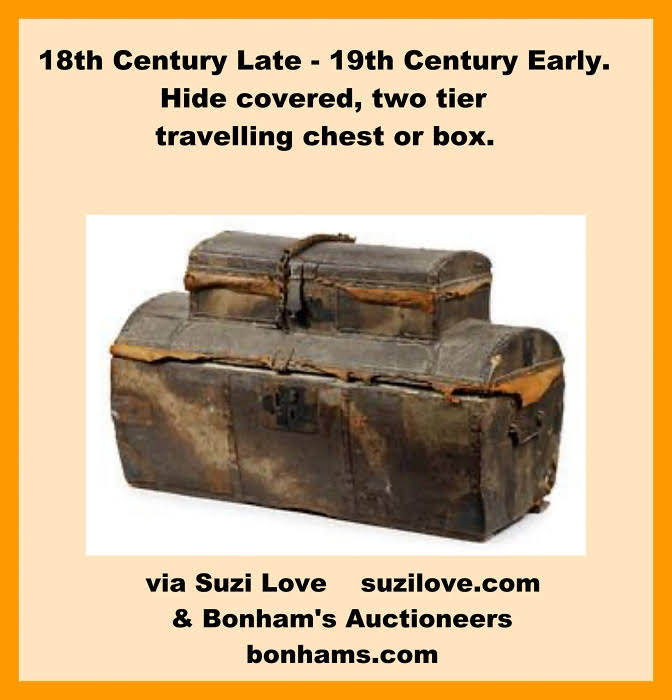
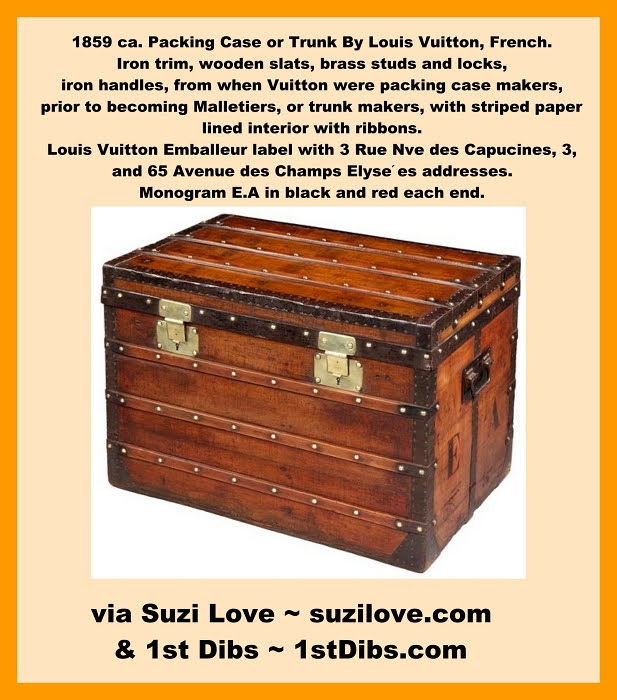
17th – 20th Centuries Luggage For Travel.






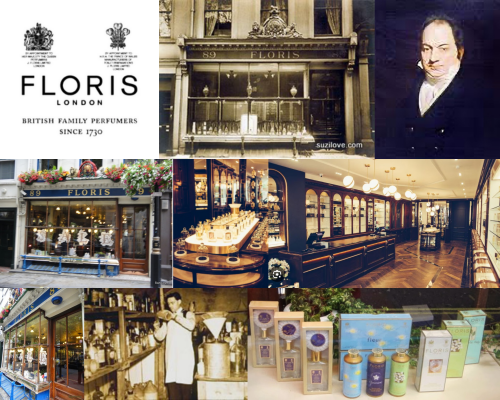
While writing about perfumes and oils, a favourite subject of mine, for my book, Scenting Scandal, I sniffed out some fascinating snippets on the history of early perfume suppliers in London. I have a nose for these things ( He He!) as in my past life I also blended oils and perfumes. One name stood out in historic London- Juan Floris.
He opened his shop at 89 Jerym St. in the elegant quarter of St. James’ London soon after his arrival from the Mediterranean in 1730. After starting as a barber and comb-maker, he missed the aromas of his Mediterranean youth and began blending oils, essences and fixatives, from Europe, into the first Floris fragrances.
‘ Purveyors of The Finest Perfumes & Toiletries to the Court of St James’ Since the Year 1730.’
In the same manner that Fortnum & Mason held Royal Warrants to supply groceries to the Royals, Floris held Royal Warrants to supply perfumes, shaving items and toiletries.
The first Royal Warrant granted to J.Floris Ltd was in 1820 as ‘Smooth Pointed Comb-makers’ to the then newly appointed King George IV. Then, the social elite followed the court until the Floris ledgers held accounts for an array of public figures, including practically every European Royal. Combs, tooth brushes and mouth washes were greatly valued by the company’s elite clientele.
These days, and at the same premises, Floris still supplies royalty and world celebrities with an array of fragrances and bathroom accessories.
The Floris archives hold letters from famous customers detailing their preferences and their thanks, including the following examples:
Embracing Scandal Book 1, Scandalous Siblings Series. Lady Rebecca Jamison sneaks into the house of the Duke of St. Martin to beg his assistance to combat a rogue and murderous group of railway investors.
Lady Rebecca Jamison told The Duke of St. Martin. ‘We utilize Foster and Braithwaite as our stock trading agents and invest through them using the minimum identification on any documents.”
“Impressive. I heard that Foster and Braithwaite’s business grew twelve fold in the last few years by riding on railway stocks.”
“Hence, our problem. Their profits, our profits, became legendary. People speculated about the mysterious names on share certificates.” At his puzzled look she added, “Simple enough. We draw up letters. Ladies sign with their initials and family name, nothing more, so no one realizes the investors aren’t men. Or rather, no one did before.”
“And now?”
“Two weeks ago, some members of the outer circle approached my brother, Michael. They believe him to be personally responsible for our own change in fortune.”
“How big a change in fortune?”
“Oh, nothing too major.” She waved a hand in a vague manner and hoped her face didn’t flush. “Modest successes. Dividend rates in excess of six percent in some situations.”
His eyebrows shot upwards. “Six percent! Nobody I do business with calls that modest. No wonder they wish to obliterate all reference to your family, and your Society.”
“Yes, if only we’d been able to keep our good fortune a secret. We take the uttermost care with our clandestine activities, as we value our privacy and our reputations.”
The Duke raised a brow and pointed at his clock. “Oh, yes. Great care with your reputation!”
She chose to ignore him. “Michael laughed it off. Refused to join their so-called group of friends who dabbled in investing. So they raised the stakes. If he refuses to hand over m … his calculations for all the new railway share ventures opening, within the next two weeks, they vowed to destroy the members of his family. One by one, until he gives in.”
“Ah, now I understand. That’s why they’re keeping you alive. They’re waiting to acquire the records. They assume as eldest, and involved in a charitable society, you hold the most knowledge of…” When he mumbled, she stiffened. Did he guess? “Of Michael’s future stock predictions. Then, when they have all they require, they’ll kill all–”
“Yes, yes, I know. They’ll dispense with us regardless.”
She lifted her chin a notch. “But I can resolve this situation. Given a little more time, plus a little assistance from you.”
“Ah! Back to the crux of the matter. What you require from me.”

1897 The Imperial Coronation Egg With A Surprise.Made By Mikhail Pushkin. Presented by Emperor Nicholas II to his wife Empress Alexandra Feodorovna as memento of entry to Moscow on May 26th, the day of the Coronation, in Uspensky Cathedral. Gold embellished with translucent yellow guilloché enamel.

Many Russian Easters were celebrated with Imperial monogramed eggs as the royals were very involved with both the religious celebrations of Easter and the family traditions. Fabergé eggs were jeweled eggs created by Peter Carl Fabergé and his company in Russia from 1885 to 1917. The most famous of the eggs are the ones made for the Russian Tsars, Alexander III and Nicholas II, as Easter gifts for their wives and mothers, often called the ‘Imperial’ Fabergé eggs. The House of Fabergé made about 50 eggs and 43 have survived. Another two were planned for Easter 1918, but because of the Russian Revolution were not delivered. After the Revolution, the Fabergé family left Russia and the Fabergé trademark has been sold several times since then. Several companies have sold Easter egg merchandise using the Fabergé name. The trademark is now owned by Fabergé Limited, which makes egg-themed jewelry.
1860 Corset, American. Cotton, metal, and bone. Manufacturer: Langdon Batcheller and Company, A1851-1860 ca. Blue Ribbed Silk Corset, English. Front and Back. Front hooks and back lacing. via Museum of London, UK. museumoflondon.org.uk

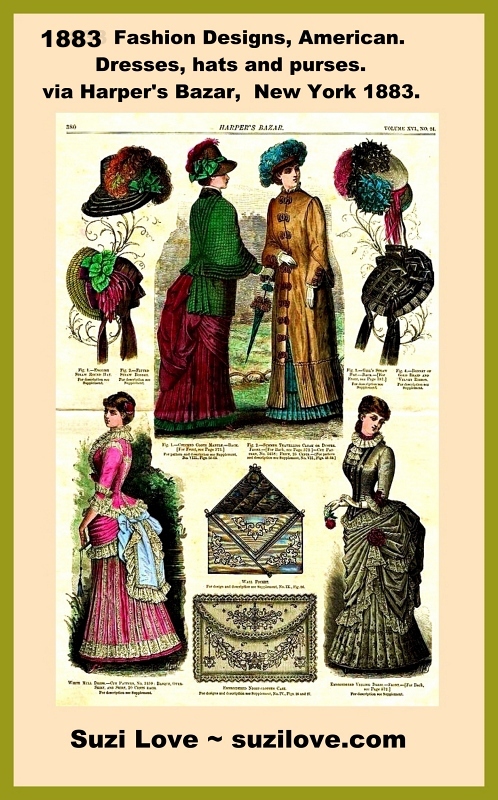
1883 Fashion Designs, American. Dresses hats and purses. Harper’s Bazar, New York City.