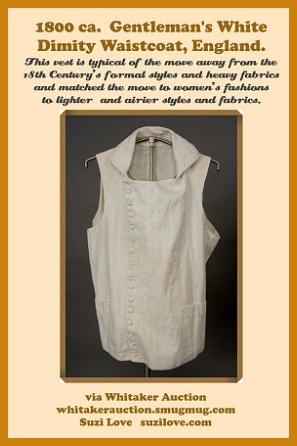
1800 ca. Gentleman’s White Dimity Waistcoat, England. This vest is typical of the move away from the 18th Century’s formal styles and fussy fabrics and matched the shift of women’s fashions towards lighter and airier styles and fabrics. via Whitaker Auction whitakerauction.smugmug.com
Waistcoats worn at the very beginning of the early 19th century generally had a straight bottom, double-breasted and with wide lapels. Not long after this, waistcoats began to be cut higher up to the waist in front so men during Jane Austen’s lifetime would have worn both styles.
1800 ca. Gentleman’s White Dimity Waistcoat, England. via suzilove.com and Whitaker Auctions.23_d2d_fashionmen1800-1819 https://books2read.com/SuziLoveFashionMen1800-1819
1817 September Glengary Riding Habit, English, as would have been worn during Bridgerton and Jane Austen’s times. Pale blue cloth, richly ornamented with frogs and braiding, front braided on each side and fastens under the body of the habit, which slopes down on each side to define the figure. Epaulettes and jacket are braided to correspond with the front as is the bottom of the sleeve which is braided nearly half-way up the arm. Habit shirt is of cambric with a high standing collar and trimmed with lace. Cravat of soft muslin is richly worked at ends, tied in a bow, narrow lace ruffles at the wrists. Headdress is a Glengary cap of blue satin, trimmed with plaited ribbon of various shades of blue and a plume of feathers. Blue kid gloves are worn and half-boots. Fashion Plate via Rudolph Ackermann’s ‘The Repository of Arts’.
Male tailors made most women’s riding habits during the Regency years and they were constructed similarly to men’s riding outfits. Generally in two pieces, a jacket and a skirt, and with a shirt with a frilled collar or front opening underneath. The trains of a habit could be caught up for walking, usually with a button and loop, and unhooked and let down so that the skirt flowed over the woman’s legs when she rode side saddle. Due to the numerous wars during the early 1800s, it was seen as patriotic for women to add military style touches to outfits in support of military men. The shoulder and cuff trims resemble the epaulettes and coat trims of a military uniform.
1817 September Glengary Riding Habit, English. Pale blue cloth, richly ornamented with frogs and braiding, front braided on each side and fastens under the body of the habit, which slopes down on each side to define the figure. Headdress is a Glengary cap of blue satin, trimmed with plaited ribbon of various shades of blue and a plume of feathers. Blue kid gloves are worn and half-boots. Fashion Plate via Rudolph Ackermann’s ‘The Repository of Arts’. Fashion Women 1815-1819 History Notes Book 28 https://books2read.com/SuziLoveFashionWomen1815-1819
1818 September 18th Le Palais Royal de Paris. ‘A Peep at the French Monstrosities’. Two English tourists dressed as dandies walk arm-in-arm under the arcade of the Palais Royal, interested in the promenading courtesans. Their dress is rather similar to that of the Englishmen, but the latter wear bell-shaped top-hats, while the Frenchmen have flower-pot shaped hats. By George Cruikshank. Via British Museum, London, UK. britishmuseum.org (PD-Art)
Easy to read overview of what an older lady did, wore, and how she lived in Jane Austen and Bridgerton’s time. Information for history buffs and pictures for readers and writers of historical fiction. Older Lady’s Day Regency Life Series Book 5 by Suzi Love books2read.com/suziloveOLD
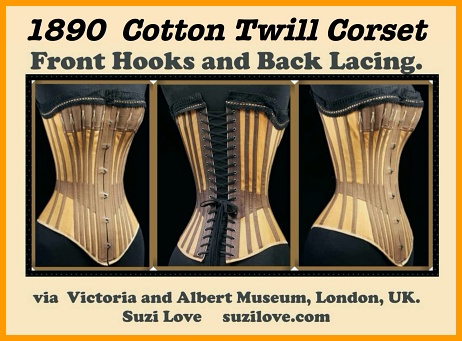
1890 Cotton Twill Corset, England or Germany. Machine stitched with front hooks and back lacing and made in two parts. Brown corset with the bones covered with a darker cotton twill, black fabric covered busks and a trimming of black machine-made cotton lace. Lined with white cotton twill and the top and bottom are bound with reddish brown tape.
The front fastens with a busk and the backs are provided with metal eyelets for a lace. The corset is hip length, curving to a rounded point in the front and less deeply at the back. The bones are close-set and splayed out at the bust and hips, and at the tops are trimmed with fancy stitching in cream. There is a band of dark brown cording at the top, covering the breasts. At the waist there is a V-shaped band in darker brown stitching. With metal fastenings. via http://collections.vam.ac.uk/item/O351699/corset-unknown/
Corsets 1880-1900 History Notes Book 20 This book shows how a fashionable silhouette became of paramount importance and how a well-fitted corset became a fashion essential. As well as a decorative fashion item, tight lacing gave a narrow waist and the desired feminine form under clothing. https://books2read.com/SuziLoveCorsetBook20
HN _20_D2D_Corsets 1880-1900Corsets 1880-1900 History Notes Book 20
https://books2read.com/SuziLoveCorsetBook20
1809 February Walking or Carriage Dress, English. Polanese coat, Saragossa mantle of spring green Virgnia cloth, trimmed round the edges and up the front of the coat with black velvet bindings, and edgings of gold lace. High puckered collar, confined round the throat with a gold cord and acorn tassels. Belt of black velvet, and rich gold clasp. Military cap formed of the same material, and trimmed also with black velvet and gold. Short white lace veil falling from the edge of the cap just below the chin. Half-boots of green kid or cloth, calashed and bound with black, and laced with gold cord. Fashion Plate via John Belle’s La Belle Assemblée or, Bell’s Court and Fashionable Magazine, London.
Fashion Women 1805-1809 History Notes Book 26
What did Jane Austen and friends wear? This book looks at early 1800s fashions, which were elegant and pretty with high waists and fabrics that were almost transparent. These Empire style gowns, named after Napoleon’s first Empress, became popular throughout Europe, and were then copied around the world. Colorful outwear was added to make an ensemble more attractive and warmer.
https://books2read.com/SuziLoveFashionWomen1805-1809
Cartoons For Riders At The Hunt. Typical comical scenes from The Bridgertons and Jane Austen’s Daily Lives. From: 1860 Mr. Sponge’s Sporting Tour by Robert Smith Surtees. via Google Books (PD-100)
Success At The Hunt. Riding with the hounds separates the good riders from the pretenders. How embarrassing! Coming to grief on the hunt. Excitement of The Hunt for all riders. A Good Place To Watch the Hunt Go Past.A Young Man Speaking To A Young Lady At the Hunt. RL_2_D2D_RetailerBuyLink_RL_2
https://books2read.com/suziloveYGD
1817 June Blue Riding Costume, English. Loose riding habit with a train on the skirt, high white neck frill on the shirt underneath, and rows of decoration on the shoulders and cuffs of the habit jacket, an extra high hat with multiple plumes, or, feathers and gloves. Fashion Plate via The Lady’s Magazine Or Entertaining Companion for the Fair Sex.
Male tailors made most women’s riding habits during the Regency years and they were constructed similarly to men’s riding outfits. Generally in two pieces, a jacket and a skirt, and with a shirt with a frilled collar or front opening underneath. The trains of a habit could be caught up for walking, usually with a button and loop, and unhooked and let down so that the skirt flowed over the woman’s legs when she rode side saddle. Due to the numerous wars during the early 1800s, it was seen as patriotic for women to add military style touches to outfits in support of military men. The shoulder and cuff trims resemble the epaulettes and coat trims of a military uniform.
1817 June Blue Riding Costume, English. Loose dress with a train, high white neck frill, extra high hat with multiple plumes, or, feathers and gloves. Fashion Plate via The Lady’s Magazine Or Entertaining Companion for the Fair Sex.
Fashion Women 1815-1819 History Notes Book 28 What did Jane Austen wear? . D2D_HN_28_https://books2read.com/SuziLoveFashionWomen1815-1819
18th Century Gorgeous Georgian frock coats and waistcoats for men. via The Argory, County Armagh, National Trust Collections, U.K.
Typical men’s fashion in the 1700s was a silk three piece suit. This consisted of a vest or waistcoat, a coat and breeches, Fabrics were luxurious an usually featured multi-colored embroidery and buttons, often of the same fabric. Vests were generally collarless and coats had turned over collars.
18th Century Gentlemen.
Frock coats and waistcoats. via The Argory, County Armagh, National Trust Collections, U.K.HN_2_D2D_Fashion Men 1700s
books2read.com/suziloveFashMen1700
1890-1920 ca. Sterling Silver Chatelaine, England. Center Medallion With Portraits, three drops of monogrammed mesh purse, globe-shaped watch and book-shaped case. Via Augusta Auctions – augusta-auction.com
Definition
The word Chatelaine is French and means the keeper of the keys
Chatelaine” derives from the Latin word for castle
In Medieval times, the chatelaine was in charge of the day-to-day running of the castle.
What did a chatelaine do?
Most important task was keeper of the keys.
Also ordered supplies, did bookkeeping, supervised servants, taught castle children, and organized guests.
By 1700’s, a metal jeweled ornament hung from pockets, attached to belts, or by hooks into skirt waistbands
During 1800’s, women wore large collections of tools hung from chains
Young girls sewed and did needlework and needed to carry sewing notions eg scissors, thimbles
What were chatelaines used for?
Worn by women of all classes, from workers to nobility
Varied depending on class and finances.
Made of silver, brass, steel, leather, or fabric
During 19th century, fashionable dresses often had no waist and nowhere to hang chatelaines
Chatelaines became decorative brooches
Often given as a wedding present from a husband to bride
Later became fashion accessories
D2D_RetailerBuyLink_HN_9. Chatelaines and Chains History Notes Book 9 By Suzi Love. #regency Women in charge of houses wore long chains holding important household items around their waist e.g. keys, pen, notebook, sewing. books2read.com/SuziLoveChatelaines