↓
 

Suzi Love

Making history fun, one year at a time.

Header_
  • Home
  • Newsletter
  • Pre order form
  • Shop
    • Cart
    • Checkout
    • My account
    • Refund and Returns Policy
  • Blog
  • BOOKS
    • History Events
    • Kelly’s Justice
    • Outback Arrival
    • Irresistible Aristocrats
    • History Notes
    • Scandalous Siblings
    • Love After Waterloo
    • Regency Life Series
  • Privacy Policy
  • EVENTS
Home » England » Page 27 << 1 2 … 25 26 27 28 29 … 62 63 >>

Category Archives: England

Post navigation

← Previous Post
Next Post→

Christmas: Crackers And Their Fascinating History #Christmas #Customs #BritishHistory #Holidays

Suzi Love Posted on December 8, 2025 by Suzi LoveDecember 8, 2025

Christmas Crackers And Their Fascinating History

First made in 1850 by a London sweet maker called Tom Smith who decided it would a fun idea if his sweets and toys opened with a crack when their fancy wrappers were pulled in half. In early 1830, Tom Smith started work in a bakers and ornamental confectioners shop in London, selling sweets such as fondants, pralines and gum pastilles. He worked hard and took particular interest in the wedding cake ornaments and decorations, experimenting and creating new, more exciting and less crude designs in his spare time. Before long he was successful enough to leave and start up his own business in Goswell Road, Clerkenwell, East London. On a trip to Paris in 1840, he discovered the ‘bon bon’, a sugared almond wrapped in a twist of tissue paper.  He brought the ‘bon bon’ to London and they sold extremely well, but in January demand virtually ceased and once again he was reliant on sales of cake and table decorations and ornaments.

Anxious to stimulate sales, Tom placed a small love motto in the tissue paper and encouraged his regular customers to take supplies. Tom took a risk and concentrated on developing it further, while still running the wedding cake ornament and confectionery business. The majority of ‘bon bons’ were sold at Christmas so Tom thought up ways to capitalize on this short, but very profitable, season. It was the crackle of a log as he threw it on his fire that gave him the flash of inspiration which eventually led to the crackers we know today. A ‘ crackle’ added excitement to his novelty ‘bon bon’ so he experimented to find a compound which gave a satisfactory bang. He perfected his chemical explosion to create a ‘pop’ caused by friction when the wrapping was broken and the trade jumped at Tom Smith’s latest novelty.

He quickly refined his product by dropping the sweet and the ‘bon bon’ name, calling his new crackers Cosaques, but he kept the motto and added a surprise gift. Delighted at his overnight success, Tom took his cracker abroad but an Eastern manufacturer copied his idea and delivered crackers to Britain just before Christmas. So Tom designed 8 different kinds of cracker, working his staff day and night and distributing stocks in time for Christmas. He lived to see the new branch of his firm grow to swamp the original premises in Goswell Road and the company moved to Finsbury Square in the City of London where it remained until 1953. When he died he left the business to his three sons, Tom Henry and Walter. A few years later, a drinking fountain was erected in Finsbury Square by Walter Smith in memory of his mother, Mary, and to commemorate the life of the man who invented the great British Cracker.

His three sons developed the cracker designs, contents and mottoes. Walter Smith, the youngest son, introduced a topical note to the mottoes which had previously been love verses. Special writers were commissioned to compose snappy and relevant maxims with references to every important event or craze at the time from greyhounds to Jazz, Frothblowers to Tutankhamen, Persian Art to The Riviera. The original early Victorian mottoes were mainly love verses. Eventually these were replaced by more complicated puzzles and cartoons, and finally by the corny jokes and riddles which characterise our crackers today. 

Walter also introduced the paper hats, many of which were elaborate and made of best tissue and decorative paper on proper hatmakers stands and he toured the world to find new, relevant and unusual ideas for the surprise gifts, such as bracelets from Bohemia, tiny wooden barrels from America, and scarf pins from Saxony. Some were assembled in the factory, like the thousands of tiny pill boxes filled with rouge complete with powder puff.

A six foot cracker decorated Euston Station in London, and in 1927 a gentleman wrote to the Company enclosing a diamond engagement ring and 10 shilling note as payment for the ring to be put in a special cracker for his fiancee. Unfortunately he did not enclose an address and never contacted the Company again; the ring, letter and 10 shilling note are still in the safe today. In the early days, there was a large variety of specialist boxes, including Wedgwood Art Crackers from original designs by permission of Josiah Wedgwood and Sons, and designs such as Japanese Menagerie crackers containing the latest novelties from Japan, including animals, birds, reptiles and mottoes in Japanese.  

Crackers were created for the War Heroes, Charlie Chaplin, The Wireless, Motoring, The Coronation and even the Channel Tunnel in 1914.  Exclusive crackers were also made for members of the Royal Family and still are to this day. During the Second World War restrictions were placed on the production of cracker snaps.

The Ministry of Defence commissioned Tom Smith to fold and tie bundles of three to six snaps together with special string and regulation knots. These bundles were then used by soldiers in training as, when the string was pulled, they mimicked the noise of machine gun fire. After the war, vast quantities of these surplus cracker snaps were released back into the cracker trade. As the demand for crackers increased, Tom Smith merged with Caley Crackers in 1953 taking over their headquarters and factory in Norwich, East Anglia.

Tom Smith Group Limited currently hold a royal warrant from: HM QUEEN ELIZABETH II Ê 1906: Tom Smith were granted their first Royal Warrant by the then Prince of Wales which entitled them in 1909 to become members of the Royal Warrant Holders Association. 1910: In December, the reigning monarch, King George V granted Tom Smith his warrant as suppliers of Christmas Crackers. Tom Smith still holds the honour of producing special crackers each year for the Royal Household.

In the countries that now use them, a cracker is set next to each plate on the Christmas dinner table and a colourful party hat, a toy or gift and a festive joke falls out when the cracker is pulled in half with a loud bang! The party hats look like crowns, supposedly to symbolise the crowns worn by the Wise Men.

Another British company strongly associated with the cracker business was Batger and Co. Like Tom Smith, they sold a wide variety of crackers in highly decorated boxes and once again many were themed or in commemoration of a special event. Batger’s Gretna Green Crackers for the famous place for eloping lovers where couples in the Regency period ran off in a carriage to Scotland to be married at the blacksmiths forge at Gretna Green.

Xmas_Christmas Crackers And Their Fascinating History

Crackers were an incredibly expensive luxury at the time costing from 14 shillings to 30 shillings a box. Others were Peerless Crackers and Mead and Field Crackers. Cabaret Girl from the Peerless series of Christmas crackers, from 1933, which promises that each cracker contains ‘both a juvenile costume and fancy hat or cap, amusing joke or riddle, a good snap.

Xmas_Christmas Crackers And Their Fascinating History
Christmas: Crackers And Their Fascinating History #Christmas #Customs #BritishHistory #Holidays https://books2read.com/suziloveHOCP Share on X

Posted in 1800s, Australia, Canada, Christmas, Customs & Manners, Edwardian Era, England, Europe, History, household, London, Suzi Love Images, U.S.A, Victorian Era | Tagged British history, Christmas, Customs and Traditions, England, europe, household, Suzi Love Images

Christmas: Words We Still Use Today. #Christmas #holidays #Traditions #Customs

Suzi Love Posted on December 7, 2025 by Suzi LoveDecember 7, 2025

Christmas Words We Still Use Today

I love finding out the tradition behind some of the things we do and say at Christmas, don’t you? So I am going to do a series of posts this week covering lots of the historical aspects of our celebrations. Why we say things, why we do things, and why we use things to decorate our houses. Enjoy the festive season with me with more posts to follow. 

CHRISTMAS

The word has been around for centuries, with  some dictionaries putting it in the late Old English period and others to the 12th century. Old forms include cristes masse and christmasse, meaning the festival (mass) of Christ. It replaced other pagan midwinter festivals when the church tried to persuade Romans to convert to Christianity.

XMAS

This abbreviation annoys a lot of people but it isn’ t simply modern shorthand.  X was used to represent the Greek symbol chi, which is also the first letter in Christ. This has been used since Roman times.

DECORATE

The word means to adorn and is from the 16th century, but the seasonal meaning of to deck with ornamental accessories dates from the 18th century. The word originates from the Latin decoratus (beautify).

TINSEL

It was first seen in the expression tinsell saten which means strips of shining metal used for ornament. It also describes things that are showy and worthless. It is believed to have come from the Anglo Norman with ancestors in Old French.

Christmas: Words We Still Use Today #Christmas #holidays #Traditions #Customs books2read.com/suziloveHOCP Share on X
Posted in Australia, Canada, Christmas, Customs & Manners, Edwardian Era, England, Europe, Georgian Era, Regency Era, Romantic Era, Suzi Love Books, Suzi Love Images, U.S.A, Victorian Era | Tagged Australia, British history, Christmas, Customs and Traditions, europe, USA

Christmas Pudding #Christmas #holidays #Food #Traditions #Customs

Suzi Love Posted on December 6, 2025 by Suzi LoveDecember 6, 2025

Christmas pudding originated as a 14th century porridge called ‘frumenty’ , made of beef and mutton with raisins, currants, prunes, wines and spices. Often more like soup, it was eaten as a fasting meal in preparation for Christmas festivities. By 1595, frumenty changed into a plum pudding thickened with eggs, breadcrumbs, dried fruit and flavoured with beer and spirits. It became the customary Christmas dessert around 1650, but in 1664 the Puritans banned it as a bad custom. In 1714, King George I re-established it as part of the Christmas meal, having tasted and enjoyed Plum Pudding.

“In December, the principal household duty lies in preparing for the creature comforts of those near and dear to us, so as to meet old Christmas with a happy face, a contented mind, and a full larder; and in stoning the plums, washing the currants, cutting the citron, beating the eggs, and mixing the pudding, a housewife is not unworthily greeting the genial season of all good things.” Via 1861 Beeton’s Book of Household Management. 

The Sunday closest to St. Andrew’s Day was Stirring-up Sunday, and the day to prepare the family’s Christmas pudding.  The eldest member of the household or a visitor would give the first stir and charms were stirred into the pudding. A ring meant a coming marriage, a button was bachelorhood, a thimble meant spinsterhood, and a sixpence was good luck. Puddings were steamed in a pudding bag and stored in a cool place until Christmas Day. 

Christmas Pudding
Christmas Pudding
Christmas Pudding
Christmas Pudding
Christmas Pudding
Christmas Pudding
Christmas Pudding
Christmas Pudding
Christmas Pudding
Christmas Pudding #Christmas #holidays #Food #Traditions #Customs https://books2read.com/suziloveHOCP Share on X

Posted in 1700s, 1800s, 1900s, Australia, Canada, Christmas, Edwardian Era, England, Europe, Food and Drink, Georgian Era, household, Regency Era, Romantic Era, Suzi Love Images, U.S.A, Victorian Era | Tagged British history, Christmas, Customs and Traditions, Food, History Of Christmases Past, household

Christmas: Early Religious Beliefs #Christmas #holidays #Traditions #Customs

Suzi Love Posted on December 5, 2025 by Suzi LoveDecember 5, 2025

Early Christians appropriated pagan customs and turned them into religious observances and, therefore, a victory over Paganism and a way to win more souls. By the end of the second century, numerous dates were being proposed as the correct date for the birth of Jesus. One popular method, allegorical theology, thought Christ must have born on the same day the sun was created, though our modern theorists estimate that the birth of Jesus was between 7 and 4 BC.

Unlike Easter, the earliest Christians didn’t celebrate the nativity or Christmas, which began in the late 3rd century AD as an alternative to pagan winter holidays. In the beginning, Christians only celebrated the baptism and resurrection of Christ and the death of the martyrs. The first evidence of Christmas being celebrated is in Rome in 336 AD and by the early fourth century, the 25th of December became the celebration day for the birth of Jesus Christ.

Origen of Alexandria, amongst others, opposed the celebration of Christ’s birth and pointed out that only Pharaoh and Herod celebrate their birthdays in the Bible, and that birthdays were for pagans, not Christians. Jehovah’s Witnesses follow this belief and reject the celebration of both Christmas and birthdays. Early religious Christmas customs began with special services held by candlelight and often at midnight. In Bethlehem, Midnight Mass is celebrated at the place of Jesus’ birth in the ancient Church of the Nativity. 

But as the years passed, going to church, especially at Christmas, was something done by villagers and landowners as a custom, an obligation, or to show respect to the local clergyman rather than for any great religious reasons. People attended Church services on Sunday and Holy Days and donated money to village or church causes but the religious fervor of early years had dimmed. If a person was particularly devoted, they would read the Bible, the Book of Common Prayer, or a book of sermons on a regular basis and probably attend the Church of England, which was the main church by the late Georgian and early Regency years.

Christmas: Early Religious Beliefs #Christmas #holidays #Traditions #Customs https://books2read.com/suziloveHOCP Share on X
Posted in Christmas, Customs & Manners, England, Europe, History, Suzi Love Images | Tagged British history, Christmas, Customs and Traditions, europe, Great Britain, religion

Christmas Greetings Around The World #Christmas #holidays #Traditions #Customs

Suzi Love Posted on December 4, 2025 by Suzi LoveDecember 2, 2025

Christmas Greetings Internationally.

  • Merry Christmas  – English
  • Joyeux Noël    –    French
  •  Meri Kurisumasu     –    Japanese
  •  Nollaig Shona Dhuit    –    Irish – Gaelic
  •  Meri Kirihimete        –     New Zealand (Maori)
  • Manuia Le Kerisimasi     –     Samoan
  •  Blithe Yule    –     Scottish
  •  Finnish –  Hyvää joulua
  • Greek  – Καλά Χριστούγεννα (Καλά Χριστούγεννα)
  •  Italian – Buon Natale
  •  Spanish. –  Feliz Navidad
  •  Turkish  – Mutlu Noeller
  • Vietnamese. –  Giáng Sinh vui vẻ
  •  German – Frohe Weihnachten

Christmas Greetings Around The World #Christmas #holidays #Traditions #Customs books2read.com/suziloveHOCP Share on X
Posted in 1700s, 1800s, 1900s, Australia, Canada, Christmas, England, Europe, History Of Christmases Past, South Pacific, Suzi Love Images, U.S.A | Tagged Christmas, England, europe, France, Germany, History Of Christmases Past, Regency Era | Leave a reply

Christmas: Symbols and Their Meanings #Christmas #holidays #Traditions #Customs

Suzi Love Posted on December 3, 2025 by Suzi LoveDecember 1, 2025

Christmas Symbols and Their Meanings

Angels – Heralds for the news of the birth of a baby in a manger.

Bells – Bells have rung out for all important events for centuries, plus lost sheep are found by the sound of the bell.

Candy Cane  – Symbolizes the crook of the shepherds who visited Christ.  Red represents the blood that was spilled and white is for purity. The peppermint oil that flavors is known for its strong healing properties.

Cards – Produced in Britain in 1843 to be sent with love to family and friends around the world by the new Postal services.

Carols – Poems and stories of worship made into songs.

Carolers – Groups of people who strolled the streets singing Christmas songs

Feasting – To celebrate the joy of the baby’s arrival on the 25th December. 

Gift Giving – The Wise Men bowed before the baby and gave him gold, frankincense and myrrh.

Gold – Decorating using the color of one of the gifts of the wise men.

Green – Decorating using the color of evergreens which show everlasting love.

Holly – Represents Eternal Life and the crown of thorns worn by Jesus.

Mistletoe: In the 18th Century, men kissed a woman who stood under mistletoe to show love, friendship and goodwill. If a woman was un-kissed, she would (supposedly) never marry.

Nativity: The birth of Jesus Christ

Poinsettia –  Red flowers used in countries such as Mexico to symbolize Christmas time.

Stockings – Hung by children to receive gifts

Twelve Days of Christmas: Twelve days between the birth of Christ on December 25 and the coming of the Magi on January 6, the Epiphany.

Tree – Evergreen tree symbolizes eternal life and love

Wreath – Made of evergreens to symbolize never ending love

Christmas: Symbols and Their Meanings #Christmas #holidays #Traditions #Customs https://books2read.com/suziloveHOCP Share on X
Posted in 1700s, 1800s, 1900s, Bridgerton, Christmas, Customs & Manners, Edwardian Era, England, Europe, Food and Drink, Georgian Era, History Of Christmases Past, household, Jane Austen, Pastimes, Regency Era, Suzi Love Books, Victorian Era | Tagged Bridgerton, British history, Christmas, Customs and Traditions, europe, History Of Christmases Past, Jane Austen, Regency Era, Victorian Era

19th Century Typical Meals and Table Settings for the Family and For Guests. #RegencyEra #RomanticEra #Food #BritishHistory

Suzi Love Posted on November 28, 2025 by Suzi LoveNovember 27, 2025

19th Century Typical Meals and Table Settings for the Family and For Guests. This is typical of the food that would have been served at Jane Austen’s meal times. Historic food from 1860s Mrs. Beeton’s Household Management.

1800s Typical Modern Table Settings. From: 1860s Mrs. Beeton's Book of Household Management. via Google Books (PD-150)
1800spical Modern Table Settings.
Food_1800s_TypicalJoints_SirloinofBeef, Boiled Beef, Leg Of Mutton, Roast Ribs Of Beef. From- 1861 Mrs. Beeton_Sml
food_1800s_TypicalGame and Poultry (1). Snipe On Toast, Larks On Toast, Roast Pheasant, Roast Pigeons, Roast Fowl, Roast Goose, Roast Duck, Boiled Fowl, Roast Turkey_1860s_Mrs. Beeton_Sml
Xmas_food_1800s_TypicalPies-and-Puddings_MrsBeeton
1800s Typical Cold Entrees. Chicken Medallions, Cold Border Of Salmon, Beef Galantine, Zephires Of Duck, Mutton Cutlets In Aspic, Chartreuse Of Pheasant, Timbale Of Turbot or Fished Baked In a Mold, Chicken Darioles or Chicken in Small Molds. From: 1860s Mrs. Beeton's Book of Household Management. via Google Books (PD-150)
Food_1800s Typical China For Serving Dinner and Dessert. Dinner Plates, Soup Tureen, Covered Cheese Dish, Jug, Dessert plates and Serving Dish. From: 1860s Mrs. Beeton's Book of Household Management. via Google Books (PD-150)
1800s Typical China For Serving Dinner and Dessert. Dinner Plates, Soup Tureen, Covered Cheese Dish, Jug, Dessert plates and Serving Dish. From: 1860s Mrs. Beeton’s Book of Household Management. via Google Books (PD-150)
19th Century Typical Meals and Table Settings for the Family and Guests in Bridgerton and Jane Austen years. #Bridgerton #JaneAusten #RegencyEra #RomanticEra #Food #BritishHistory https://books2read.com/suziloveOLD Share on X
RL_5_D2D_RetailerBuyLink_RL_5_2
RL_5_D2D_RetailerBuyLink_RL_5_ https://books2read.com/suziloveOLD
Posted in 1800s, Australia, Bridgerton, Canada, England, Europe, Food and Drink, History, household, Jane Austen, Regency Era, Romantic Era, Suzi Love Images, U.S.A, Victorian Era | Tagged 1800s Or 19th Century, Bridgerton, British history, Food, google books, household, Jane Austen, Mrs. Beeton, Romantic Era

1808 Christie’s Auction Room, London, U.K. From: Microcosm of London By Rudolph Ackermann. #JaneAusten #Regency #London #History

Suzi Love Posted on November 27, 2025 by Suzi LoveNovember 27, 2025

1808 Christie’s Auction Room, London, U.K. From: Microcosm of London By Rudolph Ackermann. The Microcosm of London was published in three volumes between 1808 and 1810 and was coordinated by German born printseller, Rudolph Ackermann, from his Repository of Arts at 101 The Strand, London, U.K. and included numerous contributors. Visitors to London in Jane Austen’s time would go to all the important buildings. https://books2read.com/suziloveROver

1808 Christie's Auction Room, London, U.K. From: Microcosm of London By Rudolph Ackermann.  #Regency #London #History
1808 Christie's Auction Room, London, U.K. From: Microcosm of London By Rudolph Ackermann. #JaneAusten #Regency #London #History. https://books2read.com/suziloveROver Share on X
RL_1_D2D_Regency Overview RetailerLinks
https://books2read.com/suziloveROver
RL_1_D2D_Regency Overview RetailerLinks https://books2read.com/suziloveROver
Posted in England, History, Regency Era, Suzi Love Images | Tagged Cartoons, google books, Jane Austen, London, Regency Fashion, Regency London, Rudolph Ackermann

What did ladies do and wear in Bridgerton and Jane Austen’s time, or early 1800s? Books 4 and 5 Regency Life Series. #Bridgerton #RegencyEra #JaneAusten #BritishHistory #nonfiction

Suzi Love Posted on November 24, 2025 by Suzi LoveNovember 23, 2025

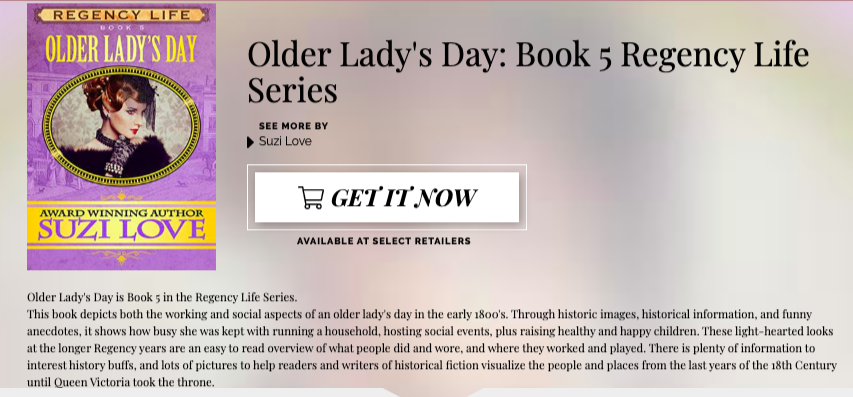
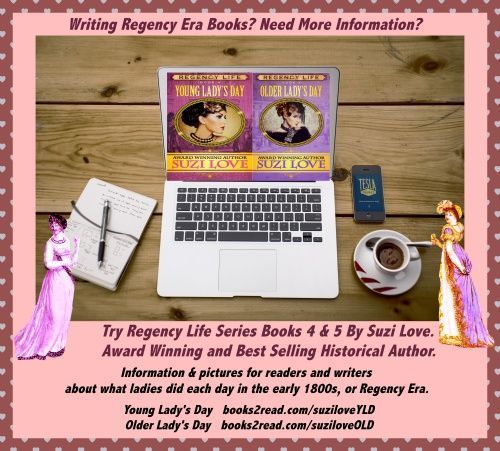
What did ladies do and wear in Jane Austen’s time, or early 1800s? #Regency #History #nonfiction Books 4 and 5 Regency Life Series. Young Lady’s Day and Older Lady’s Day in Books 4 and 5 in the Regency Life Series.
These books depict the often-frivolous life and fashions of ladies in the early 1800’s, or during the lifetime of Jane Austen, but also gives a glimpse into the more serious occupations ladies may undertake. Through historic images, historical information, and funny anecdotes, they show how a lady fills her day, where she is permitted to go, and who she spends time with. These light-hearted looks at the longer Regency years are an easy to read overview of what people did and wore, and where they worked and played. There is plenty of information to interest history buffs, and lots of pictures to help readers and writers of historical fiction visualize the people and places from the last years of the 18th Century until Queen Victoria took the throne. Young Lady’s Day ~ Older Lady’s Day

RL_4-5_YLD_Young Lady's Day Regency Life Series Book 4
What did ladies do and wear in Bridgerton and Jane Austen's time, or early 1800s? Books 4 and 5 Regency Life Series. #Bridgerton #RegencyEra #JaneAusten #BritishHistory #nonfictionRegency Life Series. https://books2read.com/suziloveYLD Share on X
D2D_RL_4_ Young Lady
http://books2read.com/suziloveYLD
Posted in 1800s, 1800s women's fashion, art, bedroom fashion, Box Or Container, Bridgerton, cartoon, Coat or Pelisse Or Redingote, Corset, Customs & Manners, dancing, Decorative Item, Dress Or Robe, England, Europe, fashion accessories, hats, household, Jane Austen, London, medical, mourning, Music, Pastimes, peerage, Regency Era, Regency Fashion, Regency Life Series, Reticule or Bag, riding, Royalty, sewing, shoes, Spencer, Suzi Love Books, Suzi Love Images, travel, U.S.A, underclothing | Tagged 1800s women's fashion, Book 4, Book 5, Bridgerton, Cartoons, Dress Or Gown, fashion accessories, Fashion Plate, Food, Hats And Hair, household, Jane Austen, magazines, music, peerage, Regency Fashion, Regency Life, Regency Life Series, Regency London, Regency Women, Shoes, Spencer, Suzi Love Books

1818 ca. Black Evening Dress Of Machine Made Net, British. #RegencyFashion #JaneAusten #Bridgerton

Suzi Love Posted on November 23, 2025 by Suzi LoveNovember 23, 2025

1818 ca. Elegant black evening dress as would have been worn in the times of Jane Austen when attending evening events, such as dinners, concerts, musical evenings or the opera. British, Empire style, or high-waisted dress of machine-made silk net, embroidered with silk, trimmed at the hem with padded black satin rouleaux and rosettes, long straight sleeves under shoulder puffs. Machine-made net was a very popular background for embroidery and laces in early 1800s and the airy texture suited loose and flowing Empire style fashions. Victoria and Albert Museum, London, UK.
collections.vam.ac.uk.

1818 ca. Black Evening Dress, British. High-waisted dress of machine-made silk net, embroidered with silk, trimmed at the hem with padded black satin rouleaux and rosettes, long straight sleeves under shoulder puffs. Machine-made net was a very popular background for embroidery and laces in early 1800s and the airy texture suited loose and flowing Empire style fashions.
1818 ca. Black Evening Dress Of Machine Made Net, British. #RegencyFashion #JaneAusten #Bridgertonhttps://books2read.com/SuziLoveFashionWomen1815-1819 Share on X
HN_28_D2D_Fashion Women 1815-1819
https://books2read.com/SuziLoveFashionWomen1815-1819
Fashion Women 1815-1819 History Notes Book 28 https://books2read.com/SuziLoveFashionWomen1815-1819
Posted in 1800s, 1800s women's fashion, Bridgerton, Dress Or Robe, England, Jane Austen, London, Regency Era, Regency Fashion, sewing, Suzi Love Images | Tagged 1800s women's fashion, Bridgerton, Dress Or Gown, Jane Austen, Regency Fashion, sewing, Victoria and Albert Museum | Leave a reply

Post navigation

← Previous Post
Next Post→

SUBSCRIBE TO SUZI LOVE'S NEWSLETTER.

Recent Posts

  • 1780 Red Wool Stays, Or Corset, and Panniers, British. #Georgian #Corset #Underclothing
  • 1800-1817 ca. Professional Man’s Black Wool Suit As Worn in Times Of the Bridgerton Family and Jane Austen. #Bridgerton #JaneAusten #RegencyFashion #RegencyEra
  • 1800s Typical Game Bird Dishes Served In Households During Bridgerton and Jane Austen Years. #Bridgerton #Food #RegencyEra #BritishHistory #JaneAusten
  • 1811 Jane Austen Style White Dress With Pink Redingote And Green Shawl. #RegencyEra #HistoricalFashion #JaneAusten
  • Book Hooks: “Help,” a voice yelled before all hell broke loose. #MilitarySuspense #ContemporaryRomance #kellysjustice #SouthPacific #Vanuatu

Recent Comments

  1. Suzi Love on Book Hooks: “Help,” a voice yelled before all hell broke loose. #MilitarySuspense #ContemporaryRomance #kellysjustice #SouthPacific #Vanuatu
  2. Lisabet Sarai on Book Hooks: “Help,” a voice yelled before all hell broke loose. #MilitarySuspense #ContemporaryRomance #kellysjustice #SouthPacific #Vanuatu
  3. Suzi Love on Book Hooks: “Help,” a voice yelled before all hell broke loose. #MilitarySuspense #ContemporaryRomance #kellysjustice #SouthPacific #Vanuatu
  4. Suzi Love on Book Hooks: “Help,” a voice yelled before all hell broke loose. #MilitarySuspense #ContemporaryRomance #kellysjustice #SouthPacific #Vanuatu
  5. Jana Richards on Book Hooks: “Help,” a voice yelled before all hell broke loose. #MilitarySuspense #ContemporaryRomance #kellysjustice #SouthPacific #Vanuatu

Login

  • Log in

Archives

  • June 2026
  • May 2026
  • April 2026
  • March 2026
  • February 2026
  • January 2026
  • December 2025
  • November 2025
  • October 2025
  • September 2025
  • August 2025
  • July 2025
  • June 2025
  • May 2025
  • April 2025
  • March 2025
  • February 2025
  • January 2025
  • December 2024
  • November 2024
  • October 2024
  • September 2024
  • August 2024
  • July 2024
  • June 2024
  • May 2024
  • April 2024
  • March 2024
  • February 2024
  • January 2024
  • November 2023
  • October 2023
  • September 2023
  • August 2023
  • July 2023
  • June 2023
  • April 2023
  • March 2023
  • February 2023
  • June 2022
  • April 2022
  • March 2022

Categories

  • 1700s
  • 1700s Mens fashion
  • 1700s Womens Fashion
  • 1800s
  • 1800s Mens Fashions
  • 1800s women's fashion
  • 1900s
  • art
  • Australia
  • Bath
  • bedroom fashion
  • Book Hooks
  • Box Or Container
  • Bridgerton
  • Bus Trips
  • Canada
  • Carriage
  • cartoon
  • Celebrity
  • Chatelaine
  • children
  • Children
  • Christmas
  • Coat or Pelisse Or Redingote
  • Contemporary
  • Corset
  • Couple
  • Customs & Manners
  • dancing
  • December Scandal
  • Decorative Item
  • Dress Or Robe
  • Easter
  • Edwardian Era
  • Embracing Scandal
  • England
  • Ester In Images
  • Europe
  • Events
  • Fashion
  • fashion accessories
  • Food and Drink
  • Four Times A Virgin
  • France
  • furniture
  • Georgian Era
  • Georgian Fashion
  • Google Books
  • Grand Tour
  • Group
  • hats
  • History
  • History Events
  • History Notes
  • History Of Christmases Past
  • household
  • Hygiene
  • Irresistible Aristocrats
  • Jane Austen
  • Keanu Reeves
  • Kellys Justice
  • Legal
  • London
  • Love After Waterloo
  • Loving Lady Katharine
  • medical
  • military
  • money
  • mourning
  • Music
  • Outback Arrival
  • pants
  • Pastimes
  • peerage
  • People
  • Petunia and Pearl Diver
  • Places
  • Pleasure House Ball
  • postal
  • Queensland
  • Quotations
  • Regency Era
  • Regency Fashion
  • Regency Life Series
  • Reticule or Bag
  • riding
  • Romantic Era
  • Royalty
  • Russia
  • Scandalous Siblings Series
  • Scenting Scandal
  • Self Publishing
  • sewing
  • Shirt
  • shoes
  • Shopping
  • South Pacific
  • Spencer
  • sports
  • Suit
  • Sunday Snippet
  • Suzi Love
  • Suzi Love Books
  • Suzi Love Images
  • Suzi Love Writing
  • Swain Cove
  • THe Viscount's Pleasure House
  • travel
  • U.S.A
  • underclothing
  • Vest or Waistcoat
  • Victorian Era
  • Victorian Fashion
  • weapons
  • weddings
  • Writing Tools

1800s men fashion 1800s women's fashion antiques Bridgerton British history Cartoons Corset cravat decorative Dress Or Gown England europe fashion accessories Fashion Plate France Georgian era Georgian Fashion gloves google books Hats And Hair historical romance History Notes household Jane Austen jewelry Journal des Dames et des Modes London Metropolitan Museum NYC pants Redingote Or Pelisse Or Coat Regency Era Regency Fashion Regency London reticule or bag riding sewing shawls Shoes Suzi Love Books Suzi Love Images Tailcoat The Repository Of Arts underclothing Vest or Waistcoat Writing Tools

©2026 - Suzi Love - Weaver Xtreme Theme Privacy Policy
↑