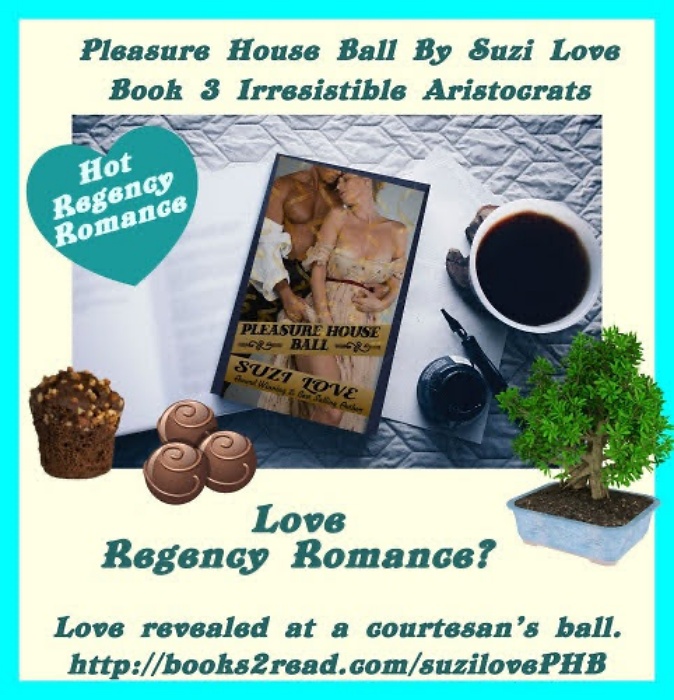
Pleasure House Ball, Book 3, Irresistible Aristocrats books2read.com/suzilovePHB. Leaning in, Lord Mallory whispered in Lady Lillian’s ear. “Well, well. I certainly didn’t expect to find you in attendance at a scandalous ball.”
1820 Blackstone House, Twenty miles south of London. Brenton, Earl Mallory, secreted himself behind a life-sized statue of a naked man. Hiding from the two hundred guests spilling through the rooms Lord Browning had opened for the Pleasure House Ball. Clearly he’d suffered a moment of insanity when he’d yielded to his friend’s pleas to accompany him to this ball. ‘For God’s sake, Michael, why are we wasting our time here? I’ve no intention of engaging a mistress and….’
Brent shook his head. ‘Must be imagining things. I know only one person who wears that perfume and she mixes it herself. That woman is a lady and a duke’s daughter and certainly wouldn’t be attending a courtesan’s ball.’
‘Good God! You don’t mean−’
For himself, Lord Mallory was past caring if he was seen at a courtesan’s ball, even stark naked, but he’d never risk Lady Lillian’s reputation. books2read.com/suzilovePHB
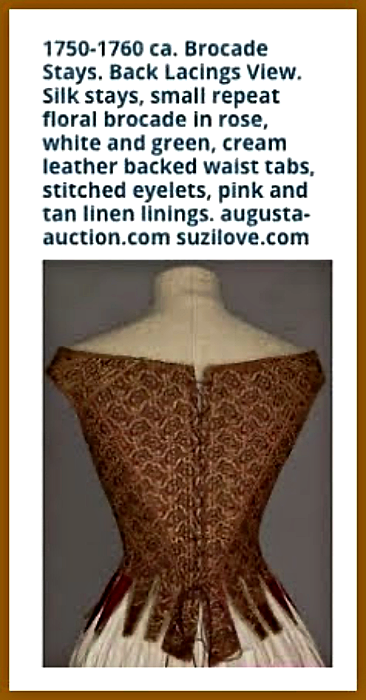
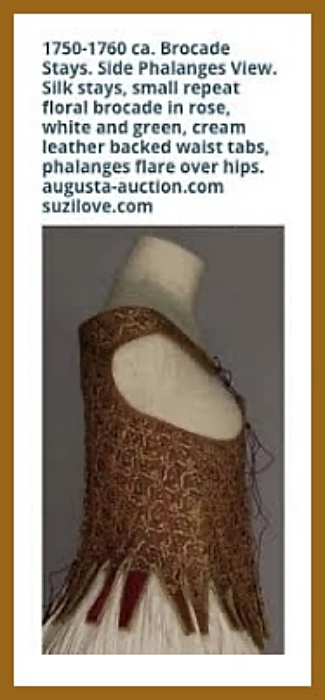
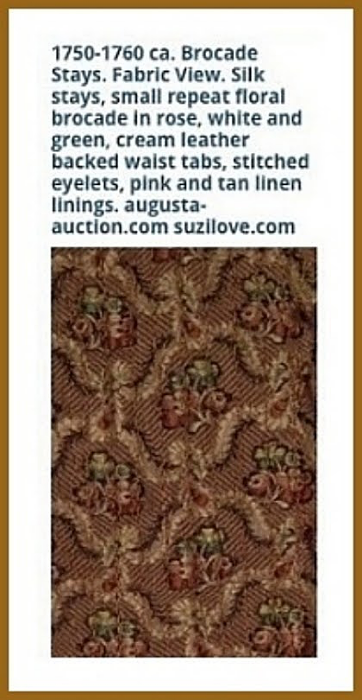
1750-1760 ca. Brown Silk Brocade Stays With Both Front and Back Lacings.
These silk stays have a small repeat floral brocade in rose, white, and green. There are cream, leather-backed waist tabs, stitched eyelets, and pink and tan linings. These stays, or corset, are unusual because they have both front and back lacings. This means that a lady could step in and out of her stays and then tighten the front lacing herself, thereby eliminating the need for assistance from a maid or dresser.
Women of the middle and lower classes needed to be able to dress themselves as they have no one to assist in tightening their lacings when they dressed. Most upper class ladies would be able to call upon a maid to help and would therefore generally use back lacing stays.
1750-1760 ca. Brown Silk Brocade Stays With Front and Back Lacings. Front Lacing View. via Augusta Auctions. augusta-auction.com1750-1760 ca. Brown Brocade Stays With Front and Back Lacings. Back Lacing View. via Augusta Auctions. augusta-auction.com1750-1760 ca. Brown Silk Brocade Stays With Front and Back Lacings. Side View. via Augusta Auctions. augusta-auction.com1750-1760 ca. Brown Silk Brocade Stays With Front and Back Lacings. Eyelet View. via Augusta Auctions. augusta-auction.com1750-1760 ca. Brown Silk Brocade Stays With Front and Back Lacings. Fabric View. via Augusta Auctions. augusta-auction.com Corsets 1700-1790 History Notes Book 15 By Suzi Love ~ Award Winning Writer and Researcher. https://books2read.com/SuziLoveCorsetBook15
An overview of women’s fashions in the first twenty years of the 19th century. What was fashionable for women in Jane Austen’s times, or the early 1800s. Wars were being fought around the globe so women’s fashion adopted a military look in support of soldiers. In Britain, the Prince Regent ruled instead of his father, King George III, so fashions, like the lifestyle, became more extravagant and accessories went from pretty to opulent.
Reader Or Writer of Regency Era? Love Jane Austen and Bridgerton fashions? What was fashionable for women in Jane Austen’s times, or 1800s, or Regency Era. High-waisted dresses were extravagantly accessorized and hats, shoes, parasols and bags were added. Set includes History Notes Books 12, 25, 26, 27 and 28. https://books2read.com/SuziLoveFashionWomenBoxSet
Ladies clothing in the early 1800’s featured a high waist line called an Empire Line, or Empire style dress, with a waist line just under the natural bust line and much higher than the natural waist. The high-waisted, or short-bodied, Regency styles shifted focus away from the natural waist and so left the natural waist unconstricted, in direct contrast to previous and future styles. Britain took these simple European styles and progressively made them more elaborate by adding more and more complicated embroidery onto white fabrics to create the white on white look popular for many years.
The empire look of fine muslin dresses left women more exposed than in the Georgian Era when fabrics had been thicker and styles bulkier. Women, especially in England, preserved their modesty by adding lace, frills, flounces, ruches, and fabric plaits to dresses to adequately cover any parts that might inadvertently be exposed. Outer layers, such as Spencers, Redingotes or Pelisses or coats, and shawls, were also added for warmth and to brighten outfits. This Empire fashion was totally dependent on a supply of fine, translucent cotton muslin – at first imported from India, then later, less exclusive imitations often woven and printed or embroidered in Britain. Fabrics were soft and lightweight and muslins and other cotton fabrics from India and other Asian countries were in high demand.
Scenting Scandal: If Lady Laura Jamison had inherited her great-grandmother’s ability to portend disaster… #HistoricalMystery #VictorianRomance #RomCom https://books2read.com/suziloveSS
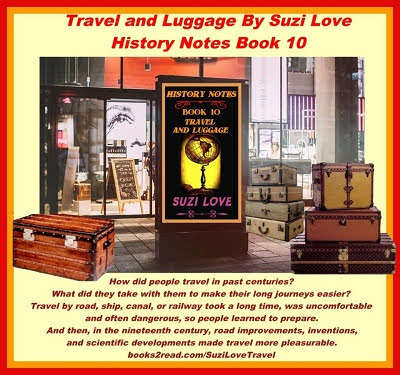
Travel and Luggage By Suzi Love History Notes Book 10. How did people travel in Bridgerton’s and Jane Austen’s times? What did they take with them to make their long journeys easier? Travel by road, ship, canal, or railway all took a long time and had dangers so people learned to prepare. And then, in the nineteenth century, road improvements, inventions, and scientific developments made travel more pleasurable. books2read.com/SuziLoveTravel
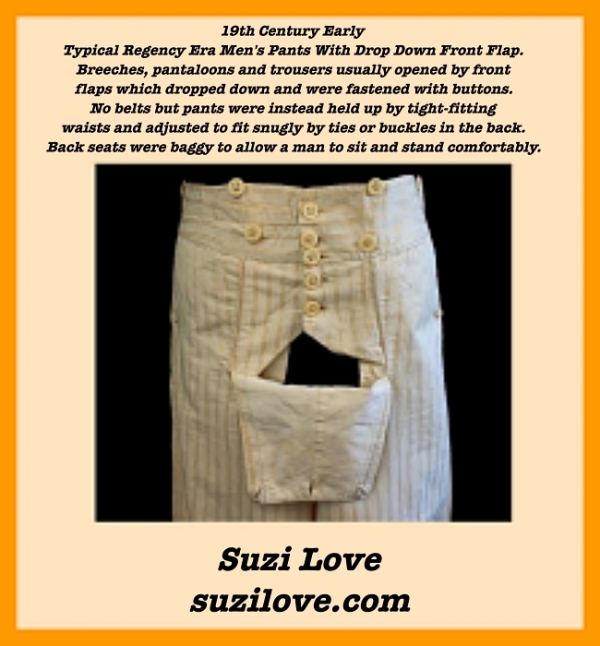
19th Century Early Typical Regency Era Men’s Pants With Drop Down Front Flap. Breeches, pantaloons and trousers usually opened by front flaps which dropped down and were fastened with buttons. No belts but pants were instead held up by tight-fitting waists and adjusted to fit snugly by ties or buckles in the back. Back seats were baggy to allow a man to sit and stand comfortably. Typical of a gentleman’s pants worn during the early 1800s, or the Regency Era, or Jane Austen’s times. They have a front flap, or fall, a back waist tie and buttons and ties to secure the breeches below the knee.
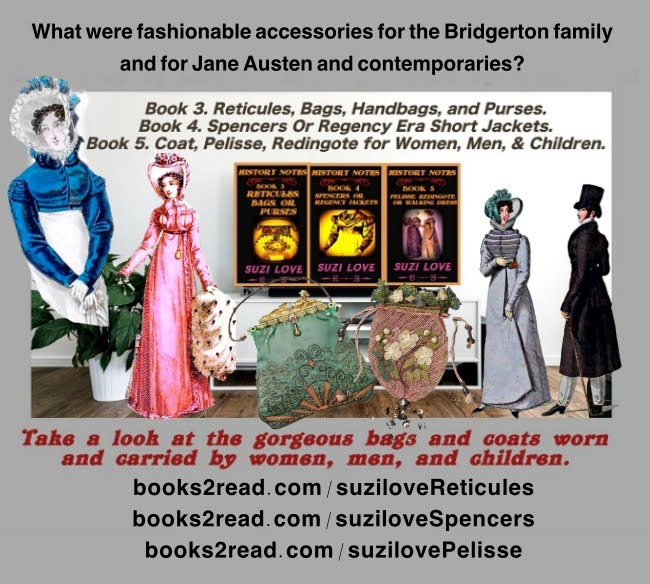
Reticule Or Bag: Purse, often with a drawstring to pull closed and usually made of cloth or covered cardboard and often decorated with beading or embroidery. Carried by a woman during the Regency period to carry all their daily necessities. in the place of pockets.
Spencer: Short jacket, cropped at the waist, worn over a dress, or gown. Delicate and regency dresses provided so little protection from the cold, so over garments were essential for warmth, modesty and good health.
Pelisse Or redingote Or Walking Dress: Coat worn over clothing of both sexes for warmth and protection from the elements.
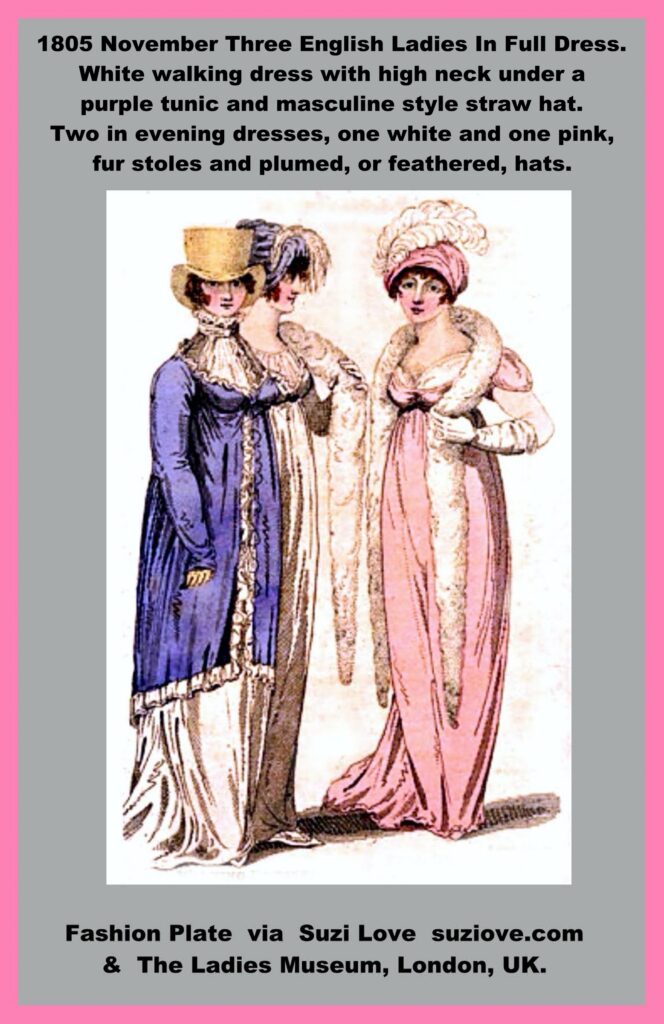
1805 November Three English Ladies In Full Dress. White walking dress with high neck under a purple tunic and masculine style straw hat. Two in evening dresses, one white and one pink, fur stoles and plumed, or feathered, hats. via Vernon and Hood Poultry at The Lady’s Monthly Museum, London, U.K. These gorgeous dresses show the transition from the round dresses of the late 1700s to the Empire style dresses with the waistline high under the bust. Small trains were still worn in the early 1800s, but much more manageable than the larger and more elaborate trains of the late 1700s. Jane Austen and her friends would have worn dresses like this to their assemblies and evening events.
Definition Accessory: An accessory completes and complements an outfit. Two groups – 1. Those worn e.g. bonnets, caps and hats, boots and shoes, cravats and ties, gloves, mittens and muffs, jewelry, scarves and shawls, socks and stockings. 2. Those carried e.g. bags, fans, and parasols.
Definition Full Dress: The most formal and complete ensemble, worn for day or night events, and includes the fullest range of accessories that could be added to the outfit to make the most impressive display.
Fashion Women 1805-1809 History Notes Book 26
What did Jane Austen and friends wear? This book looks at early 1800s fashions, which were elegant and pretty with high waists and fabrics that were almost transparent. These Empire style gowns, named after Napoleon’s first Empress, became popular throughout Europe, and were then copied around the world. Colorful outwear was added to make an ensemble more attractive and warmer.
https://books2read.com/SuziLoveFashionWomen1805-1809
19th Century Inkstand, English. Ormolu and tortoiseshell. The type of inkstand that households would have in Bridgerton’s and Jane Austen’s times for writing letters and keeping track of estate matters. Curved, recessed top, two square inkwells of faceted cut glass with round necks and ormolu lids. via 1st Dibs Auctions ~ 1stdibs.com
HN_13_D2D_WritingTools Book 13 What did the lady of the house use to pen notes? What sat on the desk of the man of the house when managing his accounts? #History #Nonfiction #travel books2read.com/SuziLoveWritingTools
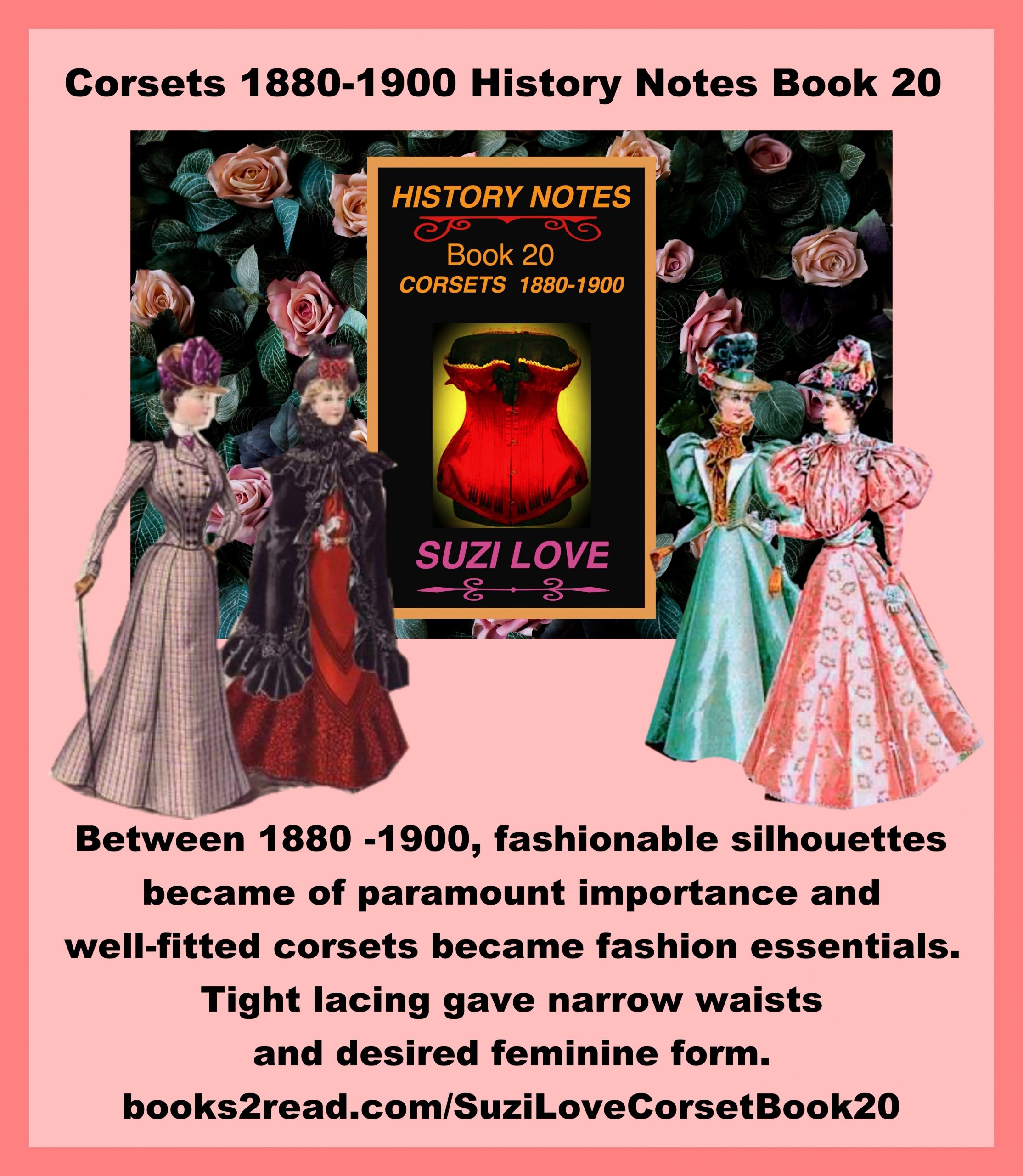
Corsets 1880-1900 History Notes Book 20. This book shows how a fashionable silhouette became of paramount importance and how a well-fitted corset became a fashion essential. As well as a decorative fashion item, tight lacing gave a narrow waist and the desired feminine form under clothing. https://books2read.com/SuziLoveCorsetBook20