1805 Typical Regency Era, or Early 1800s, Muslin Dress. Long sleeves, square neckline, and decorated with Palm Tree embroidery. via Whitaker Auction.
Definition Empire Style: Named after the First Empire in France, by 1800 Empire dresses had a very low décolleté, or neckline and a short narrow backed bodice attached to a separate skirt. Skirts started directly under the bust and flowed into the classical relaxed wide styles of Greece and Rome. This style of dress is associated with Jane Austen and her contemporaries as a simple cotton high-waisted dress was worn most days and accessorized according to the importance of the occasion.
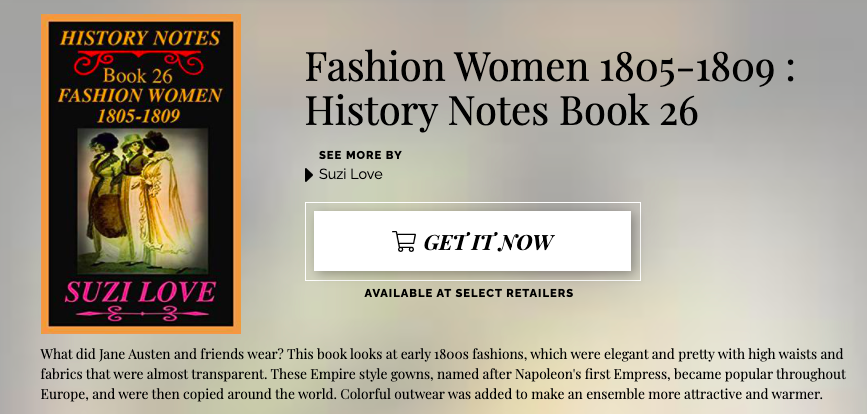
Fashion Women 1805-1809 History Notes Book 26 What did Jane Austen and friends wear? https://books2read.com/SuziLoveFashionWomen1805-1809
This book shows how corsets changed to fit well under clothing, give maximum support and comfort. Corsets pushed up breasts and showed off the bust line beneath a square-cut and low-cut neckline as in the early 1800s, or Regency years. Jane Austen and her female and friends wore these corsets. Corsets or stays worn during the early 1800s, or Jane Austen’s lifetime. https://books2read.com/SuziLoveCorsetBook17
The main purpose of corsets was to support and shape the breasts. Though they still slimmed the midriff, this was not the prime purpose of a corset between 1810 and 1830. The waistlines of dresses were lowering to below the bust line but nearer to the true waist, so corsets were longer and were given added shaping by stitching and cording and by shaping the breasts with pleated or gathered cups.
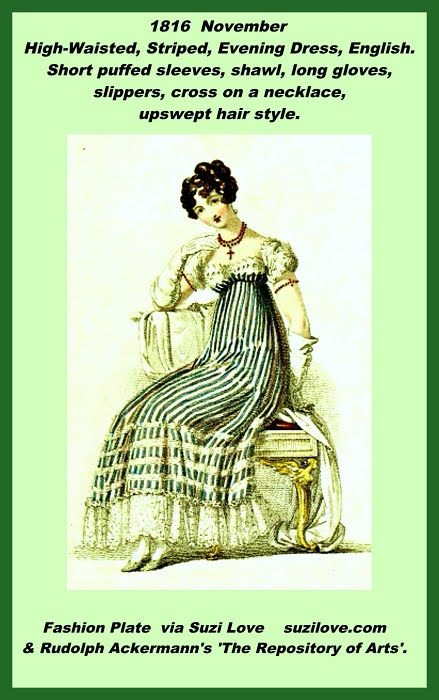
1816 November. A lilac and white striped gauze dress over a white satin slip; the bottom of the skirt is ornamented with five rows of white silk trimming, of a very light and elegant description: it has just been introduced, and the patterns has more novelty than any thing we have seen for some time; a single flounce of deep blond lace completes the trimming. The body is also very novel; the upper part is formed of lace, and the lower of gauze, to correspond with the dress; the latter is quite tight to the shape, but the former has an easy fullness, which forms the shape in a manner extremely advantageous to the figure. The sleeve is short and very full; it is composed of lace, looped high, and finished by a trimming to correspond with that of the skirt. The hair is full dressed, without any ornament. Necklace, cross, armlets, and bracelets of rubies. White satin slippers, and white kid gloves.Fashion Plate via Rudolph Ackermann’s ‘The Repository of Arts’.
Gorgeous Regency Era clothing came in a wide range of styles to suit every season and occasion. Ladies in Jane Austen’s times wore Empire style dresses which were usually of light fabric and floaty in style. By the later 1810s, stripes were very popular and lace and frills were added to make the dress more individual.
Fashion Women 1815-1819 History Notes Book 28 https://books2read.com/SuziLoveFashionWomen1815-1819
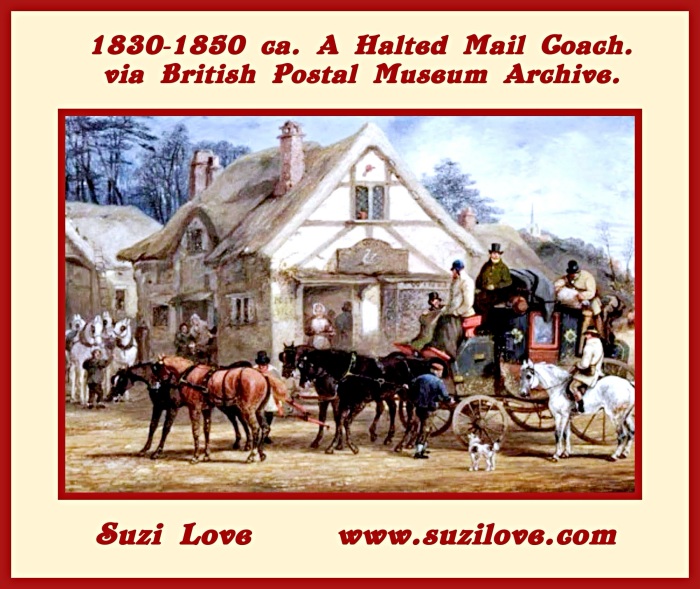
1830-1850 A Halted Mail Coach via British Postal Museum.
For many years in England, mounted carriers rode between posts and carried letters to and from local postmasters who delivered them to people in his area. The system was inefficient and post riders often robbed. John Palmer, a theatre owner, transported actors and materials and wanted to improve mail delivery so the Chancellor of the Exchequer, William Pitt, let Palmer try. He beat the old delivery time by 22 hours and brought the mail from Bristol to London in 16 hours. A year later, in 1785, the mail coach, sometimes called a post coach, was delivering mail from London to Norwich, Liverpool, Leeds, Dover, Portsmouth, Poole, Exeter, Gloucester, Worcester, Holyhead and Carlisle.
Palmer’s mail service improved after turnpike roads were introduced in the late 1780s, allowing faster travel and encouraged business between the proprietors of stage coaches.” The first mail coaches were supplied by contractors who received on average “one penny-halfpenny per mile.”, despite these contracted coaches being poorly built.. By the 1800s, the Post Office owned their own fleets of coaches with black and scarlet livery.
Mail coaches were usually drawn by four horses and took four passengers inside and three outside. The mail box was locked and secured at the rear of the coach and guarded by an armed Royal mail post office guard who followed strict rules.
Travel and Luggage By Suzi Love History Notes Book 10. How did people travel in Jane Austen’s times. In past centuries? What did they take with them to make their long journeys easier? Travel by road, ship, canal, or railway all took a long time and had dangers so people learned to prepare. And then, in the nineteenth century, road improvements, inventions, and scientific developments made travel more pleasurable. books2read.com/SuziLoveTravel
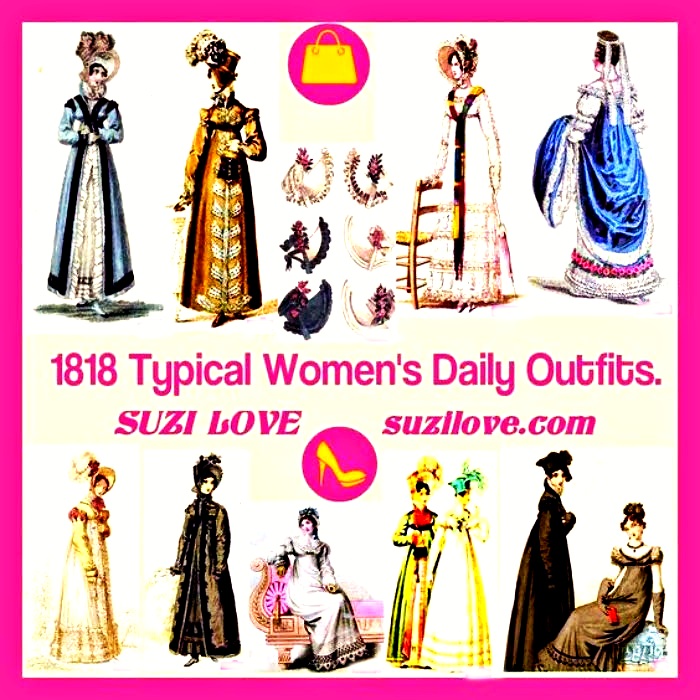
1818 Descriptions for types of ‘DRESS’ during Bridgerton’s and Jane Austen’s years. Dresses, coats or Redingotes, Spencers, shawls, fichu or shoulder cape, shoes, hats and headdresses, gloves, and Reticules or bags were displayed in various fashion magazines and copied by ladies and their modistes.
Morning Dress: Worn either at home, out shopping, or for walking in the park or country. Presentable but not overly accessorized.
Afternoon Dress: Dress made from the best fabric and beautifully decorated to see and be seen in when visiting friends, going to a museum or attending a daytime public event.
Walking Dress: Worn out shopping, walking in a city park or the country estate. Presentable and warm, more fashionable than Morning Dress but accessorized for sun protection and warmth, rather than display.
Promenade Dress: Includes gown, hat, and other accessories and more styled and fashionable than morning or walking dress. An ensemble designed to see and be seen in.
Evening Dress: Minute distinctions between ball, dinner, evening and opera gowns meant different quality of fabrics, designs, and embellishments.
Ball Dress: Gown of expensive silk fabrics, light or heavy, decorated with lace, embroidery or beading, with low-cut bodice, short or barely-there sleeves, and full skirts. Often shorter length skirt for dancing.
Mourning Dress: Mourning dress wasn’t as strict during the Regency as in Victorian era but periods of wearing black, white and grey were observed, especially for Royal deaths.
Empire Dress: Light and flowing dresses with waists just under bust worn during French Empire Period, or early 1800s.
Fashion Women 1815-1819 History Notes Book 28 What did Jane Austen wear? What was fashionable for women in Regency Era? Mourning and riding fashion, dresses, hats, shoes, reticules or bags, underclothing and fashion accessories. books2read.com/SuziLoveFashionWomen1815-1819
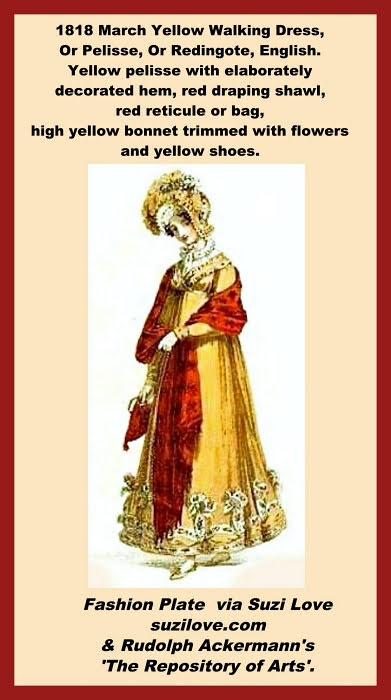
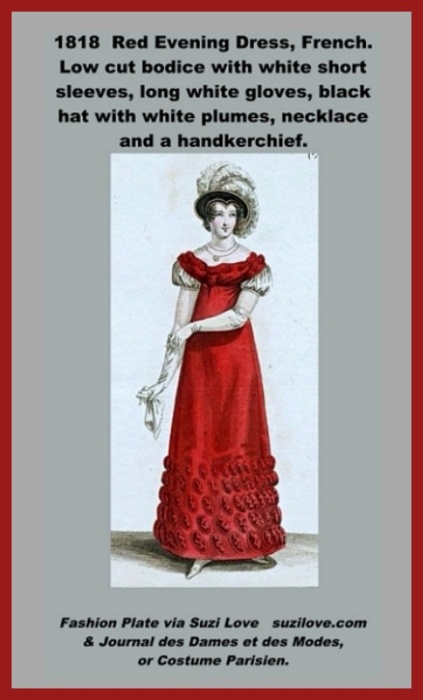
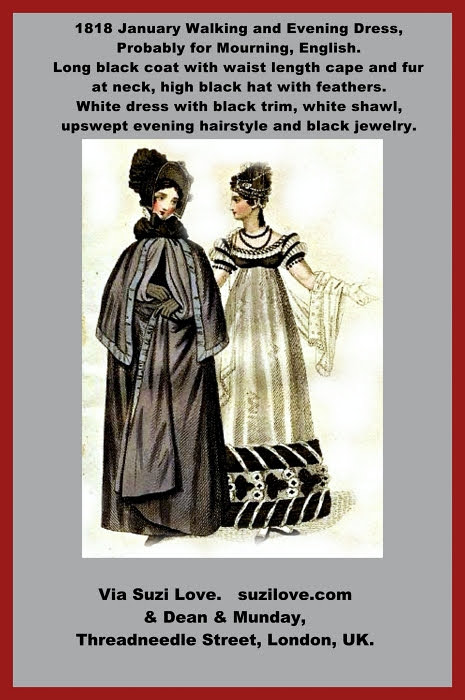
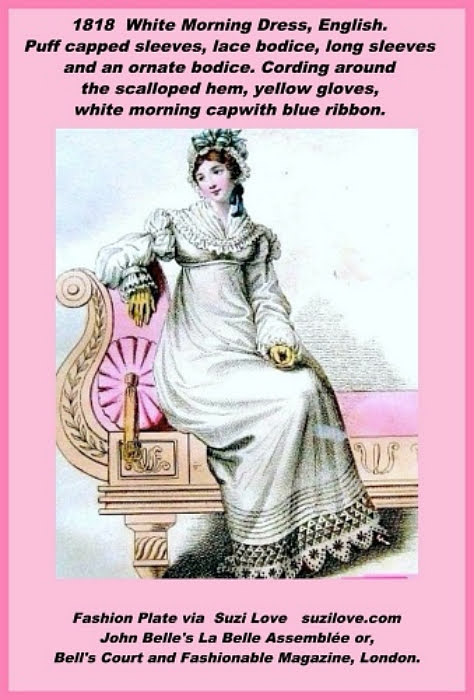
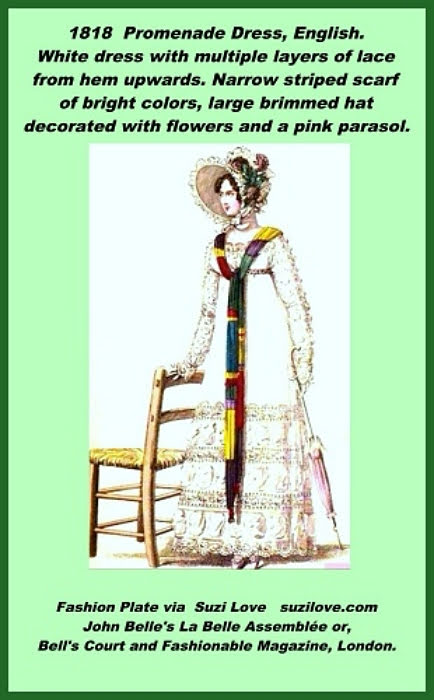
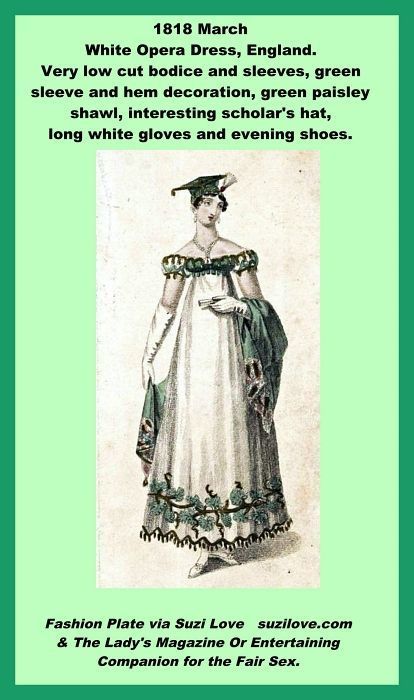
1818 March Yellow Walking Dress, Or Pelisse, Or Redingote, English. Yellow pelisse with elaborately decorated hem, red draping shawl, red reticule or bag, high yellow bonnet trimmed with flowers and yellow shoes. Fashion Plate via Rudolph Ackermann’s ‘The Repository of Arts’, London, U.K.1818 Red Evening Dress, French. Low cut bodice with white short sleeves, long white gloves, black velvet torque, or hat, with white plumes, necklace and a handkerchief. Fashion Plate via Journal des Dames et des Modes, or Costume Parisien. 1818 January Walking and Evening Dress, English. Probably for Mourning. Long black coat with waist length cape and fur at neck, high black hat with feathers. White dress with black trim, white shawl, upswept evening hairstyle and black jewelry. Via Dean & Munday, Threadneedle Street, London, UK.1818 White Morning Dress, English. Puffed capped sleeves, lace shawl like neckline, ornate bodice cording around a scalloped hem, small white hat with blue flowers, and yellow gloves. Fashion Plate via John Belle’s ‘La Belle Assemblee’, London. 1818 Promenade Dress, English. White dress with multiple layers of lace from hem upwards. Narrow striped scarf of bright colors, large brimmed hat decorated with flowers and a pink parasol. Fashion Plate via John Belle’s La Belle Assemblée or, Bell’s Court and Fashionable Magazine, London.1818 March White Opera Dress, England. Very low cut bodice and sleeves, green sleeve and hem decoration, green paisley shawl, interesting scholar’s hat, long white gloves and evening shoes. Fashion Plate via Lady’s Magazine. Fashion Women 1815-1819 History Notes Book 28 https://books2read.com/SuziLoveFashionWomen1815-1819
Looking for a HOT Regency Era read? Love revealed at a courtesan’s ball. Brenton, Lord Mallory, attends his first courtesan’s ball in ten years to appease his concerned friends, though he’d rather stay home and read to his motherless daughters.
‘The upper rooms? Are you mad? A lady cannot go prowling around the bedrooms. There will be couples in those bedrooms having…”
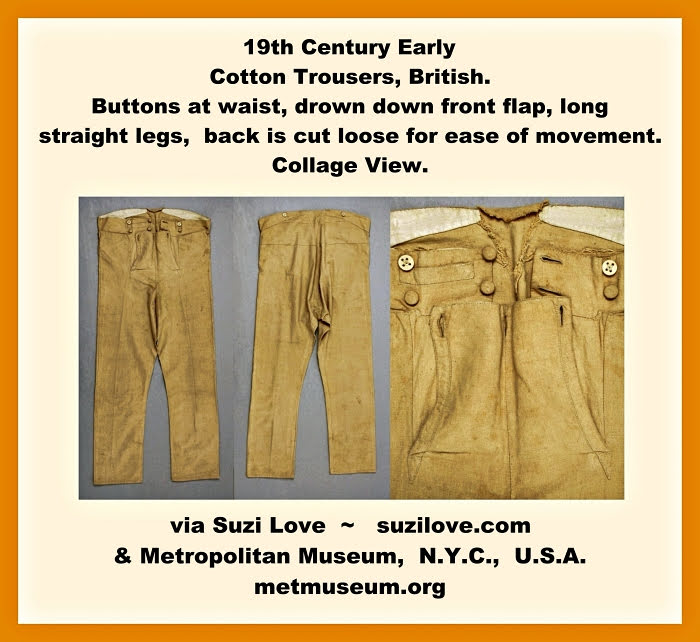
19th Century Early Cotton Trousers, British. Buttons at waist, drop down front flap with buttons and cut with excess material to allow easy movement. via Metropolitan Museum New York City, U.S.A. metmuseum.org.
Trousers: In the early 19th century, trousers were sewn with a flap in front called a fall front and was held in place by two or three buttons. Trousers were held up by tight-fitting waists which were adjusted by gusset ties in back of the waist. Seats were baggy to allow a man to rise comfortably from a sitting position.
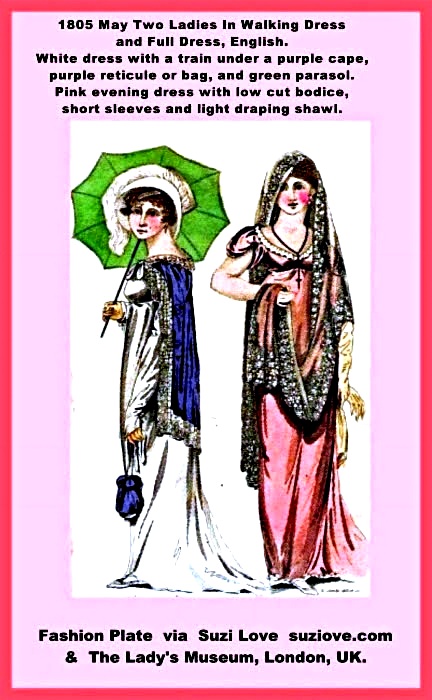
1805 May Two Ladies In Jane Austen Style Walking Dress and Full Dress, English. White dress with a train under a purple cape, purple reticule or bag, and green parasol. Pink evening full dress with low cut bodice, short sleeves and light draping shawl. via Vernon and Hood at The Lady’s Monthly Museum, London, U.K. Definition Reticule, or Ridicule, or Bag or Purse: Often with a drawstring to pull closed and usually made of cloth or covered cardboard and often decorated with beading or embroidery. A reticule, or purse, or handbag, was usually carried by a woman during the Regency period to carry all their daily necessities. Earlier, women used pockets that tied at the waistline and were hidden in the folds of their skirts. Empire style, or early 1800s, high-waisted dresses made it impossible to either sewn in a pocket or to tie on a pocket. So women began carrying small, decorated bags called Reticules, or ridicules, which generally pulled close at the top with a drawstring.