1809 May Walking Dress, English. Dress of white Scotia washing silk. Bishop’s mantle of sage or olive green striped and plain silks, made entirely without seams, border of the same color. Spanish hat to match the mantle turned up in front and decorated with artificial flowers. Shoes of sage or olive green match. Design by Mrs. James, New Bridge Street, Blackfriars. Fashion Plate via Rudolph Ackermann’s ‘The Repository’ of Arts.
General Observations for 1809 fashions from The Repository Of Arts: Spanish hats with feathers were worn all winter but are now worn as walking hats and the feathers have been replaced with flowers. Light silk mantles of all colors are being much worn. Scotia silk is now in great request for dresses and colors vary according to individual taste but silver-grey is the most elegant and fashionable. The attempt to introduce long waists failed. Full dress is the present standard.
1809 May Walking Dress, English. Fashion Women 1805-1809 History Notes Book 26 What did Jane Austen and friends wear? https://books2read.com/SuziLoveFashionWomen1805-1809
On January 27th, 1772, The Pantheon opened on Oxford Street, London. Designed by James Wyatt, The Pantheon featured a rotunda which was one of the largest rooms in England at the time. The Pantheon was intended as London’s answer to Ranelagh Gardens for winter entertainment and opened to a crush when nearly “two thousand persons of rank and fashion assembled.” The Pantheon officially closed for public entertainments in 1814, after Lord Chamberlain restrictions on the building’s use as a theatre made the final venture unprofitable. It was converted to a bazaar in 1833 and in 1867 became a winemakers office and showrooms until being demolished in 1937.
From 1819 Ackermann: The Pantheon was built “for the purpose of public evening entertainments” and was a “superb and beautiful structure” with elegant interiors furnished with fine paitnings, gilt vases, and statues depicting gods and goddesses. The building consisted of a suite of fourteen rooms, and between 1789-1792 (until a fire) was used as an exhibition space for Italian operas after the destruction by fire of the King’s Theatre in Haymarket.
1814 January The Pantheon via Ackermann’s Repository : This once noble structure, situated on the south side of Oxford-street, was originally built by Mr. James Wyatt, for the purpose of public evening entertainments. It was a most superb and beautiful structure, the admiration of all connoisseurs, foreigners as well as natives. The interior was fitted up in such a magnificent style, that it is scarcely possible for those who never saw it to conceive the elegance and grandeur of the apartments, the boldness of the paintings, or the effect produced by the disposition of the lights, which were reflected from gilt vases. Below the dome were a number of statues, representing most of the heathen gods and goddesses, supposed to be the ancient Pantheon at Rome, from which it derived its name. To these were added three beautiful statues of white porphyry, representing the King and Queen and Britannia.
The whole building formed a suite of fourteen rooms, each affording a striking specimen of taste and splendor. After the destruction of the King’s Theatre in the Haymarket by fire in June 1789, the Pantheon was used for the exhibition of Italian operas, and was frequently honored with the presence of their Majesties; till on the 14th of January, 1792, this beautiful structure also fell a prey to the same devouring element.
The fire broke out in the new buildings which had been added for the most convenient performance of operas; and before any engine reached the spot, the flames had gained such a height, that all attempts to save the building were in vain. Owing to the scenery, oil, paint and other combustible materials in the house, the conflagration was so rapid that not a single article could be saved. Persons who witnessed the progress of this tremendous fire, declare that the appearances exhibited through the windows, the lofty pillars enveloped in flames and smoke, the costly damask curtains waving from the rarefaction of the air, and the superb chandeliers turning round from the same circumstance, together with the successive crashing and falling of different portions of the building, furnished to their minds a more lively representation of Pandemonium than the imagination alone cam possibly supply.
The effects, too, of the intense frost which then prevailed, upon the water poured from the engines upon the blazing pile, are described as equally singular and magnificent. The loss occasioned by this catastrophe amounted to £60,000; only one fourth of which sum was insured. The height of the walls fortunately prevented the conflagration from spreading to the contiguous houses.
The Pantheon has been rebuilt; the original elegant front and portico still remain, but the rest of the edifice exhibits not eve a shadow of its former magnificence. Since its re-edification, it has been used principally for exhibitions, and occasionally for masquerades. Various plans have at different times been brought forward for opening it for dramatic representations; and this was actually done a few months since under a license from the magistrates, by a Mr. Condy, who is understood to have embarked a considerable fortune in the concern; but whose right has been contested by the winter theatres, and is likely to become a subject of legal discussion.
1800 Pantheon Masquerade, London, U.K. via Rudolph Ackermann’s Microcosm of London. Engraved by John Bluck. (1791-1831)
1818 May ‘Beau’s of 1818’ By George Cruikshank. Two Dandies shake hands while third watches. All wearing bell-shaped top-hats, extra high collars, short waists, long spurs and yellow gloves. One with moustache wears wide and short white trousers, one wears top-boots and riding-breeches and has monocle in his eye and third has very full trousers gathered above ankle. These are the sort of outfits that the Bridgerton men and Jane Austen’s male contemporaries would have worn. Hand colored etching. Via British Museum, London, UK. britishmuseum.org (PD-Art)
1818 May ‘Beau’s of 1818’ By George Cruikshank. Two Dandies shake hands while third watches. All wearing bell-shaped top-hats, extra high collars, short waists, long spurs and yellow gloves. One with moustache wears wide and short white trousers, one wears top-boots and riding-breeches and has monocle in his eye and third has very full trousers gathered above ankle. Hand colored etching. Via British Museum, London, UK. britishmuseum.org (PD-Art)
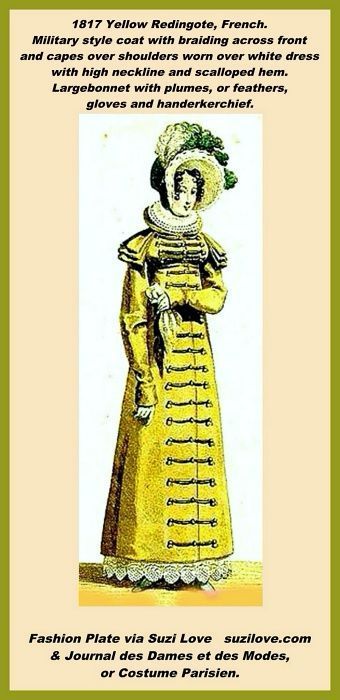
1817 Yellow Redingote, or Pelisse, or Walking Dress, French. Yellow military style pelisse with braiding across the front and capes across the shoulders and worn over a white dress with a high neckline and a scalloped hem. Large and high bonnet with plume, or feathers, and green flowers, gloves and a handkerchief. Although this is a French fashion plate, similar styles were worn everywhere and Jane Austen would have worn a Pelisse like this before her death on the 18th July, 1817. Fashion Plate via Journal des Dames et des Modes, or Costume Parisien.
The ongoing years of wars followed by the victories of Wellington’s armies brought the military into fashion in England and there was a rush of fashion articles named after him e.g. Wellington hat, Wellington bonnet, Wellington jacket and Wellington Boot. In other European countries, military headwear was copied from military helmets and hats and frogging and epaulettes added a further patriotic touch to women’s clothing. And as always, fashions were copied and spread around the world, despite the battles being fought.
Definition Redingote Or Coat Or Pelisse: Long fitted outdoor coat worn over other garments for warmth. French word developed from English words, riding coat. French fashion plates call these coats a Redingote and English plates call them a Pelisse, Or Walking Dress, or Carriage Costume.
1817 Yellow Redingote, or Pelisse, or Walking Dress, French. Yellow military style pelisse with braiding across the front and capes across the shoulders and worn over a white dress with a high neckline and a scalloped hem. Large and high bonnet with plume, or feathers, and green flowers, gloves and a handkerchief. Fashion Plate via Journal des Dames et des Modes, or Costume Parisien. Fashion Women 1815-1819 History Notes Book 28 What did Jane Austen wear? . D2D_HN_28_https://books2read.com/SuziLoveFashionWomen1815-1819
1817 October. White Promenade Dress, English. High dress of jaconet muslin richly embroidered around the hem, body composed entirely of work, Long sleeve, finished down the arm in front by bouillons of lace. Charlotte Spencer of blue satin, tight fitting and short waist, wide sleeve ornamented at wrist and shoulder, elegant trimming and disposed in so tasteful manner to give the appearance of perfect novelty. Bonnet, a la Ninon, of the same material, cut in small squares, edged with white satin, turned over at the ends, very large front displays the front hair which is braided across the forehead, edged with puffed gauze, disposed in points, and confined by a narrow fold of white satin, sprig of acacia on left side and finished by white satin strings. French ruff and ruffles of rich lace. Blue or white kid shoes and gloves.
We have again to acknowledge our obligations to Miss M’Donald of 29, Great Russel Street, Bedford Square, for our dresses this month. Fashion Plate via Rudolph Ackermann’s ‘The Repository of Arts’.
Fashion Women 1815-1819 History Notes Book 28 What did Jane Austen wear? . D2D_HN_28_https://books2read.com/SuziLoveFashionWomen1815-1819
1810 Sarcophagus Shaped Inkstand, British. Inkstand is made in the shape of a sarcophagus. Ink pots and a tray for the quill. In Jane Austen’s time, young gentlemen went on their “Grand Tour’ to gain education and experience and they sent, or brought back, unique and decorative items to represent their travels. Often, these decorative items were copied by British manufacturers to sell for the home market. via Museum of Fine Arts, Boston. mfa.org
1810 Inkstand, British. Inkstand is made in the shape of a sarcophagus. via Museum of Fine Arts, Boston. mfa.orgHN_13_D2D_Writing Tools
books2read.com/SuziLoveWritingTools
1819 January ‘Going to White’s’. By Richard Dighton. Lord Alvanley walks on the pavement going to White’s Club for gentlemen in London wearing a top-hat, double-breasted coat, strapped trousers, and the high collar of a dandy. Via British Museum, London, UK. britishmuseum.org (PD-Art)
White’s was an exclusive Gentlemen’s Club on St. James Street, London, U.K where well-dressed men, or Dandies, gathered at a special table in front of the large bow window looking out at the street. This became known as a seat of privilege and was used by London’s most famous Dandy, Beau Brummell. Other well-known dandies were William Arden, Joshua Allen, Thomas Raikes and Ball Hughes. Cartoonists loved to ridicule these high-in-the-instep gentlemen who wore the most fashionable clothes and set the fashion trends for the Regency years, and the years when Jane Austen was writing her famous novels.
1830 Hatchetts, the White Horse Cellar, Piccadilly, London, UK. By James Pollard. Denver Art Museum.
The dreadful condition of British roads caused great apprehension to all classes of travelers. Making a journey anywhere in the country was a big undertaking and often a gentleman composed his last will and testament before his departure. Traveling in vehicles was only possible during the day or on the nights with very bright moonlight with few vehicles attempting road travel in winter and any travel on a Sunday was frowned upon. books2read.com/SuziLoveTravel
Description of Stage Coach Travel in England. via 1815 Journal Tour of Great Britain. “The gentlemen coachmen, with half-a dozen great coats about them, immense capes, a large nosegay at the button-hole, high mounted on an elevated seat, with squared elbows, a prodigious whip, beautiful horses, four in hand, drive in a file to Salthill, a place about twenty miles from London, and return, stopping in the way at the several public-houses and gin-shops where stage-coachmen are in the habit of stopping for a dram, and for parcels and passengers on the top of the others as many as seventeen persons. These carriages are not suspended, but rest on steel springs, of a flattened oval shape, less easy than the old mode of leathern braces on springs. Some of these stage coaches carry their baggage below the level of the axletree.”
1830 Hatchetts, the White Horse Cellar, Piccadilly, London, UK. By James Pollard. Denver Art Museum. HN_10_D2D_RetailerBuyLink_Travel and Luggage By Suzi Love History Notes Book 10 #History #travel How did people travel in past centuries? What did they take with them to make their long journeys easier? books2read.com/SuziLoveTravel
What was fashionable for outer wear in past centuries? Different names in different countries: Pelisse, Redingote, Coat, Or Walking Dress. The Bridgertons and Jane Austen and her contemporaries wore long coats like these to keep warm when out and about, visiting, shopping etc. The thin muslin dresses worn in the early 1800s were little protection against European winters. http://books2read.com/suzilovePelisse
Pelisse, Redingote, Or Walking Dress. History Notes Book 5 By Suzi Love. What was fashionable for outer wear in past centuries? Call them what you like: Coat, Pelisse, Redingote, Walking Dress, Promenade Dress. Take a look at what was being worn by women, men, and children. books2read.com/suzilovePelisseD2D_RetailerBuyLink_HN_5_books2read.com/suzilovePelisse
1789-1790 ca. Man’s Red Riding Coat, England or France. Wool plain weave, full finish, with metallic-thread embroidery, tan breeches, black riding boots and crop. Credit: (M.2007.211.46) via Los Angeles County Museum of Art, California, USA. collections.lacma.org
1789-1790 Man’s Red Riding Coat, England or France. Wool plain weave, full finish, with metallic-thread embroidery Credit: (M.2007.211.46) via Los Angeles County Museum of Art, California, USA. collections.lacma.org suzilove.comHN_2_D2D_Fashion Men 1700s
books2read.com/suziloveFashMen1700