Top Hat Styles Chart during the 1800s, from the Regency Era through to the Victorian years. Most popular style was cone shaped and tall in height. Originally made of beaver and very short but later from silk and taller. Tall crown, widens at top, narrow brim turns up slightly at sides. https://books2read.com/SuziLoveFashionMen1800-1819
1790-1810 ca. Woman’s Black Wool Shoes. Pointed toe and low wedge heel covered in same fabric, black tape binding, leather straight or symmetrical sole, linen insole and lining. Wool satin with wool twill tape binding, plain weave linen lining, and leather sole. Place of Use: Lexington, Massachusetts, United States. Place of Manufacture: possibly Massachusetts, United States Provenance: Worn by a member of the Robbins family; inherited by Ellen A. Stone; gift to MFA, 1899. Credit Line Gift of Miss Ellen A. Stone via Museum of Fine Arts, Boston, U. S.A.
In Jane Austen’s years, she and her contemporaries spent a lot of time outdoors. Fragile slippers were worn for balls and evening events but for walking sturdier shoes were needed, In the early 1800s, these were typically made of leather and were flat or had a very small heel.
1800-1830 ca. Drawstring Bag, German. Basket-shaped, Ecru cotton knit embroidered with colored glass beads in design of grapevine on upper half, open work embroidered with weaving motif on lower half. Wired at center, cardboard at base. Green silk cord drawstring. The Elizabeth Day McCormick Collection via Museum of Fine Arts, Boston, U.S.A. mfa.org
Definition Reticule Or Ridicule Or Bag or Purse: Often with a drawstring to pull closed and usually made of cloth or covered cardboard and often decorated with beading or embroidery. A reticule, or purse, or handbag, was usually carried by a woman during the Regency period to carry all their daily necessities. Earlier, women used pockets that tied at the waistline and were hidden in the folds of their skirts. Empire style, or early 1800s, high-waisted dresses made it impossible to either sewn in a pocket or to tie on a pocket. So women began carrying small, decorated bags called Reticules, or ridicules, which generally pulled close at the top with a drawstring.
1800-1830 ca. Reticule, or Bag, American. Bottom of bag shaped like basket and made of stiff deep cream colored mohair with minute blue figure, two panels of light blue painted silk moiré, upper part of bag of deep cream colored figured silk, blue silk ribbon, drawstring and bows trimming lower part of bag. via Museum of Fine Arts, Boston, U.S.A. mfa.orgD2D_RetailerBuyLink_HN_3 http://books2read.com/suziloveReticules
1801 Young Man’s Daily Outfit, French. Blue cutaway coat with extra high collar, brown knee breeches, chin high white cravat, an all-over curly hairstyle and a round-hat with a wide brim and a low crown which is flat on the top. The hats only decoration is a narrow ribbon and buckle. Fashion Plate via Journal des Dames et des Modes, or Costume Parisien. https://books2read.com/SuziLoveFashionMen1800-1819
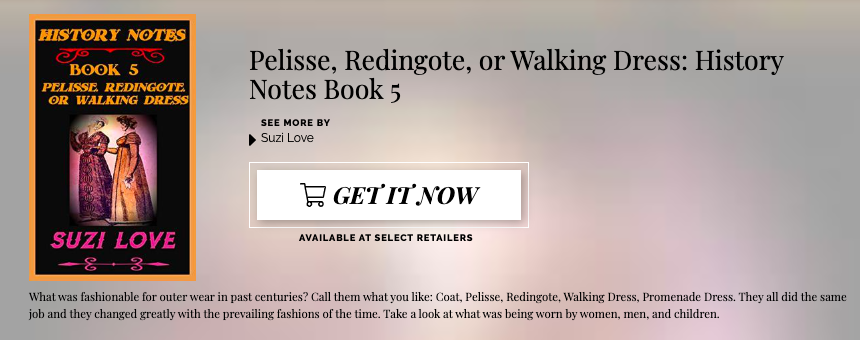
What was fashionable for outer wear in past centuries? Different names in different countries: Pelisse, Redingote, Coat, Or Walking Dress. The Bridgertons and Jane Austen and her contemporaries wore long coats like these to keep warm when out and about, visiting, shopping etc. The thin muslin dresses worn in the early 1800s were little protection against European winters. http://books2read.com/suzilovePelisse
Pelisse, Redingote, Or Walking Dress. History Notes Book 5 By Suzi Love. What was fashionable for outer wear in past centuries? Call them what you like: Coat, Pelisse, Redingote, Walking Dress, Promenade Dress. Take a look at what was being worn by women, men, and children. books2read.com/suzilovePelisseD2D_RetailerBuyLink_HN_5_books2read.com/suzilovePelisse
19th Century Early Reticule, Or Bag, New England, England or U.S.A. Septagonal, or four sided, with embroidery and silk tassels. White satin embroidered with polychrome silks, silver threads, silver sequins. On front, in center of wreath of roses tied with blue bow, is written VALUE THE TRIFLE. On back, in similar wreath, is FRIENDSHIP. On sides are floral motifs, one of sweetpeas and the other of pansies. On all sides a border of silver threads in chain motif entwined with curling brown vine. Primarily worked in satin stitch. Thirteen silk tassels attached. White ribbon ties. via Museum of Fine Arts, Boston, U.S.A. mfa.org
Definition Reticule Or Ridicule Or Bag or Purse: Often with a drawstring to pull closed and usually made of cloth or covered cardboard and often decorated with beading or embroidery. A reticule, or purse, or handbag, was usually carried by a woman during the Regency period to carry all their daily necessities. Earlier, women used pockets that tied at the waistline and were hidden in the folds of their skirts. Empire style, or early 1800s, high-waisted dresses made it impossible to either sewn in a pocket or to tie on a pocket. So women began carrying small, decorated bags called Reticules, or ridicules, which generally pulled close at the top with a drawstring.
Fashion Women 1800 By Suzi Love History Notes Book 12 #Regency #Fashion Love gorgeous historical women’s fashions? Take a look at what women wore and carried in 1800 in Europe and around the world. This is the world Jane Austen lived in and the fashions she wore. books2read.com/SuziLoveFashionWomen1800
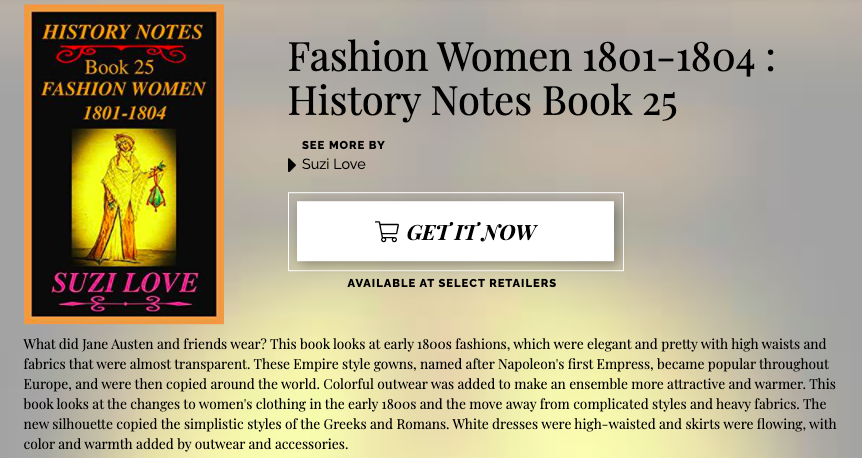
Women’s dress changed dramatically after 1785. The rich fabrics and complicated, formal shapes of the late 18th century gave way to simple, light fabrics that draped easily. These new gowns achieved something of the effect of the simple tunics shown on classical Greek and Roman statues and vases. Inspired in part by the statuary of ancient Greece and Rome, the new fashion was epitomised by light cotton gowns falling around the body in an unstructured way, held around the high waist with a simple sash and accompanied by a soft shawl draped around exposed shoulders. This style was ideal for the Indian imports like Kashmiri shawls and Bengali muslin, as used in this embroidered gown. Championed by such influential figures as Emma Hamilton in England and Madame Récamier in France, the so-called ‘Empire’ style catapulted Indian muslin into the forefront of fashion.
Empire Dress: Owes its name, physical emancipation, popularity, and even its sexiness to France. In this English example, French style is slavishly followed in the gown’s high waist and modish stripes.
Empire style, or early 1800s, high-waisted dresses made it impossible to either sewn in a pocket or to tie on a pocket. So women began carrying small, decorated bags called Reticules, or ridicules, which generally pulled close at the top with a drawstring.
Inspired in part by the statuary of ancient Greece and Rome, the new fashion was epitomised by light cotton gowns falling around the body in an unstructured way, held around the high waist with a simple sash and accompanied by a soft shawl draped around exposed shoulders. This style was ideal for the Indian imports like Kashmiri shawls and Bengali muslin, as used in this embroidered gown. Championed by such influential figures as Emma Hamilton in England and Madame Récamier in France, the so-called ‘Empire’ style catapulted Indian muslin into the forefront of fashion.
Reticule Or Bag: Purse, often with a drawstring to pull closed and usually made of cloth or covered cardboard and often decorated with beading or embroidery. Carried by a woman during the Regency period to carry all their daily necessities. in the place of pockets.
Spencer: Short jacket, cropped at the waist, worn over a dress, or gown. Delicate and regency dresses provided so little protection from the cold, so over garments were essential for warmth, modesty and good health.
Pelisse Or redingote Or Walking Dress: Coat worn over clothing of both sexes for warmth and protection from the elements.
1820 ca. Silk Pelisse, Probably American. Puffed sleeves at the shoulders, scalloped collar, military style braiding to decorate, waist slightly lower and skirt more bell shaped than typical Empire style, straight front and gathered back. via Metropolitan Museum, N.Y.C., U.S.A. metmuseum.org
Definition Redingote Or Pelisse Or Walking Dress Or Coat: French word developed from English words, riding coat. Long fitted outdoor coat worn over other garments for warmth. Often left open at the front to show off the dress underneath. Sometimes cut away in front. Originally made with several capes and trimmed with large buttons. French fashion plates call these coats Redingotes and they are designed for women, men and children. English fashion plates call them a Pelisse, a walking dress, Promenade dress, or Carriage dress.
Definition Military Style: The short puffed sleeves over the long straight sleeves and the military style of braids across the vertical front opening became popular in the late Regency years when many countries, especially Britain and France, had been fighting wars for many years. It was seen as patriotic to wear military styled clothing in support the hundreds of thousands of soldiers wearing their uniforms in cities all across Europe. Aristocrats wearing uniforms were seen as romantic heroes and men who couldn’t fight in the battles wore coats, Redingotes, and Pelisses that looked military with capes, brass buttons and braids. books2read.com/suzilovePelisse