Are you a Bridgerton fan? Love Jane Austen? Love history? Take a look at a Young Gentleman’s Day in early 1800s. Young Gentleman’s Day Regency Life Series Books 2 by Suzi Love. Easy to read books on what a young gentleman did, wore, and lived during the early 1800s, or the Regency Era when King George 3rd was mad and his son, Prince George, was the Regent in Britain. #Regency #JaneAusten #amwriting books2read.com/suziloveYGD
1807 February 15th ‘Miseries of Travelling’ in Jane Austen’s times. The Overloaded Coach Series By Thomas Rowlandson. Publisher Rudolph Ackermann, London (active 1794–1829). Hand colored etching.
1800s Early Tattersall’s Horse Auctions, London, U.K.. Top sporting venue for Regency Life in London. ‘A mixture of persons of nearly all ranks’. By Pierce Egan. Via Wikimedia Commons (PD-ART)
In Jane Austen’s and Bridgerton times, or the Regency Era, horse riding was a vital mode of transport and Tattersall’s was the best place to buy and sell horses. Tattersall’s was established in 1773 near Hyde Park Corner for the sale by auction of horses, carriages, hounds and harnesses. Sales during the winter months were every Monday and Thursday, and on Mondays only during the spring and summer. On the mornings when there was no sale, Tattersall’s was a meeting place for fashionable sporting gentlemen.
Pierce Egan’s Description of Tattersall’s
A masquerade could scarcely exhibit more motley groups than the attendants of this place of fashionable resort. There were Peers, Baronets, Members of Parliament, Turf gentlemen and Turf-servants, Jockies, Grooms, Horse-dealers, Gamblers, &c. There you might see the oldest and some of the best blood in England, disguised like coachmen.
From: 1820 Sporting Anecdotes by Pierce Egan via Google Books (PD-150)
1816 Crossing The Pont des Arts, Paris. Illustrations by Francis Courboin. via Les Modes de Paris. (PD-Art) suzilove.comThis plate depicts two women crossing the Pont des Arts, which is also known as the Passerelle des Arts. The women wear very high-waisted dresses. Both women wear a large white feather in their hats, symbolic of the white plume of Henri IV’s famous battle cry, “Ralliez-vous à mon panache blanc!” and made popular by the 1814 restoration of Louis XVIII on the throne. Restoration also brought back various styles, especially those denoting luxury, from the Ancien Regime. The woman on the left wears an ‘old-fashioned’ lace collar and the resurgence of luxury materials, such as fur are indicative of feminine styles of the Restoration period. (PD-Art) Illustrations by François Courboin from Octave Uzanne’s Les Modes de Paris. Variations du goût et de l’esthétique de la femme, 1797-1897, L. Henry May, Paris, 1898, or from the English translation of the same work: Fashion in Paris : the various phases of feminine taste and aesthetics from 1797 to 1897, William Heinemann, London, 1898. Modes De Paris
Fashion Women 1815-1819 History Notes Book 28 What did Jane Austen wear? . D2D_HN_28_https://books2read.com/SuziLoveFashionWomen1815-1819
1807 Game of Billiards By Louis Leopold Boilly, French. Ladies playing billiards as they did in Jane Austen’s time. via Heritage Museum, Russia ~ heritagemuseum.org
Fashion Women 1805-1809 History Notes Book 26 What did Jane Austen and friends wear? https://books2read.com/SuziLoveFashionWomen1805-1809
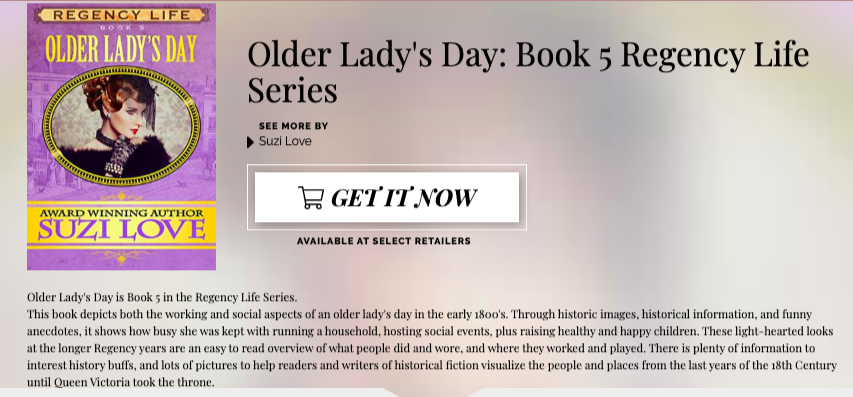
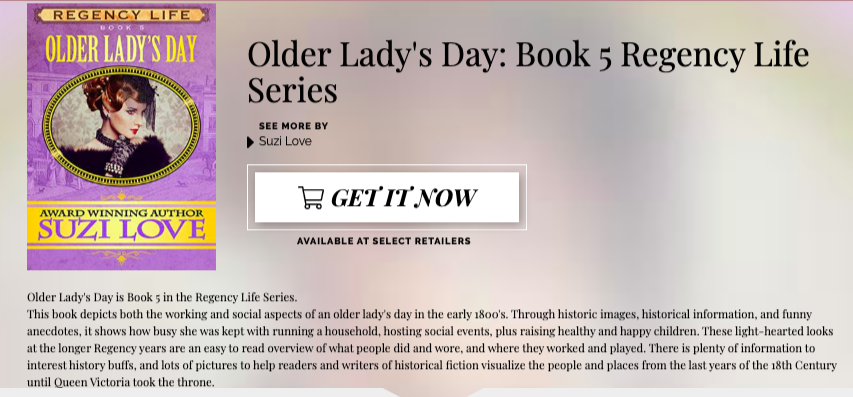
What did an older lady do in the Bridgerton family’s and Jane Austen’s times, or the early 1800s. An easy to read overview of what an older lady did, wore, and how she lived in the early 19th Century. Information for history buffs and pictures for readers and writers of historical fiction. Older Lady’s Day, Regency Life Series, Book 5, by Suzi Love. books2read.com/suziloveOLD
Through historic images, historical information, and funny anecdotes, it shows how an older lady in Jane Austen’s times fills her day, where she goes, and with whom she spends her time. This light-hearted look at the longer Regency years is an easy to read overview of what people did and wore, and where they worked and played. There is plenty of information to interest history buffs, and lots of pictures to help readers and writers of historical fiction visualize the people and places from the last years of the 18th Century until Queen Victoria took the throne.
1810 January 1st. West India Docks, London. By Thomas Rowlandson and Augustus Charles Pugin. Printed in 1810 By Rudolph Ackermann in Microcosm Of London, or London In Miniature. Volume 1. Aquatint showing warehouses at quayside and several West Indiamen moored alongside. Warehouses held thousands of tons of cargo, including sugar, rum, molasses, coffee, spices and hardwood. Docks were constructed by powerful group of businessmen led by Robert Milligan, wealthy merchant and ship-owner outraged at losses suffered due to theft and delay at riverside wharves. via National Maritime Museum, Greenwich, London, U.K. ~ collections.rmg.co.uk
West India Docks, London, U.K. From: 1810 Microcosm of London or London in Miniature Published By Rudolph Ackermann. Via Google Books & Creative Commons (PD-ART)RL_1_D2D_Regency Overview RetailerLinks
https://books2read.com/suziloveROver
Are you a Bridgerton fan? Love Jane Austen? Love history? Take a look at a Young Gentleman’s Day in early 1800s. Young Gentleman’s Day Regency Life Series Books 2 by Suzi Love. Easy to read books on what a young gentleman did, wore, and lived during the early 1800s, or the Regency Era when King George 3rd was mad and his son, Prince George, was the Regent in Britain. #Regency #JaneAusten #amwriting books2read.com/suziloveYGD
What did an older lady do and wear in the Regency Era? Information & pictures for readers and writers of early 1800s history, nonfiction and fiction. books2read.com/suziloveOLD
The older lady’s day usually started with her toilette in her bedroom, where her maid helped her dress for the day and styled her hair. After that, she would join her family downstairs for breakfast unless she preferred a tray with either tea or hot chocolate in her bedroom as she prepared for her busy day. Her day would be made up of speaking with the housekeeper and the cook about the week’s menus, assuring that the servants were all available that day and no one was ill, and checking the list of foods needed. She would also enquire if the laundry was up to date and that they had enough good linen to make up all the beds before extended family members and guests arrived. If she was in the country and hosting a weekend house party, she would assign rooms to the guests on her lists and query that all was in readiness for their arrival.