↓
 

Suzi Love

Making history fun, one year at a time.

Header_
  • Home
  • Newsletter
  • Pre order form
  • Shop
    • Cart
    • Checkout
    • My account
    • Refund and Returns Policy
  • Blog
  • BOOKS
    • History Events
    • Kelly’s Justice
    • Outback Arrival
    • Irresistible Aristocrats
    • History Notes
    • Scandalous Siblings
    • Love After Waterloo
    • Regency Life Series
  • Privacy Policy
  • EVENTS
Home » art » Page 6 << 1 2 … 4 5 6 7 8 >>

Category Archives: art

Post navigation

← Previous Post
Next Post→

1804 September Exhibition of Water Coloured Drawings, Old Bond Street, London By Thomas Rowlandson. #Regency #London #Art

Suzi Love Posted on November 26, 2024 by Suzi LoveNovember 16, 2024

1804 September Exhibition of Water Coloured Drawings, Old Bond Street, London, U.K. Designed and etched by Thomas Rowlandson. Via Wikimedia Commons commons.wikimedia.org (PD-ART)

1804 September Exhibition of Water Coloured Drawings, Old Bond Street, London, U.K. Designed and etched by Thomas Rowlandson. Via Suzi Love suzilove.com & Wikimedia Commons commons.wikimedia.org (PD-ART)

RL_1_D2D_Regency Overview RetailerLinks
https://books2read.com/suziloveROver
RL_1_D2D_Regency Overview RetailerLinks https://books2read.com/suziloveROver
Posted in 1800s, art, cartoon, England, History, Jane Austen, London, Pastimes, Regency Era, Regency Fashion, Suzi Love Images | Tagged art, Cartoons, Regency Life, Regency London

1800 Pantheon, London. via Ackermann’s Repository. #RegencyEra #London #RudolphAckermann

Suzi Love Posted on November 19, 2024 by Suzi LoveNovember 4, 2024

On January 27th, 1772, The Pantheon opened on Oxford Street, London. Designed by James Wyatt, The Pantheon featured a rotunda which was one of the largest rooms in England at the time. The Pantheon was intended as London’s answer to Ranelagh Gardens for winter entertainment and opened to a crush when nearly “two thousand persons of rank and fashion assembled.” The Pantheon officially closed for public entertainments in 1814, after Lord Chamberlain restrictions on the building’s use as a theatre made the final venture unprofitable. It was converted to a bazaar in 1833 and in 1867 became a winemakers office and showrooms until being demolished in 1937.

From 1819 Ackermann: The Pantheon was built “for the purpose of public evening entertainments” and was a “superb and beautiful structure” with elegant interiors furnished with fine paitnings, gilt vases, and statues depicting gods and goddesses.  The building consisted of a suite of fourteen rooms, and between 1789-1792 (until a fire) was used as an exhibition space for Italian operas after the destruction by fire of the King’s Theatre in Haymarket.

1814 January The Pantheon  via Ackermann’s Repository : This once noble structure, situated on the south side of Oxford-street, was originally built by Mr. James Wyatt, for the purpose of public evening entertainments. It was a most superb and beautiful structure, the admiration of all connoisseurs, foreigners as well as natives. The interior was fitted up in such a magnificent style, that it is scarcely possible for those who never saw it to conceive the elegance and grandeur of the apartments, the boldness of the paintings, or the effect produced by the disposition of the lights, which were reflected from gilt vases. Below the dome were a number of statues, representing most of the heathen gods and goddesses, supposed to be the ancient Pantheon at Rome, from which it derived its name. To these were added three beautiful statues of white porphyry, representing the King and Queen and Britannia.

The whole building formed a suite of fourteen rooms, each affording a striking specimen of taste and splendor. After the destruction of the King’s Theatre in the Haymarket by fire in June 1789, the Pantheon was used for the exhibition of Italian operas, and was frequently honored with the presence of their Majesties; till on the 14th of January, 1792, this beautiful structure also fell a prey to the same devouring element.

The fire broke out in the new buildings which had been added for the most convenient performance of operas; and before any engine reached the spot, the flames had gained such a height, that all attempts to save the building were in vain. Owing to the scenery, oil, paint and other combustible materials in the house, the conflagration was so rapid that not a single article could be saved. Persons who witnessed the progress of this tremendous fire, declare that the appearances exhibited through the windows, the lofty pillars enveloped in flames and smoke, the costly damask curtains waving from the rarefaction of the air, and the superb chandeliers turning round from the same circumstance, together with the successive crashing and falling of different portions of the building, furnished to their minds a more lively representation of Pandemonium than the imagination alone cam possibly supply.

The effects, too, of the intense frost which then prevailed, upon the water poured from the engines upon the blazing pile, are described as equally singular and magnificent. The loss occasioned by this catastrophe amounted to £60,000; only one fourth of which sum was insured. The height of the walls fortunately prevented the conflagration from spreading to the contiguous houses.

The Pantheon has been rebuilt; the original elegant front and portico still remain, but the rest of the edifice exhibits not eve a shadow of its former magnificence. Since its re-edification, it has been used principally for exhibitions, and occasionally for masquerades. Various plans have at different times been brought forward for opening it for dramatic representations; and this was actually done a few months since under a license from the magistrates, by a Mr. Condy, who is understood to have embarked a considerable fortune in the concern; but whose right has been contested by the winter theatres, and is likely to become a subject of legal discussion.

1800 Pantheon Masquerade, London, U.K. via Rudolph Ackermann’s Microcosm of London. Engraved by John Bluck. (1791-1831)

1800 Pantheon Masquerade, London, U.K. Ackermann's Microcosm of London. Engraved by John Bluck. (1791-1831)
RL_1_D2D_Regency Overview RetailerLinks
https://books2read.com/suziloveROver
RL_1_D2D_Regency Overview RetailerLinks https://books2read.com/suziloveROver

Posted in 1800s, art, Customs & Manners, Google Books, Jane Austen, London, Regency Era, Suzi Love Images | Tagged art, Jane Austen, London, Regency Era, Regency London, Rudolph Ackermann, shopping | Leave a reply

1843 Mail Coach runs over ground in little over four hours. #RegencyEra #Travel #BritishHistory #Carriage

Suzi Love Posted on October 18, 2024 by Suzi LoveOctober 2, 2024

1843 Mail Coach now runs over ground in a little over four hours. Via 1843 The Chace, the Turf, and the Road by Nimrod via Google Books (PD-150)

1843 Coach now runs over ground in a little over four hours. Via 1843 The Chace, the Turf, and the Road by Nimrod via Google Books (PD-150)books2read.com/SuziLoveTravel
1843 Coach now runs over ground in a little over four hours. Via 1843 The Chace, the Turf, and the Road by Nimrod via Google Books (PD-150)
HN_10_D2D_RetailerBuyLink_HN_10.books2read.com/SuziLoveTravel
D2D_RetailerBuyLink_HN_10. books2read.com/SuziLoveTravel
Posted in 1800s, art, Carriage, cartoon, England, Jane Austen, postal, Regency Era, travel | Tagged British history, carriages, England, google books, mail coach, postal, Suzi Love Images, travel | Leave a reply

Are you following my Pinterest Boards? Images galore for history, books, Regency Era, fashion and writing. #RegencyEra #books #History #Pinterest #SuziLove

Suzi Love Posted on October 16, 2024 by Suzi LoveSeptember 16, 2024

Pinterest Boards By Suzi Love.

I love Pinterest for keeping thousands of historical images in some sort of order. And I love using Pinterest Boards as inspiration for my romance books. What about you? Do you use Pinterest for planning something, or just for fun? Need more hints for what to do with your boards and pins? Take a look at these fascinating articles on Pinterest. if you want even more Pinterest information and tips for becoming a power user, check out my Suzi Love Pinterest Boards


Are you following my Pinterest Boards? Images galore for history, books, Regency Era, fashion and writing. #Regency #books #Historyhttp://www.pinterest.com/suziloveoz/
RL_2_D2D_RetailerBuyLink_RL_2
RL_2_D2D_RetailerBuyLink_RL_2 https://books2read.com/suziloveYGD
Posted in 1700s, 1700s Mens fashion, 1700s Womens Fashion, 1800s, 1800s Mens Fashions, 1800s women's fashion, 1900s, art, Australia, bedroom fashion, Box Or Container, Bridgerton, Canada, Carriage, cartoon, Chatelaine, children, Children, Coat or Pelisse Or Redingote, Corset, Couple, Customs & Manners, dancing, Decorative Item, Dress Or Robe, Edwardian Era, England, Europe, Events, fashion accessories, Food and Drink, furniture, Georgian Era, Georgian Fashion, Google Books, Grand Tour, hats, History, household, Jane Austen, Keanu Reeves, medical, military, money, mourning, Music, pants, Pastimes, peerage, People, Places, postal, Quotations, Regency Era, Regency Fashion, Reticule or Bag, riding, Romantic Era, Royalty, sewing, shoes, South Pacific, Spencer, sports, Suit, Suzi Love Books, Suzi Love Images, Suzi Love Writing, travel, U.S.A, underclothing, Vest or Waistcoat, Victorian Era, weapons, weddings, Writing Tools | Tagged 1800s men fashion, 1800s women's fashion, Battle of Waterloo, Bridgerton, Cartoons, Dress Or Gown, Edwardian Era, fans, fashion accessories, Fashion Plate, Georgian era, gloves, google books, Hats And Hair, historical erotic romance, Historical Mystery, historical romance, History Notes, Irresistible Aristocrats, Jane Austen, Journal des Dames et des Modes, La Belle Assemblee, military, money, pants, Regency Fashion, Romantic Era, Scandalous Siblings Series, Shoes, Suzi Love Books, The Lady's Magazine, The Lady's Monthly Museum, The Repository Of Arts, travel, Victorian Era

Want to know what Jane Austen wore? Elegant and pretty fashions from the early 1800s, or Regency Era. #RegencyEra #JaneAusten #HistoricalFashion

Suzi Love Posted on September 28, 2024 by Suzi LoveAugust 28, 2024

What did Jane Austen and friends wear? Early 1800s fashions were elegant and pretty with high waists and fabrics that were almost transparent. These Empire style gowns, named after Napoleon’s first Empress, became popular throughout Europe, and were then copied around the world. Colorful outwear was added to make an ensemble more attractive and warmer. History Notes Book 26 Fashion Women 1805-1809.
https://books2read.com/SuziLoveFashionWomen1805-1809

The Empire waist gown defined women’s fashion during the Regency Era. ‘Empire’ is the name given in France to the period when Napoleon built his French Empire. High-waisted, loose gowns were adopted by the aristocracy as a symbol of turning away from the fussy, elaborate and expensive clothing worn in the 1700s. Jean-Jaques Rousseau advocated copying peasants and returning to a simpler life and more natural fashions. Unrestricting clothing was part of the new Democracy in France and these simpler and flowing fashions were adopted all over Europe, including Britain and despite the continual wars being fought against France during the early 1800s. Not even war stopped fashions from being copied everywhere.
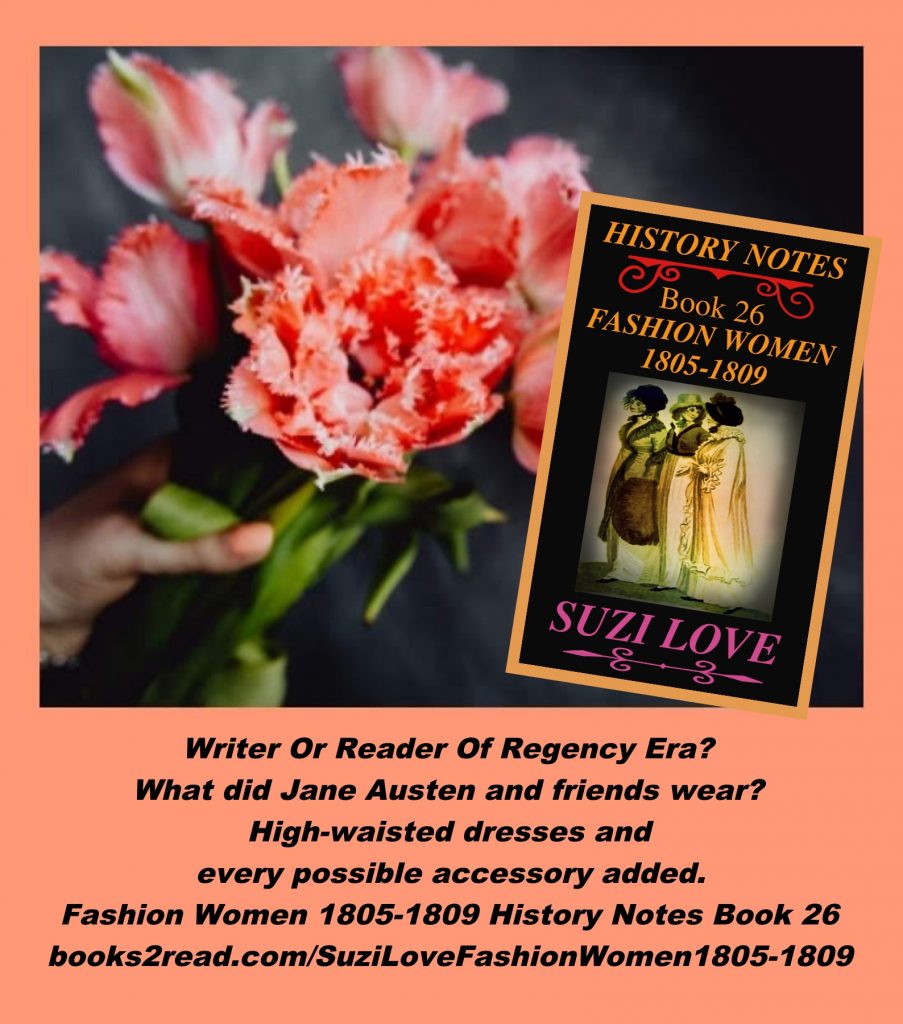
HN_26_Fashion Women 1805-1809 History Notes Book 26 What did Jane Austen and friends wear? This book looks at early 1800s fashions, which were elegant and pretty with high waists and fabrics that were almost transparent. These Empire style gowns, named after Napoleon's first Empress, became popular throughout Europe, and were then copied around the world. Colorful outwear was added to make an ensemble more attractive and warmer. https://books2read.com/SuziLoveFashionWomen1805-1809
Fashion Women 1805-1809 History Notes Book 26 What did Jane Austen and friends wear? This book looks at early 1800s fashions, which were elegant and pretty with high waists and fabrics that were almost transparent. These Empire style gowns, named after Napoleon’s first Empress, became popular throughout Europe, and were then copied around the world. Colorful outwear was added to make an ensemble more attractive and warmer. https://books2read.com/SuziLoveFashionWomen1805-1809
HN_26_D2D_FsshionWomen1805-1809 
https://books2read.com/SuziLoveFashionWomen1805-1809
HN_26_D2D_FsshionWomen1805-1809
Posted in 1800s women's fashion, art, Australia, bedroom fashion, Canada, cartoon, Coat or Pelisse Or Redingote, Corset, Dress Or Robe, England, Europe, fashion accessories, France, Google Books, hats, History, History Notes, Jane Austen, London, mourning, Quotations, Regency Era, Regency Fashion, Reticule or Bag, riding, Russia, shoes, Spencer, Suzi Love Books, Suzi Love Images, U.S.A, underclothing | Tagged 1800s women's fashion, Book 26, Corset, Dress Or Gown, fashion accessories, Fashion Plate, Fashions Of London and Paris, google books, Hats And Hair, History Notes, Jane Austen, jewelry, Journal des Dames et des Modes, La Belle Assemblee, mourning, Napoleon Bonaparte, Regency Fashion, riding, shawls, Shoes, Spencer, Suzi Love Books, The Lady's Monthly Museum, The Repository Of Arts, underclothing, weddings | Leave a reply

1805 Lady wearing Jane Austen Style Half-dress with Sketching Portfolio, French. #RegencyEra #JaneAusten #HistoricalFashion

Suzi Love Posted on September 10, 2024 by Suzi LoveAugust 30, 2024

1805 Lady With Her Sketching Portfolio In Half Dress, French. White, At-Home, High-waisted, relaxed & flowing dress with white cap and pink flowers to match, long gloves, slippers. Fashion Plate via Journal des Dames et des Modes, or Costume Parisien. Definition Caps: Worn as morning caps, night caps, or under other hats. Jane Austen and her family and female friends would have worn caps like these, sometimes during the morning at home, to bed to keep their long hair from becoming knotted, or under a bonnet to hold a hairstyle in place. Caps sometimes had hanging ties, or tails, and were also called ‘follow me lads’, or ‘flirtation ribbons’. Or flaps covering theirs called Lappets. Magazine Journal des Dames et des Modes, or Costume Parisien, French. French fashion magazine published between 1797 and 1839 and second oldest fashion magazine published in France. Pierre de la Mesangere was editor and published every five days, which is why there is an abundance of French fashion plates from these years in France and internationally.

1805_HalfDress_WhiteAtHomeDress_LadywithSketchingPortfolio_CP_Lge.jpg ]
1805 Lady With Her Sketching Portfolio In Half Dress, French. White, At-Home, High-waisted, relaxed & flowing dress with white cap and pink flowers to match, long gloves, slippers. Fashion Plate via Journal des Dames et des Modes, or Costume Parisien.
HN_26_D2D Fashion Women 1805-1809
https://books2read.com/SuziLoveFashionWomen1805-1809

Posted in 1800s, 1800s women's fashion, art, Dress Or Robe, England, Europe, fashion accessories, France, hats, household, Jane Austen, London, Pastimes, Regency Era, Regency Fashion, shoes, Suzi Love Images | Tagged 1800s women's fashion, art, Dress Or Gown, fashion accessories, Fashion Plate, gloves, Hats And Hair, Jane Austen, Journal des Dames et des Modes, pastimes, Regency Fashion, Shoes | Leave a reply

1806 Waiting For the St. Cloud Coach, Place de la Concorde, Paris. #RegencyEra #JaneAusten #Paris #Art

Suzi Love Posted on September 7, 2024 by Suzi LoveAugust 28, 2024

1806 Waiting For the St. Cloud Coach, Place de la Concorde, Paris. Illustrations by Francis Courboin. via Les Modes de Paris. (PD-Art) This couple is depicted waiting for the coach, which was a passenger vehicle drawn by four horses. The woman is wearing a fashionable hat or “capote” that covers her face. Her dress maintains the empire waist and has very long sleeves that also have a ‘mancheron’ or a gathered sleeve at the shoulders. The man is wearing a ‘habit du gagé’ or a coat with tails, buttoned at the waist. His hat is a ‘haut-de-forme’ or what is commonly known in English as a top hat. He wears tight, short pants tucked into large, riding boots, as was the fashion for men. Illustrations by François Courboin from Octave Uzanne‘s Les Modes de Paris. Variations du goût et de l’esthétique de la femme, 1797-1897, L. Henry May, Paris, 1898, or from the English translation of the same work: Fashion in Paris : the various phases of feminine taste and aesthetics from 1797 to 1897, William Heinemann, London, 1898. Modes de Paris VIa Brown University Library .

1806 Waiting for the Saint-Cloud Coach, Place de la Concorde, France. Couple waits for the coach, a passenger vehicle drawn by four horses. Woman wears a fashionable hat, or capote, that covers her face, an Empire style, or high-waisted blue Redingote or Pelisse, with long sleeves with a mancheron, or gathered sleeve, at the shoulders. Man in tailcoat buttoned at the waist, breeches tucked into fashionable riding boots with tan tops and wearing a 'haut-de-forme', or top hat. via Suzi Love ~ suzilove.com & Illustrations by François Courboin, French librarian (1865-1926) From Octave Uzanne's 'Les Modes de Paris, or Fashion in Paris,' the various phases of feminine taste and aesthetics from 1797 to 1897. (PD-Art) via Brown University Library, U.S.A.
RL_2_D2D_RetailerBuyLink_RL_2
RL_2_D2D_RetailerBuyLink_RL_2 https://books2read.com/suziloveYGD
Posted in 1800s, 1800s Mens Fashions, 1800s women's fashion, art, cartoon, Coat or Pelisse Or Redingote, Dress Or Robe, England, Europe, fashion accessories, France, hats, Jane Austen, London, pants, Regency Era, Regency Fashion, shoes, Suit, Suzi Love Images, travel | Tagged 1800s men fashion, 1800s women's fashion, boots, carriages, Dress Or Gown, fashion accessories, France, gloves, Hats And Hair, Jane Austen, Modes de Paris, pants, Paris, Redingote Or Pelisse Or Coat, Regency Fashion, Regency Life, Regency Men, Regency Women, Shoes, Tailcoat | Leave a reply

What Sort Of Pianoforte Or Piano Was Played By the Bridgertons and Jane Austen? #Bridgerton #Music #JaneAusten #RegencyEra #GeorgianEra

Suzi Love Posted on September 2, 2024 by Suzi LoveSeptember 1, 2024

What Sort Of Pianoforte or Piano Was Played By Jane Austen and Contemporaries? Pianos, pianofortes and more. History Notes Book 7 Music Pianos books2read.com/suziloveMusicPiano

Definition Pianoforte or Piano: ‘Stringed keyboard instrument with a hammer action, as opposed to the jack and quill action of the harpsichord.  Capable of gradations of soft and loud, the piano became the central instrument of music pedagogy and amateur study. By the end of the nineteenth century, no middle-class household of any stature in Europe or North America was without one.’  Definition via the Metropolitan Museum, NYC.

Around 1700, the Pianoforte, or Piano,  was invented in Italy by Bartolomeo Cristofori, who created a hammer action keyboard instrument on which a musician could make changes in loudness by changing the force with which the keys were struck. He called his instrument “gravicembalo col piano e forte”, or,  (harpsichord with soft and loud). Cristofori’s  long name was later shortened to fortepiano or pianoforte, and finally just piano.

Musical Instruments were so important in most of the more affluent households in history that large industries grew all around the world to manufacture instruments, musical accessories, and to print sheet music.  Pianos, pianofortes, harpsichords, and organs were found everywhere and were often the focus of a family gathering. By the end of the 18th Century, the pianoforte, or piano, was the leading instrument of Western music.

What sort of pianos did Jane Austen and the Bridgerton family play? Pianos, pianofortes etc in 17th, 18th, and 19th Centuries. Music Piano. History Notes Book 7 By Suzi Love. Pianos, pianofortes, harpsichord, organs in 17th, 18th, and 19th Centuries, as used by Jane Austen and her family.  books2read.com/suziloveMusicPiano
HN_7_Music Piano. History Notes Book 7 By Suzi Love. Pianos, pianofortes, harpsichord, organs in 17th, 18th, and 19th Centuries. #music #history #nonfiction books2read.com_suziloveMusicPiano
D2D_RetailerBuyLink_HN_7 Piano
D2D_RetailerBuyLink_HN_7 Piano books2read.com/suziloveMusicPiano
Posted in 1700s, 1800s, 1900s, art, Australia, Bridgerton, Canada, Edwardian Era, England, Europe, furniture, Georgian Era, History Notes, household, Jane Austen, Music, Regency Era, Romantic Era, Suzi Love Books, Suzi Love Images, U.S.A, Victorian Era | Tagged 1700s Or Georgian Era, 1800s Or 19th Century, Book 7, Bridgerton, Georgian era, History Notes, Jane Austen, music, piano, Regency Era, Suzi Love Books, Victorian Era | Leave a reply

1809-1829 Magazine for the Bridgertons and Jane Austen: Rudolph Ackermann and ‘The Repository of Arts’, The Strand, London. #JaneAusten #Bridgerton #RegencyEra #London #History

Suzi Love Posted on August 28, 2024 by Suzi LoveAugust 24, 2024

A portrait from 1810-1814 of Rudolph Ackermann, shop owner and founder of ‘The Repository Of Arts’ magazine, The Strand, London. via National Portrait Gallery, London. Plus, an image of Ackermann’s premises in 1809. His ‘Repository of Arts, Literature, Fashion, Manufactures, etc.’ was published from 1809 to 1829 with images of Regency London, Regency furnishings and grand homes as well as beautiful fashion prints and descriptions every month. Ackermann originally supplied artists, amateur and professional, with supplies for watercolor painting. In 1799, he began manufacturing and selling his own watercolor paint blocks which were supplied by other colourmen, although at least three colors were his own mixture – Ackermann’s Green, White and Yellow. From 1817, his eldest son Rudolph Ackermann junior was responsible for the watercolor manufacturing. Ackermann also trained as a carriage designer. He began publishing prints and colour-plate books like ‘The Microcosm of London’ and ‘Doctor Syntax’ in the early 1800s.

The Repository of Arts was one the most popular magazines in Jane Austen’s time as it displayed everything ladies wanted to learn e.g. history, important country seats and houses in England, music, current events such as theatre plays, plus fashion plates and embroidery patterns. Ackermann’s shop in The Strand, London, was one of the fashionable places to shop during the Regency Era. The Repository also included poetry, travel reports, society reports and upcoming lectures. It also included serious subjects e.g. politics, legal matters, medicine and agriculture, a meteorological journal and details of the London markets. In 1817, the price of the magazine was 4 Shillings, so quite expensive for the time.

 In the first issue, published for January 1809, Ackermann included an ‘introduction to the history of the useful and polite arts’ which said: “It is universally admitted, that to cultivate a taste for the arts, and an acquaintance with the sciences, is a pleasure of the most refined nature; but to do this without regard to its influence upon the passions and affections, is to ‘tear a tree for its blossoms, which is capable of yielding the richest and most valuable fruit.’ The cultivation of this taste may and ought to be subservient to higher and more important purposes: it should dignify and exalt our affections, and elevate them to the admiration and love of that Being who is the author of every thing that is fair, sublime, and good in nature.”

1810-1814 Portrait of Rudolph Ackermann, shop owner and founder of The Repository Of Arts magazine. via National Portrait Gallery, London.
1809 January Ackermann's Repository of Arts, 101 Strand, London, U.K. Drawn by Augustus Pugin and Thomas Rowlandson. Published By Rudolph Ackermann. Etching and aquatint with hand coloring.
1809 January Ackermann’s Repository of Arts, 101 Strand, London, U.K. Drawn by Augustus Pugin and Thomas Rowlandson. Published By Rudolph Ackermann. Etching and aquatint with hand coloring.
D2D_RL_4_YLD_Young Lady's Day Regency Life Series Book 4 by Suzi Love. A light-hearted look at the longer Regency years and an easy to read view of what a young lady did, wore, and lived. https://books2read.com/suziloveYLD

D2D_RL_4_YLD_Young Lady's Day Regency Life Series Book 4 by Suzi Love. A light-hearted look at the longer Regency years and an easy to read view of what a young lady did, wore, and lived. https://books2read.com/suziloveYLD
Posted in 1800s, 1800s women's fashion, art, Bridgerton, Coat or Pelisse Or Redingote, Decorative Item, Dress Or Robe, England, fashion accessories, furniture, Google Books, hats, History, household, Jane Austen, London, mourning, Music, Pastimes, Regency Era, Regency Fashion, Reticule or Bag, sewing, shoes, Spencer, Suzi Love Images, travel, weddings | Tagged 1800s women's fashion, art, Dress Or Gown, fashion accessories, Fashion Plate, gloves, Hats And Hair, Jane Austen, London, magazines, music, pastimes, Regency Fashion, Regency Life, Regency London, Regency Women, Rudolph Ackermann, Shoes, shopping, The Repository Of Arts

Are you a Regency Era and Jane Austen lover? Her family and friends wore elegant and pretty fashions in the early 1800s. #RegencyFashion #JaneAusten #HistoricalFashion

Suzi Love Posted on August 27, 2024 by Suzi LoveAugust 17, 2024

What did Jane Austen and friends wear? Early 1800s fashions were elegant and pretty with high waists and fabrics that were almost transparent. These Empire style gowns, named after Napoleon’s first Empress, became popular throughout Europe, and were then copied around the world. Colorful outwear was added to make an ensemble more attractive and warmer. History Notes Book 26 Fashion Women 1805-1809.
https://books2read.com/SuziLoveFashionWomen1805-1809

The Empire waist gown defined women’s fashion during the Regency Era. ‘Empire’ is the name given in France to the period when Napoleon built his French Empire. High-waisted, loose gowns were adopted by the aristocracy as a symbol of turning away from the fussy, elaborate and expensive clothing worn in the 1700s. Jean-Jaques Rousseau advocated copying peasants and returning to a simpler life and more natural fashions. Unrestricting clothing was part of the new Democracy in France and these simpler and flowing fashions were adopted all over Europe, including Britain and despite the continual wars being fought against France during the early 1800s. Not even war stopped fashions from being copied everywhere.
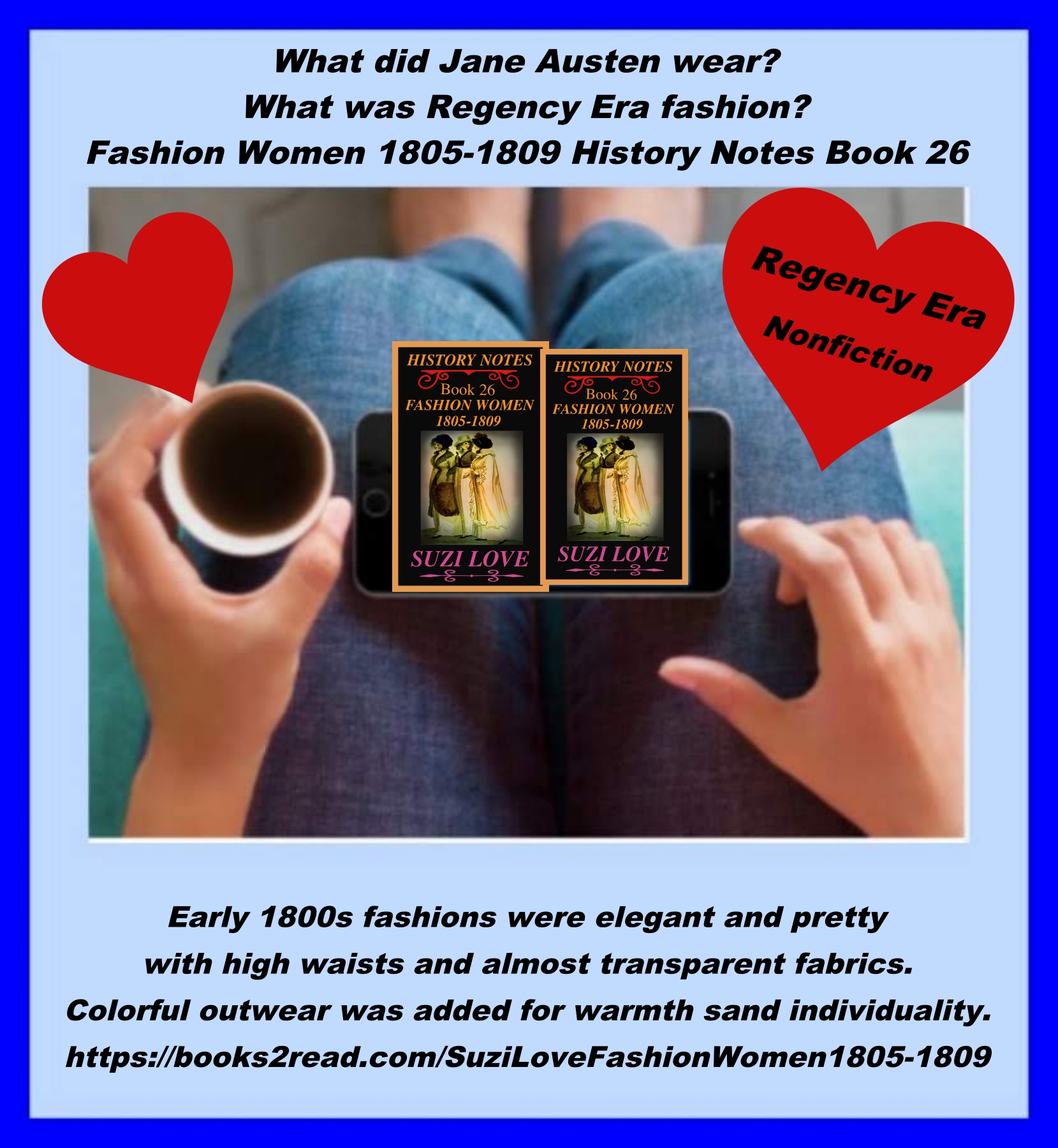
HN_26_Fashion Women 1805-1809 History Notes Book 26 What did Jane Austen and friends wear? This book looks at early 1800s fashions, which were elegant and pretty with high waists and fabrics that were almost transparent. These Empire style gowns, named after Napoleon's first Empress, became popular throughout Europe, and were then copied around the world. Colorful outwear was added to make an ensemble more attractive and warmer. https://books2read.com/SuziLoveFashionWomen1805-1809
Fashion Women 1805-1809 History Notes Book 26 What did Jane Austen and friends wear? This book looks at early 1800s fashions, which were elegant and pretty with high waists and fabrics that were almost transparent. These Empire style gowns, named after Napoleon’s first Empress, became popular throughout Europe, and were then copied around the world. Colorful outwear was added to make an ensemble more attractive and warmer. https://books2read.com/SuziLoveFashionWomen1805-1809
HN_26_D2D_FsshionWomen1805-1809 
https://books2read.com/SuziLoveFashionWomen1805-1809
HN_26_D2D_FsshionWomen1805-1809
Posted in 1800s, 1800s women's fashion, art, Australia, bedroom fashion, Canada, cartoon, Coat or Pelisse Or Redingote, Dress Or Robe, England, Europe, fashion accessories, France, hats, History, History Notes, Jane Austen, London, mourning, Regency Era, Regency Fashion, Reticule or Bag, riding, Russia, sewing, shoes, Spencer, Suzi Love Books, Suzi Love Images, U.S.A, underclothing | Tagged 1800s women's fashion, Book 26, Corset, Dress Or Gown, fashion accessories, Fashion Plate, Fashions Of London and Paris, google books, Hats And Hair, History Notes, Jane Austen, jewelry, Journal des Dames et des Modes, La Belle Assemblee, mourning, Napoleon Bonaparte, Regency Fashion, riding, shawls, Shoes, Spencer, Suzi Love Books, The Lady's Monthly Museum, The Repository Of Arts, underclothing, weddings

Post navigation

← Previous Post
Next Post→

SUBSCRIBE TO SUZI LOVE'S NEWSLETTER.

Recent Posts

  • 1840-1880 ca. Burgundy and White Silk Jacket, Russian. #RomanticEra #Fashion #Russia
  • 1810 Pantaloons and Double-Breasted Cutaway Coat As Worn by Gentleman in Jane Austen years. #RegencyFashion #JaneAusten #pantaloons
  • 1820 ca. High-Waisted Cream Pelisse, Or Coat, as fashionable in Bridgerton times. #Bridgerton #RegencyFashion #Pelisse #Coat
  • 1812 Man’s Overcoat With Layered Capes as worn by men of Jane Austen’s acquaintance. #RegencyFashion #JaneAusten #HistoricalFashion
  • 1816 White short length dancing dress as worn by the Bridgertons and Jane Austen. Multiple frills above hem and a black bodice. #Bridgerton #RegencyEra #JaneAusten #HistoricalFashion

Recent Comments

  1. Suzi Love on Book Hooks: Brent looked at Lillian. ‘Is she correct? You’ve been lonely.’#RegencyRomance #HistRom #ReadARegency #EroticRomance
  2. Jana Richards on Book Hooks: Brent looked at Lillian. ‘Is she correct? You’ve been lonely.’#RegencyRomance #HistRom #ReadARegency #EroticRomance
  3. Lisabet Sarai on Book Hooks: Brent looked at Lillian. ‘Is she correct? You’ve been lonely.’#RegencyRomance #HistRom #ReadARegency #EroticRomance
  4. James DiBenedetto on Book Hooks: Brent looked at Lillian. ‘Is she correct? You’ve been lonely.’#RegencyRomance #HistRom #ReadARegency #EroticRomance
  5. Suzi Love on Book Hooks: ‘Why are you eager for me to risk a repeat of my miserable marriage?’ Lady Lillian asked. #RegencyRomance #HistRom #ReadARegency #EroticRomance

Login

  • Log in

Archives

  • July 2026
  • June 2026
  • May 2026
  • April 2026
  • March 2026
  • February 2026
  • January 2026
  • December 2025
  • November 2025
  • October 2025
  • September 2025
  • August 2025
  • July 2025
  • June 2025
  • May 2025
  • April 2025
  • March 2025
  • February 2025
  • January 2025
  • December 2024
  • November 2024
  • October 2024
  • September 2024
  • August 2024
  • July 2024
  • June 2024
  • May 2024
  • April 2024
  • March 2024
  • February 2024
  • January 2024
  • November 2023
  • October 2023
  • September 2023
  • August 2023
  • July 2023
  • April 2023
  • March 2023
  • February 2023
  • June 2022
  • April 2022

Categories

  • 1700s
  • 1700s Mens fashion
  • 1700s Womens Fashion
  • 1800s
  • 1800s Mens Fashions
  • 1800s women's fashion
  • 1900s
  • art
  • Australia
  • Bath
  • bedroom fashion
  • Book Hooks
  • Box Or Container
  • Bridgerton
  • Bus Trips
  • Canada
  • Carriage
  • cartoon
  • Celebrity
  • Chatelaine
  • children
  • Children
  • Christmas
  • Coat or Pelisse Or Redingote
  • Contemporary
  • Corset
  • Couple
  • Customs & Manners
  • dancing
  • December Scandal
  • Decorative Item
  • Dress Or Robe
  • Easter
  • Edwardian Era
  • Embracing Scandal
  • England
  • Ester In Images
  • Europe
  • Events
  • Fashion
  • fashion accessories
  • Food and Drink
  • Four Times A Virgin
  • France
  • furniture
  • Georgian Era
  • Georgian Fashion
  • Google Books
  • Grand Tour
  • Group
  • hats
  • History
  • History Events
  • History Notes
  • History Of Christmases Past
  • household
  • Hygiene
  • Irresistible Aristocrats
  • Jane Austen
  • Keanu Reeves
  • Kellys Justice
  • Legal
  • London
  • Love After Waterloo
  • Loving Lady Katharine
  • medical
  • military
  • money
  • mourning
  • Music
  • Outback Arrival
  • pants
  • Pastimes
  • peerage
  • People
  • Petunia and Pearl Diver
  • Places
  • Pleasure House Ball
  • postal
  • Queensland
  • Quotations
  • Regency Era
  • Regency Fashion
  • Regency Life Series
  • Reticule or Bag
  • riding
  • Romantic Era
  • Royalty
  • Russia
  • Scandalous Siblings Series
  • Scenting Scandal
  • Self Publishing
  • sewing
  • Shirt
  • shoes
  • Shopping
  • South Pacific
  • Spencer
  • sports
  • Suit
  • Sunday Snippet
  • Suzi Love
  • Suzi Love Books
  • Suzi Love Images
  • Suzi Love Writing
  • Swain Cove
  • THe Viscount's Pleasure House
  • travel
  • U.S.A
  • underclothing
  • Vest or Waistcoat
  • Victorian Era
  • Victorian Fashion
  • weapons
  • weddings
  • Writing Tools

1800s men fashion 1800s women's fashion antiques Bridgerton British history Cartoons Corset cravat decorative Dress Or Gown England europe fashion accessories Fashion Plate France Georgian era Georgian Fashion gloves google books Hats And Hair historical romance History Notes household Jane Austen jewelry Journal des Dames et des Modes London Metropolitan Museum NYC pants Redingote Or Pelisse Or Coat Regency Era Regency Fashion Regency London reticule or bag riding sewing shawls Shoes Suzi Love Books Suzi Love Images Tailcoat The Repository Of Arts underclothing Vest or Waistcoat Writing Tools

©2026 - Suzi Love - Weaver Xtreme Theme Privacy Policy
↑