↓
 

Suzi Love

Making history fun, one year at a time.

Header_
  • Home
  • Newsletter
  • Pre order form
  • Shop
    • Cart
    • Checkout
    • My account
    • Refund and Returns Policy
  • Blog
  • BOOKS
    • History Events
    • Kelly’s Justice
    • Outback Arrival
    • Irresistible Aristocrats
    • History Notes
    • Scandalous Siblings
    • Love After Waterloo
    • Regency Life Series
  • Privacy Policy
  • EVENTS
Home » art » Page 8 << 1 2 … 6 7 8 9 >>

Category Archives: art

Post navigation

← Previous Post
Next Post→

1804 September Exhibition of Water Coloured Drawings, Old Bond Street, London By Thomas Rowlandson. #Regency #London #Art

Suzi Love Posted on November 26, 2024 by Suzi LoveNovember 16, 2024

1804 September Exhibition of Water Coloured Drawings, Old Bond Street, London, U.K. Designed and etched by Thomas Rowlandson. Via Wikimedia Commons commons.wikimedia.org (PD-ART)

1804 September Exhibition of Water Coloured Drawings, Old Bond Street, London, U.K. Designed and etched by Thomas Rowlandson. Via Suzi Love suzilove.com & Wikimedia Commons commons.wikimedia.org (PD-ART)

RL_1_D2D_Regency Overview RetailerLinks
https://books2read.com/suziloveROver
RL_1_D2D_Regency Overview RetailerLinks https://books2read.com/suziloveROver
Posted in 1800s, art, cartoon, England, History, Jane Austen, London, Pastimes, Regency Era, Regency Fashion, Suzi Love Images | Tagged art, Cartoons, Regency Life, Regency London

1800 Pantheon, London. via Ackermann’s Repository. #RegencyEra #London #RudolphAckermann

Suzi Love Posted on November 19, 2024 by Suzi LoveNovember 4, 2024

On January 27th, 1772, The Pantheon opened on Oxford Street, London. Designed by James Wyatt, The Pantheon featured a rotunda which was one of the largest rooms in England at the time. The Pantheon was intended as London’s answer to Ranelagh Gardens for winter entertainment and opened to a crush when nearly “two thousand persons of rank and fashion assembled.” The Pantheon officially closed for public entertainments in 1814, after Lord Chamberlain restrictions on the building’s use as a theatre made the final venture unprofitable. It was converted to a bazaar in 1833 and in 1867 became a winemakers office and showrooms until being demolished in 1937.

From 1819 Ackermann: The Pantheon was built “for the purpose of public evening entertainments” and was a “superb and beautiful structure” with elegant interiors furnished with fine paitnings, gilt vases, and statues depicting gods and goddesses.  The building consisted of a suite of fourteen rooms, and between 1789-1792 (until a fire) was used as an exhibition space for Italian operas after the destruction by fire of the King’s Theatre in Haymarket.

1814 January The Pantheon  via Ackermann’s Repository : This once noble structure, situated on the south side of Oxford-street, was originally built by Mr. James Wyatt, for the purpose of public evening entertainments. It was a most superb and beautiful structure, the admiration of all connoisseurs, foreigners as well as natives. The interior was fitted up in such a magnificent style, that it is scarcely possible for those who never saw it to conceive the elegance and grandeur of the apartments, the boldness of the paintings, or the effect produced by the disposition of the lights, which were reflected from gilt vases. Below the dome were a number of statues, representing most of the heathen gods and goddesses, supposed to be the ancient Pantheon at Rome, from which it derived its name. To these were added three beautiful statues of white porphyry, representing the King and Queen and Britannia.

The whole building formed a suite of fourteen rooms, each affording a striking specimen of taste and splendor. After the destruction of the King’s Theatre in the Haymarket by fire in June 1789, the Pantheon was used for the exhibition of Italian operas, and was frequently honored with the presence of their Majesties; till on the 14th of January, 1792, this beautiful structure also fell a prey to the same devouring element.

The fire broke out in the new buildings which had been added for the most convenient performance of operas; and before any engine reached the spot, the flames had gained such a height, that all attempts to save the building were in vain. Owing to the scenery, oil, paint and other combustible materials in the house, the conflagration was so rapid that not a single article could be saved. Persons who witnessed the progress of this tremendous fire, declare that the appearances exhibited through the windows, the lofty pillars enveloped in flames and smoke, the costly damask curtains waving from the rarefaction of the air, and the superb chandeliers turning round from the same circumstance, together with the successive crashing and falling of different portions of the building, furnished to their minds a more lively representation of Pandemonium than the imagination alone cam possibly supply.

The effects, too, of the intense frost which then prevailed, upon the water poured from the engines upon the blazing pile, are described as equally singular and magnificent. The loss occasioned by this catastrophe amounted to £60,000; only one fourth of which sum was insured. The height of the walls fortunately prevented the conflagration from spreading to the contiguous houses.

The Pantheon has been rebuilt; the original elegant front and portico still remain, but the rest of the edifice exhibits not eve a shadow of its former magnificence. Since its re-edification, it has been used principally for exhibitions, and occasionally for masquerades. Various plans have at different times been brought forward for opening it for dramatic representations; and this was actually done a few months since under a license from the magistrates, by a Mr. Condy, who is understood to have embarked a considerable fortune in the concern; but whose right has been contested by the winter theatres, and is likely to become a subject of legal discussion.

1800 Pantheon Masquerade, London, U.K. via Rudolph Ackermann’s Microcosm of London. Engraved by John Bluck. (1791-1831)

1800 Pantheon Masquerade, London, U.K. Ackermann's Microcosm of London. Engraved by John Bluck. (1791-1831)
RL_1_D2D_Regency Overview RetailerLinks
https://books2read.com/suziloveROver
RL_1_D2D_Regency Overview RetailerLinks https://books2read.com/suziloveROver

Posted in 1800s, art, Customs & Manners, Google Books, Jane Austen, London, Regency Era, Suzi Love Images | Tagged art, Jane Austen, London, Regency Era, Regency London, Rudolph Ackermann, shopping | Leave a reply

1843 Mail Coach runs over ground in little over four hours. #RegencyEra #Travel #BritishHistory #Carriage

Suzi Love Posted on October 18, 2024 by Suzi LoveOctober 2, 2024

1843 Mail Coach now runs over ground in a little over four hours. Via 1843 The Chace, the Turf, and the Road by Nimrod via Google Books (PD-150)

1843 Coach now runs over ground in a little over four hours. Via 1843 The Chace, the Turf, and the Road by Nimrod via Google Books (PD-150)books2read.com/SuziLoveTravel
1843 Coach now runs over ground in a little over four hours. Via 1843 The Chace, the Turf, and the Road by Nimrod via Google Books (PD-150)
HN_10_D2D_RetailerBuyLink_HN_10.books2read.com/SuziLoveTravel
D2D_RetailerBuyLink_HN_10. books2read.com/SuziLoveTravel
Posted in 1800s, art, Carriage, cartoon, England, Jane Austen, postal, Regency Era, travel | Tagged British history, carriages, England, google books, mail coach, postal, Suzi Love Images, travel | Leave a reply

1805 Lady wearing Jane Austen Style Half-dress with Sketching Portfolio, French. #RegencyEra #JaneAusten #HistoricalFashion

Suzi Love Posted on September 10, 2024 by Suzi LoveAugust 30, 2024

1805 Lady With Her Sketching Portfolio In Half Dress, French. White, At-Home, High-waisted, relaxed & flowing dress with white cap and pink flowers to match, long gloves, slippers. Fashion Plate via Journal des Dames et des Modes, or Costume Parisien. Definition Caps: Worn as morning caps, night caps, or under other hats. Jane Austen and her family and female friends would have worn caps like these, sometimes during the morning at home, to bed to keep their long hair from becoming knotted, or under a bonnet to hold a hairstyle in place. Caps sometimes had hanging ties, or tails, and were also called ‘follow me lads’, or ‘flirtation ribbons’. Or flaps covering theirs called Lappets. Magazine Journal des Dames et des Modes, or Costume Parisien, French. French fashion magazine published between 1797 and 1839 and second oldest fashion magazine published in France. Pierre de la Mesangere was editor and published every five days, which is why there is an abundance of French fashion plates from these years in France and internationally.

1805_HalfDress_WhiteAtHomeDress_LadywithSketchingPortfolio_CP_Lge.jpg ]
1805 Lady With Her Sketching Portfolio In Half Dress, French. White, At-Home, High-waisted, relaxed & flowing dress with white cap and pink flowers to match, long gloves, slippers. Fashion Plate via Journal des Dames et des Modes, or Costume Parisien.
HN_26_D2D Fashion Women 1805-1809
https://books2read.com/SuziLoveFashionWomen1805-1809

Posted in 1800s, 1800s women's fashion, art, Dress Or Robe, England, Europe, fashion accessories, France, hats, household, Jane Austen, London, Pastimes, Regency Era, Regency Fashion, shoes, Suzi Love Images | Tagged 1800s women's fashion, art, Dress Or Gown, fashion accessories, Fashion Plate, gloves, Hats And Hair, Jane Austen, Journal des Dames et des Modes, pastimes, Regency Fashion, Shoes | Leave a reply

Are you a Regency Era and Jane Austen lover? Her family and friends wore elegant and pretty fashions in the early 1800s. #RegencyFashion #JaneAusten #HistoricalFashion

Suzi Love Posted on August 27, 2024 by Suzi LoveAugust 17, 2024

What did Jane Austen and friends wear? Early 1800s fashions were elegant and pretty with high waists and fabrics that were almost transparent. These Empire style gowns, named after Napoleon’s first Empress, became popular throughout Europe, and were then copied around the world. Colorful outwear was added to make an ensemble more attractive and warmer. History Notes Book 26 Fashion Women 1805-1809.
https://books2read.com/SuziLoveFashionWomen1805-1809

The Empire waist gown defined women’s fashion during the Regency Era. ‘Empire’ is the name given in France to the period when Napoleon built his French Empire. High-waisted, loose gowns were adopted by the aristocracy as a symbol of turning away from the fussy, elaborate and expensive clothing worn in the 1700s. Jean-Jaques Rousseau advocated copying peasants and returning to a simpler life and more natural fashions. Unrestricting clothing was part of the new Democracy in France and these simpler and flowing fashions were adopted all over Europe, including Britain and despite the continual wars being fought against France during the early 1800s. Not even war stopped fashions from being copied everywhere.

HN_26_Fashion Women 1805-1809 History Notes Book 26 What did Jane Austen and friends wear? This book looks at early 1800s fashions, which were elegant and pretty with high waists and fabrics that were almost transparent. These Empire style gowns, named after Napoleon's first Empress, became popular throughout Europe, and were then copied around the world. Colorful outwear was added to make an ensemble more attractive and warmer. https://books2read.com/SuziLoveFashionWomen1805-1809
Fashion Women 1805-1809 History Notes Book 26 What did Jane Austen and friends wear? This book looks at early 1800s fashions, which were elegant and pretty with high waists and fabrics that were almost transparent. These Empire style gowns, named after Napoleon’s first Empress, became popular throughout Europe, and were then copied around the world. Colorful outwear was added to make an ensemble more attractive and warmer. https://books2read.com/SuziLoveFashionWomen1805-1809
HN_26_D2D_FsshionWomen1805-1809 
https://books2read.com/SuziLoveFashionWomen1805-1809
HN_26_D2D_FsshionWomen1805-1809
Posted in 1800s, 1800s women's fashion, art, Australia, bedroom fashion, Canada, cartoon, Coat or Pelisse Or Redingote, Dress Or Robe, England, Europe, fashion accessories, France, hats, History, History Notes, Jane Austen, London, mourning, Regency Era, Regency Fashion, Reticule or Bag, riding, Russia, sewing, shoes, Spencer, Suzi Love Books, Suzi Love Images, U.S.A, underclothing | Tagged 1800s women's fashion, Book 26, Corset, Dress Or Gown, fashion accessories, Fashion Plate, Fashions Of London and Paris, google books, Hats And Hair, History Notes, Jane Austen, jewelry, Journal des Dames et des Modes, La Belle Assemblee, mourning, Napoleon Bonaparte, Regency Fashion, riding, shawls, Shoes, Spencer, Suzi Love Books, The Lady's Monthly Museum, The Repository Of Arts, underclothing, weddings

What was fashionable in Bridgerton and Jane Austen times? Mourning, riding, daytime, corsets and underclothing. #Bridgerton #RegencyEra #JaneAusten #HistoricalFashion #BritishHistory

Suzi Love Posted on August 26, 2024 by Suzi LoveAugust 15, 2024

What was fashionable for women in Jane Austen’s times? Mourning, riding, daytime, evening clothing, plus underclothing, corsets and accessories. Wars were being fought so women adopted military looks in support of soldiers. https://books2read.com/SuziLoveFashion1810-1814

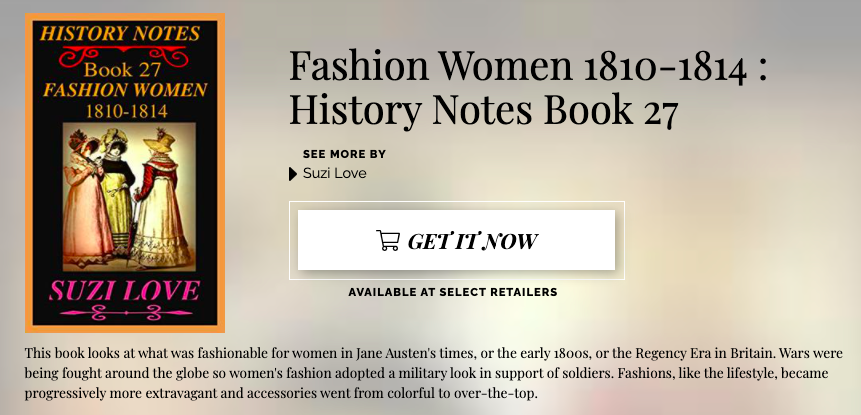
HN_27_History Notes book 27 What was fashionable for women in Jane Austen's times? Mourning, riding, daytime, evening clothing, plus underclothing, corsets and accessories. Wars were being fought so women adopted military looks in support of soldiers. https://books2read.com/SuziLoveFashion1810-1814
HN_27_D2D_FashWomen1810-1814
27_D2D_FashWomen1810-1814
Posted in 1800s, 1800s women's fashion, art, Australia, bedroom fashion, Canada, cartoon, Coat or Pelisse Or Redingote, Corset, dancing, Decorative Item, Dress Or Robe, England, Europe, fashion accessories, France, Google Books, hats, History, History Notes, Jane Austen, London, mourning, Music, peerage, Quotations, Regency Era, Regency Fashion, Reticule or Bag, riding, Russia, sewing, shoes, Spencer, Suzi Love Books, Suzi Love Images, U.S.A, underclothing, weddings | Tagged 1800s women's fashion, Book 28, Corset, Dress Or Gown, fashion accessories, Fashion Plate, Fashions Of London and Paris, gloves, google books, Hats And Hair, History Notes, Jane Austen, jewelry, Journal des Dames et des Modes, La Belle Assemblee, mourning, parasol, Regency Fashion, reticule or bag, riding, Shoes, stockings, Suzi Love Books, The Lady's Magazine, The Lady's Monthly Museum, The Repository Of Arts, underclothing

What did women wear in Bridgerton and Jane Austen times? Mourning, riding, daytime, evening fashions plus underclothing. #Bridgerton #RegencyEra #JaneAusten #HistoricalFashion

Suzi Love Posted on August 24, 2024 by Suzi LoveAugust 15, 2024

Fashion Women 1810-1814 History Notes Book 27 This book looks at what was fashionable for women in Jane Austen’s times, or the early 1800s, or the Regency Era in Britain. Wars were being fought around the globe so women’s fashion adopted a military look in support of soldiers. Fashions, like the lifestyle, became progressively more extravagant and accessories went from colorful to over-the-top. https://books2read.com/SuziLoveFashion1810-1814
HN_27_History Notes book 27 What was fashionable for women in Jane Austen's times? Mourning, riding, daytime, evening clothing, plus underclothing, corsets and accessories. Wars were being fought so women adopted military looks in support of soldiers. https://books2read.com/SuziLoveFashion1810-1814
HN_27_D2D_FashWomen1810-1814
https://books2read.com/SuziLoveFashion1810-1814
27_D2D_FashWomen1810-1814
Posted in 1800s, 1800s women's fashion, art, Australia, bedroom fashion, Canada, cartoon, Coat or Pelisse Or Redingote, Corset, dancing, Decorative Item, Dress Or Robe, England, Europe, fashion accessories, France, hats, History, History Notes, Jane Austen, London, mourning, Music, peerage, Quotations, Regency Era, Regency Fashion, Reticule or Bag, riding, Russia, sewing, shoes, Spencer, Suzi Love Books, Suzi Love Images, U.S.A, underclothing, weddings | Tagged 1800s women's fashion, Book 28, Corset, Dress Or Gown, fans, fashion accessories, Fashion Plate, Fashions Of London and Paris, gloves, google books, Hats And Hair, History Notes, Jane Austen, jewelry, Journal des Dames et des Modes, La Belle Assemblee, mourning, parasol, Regency Fashion, reticule or bag, riding, shawls, Shoes, stockings, Suzi Love Books, The Lady's Magazine, The Lady's Monthly Museum, The Repository Of Arts, underclothing

What was fashionable in Bridgerton and Jane Austen times? Mourning, riding, daytime, evening fashions plus corsets and underclothing. #Bridgerton #RegencyFashion #JaneAusten

Suzi Love Posted on August 24, 2024 by Suzi LoveAugust 23, 2024

What was fashionable for women in Jane Austen’s times? Mourning, riding, daytime, evening clothing, plus underclothing, corsets and accessories. Fashion Women 1810-1814 History Notes Book 27 This book looks at what was fashionable for women in Jane Austen’s times, or the early 1800s, or the Regency Era in Britain. Wars were being fought around the globe so women’s fashion adopted a military look in support of soldiers. Fashions, like the lifestyle, became progressively more extravagant and accessories went from colorful to over-the-top. https://books2read.com/SuziLoveFashion1810-1814

The Lady’s Magazine said of the basis of women’s fashion that was popular for the first twenty years of the 1800s, ‘White is still the prevailing color for robes. For morning dresses, linen gowns, in large diamonds or squares, are fashionable. Indian muslins, plain or embroidered, are preferred to Florence and satins. The designs of embroidery for shawls are of infinite variety. Long gloves, which reach above the elbow, are not yet laid aside. Medallions are hung around the neck from crossed chains and some of these medallions are shaped like the bags, called ridicules. These reticules are of the lozenge or hexagon shape, with a small tassel at each angle. Reticules, or ridicules, are in lozenge or hexagon shapes with a small tassel at each angle. In capotes, or hats, and ribbands, the violet and dark green prevail over jonquil. Bracelets in hair, pear-shaped ear-rings, medallions on square plates, saltiers of colored stones, are still in fashion.’
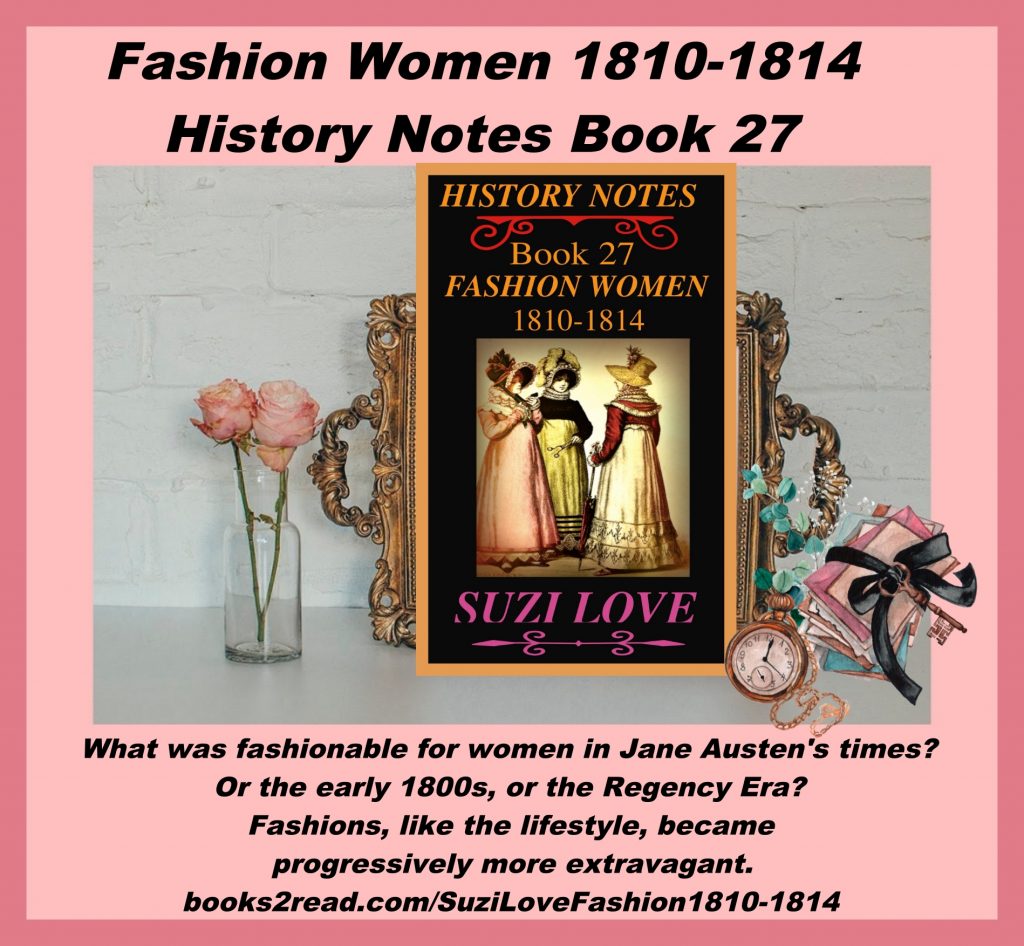
HN_27_History Notes book 27 What was fashionable for women in Jane Austen's times? Mourning, riding, daytime, evening clothing, plus underclothing, corsets and accessories. Wars were being fought so women adopted military looks in support of soldiers. https://books2read.com/SuziLoveFashion1810-1814

https://books2read.com/SuziLoveFashion1810-1814
HN_27_D2D_FashWomen1810-1814

https://books2read.com/SuziLoveFashion1810-1814
27_D2D_FashWomen1810-1814
Posted in 1800s, 1800s women's fashion, art, Australia, bedroom fashion, Canada, cartoon, Coat or Pelisse Or Redingote, Corset, Customs & Manners, dancing, Decorative Item, Dress Or Robe, England, Europe, fashion accessories, France, hats, History, History Notes, Jane Austen, London, Music, Pastimes, peerage, Regency Era, Regency Fashion, Reticule or Bag, riding, Russia, sewing, shoes, Spencer, Suzi Love Books, Suzi Love Images, travel, U.S.A, underclothing, weddings | Tagged 1800s women's fashion, Book 28, Corset, Dress Or Gown, fans, fashion accessories, Fashion Plate, Fashions Of London and Paris, gloves, google books, Hats And Hair, History Notes, Jane Austen, jewelry, Journal des Dames et des Modes, La Belle Assemblee, mourning, parasol, Regency Fashion, reticule or bag, riding, shawls, Shoes, stockings, Suzi Love Books, The Lady's Magazine, The Lady's Monthly Museum, The Repository Of Arts, underclothing

What did Jane Austen wear? Her family and friends wore elegant and pretty fashions in the early 1800s. #RegencyEra #JaneAusten #HistoricalFashion

Suzi Love Posted on August 17, 2024 by Suzi LoveAugust 17, 2024

What did Jane Austen and friends wear? Early 1800s fashions were elegant and pretty with high waists and fabrics that were almost transparent. These Empire style gowns, named after Napoleon’s first Empress, became popular throughout Europe, and were then copied around the world. Colorful outwear was added to make an ensemble more attractive and warmer. History Notes Book 26 Fashion Women 1805-1809.
https://books2read.com/SuziLoveFashionWomen1805-1809

The Empire waist gown defined women’s fashion during the Regency Era. ‘Empire’ is the name given in France to the period when Napoleon built his French Empire. High-waisted, loose gowns were adopted by the aristocracy as a symbol of turning away from the fussy, elaborate and expensive clothing worn in the 1700s. Jean-Jaques Rousseau advocated copying peasants and returning to a simpler life and more natural fashions. Unrestricting clothing was part of the new Democracy in France and these simpler and flowing fashions were adopted all over Europe, including Britain and despite the continual wars being fought against France during the early 1800s. Not even war stopped fashions from being copied everywhere.

HN-26_Fashion Women 1805-1809 History Notes Book 26 What did Jane Austen and friends wear? This book looks at early 1800s fashions, which were elegant and pretty with high waists and fabrics that were almost transparent. These Empire style gowns, named after Napoleon's first Empress, became popular throughout Europe, and were then copied around the world. Colorful outwear was added to make an ensemble more attractive and warmer. https://books2read.com/SuziLoveFashionWomen1805-1809
HN_26_D2D_FsshionWomen1805-1809 
https://books2read.com/SuziLoveFashionWomen1805-1809
HN_26_D2D_FsshionWomen1805-1809
Posted in 1800s, 1800s women's fashion, art, Australia, bedroom fashion, Canada, cartoon, Coat or Pelisse Or Redingote, Corset, Customs & Manners, dancing, Dress Or Robe, England, Europe, fashion accessories, France, hats, History, History Notes, Jane Austen, London, mourning, Regency Era, Regency Fashion, Reticule or Bag, riding, Russia, shoes, Spencer, Suzi Love Books, Suzi Love Images, U.S.A, underclothing | Tagged 1800s women's fashion, Book 26, Corset, Dress Or Gown, fashion accessories, Fashion Plate, Fashions Of London and Paris, google books, Hats And Hair, History Notes, Jane Austen, jewelry, Journal des Dames et des Modes, La Belle Assemblee, mourning, Napoleon Bonaparte, Regency Fashion, riding, shawls, Shoes, Spencer, Suzi Love Books, The Lady's Monthly Museum, The Repository Of Arts, underclothing, weddings

18th Century Taking Snuff and Pretty Snuff Boxes. #Georgian #Antiques #BritishHistory

Suzi Love Posted on June 6, 2024 by Suzi LoveJune 4, 2024

18th Century Snuff Boxes. Not only were boxes made to serve a purpose, but decorative boxes of all types were prized, especially in the 18th Century when everything decorative and extravagant was in vogue and taking a pinch of snuff was fashionable. Snuff is made from ground or pulverized tobacco leaves and is sniffed from a pinch of snuff placed on the back of the hand. Flavorings were added to the tobacco to give a fast hit of nicotine and a lasting scent. Snuff began in the Americas and was used in Europe by the 17th Century.

Snuff became popular from the mid 1600s to the mid 1800s and was more popular than smoking. Inhaling snuff, or snuffing, was first seen by a European missionary in 1493 in Christopher Columbus’s new world within Haiti’s indigenous Taino. Until then, tobacco had been unknown to Europeans, but its use spread quickly throughout Europe during the 1500s.  By the second half of the 17th century, ornate boxes started being produced to keep the precious powder dry and an entire industry making accessories blossomed around the fashion of taking snuff.  Noblemen, and some women, carried extravagantly decorated snuff boxes with them at all times and would offer a pinch of their own particular blend to friends and family. Therefore, these boxes were always on display and so it became a competition to see who could have the most bejeweled or expensive box possible. books2read.com/suziloveFashMen1700

1770-1771 ca. Gold and Enamel Snuffbox With Three Putti Playing cards. By Nicholas Prevost, Paris, France. via suzilove.com Victoria and Albert Museum, London, UK. collections.vam.ac.uk.
1770-1771 ca. Gold and Enamel Snuffbox
18th Century ca. Gold and Enamel Snuff Box, Europe. Cartouche-form, cover with courtship scene in stylized rococo setting, ground later enameled in translucent colors. via suzilove.com and Christie’s Auction Rooms. christies.com
18th Century ca. Gold and Enamel Snuff Box, Europe.
1759 Gold Snuff Box, English. By John Barbe, London, UK. Jason and the Gold Fleece to King Pelias on lid, sides with picturesque ruins and flowers in rococo scrollwork. via suzilove.com and Sotheby's Auctions. sothebys.com
1759 Gold Snuff Box, English.
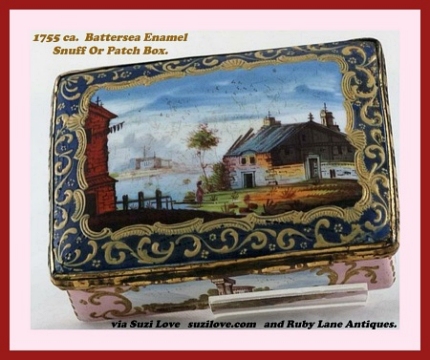
1755 Battersea Enamel Snuff Or Patch Box. via suzilove.com and Ruby Lane Antiques. rubylane.com
1755 Battersea Enamel Snuff Or Patch Box.
1754-1755 ca. Gold Snuffbox, French. Engine-turned overall with undulating ribbons, for two types of powdered tobacco, By Jean Ducrollay, 1754-1755, Paris, France. via suzilove.com Victoria and Albert Museum, London, UK. collections.vam.ac.uk.
1754-1755 ca. Gold Snuffbox, French.
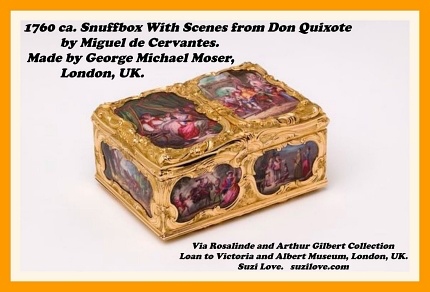
1760 ca. Snuffbox With Scenes from Don Quixote by Miguel de Cervantes, George Michael Moser, London via suzilove.com Victoria and Albert Museum, London, UK. collections.vam.ac.uk.
1760 ca. Snuffbox With Scenes from Don Quixote
1760 ca. Gold Mounted Lapis Lazuli Snuff Box with Shell Inlays, probably Dresden, Germany. By Heinrich Taddel. museum no. Loan-Gilbert.404-2008 suzilove.com
1760 ca. Gold Mounted Lapis Lazuli Snuff Box
1700s Portrait Miniature Snuff Box of Gold and Tortoiseshell, French. via suzilove.com and 1st Dibs Auctions 1stdibs.com
1700s Portrait Miniature Snuff Box of Gold and Tortoiseshell
1750 ca. Carved Agate Snuffbox, Germany. via suzilove.com Victoria and Albert Museum, London, UK. collections.vam.ac.uk.
1750 ca. Carved Agate Snuffbox, Germany.
1749-1750 ca. Double Snuff Box, French. By Jean Ducrollay (French, born 1709, master 1734, recorded 1760) Paris. via suzilove.com and Metropolitan Museum New York City, U.S.A. metmuseum.org
1749-1750 ca. Double Snuff Box, French.
1728-1729 ca. Snuffbox With Dolphin and Ship, Paris, France. via suzilove.com Victoria and Albert Museum, London, UK. collections.vam.ac.uk.
1728-1729 ca. Snuffbox With Dolphin and Ship,
RL_2_D2D_RetailerBuyLink_RL_2
RL_2_D2D_RetailerBuyLink_RL_2 https://books2read.com/suziloveYGD
Posted in 1700s, art, Box Or Container, Customs & Manners, Decorative Item, England, Europe, Georgian Era, History, Suzi Love Images, U.S.A | Tagged 1700s Or Georgian Era, antiques, art, Box Or Container, decorative, Georgian era, snuff, Suzi Love Images, Suzi Love Research

Post navigation

← Previous Post
Next Post→

SUBSCRIBE TO SUZI LOVE'S NEWSLETTER.

Recent Posts

  • Jane Austen fan? Women’s dress styles around 1800. History Notes Book 12. #RegencyFashion #JaneAusten #nonfiction
  • 1815 June Lady Reading Book Wearing Jane Austen Style White Carriage Dress. #RegencyFashion #JaneAusten #HistoricalFashion
  • 1825 The Quadrant, London, in Jane Austen and Bridgerton years. #JaneAusten #Bridgerton #London #BritishHistory
  • 1809 Women’s Fashions in Jane Austen Times: Dresses, Shawls, Hats and Jewelry. #RegencyFashion #JaneAusten #HistoricalFashion
  • 1807 Healthful Dipping In Jane Austen Times. Lady in chemise preparing to dip in spa waters. #Underclothing #JaneAusten #RegencyFashion

Recent Comments

  1. Suzi Love on Book Hooks: Petunia and the Pearl Diver. Petunia was too well spoken for a brothel worker. #Regencyromance #historicalromance #London #mfrw
  2. Bianca White on Book Hooks: Petunia and the Pearl Diver. Petunia was too well spoken for a brothel worker. #Regencyromance #historicalromance #London #mfrw
  3. Suzi Love on Book Hooks: Petunia and the Pearl Diver. Petunia was too well spoken for a brothel worker. #Regencyromance #historicalromance #London #mfrw
  4. Suzi Love on Book Hooks: Petunia and the Pearl Diver. Petunia was too well spoken for a brothel worker. #Regencyromance #historicalromance #London #mfrw
  5. Suzi Love on Book Hooks: Petunia and the Pearl Diver. Petunia was too well spoken for a brothel worker. #Regencyromance #historicalromance #London #mfrw

Login

  • Log in

Archives

  • October 2026
  • September 2026
  • August 2026
  • July 2026
  • June 2026
  • May 2026
  • April 2026
  • March 2026
  • February 2026
  • January 2026
  • December 2025
  • November 2025
  • October 2025
  • September 2025
  • August 2025
  • July 2025
  • June 2025
  • May 2025
  • April 2025
  • March 2025
  • February 2025
  • January 2025
  • December 2024
  • November 2024
  • October 2024
  • September 2024
  • August 2024
  • July 2024
  • June 2024
  • May 2024
  • April 2024
  • March 2024
  • February 2024
  • January 2024
  • November 2023
  • October 2023
  • September 2023
  • August 2023
  • June 2022
  • April 2022

Categories

  • 1700s
  • 1700s Mens fashion
  • 1700s Womens Fashion
  • 1800s
  • 1800s Mens Fashions
  • 1800s women's fashion
  • 1900s
  • art
  • Australia
  • Bath
  • bedroom fashion
  • Book Hooks
  • Box Or Container
  • Bridgerton
  • Bus Trips
  • Canada
  • Carriage
  • cartoon
  • Celebrity
  • Chatelaine
  • children
  • Children
  • Christmas
  • Coat or Pelisse Or Redingote
  • Contemporary
  • Corset
  • Couple
  • Customs & Manners
  • dancing
  • December Scandal
  • Decorative Item
  • Dress Or Robe
  • Easter
  • Edwardian Era
  • Embracing Scandal
  • England
  • Ester In Images
  • Europe
  • Events
  • Fashion
  • fashion accessories
  • Food and Drink
  • Four Times A Virgin
  • France
  • furniture
  • Georgian Era
  • Georgian Fashion
  • Google Books
  • Grand Tour
  • Group
  • hats
  • History
  • History Events
  • History Notes
  • History Of Christmases Past
  • household
  • Hygiene
  • Irresistible Aristocrats
  • Jane Austen
  • Keanu Reeves
  • Kellys Justice
  • Legal
  • London
  • Love After Waterloo
  • Loving Lady Katharine
  • medical
  • military
  • money
  • mourning
  • Music
  • Outback Arrival
  • pants
  • Pastimes
  • peerage
  • People
  • Petunia and Pearl Diver
  • Places
  • Pleasure House Ball
  • postal
  • Queensland
  • Quotations
  • Regency Era
  • Regency Fashion
  • Regency Life Series
  • Reticule or Bag
  • riding
  • Romantic Era
  • Royalty
  • Russia
  • Scandalous Siblings Series
  • Scenting Scandal
  • Self Publishing
  • sewing
  • Shirt
  • shoes
  • Shopping
  • South Pacific
  • Spencer
  • sports
  • Suit
  • Sunday Snippet
  • Suzi Love
  • Suzi Love Books
  • Suzi Love Images
  • Suzi Love Writing
  • THe Viscount's Pleasure House
  • travel
  • U.S.A
  • underclothing
  • Vest or Waistcoat
  • Victorian Era
  • Victorian Fashion
  • weapons
  • weddings
  • Writing Tools

1800s men fashion 1800s women's fashion antiques Bridgerton British history Cartoons Corset cravat decorative Dress Or Gown England europe fashion accessories Fashion Plate France Georgian era Georgian Fashion gloves google books Hats And Hair historical romance History Notes household Jane Austen jewelry Journal des Dames et des Modes London Metropolitan Museum NYC pants Redingote Or Pelisse Or Coat Regency Era Regency Fashion Regency London reticule or bag riding Romantic Era sewing shawls Shoes Suzi Love Books Suzi Love Images Tailcoat The Repository Of Arts underclothing Vest or Waistcoat

©2026 - Suzi Love - Weaver Xtreme Theme Privacy Policy
↑