1820 ca. Brown Silk Pelisse, Or Coat, British. Worn over a light weight dress for warmth. Silk, lined with blue silk satin and cotton, hand-sewn. Front opening with concealed buttons and loops, wide stiffened collar, elaborate piping with thin rolls of fabric, skirt cut A-line shape and hem padded to accentuate shape, fairly high waistline with attached gored skirt and gathered panel at back. Long sleeves with short puffed over-sleeves. Green shawl, parasol, matching bonnet. via Victoria and Albert Museum, London, UK. collections.vam.ac.uk.
Definition Redingote Or Pelisse Or Walking Dress Or Coat: French word developed from English words, riding coat. Long fitted outdoor coat worn over other garments for warmth. Often left open at the front to show off the dress underneath. Sometimes cut away in front. Originally made with several capes and trimmed with large buttons. French fashion plates call these coats Redingotes and they are designed for women, men and children. English fashion plates call them a Pelisse, a walking dress, Promenade dress, or Carriage dress.
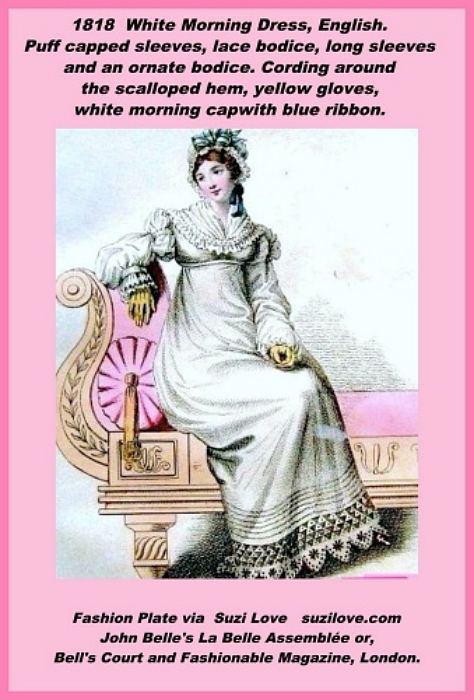
1818 Empire style, or high-waisted white morning dress, English. Puffed capped sleeves, lace shawl like neckline, ornate bodice cording around a scalloped hem, small white hat with blue flowers, and yellow gloves. Fashion Plate via John Belle’s ‘La Belle Assemblee’, London.
Definition Morning or At-Home Dress: Worn at home for reading, painting, sewing or for walking locally or while residing in the country. To be seen by family and close friends.
Definition Empire Style Dress: High-waisted white gown defined women’s fashion during the Regency Era. ‘Empire’ is the name given to the period when Napoleon Bonaparte built his French Empire. High-waisted, loose gowns were adopted by the aristocracy as a symbol of turning away from the fussy, elaborate and expensive clothing worn in the 1700s.
Definition Morning Cap Or Cornette: Muslin or other lightweight material, worn to cover hair during at-home pursuits such as reading, playing music, or sketching, tied under chin and sometimes worn under a bonnet.
ance”As the Duke of Sherwyn, you’ve entree into the best houses and social events.”
After a scowl towards the ceiling, he muttered, “Thanks to my stepmother, I’m forced into it. But what does my recent social popularity have to do with your current predicament?”
“In daylight, with other ladies, I can stroll about the streets. Visit shops, sometimes slip unnoticed into the twice-weekly stock auctions at the Hall of Commerce in Threadneedle Street. And I’ve already searched the desks of many of the mere misters and lesser peers of the lower orders of the consortium, as their houses aren’t guarded like fortresses.”
“Do you mean to say you entered these men’s homes and rifled their papers?”
“Well yes, but–”
“Are you mad?”
“I risked little, because those sort of houses cannot afford a footman guarding every passageway. Especially not on occasions such as those I attended, where every footman is needed to fetch drinks for belligerent guests. Slipping into those libraries was child’s play.” She sighed. “What I cannot do is visit the homes of the highest ranking peers to scour their correspondence for any that bears the special seal of the consortium. Nor secure enough privacy to copy any incriminating letters I may find. Someone always hovers, and watches, at those type of houses.”
He paced before her like a restless panther, an angry scowl pulling his face taut. His fine looks had always turned heads, but this brooding beast carried a lethal combination of strength and menacing masculinity. She shivered. His newly acquired arrogance of bearing enhanced, rather than detracted from, his magnetism, although this time, she knew to avoid his magnetic pull.
“You intend searching the houses of every peer in the city who is making money from stock shares?”
“No, no, not all of them. We’ve done a lot of research–”
“We?”
“My family have become quite adept at research. We’ve narrowed our search to gentlemen known to invest in railway expansions in a large way. Our final list is of those we consider to be involved in the inner, and most secret, tier of the syndicate. It contains eighteen names, the majority of whom are high-ranking peers.
“Bloody hell, Becca.” He ground the expletive out through clenched teeth. “You’re out of your depth. I’ve been involved in similar commercial groups. They’ll stop at nothing for the sake of money.”
“Nevertheless, we need certain details you may overhear at clubs about certain gentlemen having sudden windfalls. Or things gleaned at certain balls and soirees.
“Unbelievable.” Both hands went up in the air. “That’s certainly as clear as muddy water.”
“Clear or not, I’m asking you to trust me. To help me.”
She held out both hands, palms up, and hoped he wouldn’t notice their tremors. “With your assistance, I can verify more names. Collect proof of each one’s involvement and hand it over to Scotland Yard. Time is of the essence, as we’ve now less than two weeks.”
She watched him absorb, assess, decide. In under a minute, he guided her to his desk and seated her before it.
“Make a start. List the names of every man you suspect to be a member.” He placed writing materials before her. “Then list those you consider inner tier, and include their ranking.”
1818 December 11th A dandy fainting or – an exquisite in fits. Scene a private box opera. A dandy lies back fainting in a chair, his limbs rigid, supported by three others while a fourth (left) draws the curtain, cutting off a view of the (distant) stage where a singer is posturing. Via British Museum, London, UK. britishmuseum.org (PD-Art)
1818 September ‘A Nice Gentleman’ By George Cruikshank. A grotesque dandy walks outdoors sucking a cane. Inscribed with names of food, e.g. red carbuncled rose is ‘Currant Jelly’, shallow broad-brimmed hat is ‘Calves Head Jelly’ and ‘Pancake’, cravat which covers neck, cheek and chin is ‘Puff Paste’, loose short trousers are ‘White Sugar Bags’, handkerchief ‘Blow Monge’ and long spurs ‘Gilt Gingerbread’. Via British Museum, London, UK. britishmuseum.org (PD-Art)
1809 June Evening Full Dress, English. Lemon dress with white underskirt, short sleeves, braid decorated bodice, zig-zag hem, long white gloves, plumed headdress, full Parure of necklace, bracelet and earrings, evening slippers and a fan. Fashion Plate via John Belle’s La Belle Assemblée or, Bell’s Court and Fashionable Magazine, London.
Definition Full Evening Dress – Ball, dinner, evening and opera gowns but with every possible accessory added to make the most impressive display possible, such as adding a Grand Parure, or full jewelry set and including headpieces as with the feathered headdress above.
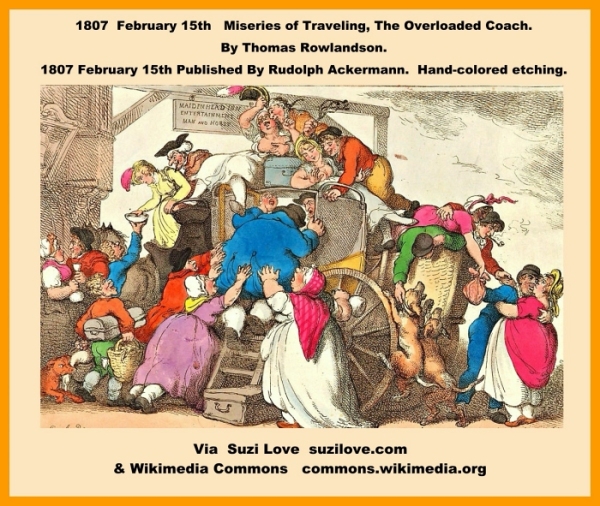
1807 February 15th ‘Miseries of Travelling’ in Jane Austen’s times. The Overloaded Coach Series By Thomas Rowlandson. Publisher Rudolph Ackermann, London (active 1794–1829). Hand colored etching.
1800s Early Tattersall’s Horse Auctions, London, U.K.. Top sporting venue for Regency Life in London. ‘A mixture of persons of nearly all ranks’. By Pierce Egan. Via Wikimedia Commons (PD-ART)
In Jane Austen’s and Bridgerton times, or the Regency Era, horse riding was a vital mode of transport and Tattersall’s was the best place to buy and sell horses. Tattersall’s was established in 1773 near Hyde Park Corner for the sale by auction of horses, carriages, hounds and harnesses. Sales during the winter months were every Monday and Thursday, and on Mondays only during the spring and summer. On the mornings when there was no sale, Tattersall’s was a meeting place for fashionable sporting gentlemen.
Pierce Egan’s Description of Tattersall’s
A masquerade could scarcely exhibit more motley groups than the attendants of this place of fashionable resort. There were Peers, Baronets, Members of Parliament, Turf gentlemen and Turf-servants, Jockies, Grooms, Horse-dealers, Gamblers, &c. There you might see the oldest and some of the best blood in England, disguised like coachmen.
From: 1820 Sporting Anecdotes by Pierce Egan via Google Books (PD-150)
As the Duke of Stirkton, Max was well accustomed to being watched. Young pups copied his dress style. Toad-eaters mimicked his behavior in futile attempts to ingratiate themselves into his life. Conservative groups applauded his somber public behavior, while cartoonists ridiculed his straight-laced demeanor and suggested he take a mistress. Or two.
Whichever way people viewed him, no one had dared ridicule him to his face. Until this evening. The Countess had side-stepped his butler and marched into his drawing room as if an unannounced call upon an unmarried duke was something she did regularly. Max had informed her, in great detail, of the extensive search he and his cousin had undertaken to locate her and the other women. She’d huffed and rolled her eyes.
Normally, his month-about- mistresses gleefully accepted his proposal because sharing a duke’s bed for a month would set them up for the rest of their lives. Apart from the financial benefits, he was a generous lover. One benefit of his abnormal upbringing had been an early and full education into what women wanted in a bed partner. Until the Countess had laughed at him, he’d never had reason to doubt his sexual prowess. In the brief time she’d been in his house, she’d challenged several of his beliefs.
“It’s the ideal solution.” And something he needed. “I will help you search my grandfather’s boxes by day and, in exchange, you’ll make yourself available to me in the evenings.” Max waited, unsure what to expect. An odd situation for a man who prided himself on reading adversaries as easily as he tallied the accounts. books2read.com/suziloveFTAV