1800s Typical Breakfast and Tea China, England. Tea cups, Bread and Butter plates, Teapot, Butter Dish, Coffee Cups, Tea Set, Milk Jug, Water Jug, Bread Dish, Sardine Dish, Bacon Dish, Marmalade Jar and Breakfast Cups. From: 1860 Mrs. Isabella Beeton’s Book of Household Management. These are the sort of salads that Jane Austen’s family would have eaten to accompany main dishes during the early 1800s, or Regency Era.
Travel and Luggage By Suzi Love History Notes Book 10. How did people travel in Jane Austen’s times. In past centuries? What did they take with them to make their long journeys easier? Travel by road, ship, canal, or railway all took a long time and had dangers so people learned to prepare. And then, in the nineteenth century, road improvements, inventions, and scientific developments made travel more pleasurable. books2read.com/SuziLoveTravel
What salads were served in Jane Austen and the Bridgerton households? Salads “Persons in health, who feel a craving for salad, may indulge in the enjoyment of it to a great extent with perfect impunity, if not with positive benefit. Oil, when mixed in salad, appears to render the raw vegetables and herbs more digestible. Vinegar likewise promotes the digestion of lettuce, celery, and beet-root.
“Endive is very wholesome, strengthening, and easy of digestion; but when strong seasoning is added to it, it becomes an epicurean sauce. — Mayo.”
Recipe for a Winter Salad, by the late Rev. Sydney Smith. Two large potatoes, passed through kitchen sieve, Unwonted softness to the salad give, Of mordent mustard add a single spoon; To add a double quantity of salt; Three times the spoon with oil of Lucca crown, And once with vinegar, procured from town. True flavor needs it, and your poet begs The pounded yellow of two well-boiled eggs. Let onion atoms lurk within the bowl, And, scarce suspected, animate the whole; And, lastly, on the flavored compound toss A magic teaspoon of anchovy sauce. Then, though green turtle fail, though venison’s tough, And ham and turkey are not boiled enough, Serenely full the Epicure may say,- Fate cannot harm me—I have dined to-day!
The Spanish proverb says four persons are wanted to make a good salad: a spendthrift for oil, a miser for vinegar, a counsellor for salt, and a madman to stir all up.
1859 Hints for the Table by John Timbs.
1800s Typical Salads: Cucumber, Beetroot and Potato, Macedone Salad, Tomato Salad, Jellied Russian and Italian Salads, Prawn Salad, Egg and Lettuce, Lobster Salad and Salad Dumas. From: Mrs. Beeton’s Book of Household Management. via Google Books (PD-150)
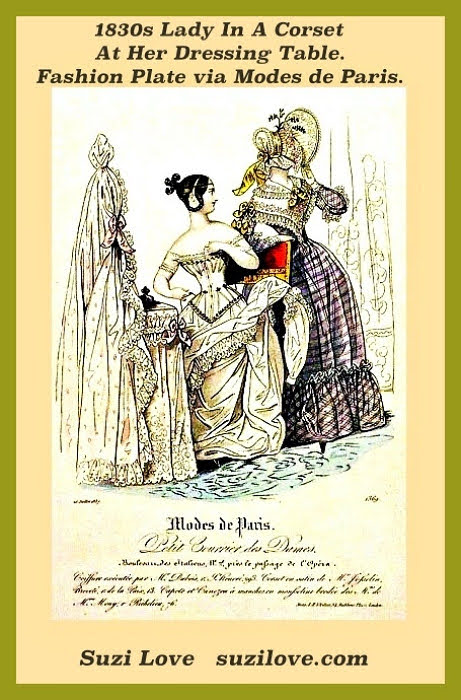
1830s Lady In A Corset At Her Dressing Table. Fashion Plate via Modes de Paris.
Romantic Era women’s corsets supported plus fitted well to give a fashionable silhouette. Becoming a fashion item, rather than simply hidden underclothing. https://books2read.com/SuziLoveCorsetBook18
1830s_Lady In Corset At Dressing Table. Modes de Paris.HN_18_D2D_Corset_1830-https://books2read.com/SuziLoveCorsetBook18
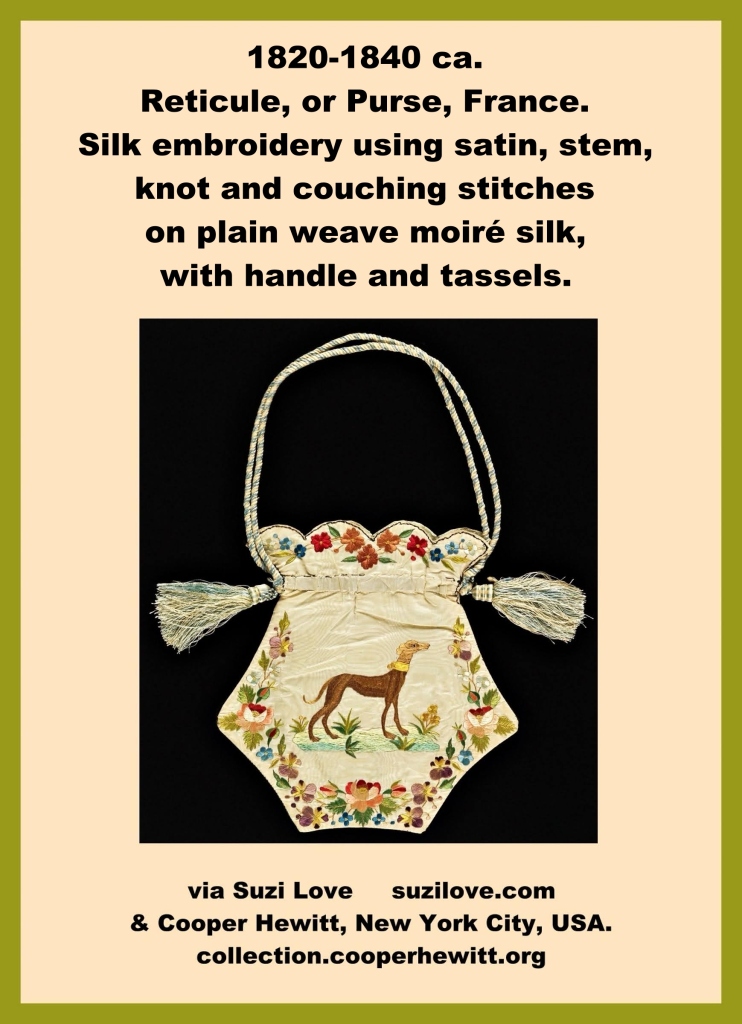
1820-1840 ca. Reticule, Or Purse, France. Bag of plain weave white moiré silk embroidered in colored silks using satin, stem, knot and couching stitches. Shape is five-sided, flat, with a scalloped top. Borders of flower wreaths. Embroidered on one side with a greyhound and with a long-tailed bird on the other. Worked as two separate panels, joined. Lined in pale blue taffeta. Blue and white silk cord. via Cooper Hewitt, New York City, USA. collection.cooperhewitt.org
Definition Reticule: Bag or purse, often with a drawstring to pull closed and usually made of cloth or covered cardboard and often decorated with beading or embroidery. A reticule, or purse, or handbag, was usually carried by a woman during the Regency period to carry all their daily necessities. Earlier, women used pockets that tied at the waistline and were hidden in the folds of their skirts. Empire style, or early 1800s, high-waisted dresses made it impossible to either sewn in a pocket or to tie on a pocket. So women began carrying small, decorated bags called Reticules, or ridicules, which generally pulled close at the top with a drawstring. http://books2read.com/suziloveReticules
Michael Brandon nodded. “Yes, I’m related to Lord Brandon, Frederick, who disappeared four years ago.” He faced the sick man. “We searched everywhere for you. Men scoured the streets of London for weeks after you disappeared, and then we widened our search. Ports, inns, the countryside, anywhere you might have gone. Or anywhere that you might have been taken if you’d been kidnapped and held for ransom.”
Michael groaned. “Three years of nothing. Not a sign. The police declared you a missing person, most likely deceased, and told us to wait out the seven years until we could officially declare you dead.” He swiped at his eyes, brushing aside the gathering tears. He took Frederick’s hand. “But we never gave up hope. None of us, and especially not mother.”
Tears trickled down Michael’s cheek and he brushed them aside impatiently. He didn’t care that everyone saw his raw grief. He only cared that his brother, if this shell of a man truly was his previously vibrant brother, heard his words and understood the truth in them. The heartache and sorrow that they’d all carried for years. The pain they’d suffered thinking they might never set eyes on Frederick again.
“Your mother …” His words caught as a sob escaped him, echoing the continuing sobbing from Melissa behind him. “Your mother died a year ago, but her last words were a desperate plea for me to keep looking for you. To find you, and to bring you home.”
Michael watched tears trickle and run over the creases on the aged face before him, and he knew. This was Frederick, his constant companion during hundreds of childish escapades.
https://books2read.com/suziloveDS December Scandal, Book 3 Scandalous Siblings.
DS_December Scandal Book 3 Scandalous Siblings #HistoricalRomance Michael Brandon travels to introduce the woman he loves to family but is shocked when his missing brother arrives. https://books2read.com/suziloveDS
DS_December Scandal D2D_RetailerLinkhttps://books2read.com/suziloveDS
Travel and Luggage By Suzi Love History Notes Book 10. How did people travel in Bridgerton’s and Jane Austen’s times? What did they take with them to make their long journeys easier? Travel by road, ship, canal, or railway all took a long time and had dangers so people learned to prepare. And then, in the nineteenth century, road improvements, inventions, and scientific developments made travel more pleasurable. books2read.com/SuziLoveTravel
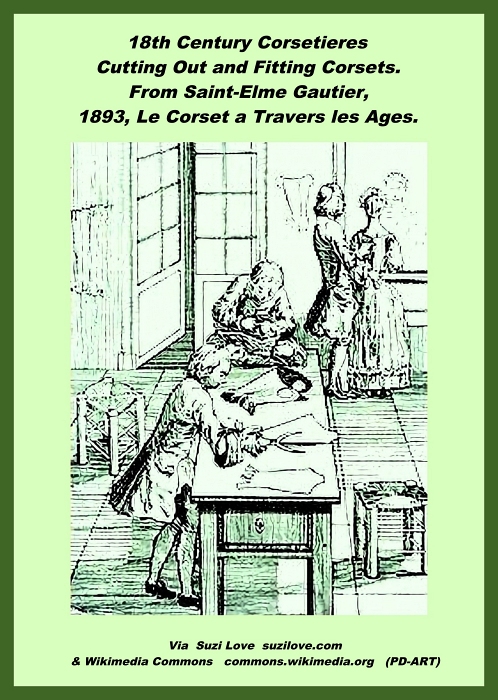
There has been some discussion on the names for Corset Makers. I’ve seen lots of names, including Stay Maker, Stay Manufacturer, Corset Maker, Body Tailor and Milliner. It was mainly men who were Stay Makers, but there were also some women who included stay making with their millinery.
Corsets Overview History Notes Nonfiction Book 14. This book shows how body wraps, stays, and corsets were worn to create a variety of fashionable silhouettes through past centuries. Corsets flattened breasts and accentuated rounded hips or pushed up breasts and showed off the bust line depending on the fashions of the time and the desired silhouette. Includes corsets through the Georgian, Regency, Victorian and Edwardian Eras and Jane Austen’s lifetime. Overview of corsets through history, including the Georgian, Regency, Victorian and Edwardian Eras and Jane Austen’s lifetime.
1776 April 28th John McQueen, Stay Maker., New York. At the sign of the White Stays in Smith Street,near the Mayor’s baths, New York. Making all sorts of stays in the newest fashion that is worn by the ladies of Great Britain or France. Packthread stays for babies from one month to seven years, stays for children of Tabby, Ruffled Canvas, Or Buckram, and for older girls an assortment of thin boned stays of different sorts and sizes.1835 Milliner, Dress and Corset Maker to the Royal Family. Mrs. Langdon. 37 Milson Street, Bath, U.K. Local Trade Advertisements. From 1835 The Historical and Local New Bath Guide By C. Duffield. via Google Books (PD- 150)18th Century Interior of the shop of a body tailor, or corset maker. From 1893 The Art of the Tailor of the Bodies of Women and Children.1835 Fashionable Long and Short Stay Manufacturer. Robert Drew & Co. Local Trade Advertisements. From- 1835 The Historical and Local New Bath Guide. Published by C. Duffield via Google Books (PD-150)18th Century Corset Maker From 1893 Le Corset, A Travers Les Ages.18th Century Corsetieres cutting out and fitting. From Saint-Elme Gautier, Le Corset a Travers les Ages. en.wikipedia.org
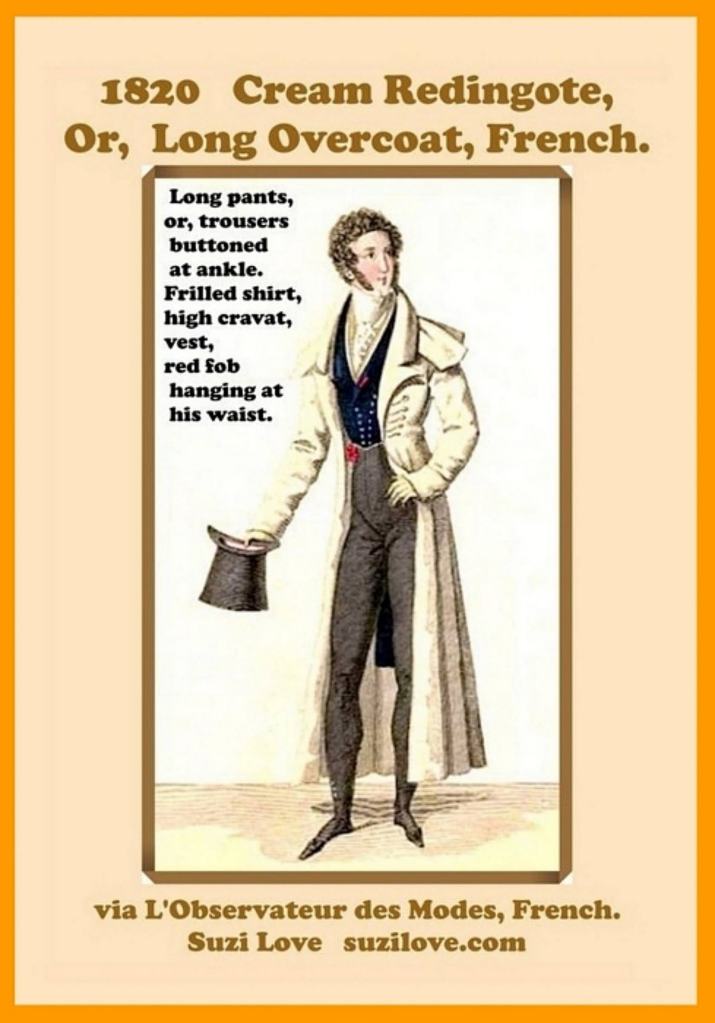
1820 Gentleman’s Cream Redingote, Or Long Overcoat, French. Long pants, or trousers, buttoned at the ankles, frilled shirt, high cravat, vest, red fob hanging at his waist. via L’Observateur des Modes, French.
1840s Woman’s Shoes or Slippers, Probably United States. Square toes, silk satin, sueded leather, linen, and kid leather. via Los Angeles County Museum of Art, California, USA. collections.lacma.org Shoes in the early 1800s were flat or low heeled and occasionally decorated with a bow or floral embellishments. From the 1820s onwards, square toes became fashionable.
1840s Woman’s Shoes or Slippers, Probably United States. Square toes, silk satin, sueded leather, linen, and kid leather. via Suzi Love suzilove.com
& Los Angeles County Museum of Art, California, USA.
collections.lacma.org