18th Century Late. Inkstand, Sheffield, England. Square, resting on four ball feet, the top pierced with four circular holes into which fit two inkwells, a pounce box and a box for wafers. Silver inkstands appeared in Britain in 17th century and included pot, or well, for ink, plus another pot with pierced cover held ‘pounce’ or sand, which writers scattered over paper to fix ink. Wafers to seal finished letter and tray to hold pens or quills. collections.vam.ac.uk
19th Century Cross Letter or Cross Writing or Cross Hatching. The writer reached the bottom of the page, turned the paper sideways and adds a second layer of text. During the 19th century, paper was expensive and postal delivery was charged per page, or by the size of the paper. Cross-writing was a way to save paper and postage in Jane Austen and Bridgerton times, and many of Jane Austen’s letters were written this way. Once it becomes familiar, the mind adapts easily and cross-writing letters are surprisingly legible. Charles Darwin also favored this technique.
Rates of Postage of single Letters in Pence.
From any post-office in England or Wales, to any place not exceeding 15 miles from such office – – – 3
For any distance above 15, and not exceeding 30 miles — — 4
For any distance above 30, and not exceeding 50 miles — 5
For any distance above 50, and not exceeding 80 miles – 6
For any distance above 80, and not exceeding 12O miles — 7
For any distance above 120, and not exceeding 170 miles – 8
For any distance above 170, and not exceeding 230 miles — 9
For my distance above 230, and not exceeding 300 miles — — 10
For any distance above 300, and not exceeding 400 miles – 11
For any distance above 400, and nut exceeding 500 mites — 12
1802 Picture of London Printed for R. Phillips via Google Books (PD-180)
And so in proportion; the postage increasing progressively one penny for a single letter for every like excess ok distance of 100 miles. 1802 Picture of London Printed for R. Phillips via Google Books (PD-180)
The Twopenny Post- Office.
There are two principal offices, one in the General Post—office yard, Lombard—street and the other in Gerrard-street, Soho. There are also numerous receiving houses in both the town and country.
There are SI X collections and deliveries of letters in town daily, (Sundays excepted) and there are two dispatches from, and three deliveries at, most places in the country, within the limits of this office.
1802 Picture of London Printed for R. Phillips via Google Books (PD-180)
1880 ca. Travelling Inkwell, English. Red Leather and Heart Shaped. via Ruby Lane Antiques. rubylane.com
HN_13_D2D_WritingTools Book 13 What did the lady of the house use to pen notes? What sat on the desk of the man of the house when managing his accounts? #History #Nonfiction #travel books2read.com/SuziLoveWritingTools
Do you need more factual and visual information for your historical fiction? Try History Notes Books 1-28. Non-fiction Series: Fashion, corsets, Regency Era, music and social manners in the 18th and 19th centuries e.g.
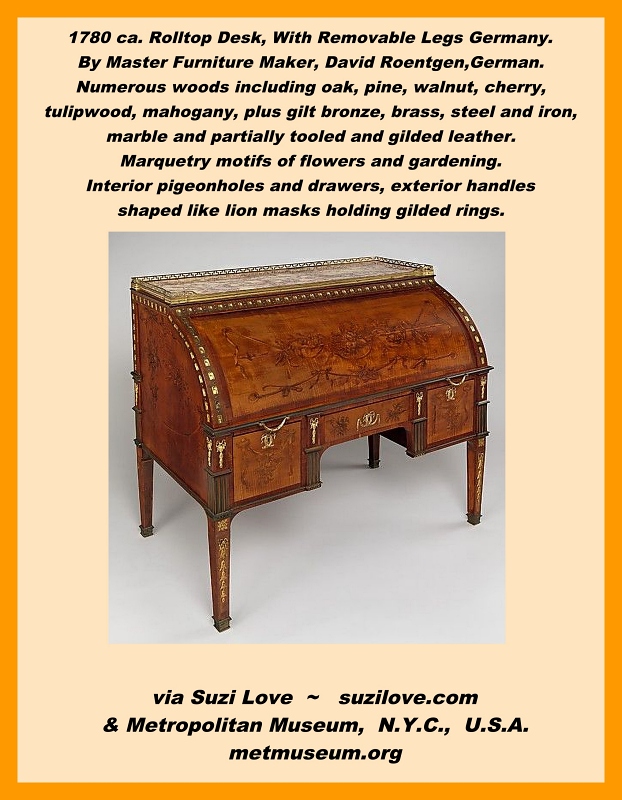
1780 Rolltop Desk, With Removable Legs Germany. By Master Furniture Maker, David Roentgen,German. Numerous woods including oak, pine, walnut, cherry, tulipwood, mahogany, plus gilt bronze, brass, steel and iron, marble and partially tooled and gilded leather. Marquetry motifs of flowers and gardening. Interior pigeonholes and drawers, exterior handles shaped like lion masks holding gilded rings. via Metropolitan Museum, N.Y.C., U.S.A. metmuseum.org
19th Century Mid-Late Five Desk Seals. L-R Carnelian seal with silver mounts set with colored stones; malachite urn seal: gilt-bronze seal with winged cherub heads: Silver-gilt seal eagle, Silver-gilt seal as eagle’s leg below a blue glass ball. via Sotheby’s Auctions. sothebys.com
In the Bridgerton family, or Jane Austen’s household, and during the Regency Era, sealing wax was not only impressed onto the back of a letter with a seal to protect against tampering, but also to identify the sender of the letter. People, especially aristocrats, kept personal and family seals to be used for many different purposes e.g. A letter to a government official would be sealed with an aristocrat’s crest or title. Personal seals for identification have been since early civilizations. The rubber stamps and embossers we use today serve the same purpose, identifying the sender.
Definition: Wax Seals: Pressed onto a letter or envelope to show that a document is unopened or to verify the sender’s identity. A signet ring or was seal is pressed into a dollop of hot wax to seal a letter or envelope closed.
Do you need more factual and visual information for your historical fiction? History of fashion, music, peerage and customs in 18th and 19th centuries. Non-fiction series full of gorgeous pictures and engraved fashion plates. A visual history of fashion, music, peerage, social manners and customs from late 1700s to late 1800s, or 18th and 19th centuries.