What did an older lady do and wear in the Regency Era? Information & pictures for readers and writers of early 1800s history, nonfiction and fiction. books2read.com/suziloveOLD
The older lady’s day usually started with her toilette in her bedroom, where her maid helped her dress for the day and styled her hair. After that, she would join her family downstairs for breakfast unless she preferred a tray with either tea or hot chocolate in her bedroom as she prepared for her busy day. Her day would be made up of speaking with the housekeeper and the cook about the week’s menus, assuring that the servants were all available that day and no one was ill, and checking the list of foods needed. She would also enquire if the laundry was up to date and that they had enough good linen to make up all the beds before extended family members and guests arrived. If she was in the country and hosting a weekend house party, she would assign rooms to the guests on her lists and query that all was in readiness for their arrival.
Love the Bridgerton family and Jane Austen? Reader Or Writer of Regency Era stories? Mourning and riding fashion, dresses, hats, shoes, reticules or bags, underclothing and fashion accessories. books2read.com/SuziLoveFashionWomen1815-1819
History Notes 28 Fashion Women 1815-1819: This book looks at what was fashionable for women in the Georgian Era and at the end of the Regency Era in Britain and the reconstruction in Europe after the wars. Lifestyles were freer and fashions expressed this by becoming the focus of most women’s lives. A wardrobe full of opulent accessories was requisite. Includes mourning and riding fashion, dresses, hats, shoes, reticules or bags, underclothing, and fashion accessories.
What was fashionable for women in Jane Austen’s times? Mourning, riding, daytime, evening clothing, plus underclothing, corsets and accessories. Fashion Women 1810-1814 History Notes Book 27 This book looks at what was fashionable for women in Jane Austen’s times, or the early 1800s, or the Regency Era in Britain. Wars were being fought around the globe so women’s fashion adopted a military look in support of soldiers. Fashions, like the lifestyle, became progressively more extravagant and accessories went from colorful to over-the-top. https://books2read.com/SuziLoveFashion1810-1814
The Lady’s Magazine said of the basis of women’s fashion that was popular for the first twenty years of the 1800s, ‘White is still the prevailing color for robes. For morning dresses, linen gowns, in large diamonds or squares, are fashionable. Indian muslins, plain or embroidered, are preferred to Florence and satins. The designs of embroidery for shawls are of infinite variety. Long gloves, which reach above the elbow, are not yet laid aside. Medallions are hung around the neck from crossed chains and some of these medallions are shaped like the bags, called ridicules. These reticules are of the lozenge or hexagon shape, with a small tassel at each angle. Reticules, or ridicules, are in lozenge or hexagon shapes with a small tassel at each angle. In capotes, or hats, and ribbands, the violet and dark green prevail over jonquil. Bracelets in hair, pear-shaped ear-rings, medallions on square plates, saltiers of colored stones, are still in fashion.’
What did ladies do and wear in Jane Austen’s time, or early 1800s? #Regency #History #nonfiction Books 4 and 5 Regency Life Series. Young Lady’s Day and Older Lady’s Day in Books 4 and 5 in the Regency Life Series. These books depict the often-frivolous life and fashions of ladies in the early 1800’s, or during the lifetime of Jane Austen, but also gives a glimpse into the more serious occupations ladies may undertake. Through historic images, historical information, and funny anecdotes, they show how a lady fills her day, where she is permitted to go, and who she spends time with. These light-hearted looks at the longer Regency years are an easy to read overview of what people did and wore, and where they worked and played. There is plenty of information to interest history buffs, and lots of pictures to help readers and writers of historical fiction visualize the people and places from the last years of the 18th Century until Queen Victoria took the throne. Young Lady’s Day ~ Older Lady’s Day
1784-1826 ca. Woman’s Under Dress. White high-waisted underdress with drawstrings at neck and waist, narrow shoulder straps, back tie closure, embroidered with large scale scrolling floral motifs with meandering vine and bands of dots along the bottom edge. The type of underdress worn by Jane Austen’s female friends and family. via Museum of Fine Arts, Boston, U.S.A. mfa.org
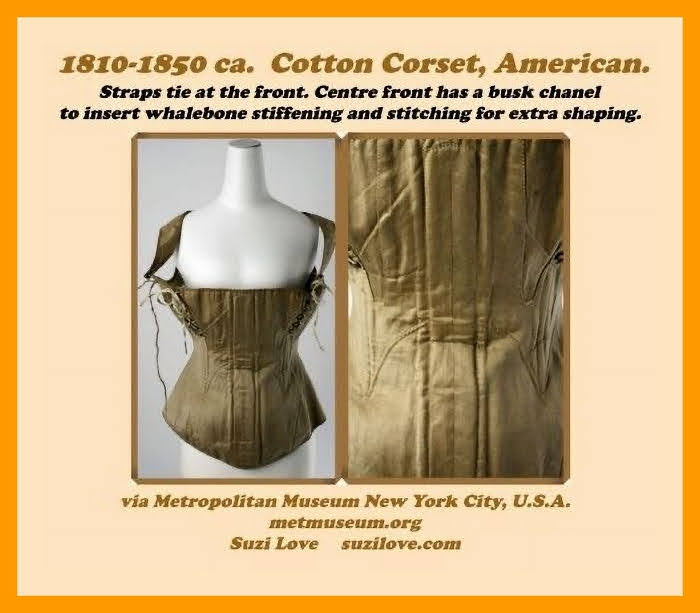
1810-1850 ca. Cotton Corset With Whalebone Busk, American. Straps tie at the front. Center front has a busk Chanel to insert a whalebone to keep the corset stiff and in place. There is extra stitching on the corset to give more shape and extra reinforcing to keep the corset upright and the dress worn over it smooth and flat. Marking stamped on the lining, ‘Jane Laney’ and Mrs. Bishop, Corset Maker, 108 Hudson St., New. York, USA. via Metropolitan Museum New York City, U.S.A. metmuseum.org
Surviving stays, or corsets as they became to be called in the nineteenth century, show that both longline and shorter corsets were worn and that they were made of cotton, silk and sateen. A lot of these corsets were front fastening, plus many were laced at both the front and the back so our aristocratic fictional heroines could indeed dress and undress themselves without the assistance of a maid.
Definition Busk: Central panel in a corset to give it extra shape. Made from wood, bone which was usually whalebone, ivory, and in the latter 1800s from metal.
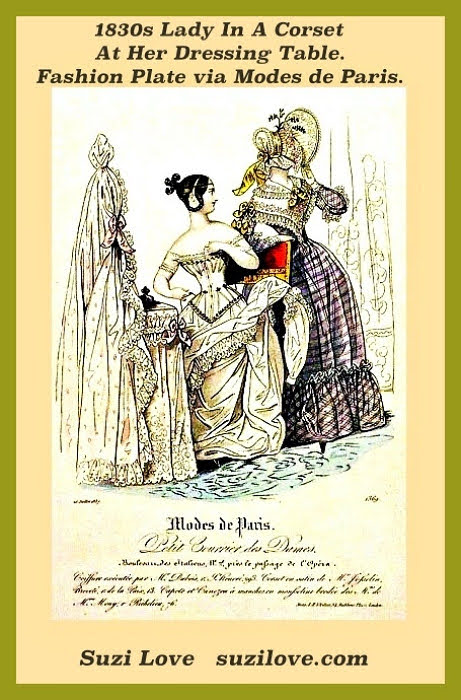
1830s Lady In A Corset At Her Dressing Table. Fashion Plate via Modes de Paris.
Romantic Era women’s corsets supported plus fitted well to give a fashionable silhouette. Becoming a fashion item, rather than simply hidden underclothing. https://books2read.com/SuziLoveCorsetBook18
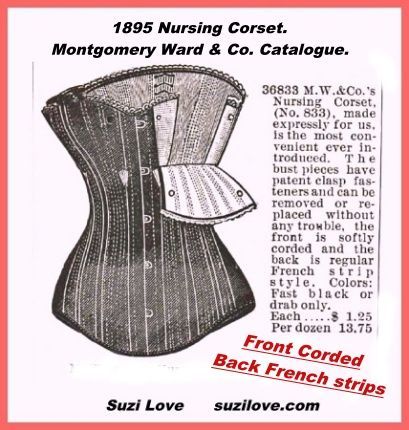
1895 Nursing Corset, French. via Montgomery Ward and co. Catalogue. Boned, soft and pliable busts, French sateen covered strips.
Definition Montgomery Ward: World first American mail order business and later a department store chain that operated between 1872 and 2001.
Corsets 1880-1900 History Notes Book 20 This book shows how a fashionable silhouette became of paramount importance and how a well-fitted corset became a fashion essential. As well as a decorative fashion item, tight lacing gave a narrow waist and the desired feminine form under clothing. https://books2read.com/SuziLoveCorsetBook20
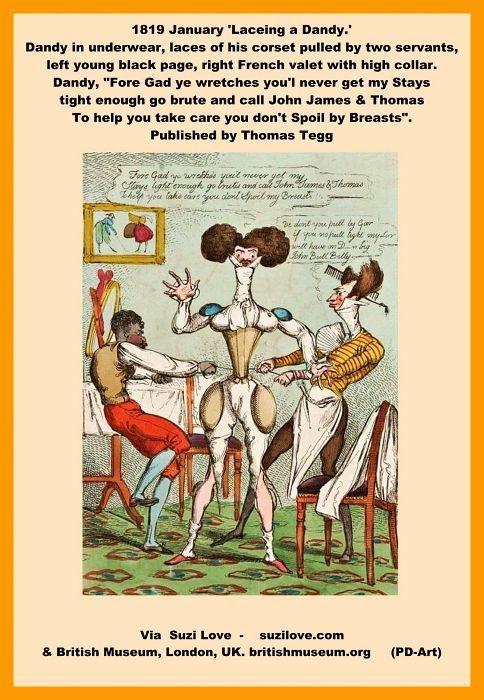
1819 January ‘Laceing a Dandy.’ Dandy in underwear, laces of his corset pulled by two servants, left young black page, right French valet with high collar. Dandy, “Fore Gad ye wretches you’ll never get my Stays tight enough go brute and call John James & Thomas, To help you take care you don’t Spoil by Breasts”. Published by: Thomas Tegg. Hand colored etching. Via British Museum, London, UK. britishmuseum.org (PD-Art)
1864 Silk corset, made to be worn over a chemise. Made in France or Britain. Aqua blue silk lined with linen, edged with machine-made lace, reinforced with whalebone, metal, lined with cotton twill. The front has fastenings and the back has lacings. The wearer of this corset could dress without help because the steel ‘split busk’ fastens in front. The front fastening was invented in 1829 but did not become common until the 1850s. The whalebones press into the waist to shape the hipline into an extravagant curve, to flatter and support the fashionable cage crinoline. In the 1860s women relied on voluminous skirts, in addition to corsets, to make their waists appear small.
Flossing, or embroidery, to stop bones poking through fabric, edged with machine-made lace, reinforced with whalebone, metal fasteners, V-shaped front for better fit & extra shaping. The front has fastenings and the back has lacings. There are fewer bones in the back of the corset than the front and none over the hips. Trimmed at the top edge with a narrow band of machine-made lace. Stiffened with whalebone and machine-stitched with an incised swivel latch to lock the busk fastening. Boned at the centre front, back and diagonally from the side to back and sides to front. The boning is hand-stitched into place. Metal eyelets. Lined with cotton twill. The corset reaches the top of the hips and is gored at the bust and hips.
During the 19th century, corsets were made from a variety of materials and shapes changed often. Sometimes breasts were pushed up and almost over the top and waists could be tiny and other curves were emphasized. By the end of the 19th century, corsets weren’t laced so tightly because wide crinolines created the illusion of tiny waists. There are fewer bones in the back of the corset than the front and none over the hips. From the late 1840s to the 1860s skirts were full and bell-shaped, at which point corsets were relatively short and not particularly tightly laced, since the massive skirts made all waists look proportionally small.
The corset was worn over the chemise and it moulded the figure of the wearer into the fashionable shape of the day. These shapes ranged from slender to curvaceous and everything in between during the 19th century. Like the chemise, the corset in the 19th century was made of a wider variety of materials, in this case blue silk lined with linen. It did not need to be very tightly laced, for the illusion of a small waist was created by the very wide circumference of the crinoline.
Credit : Given by the Burrows family. Museum number:T.169-1961. The donors of this corset linked it to a 1864 marriage in the family. Victoria and Albert Museum, London, U.K.