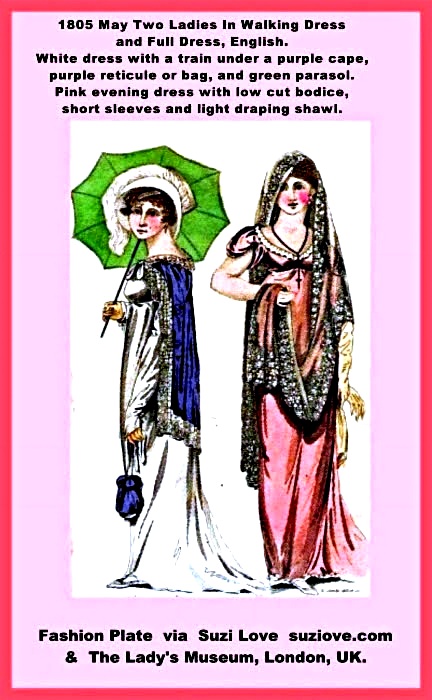
1805 May Two Ladies In Jane Austen Style Walking Dress and Full Dress, English. White dress with a train under a purple cape, purple reticule or bag, and green parasol. Pink evening full dress with low cut bodice, short sleeves and light draping shawl. via Vernon and Hood at The Lady’s Monthly Museum, London, U.K. Definition Reticule, or Ridicule, or Bag or Purse: Often with a drawstring to pull closed and usually made of cloth or covered cardboard and often decorated with beading or embroidery. A reticule, or purse, or handbag, was usually carried by a woman during the Regency period to carry all their daily necessities. Earlier, women used pockets that tied at the waistline and were hidden in the folds of their skirts. Empire style, or early 1800s, high-waisted dresses made it impossible to either sewn in a pocket or to tie on a pocket. So women began carrying small, decorated bags called Reticules, or ridicules, which generally pulled close at the top with a drawstring.
What was fashionable outdoor wear for the Bridgerton ladis, Jane Austen, and their contemporaries? Reticules, Spencers, and Pelisses, or Walking Dresses, Or Redingotes. History Notes Books 3, 4, and 5 By Suzi Love.
What was fashionable for purses in past centuries? Call them what you like: purses, bags, handbags, reticules, ridicules, clutches, or pocket replacements. They all did the same job and they changed greatly with the prevailing fashions of time. books2read.com/suziloveReticules
What was fashionable in women’s jackets in the Regency Era? Call them what you like: Spencers, short jackets, or Regency jackets. They provided modesty and warmth and they changed greatly with the prevailing fashions of the time. Take a look at the jackets being worn by women in the early 1800s. books2read.com/suziloveSpencers
What sort of coats did women wear during the Regency years? them what you like: Coat, Pelisse, Redingote, Walking Dress, Promenade Dress. Take a look at what was being worn by women, men, and children. books2read.com/suzilovePelisse
HN_4_Spencers, Or Jackets. #Regency #Georgian #Victorian #Fashion History Notes Book 4 By Suzi Love.
1810-1815 ca. Salmon Pink Empire Style Dress, Norway. Typical Regency high-waisted dress. Long sleeves with puckered sleeve cap. Deep neckline with short shirred bodice. Long full skirt. via Digital Museum, Norway. digitalmuseum.no Regency fashion at its prettiest. The style of Empire style, or high-waisted, dress worn by Jane Austen and her contemporaries and the ladies in the Bridgerton family.
The Empire waist gown defined women’s fashion during the Regency Era. ‘Empire’ is the name given in France to the period when Napoleon built his French Empire. High-waisted, loose gowns were adopted by the aristocracy as a symbol of turning away from the fussy, elaborate and expensive clothing worn in the 1700s. Jean-Jaques Rousseau advocated copying peasants and returning to a simpler life and more natural fashions. Unrestricting clothing was part of the new Democracy in France and these simpler and flowing fashions were adopted all over Europe, including Britain and despite the continual wars being fought against France during the early 1800s. Not even war stopped fashions from being copied everywhere.
This book looks at what was fashionable for women in Jane Austen’s or the Bridgerton family’s times, or the early 1800s, or the Regency Era in Britain. Wars were being fought around the globe so women’s fashion adopted a military look in support of soldiers. Fashions, like the lifestyle, became progressively more extravagant and accessories went from colorful to over-the-top.
1803 Jane Austen Style Dress Bodice and Five Trimmed Hats. Low cut bodice, puffed sleeves, scarf, four variations of trimmed hats. Fashion Plate via Journal des Dames et des Modes, or Costume Parisien. https://books2read.com/SuziLoveFashionWomen1801-1804
Hats: Early 1800s: Lightweight caps or muslin, linen, lace or net were worn as morning caps, night caps, or under other hats. Jane Austen and her family and female friends would have worn caps like these, sometimes during the morning at home, to bed to keep their long hair from becoming knotted, or under a bonnet to hold a hairstyle in place. But for outdoor ventures, hats were more substantial and for the evening a lot more individual and elaborate. The ties of a bonnet that were secured under the chin vary from the very simple to the quite fanciful.
1806 Two Ladies In White Walking Dresses, French. Puffed sleeves, extra long gloves, bonnets tied under chins and decorated with flowers, walking boots, green cashmere shawl. Fashion Plate via Journal des Dames et des Modes, or Costume Parisien. These fashionable ensembles with a variety of fashionable and practical accessories would have been worn by Jane Austen and her family and friends during the day when out walking in the park or visiting village shops. Hats were a necessity to protect fair skin from the sun and scarfs and shawls added color and warmth to an outfit.
Definition Empire Style Dress: Named after the First Empire in France. Empire dresses had a low neckline and skirts started directly under the bust and flowed into the classical relaxed wide styles of Greece and Rome. This style of dress is associated with Jane Austen and her contemporaries as a high-waisted dress was worn most days. Cotton, silk or taffeta were the popular fabrics. Only the very wealthy could afford white dress in this style as the cottons were imported from India and had to be carefully cleaned, usually by a lady’s maid.
1810 ca. Silk Dress, Probably French. High-waisted, or Empire line, dress with long straight sleeves, back opening, embroidery on neck frill and multiple rows of embroidery on the hem. via Metropolitan Museum New York City, U.S.A. ~ metmuseum.org
Definition Empire Style Dress: Named after the First Empire in France. Empire dresses had a low neckline and skirts started directly under the bust and flowed into the classical relaxed wide styles of Greece and Rome. This style of dress is associated with Jane Austen and her contemporaries as a high-waisted dress was worn most days. Cotton, silk or taffeta were the popular fabrics. Only the very wealthy could afford white dress in this style as the cottons were imported from India and had to be carefully cleaned, usually by a lady’s maid.
A portrait from 1810-1814 of Rudolph Ackermann, shop owner and founder of ‘The Repository Of Arts’ magazine, The Strand, London. via National Portrait Gallery, London. Plus, an image of Ackermann’s premises in 1809. His ‘Repository of Arts, Literature, Fashion, Manufactures, etc.’ was published from 1809 to 1829 with images of Regency London, Regency furnishings and grand homes as well as beautiful fashion prints and descriptions every month. Ackermann originally supplied artists, amateur and professional, with supplies for watercolor painting. In 1799, he began manufacturing and selling his own watercolor paint blocks which were supplied by other colourmen, although at least three colors were his own mixture – Ackermann’s Green, White and Yellow. From 1817, his eldest son Rudolph Ackermann junior was responsible for the watercolor manufacturing. Ackermann also trained as a carriage designer. He began publishing prints and colour-plate books like ‘The Microcosm of London’ and ‘Doctor Syntax’ in the early 1800s.
The Repository of Arts was one the most popular magazines in Jane Austen’s time as it displayed everything ladies wanted to learn e.g. history, important country seats and houses in England, music, current events such as theatre plays, plus fashion plates and embroidery patterns. Ackermann’s shop in The Strand, London, was one of the fashionable places to shop during the Regency Era. The Repository also included poetry, travel reports, society reports and upcoming lectures. It also included serious subjects e.g. politics, legal matters, medicine and agriculture, a meteorological journal and details of the London markets. In 1817, the price of the magazine was 4 Shillings, so quite expensive for the time.
In the first issue, published for January 1809, Ackermann included an ‘introduction to the history of the useful and polite arts’ which said: “It is universally admitted, that to cultivate a taste for the arts, and an acquaintance with the sciences, is a pleasure of the most refined nature; but to do this without regard to its influence upon the passions and affections, is to ‘tear a tree for its blossoms, which is capable of yielding the richest and most valuable fruit.’ The cultivation of this taste may and ought to be subservient to higher and more important purposes: it should dignify and exalt our affections, and elevate them to the admiration and love of that Being who is the author of every thing that is fair, sublime, and good in nature.”
1810-1814 Portrait of Rudolph Ackermann, shop owner and founder of The Repository Of Arts magazine. via National Portrait Gallery, London.
1809 January Ackermann’s Repository of Arts, 101 Strand, London, U.K. Drawn by Augustus Pugin and Thomas Rowlandson. Published By Rudolph Ackermann. Etching and aquatint with hand coloring.
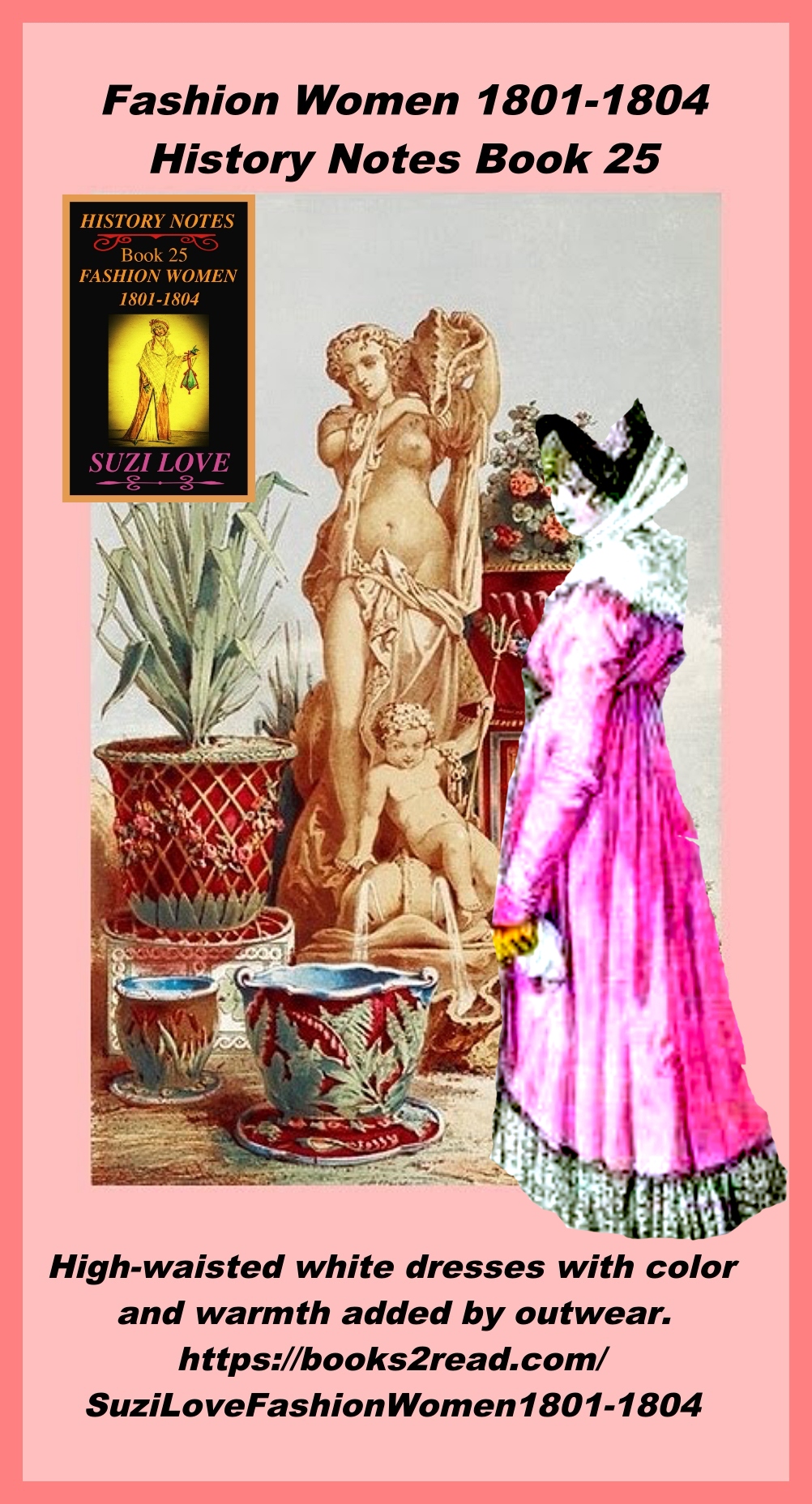
Fan of the Bridgerton Series? Jane Austen Lover? Writer Or Reader Of Regency Era? What did they wear in early 1800s? Women’s clothing changed dramatically in early 1800s. New silhouette copied simplistic styles of Greeks and Romans. High-waisted white dresses and flowing skirts with color and warmth added by outerwear and accessories. Fashion Women 1801-1804 History Notes Book 25 https://books2read.com/SuziLoveFashionWomen1801-1804
Definition Empire Style Dress: High-waisted white gowns defined women’s fashion during the Regency Era. ‘Empire’ is the name given to the period when Napoleon Bonaparte built his French Empire. High-waisted, loose gowns were adopted by the aristocracy as a symbol of turning away from the elaborate clothing worn in the 1700s. This sort of high-waisted dress would have been worn by Jane Austen and her contemporaries in England.
Definition Shawls: The shawl started off in India as a fine wool garment for men that could be worn as a scarf, turban or as a mantle: the word comes from the Persian shäl. Originally imported from the East, European Kashmir shawls were made first in Norwich and Edinburgh in Britain in the late 18th century. Shawls were an essential item in the early 1800s to cover the thin gowns women wore. They were made of muslin, gauze, silk, wool, and velvet, though cashmere shawls were the softest and most prized.
1820 ca. Silk Spencer, British. Made of silk and willow. Short length, long sleeves, extensive decoration on shoulders, sleeves and wrists. Military style braiding on the spencer in support of all the soldiers fighting wars across the world. The sort of jacket worn by fashionable Regency ladies over their light and flowing Empire dresses. Credit Line:Catharine Breyer Van Bomel Foundation Fund, 1987 via Metropolitan Museum New York City, U.S.A. metmuseum.org
Definition Spencer: Short jackets cut to match the high waistlines of Empire dresses. They often copied military styling, such as braiding, shoulder decoration, buttons and loop fasteners, and wrist adornments. They were generally of complex construction, often with a diamond shaped piece in the back. Said to have originated in an accident to Lord Spencer while hunting when his coat tails were torn off and he wore it as a short jacket.
1820 ca. Spencer, British. Silk and willow. Front View.1820 ca. Spencer, British. Silk and willow. Back View. 1820 ca. Spencer, British. Silk and willow. Sleeve View. 1820 ca. Spencer, British. Silk and willow. Sleeve Decoration View. 1820 ca. Spencer, British. Silk and willow. Braiding View. 1820 ca. Spencer, British. Silk and willow. Wrist View.
1820 ca. Military Style Silk Spencer With Braiding In the Style of the Bridgertons and Jane Austen. #Bridgerton #JaneAusten #RegencyFashion #BritishHistory books2read.com/suziloveSpencers
HN_4_Spencers, Or Jackets. #Regency #Georgian #Victorian #Fashion History Notes Book 4 By Suzi Love.