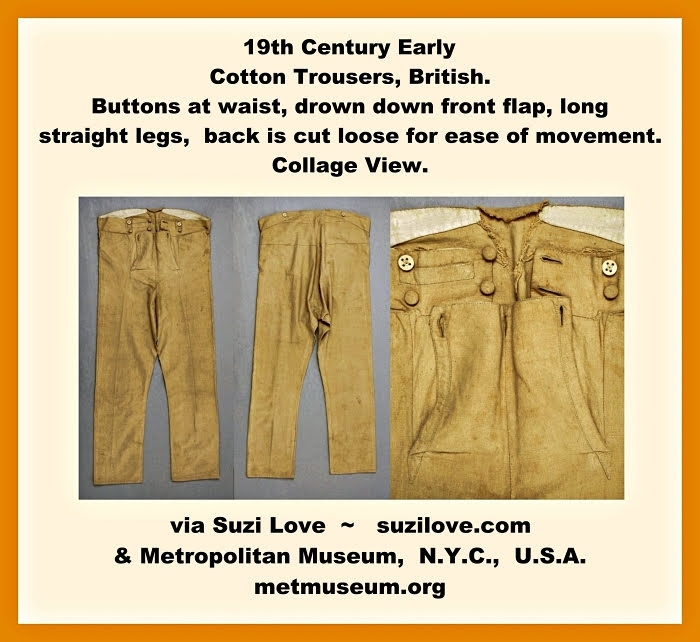
19th Century Early Cotton Trousers, British. Buttons at waist, drop down front flap with buttons and cut with excess material to allow easy movement. via Metropolitan Museum New York City, U.S.A. metmuseum.org.
Trousers: In the early 19th century, trousers were sewn with a flap in front called a fall front and was held in place by two or three buttons. Trousers were held up by tight-fitting waists which were adjusted by gusset ties in back of the waist. Seats were baggy to allow a man to rise comfortably from a sitting position.
Check out these beautiful words, and then watch for the next post on Ugly Words from Daily Writing Tips,
Indulge yourselves,
Suzi
One of the many fascinating features of our language is how often words with pleasant associations are also quite pleasing on the tongue and even to the eye, and how many words, by contrast, acoustically and visually corroborate their disagreeable nature — look no further than the heading for this post.
Enrich the poetry of your prose by applying words that provide precise connotation while also evoking emotional responses. (Note the proportion of beautiful words to ugly ones in the compilation below; it’s easier to conjure the former than the latter, though I omitted words associated with bodily functions, as well as onomatopoeic terms.)
Notice how often attractive words present themselves to define other beautiful ones, and note also how many of them are interrelated, and what kind of sensations, impressions, and emotions they have in common. Also, try enunciating beautiful words as if they were ugly, or vice versa. Are their sounds suggestive of their quality, or does their meaning wholly determine their effect on us?
Beautiful Words
Amorphous: indefinite, shapeless Beguile: deceive Caprice: impulse Cascade: steep waterfall Cashmere: fine, delicate wool Chrysalis: protective covering Cinnamon: an aromatic spice; its soft brown color Coalesce: unite, or fuse Crepuscular: dim, or twilit Crystalline: clear, or sparkling Desultory: half-hearted, meandering Diaphanous: gauzy Dulcet: sweet Ebullient: enthusiastic Effervescent: bubbly Elision: omission Enchanted: charmed Encompass: surround Enrapture: delighted Ephemeral: fleeting Epiphany: revelation Epitome: embodiment of the ideal Ethereal: celestial, unworldly, immaterial Etiquette: proper conduct Evanescent: fleeting Evocative: suggestive Exuberant: abundant, unrestrained, outsize Felicity: happiness, pleasantness Filament: thread, strand Halcyon: care-free Idyllic: contentedly pleasing Incorporeal: without form Incandescent: glowing, radiant, brilliant, zealous Ineffable: indescribable, unspeakable Inexorable: relentless Insouciance: nonchalance Iridescent: luster Languid: slow, listless Lassitude: fatigue Lilt: cheerful or buoyant song or movement Lithe: flexible, graceful Lullaby: soothing song Luminescence: dim chemical or organic light Mellifluous: smooth, sweet Mist: cloudy moisture, or similar literal or virtual obstacle Murmur: soothing sound Myriad: great number Nebulous: indistinct Opulent: ostentatious Penumbra: shade, shroud, fringe Plethora: abundance Quiescent: peaceful Quintessential: most purely representative or typical Radiant: glowing Redolent: aromatic, evocative Resonant: echoing, evocative Resplendent: shining Rhapsodic: intensely emotional Sapphire: rich, deep bluish purple Scintilla: trace Serendipitous: chance Serene: peaceful Somnolent: drowsy, sleep inducing Sonorous: loud, impressive, imposing Spherical: ball-like, globular Sublime: exalted, transcendent Succulent: juicy, tasty, rich Suffuse: flushed, full Susurration: whispering Symphony: harmonious assemblage Talisman: charm, magical device Tessellated: checkered in pattern Tranquility: peacefulness Vestige: trace Zenith: highest point
Many of today’s wedding customs originate from olden day rituals.
The best man – He was chosen for being the strongest and bravest man who accompanied and protected the groom when he rode off to capture a bride.
The bride on the left side – This was so that the groom’s right hand was always free to draw his sword if they were attacked during the ceremony by jealous rivals.
The bride’s veil – These days it is only a flimsy piece of lace, but it used to be a large sheet used to wrap over the bride when she was captured and carried away by a groom. Smaller veils then became a symbol of hidden precious goods, and a symbol of complete submission to a husband.
Orange blossoms – White ones worn as a sign of virginity, but as few trees bear greater crops, orange blossoms were also worn as a prayer for the bride to bear fruit in a prolific manner like the tree.
Tying the knot – The wrists of a couple are bound together with a strip of leather or ribbon in handfasting. When their wrists were bound with an infinity knot, the couple recited their vows and the celebration commenced.
1808 Lady In A Dancing Dress, French. Dress of Tulle Broderie, short puffed sleeves, floral embroidery, dancing slippers and upswept hairstyle. Fashion Plate via Journal des Dames et des Modes, Costume Parisien. When attending assemblies or balls, ladies in Jane Austen’s times women wore Empire style dresses which were usually made of light fabric and floaty in style and often of a shorter length suitable for dancing.
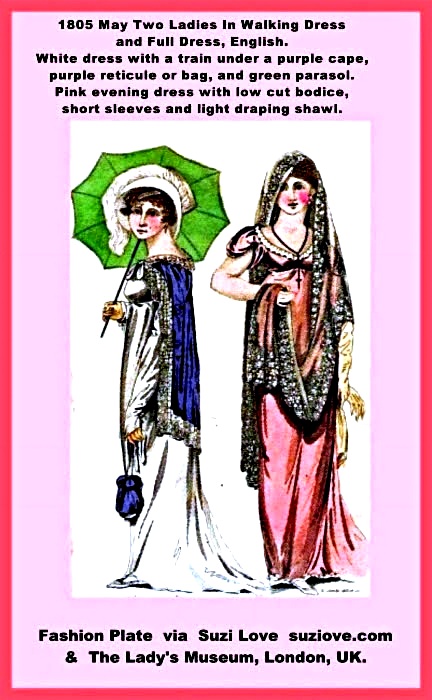
1805 May Two Ladies In Jane Austen Style Walking Dress and Full Dress, English. White dress with a train under a purple cape, purple reticule or bag, and green parasol. Pink evening full dress with low cut bodice, short sleeves and light draping shawl. via Vernon and Hood at The Lady’s Monthly Museum, London, U.K. Definition Reticule, or Ridicule, or Bag or Purse: Often with a drawstring to pull closed and usually made of cloth or covered cardboard and often decorated with beading or embroidery. A reticule, or purse, or handbag, was usually carried by a woman during the Regency period to carry all their daily necessities. Earlier, women used pockets that tied at the waistline and were hidden in the folds of their skirts. Empire style, or early 1800s, high-waisted dresses made it impossible to either sewn in a pocket or to tie on a pocket. So women began carrying small, decorated bags called Reticules, or ridicules, which generally pulled close at the top with a drawstring.
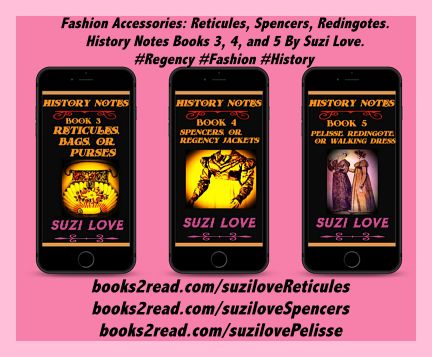
What was fashionable outdoor wear for the Bridgerton ladis, Jane Austen, and their contemporaries? Reticules, Spencers, and Pelisses, or Walking Dresses, Or Redingotes. History Notes Books 3, 4, and 5 By Suzi Love.
What was fashionable for purses in past centuries? Call them what you like: purses, bags, handbags, reticules, ridicules, clutches, or pocket replacements. They all did the same job and they changed greatly with the prevailing fashions of time. books2read.com/suziloveReticules
What was fashionable in women’s jackets in the Regency Era? Call them what you like: Spencers, short jackets, or Regency jackets. They provided modesty and warmth and they changed greatly with the prevailing fashions of the time. Take a look at the jackets being worn by women in the early 1800s. books2read.com/suziloveSpencers
What sort of coats did women wear during the Regency years? them what you like: Coat, Pelisse, Redingote, Walking Dress, Promenade Dress. Take a look at what was being worn by women, men, and children. books2read.com/suzilovePelisse
HN_4_Spencers, Or Jackets. #Regency #Georgian #Victorian #Fashion History Notes Book 4 By Suzi Love.
1780-1789 Linen Stays Or Corset, Great Britain. Stays, 1780-1789 (made). Linen, lined with linen and reinforced with whalebone, trimmed with pale blue silk ribbon. Hand sewn with linen thread, applied ribbon, chamois and whalebone.
Stays were an essential item of underwear for women during the 18th century. By the 1780s, the fashionable torso consisted of an inverted cone shape. Achieving smoothness of profile and firmness of contour were the primary function of 18th-century stays, rather than emphasising the bust or constricting the waist. Although custom-made and very intricately designed, stays were usually very plain. In this example a narrow blue ribbon covering the seams is the only decoration.
The narrow rows of very fine, even hand-stitching form the compartments into which thin strips of whalebone were inserted. Although the stays appear very rigid, whalebone was quite flexible. It had the added advantage of softening with the heat of the wearer’s body, allowing the stays to mould to her shape. When worn, the shaped and boned tabs at the lower edge would splay over the wearer’s hips, giving further fullness to the petticoat tied at the waist over the stays. Given by Mrs Strachan. Museum Number T.172-1914. Victoria and Albert Museum, London, U.K.
1813 October White Empire style, or high-waisted, Carriage Dress, English. Brown shawl, brown boots, and a lace cap tied under the chin. Typical of the carriage fashions that would have been worn by Jane Austen and her contemporaries. Fashion Plate via The Lady’s Magazine Or Entertaining Companion for the Fair Sex.
Definition Empire Style Dress: High-waisted white gown defined women’s fashion during the Regency Era. ‘Empire’ is the name given to the period when Napoleon Bonaparte built his French Empire. High-waisted, loose gowns were adopted by the aristocracy as a symbol of turning away from the fussy, elaborate and expensive clothing worn in the 1700s. https://books2read.com/SuziLoveFashion1810-1814
Michael Brandon travels to introduce the woman he loves to family but is shocked when his missing brother arrives. Four years ago, Melissa called herself a widow to protect her daughter. When her past lover returns from the dead, she’s forced to reveals the truth to him, and to her new love. Will the brothers forgive her deceit? https://books2read.com/suziloveDS
Keep Calm and Read my Scandalous Siblings Series Books 1-3. The scientifically gifted Jamison siblings beg assistance from the St. Martin clan to battle a greedy railway investment syndicate. https://books2read.com/suziloveES
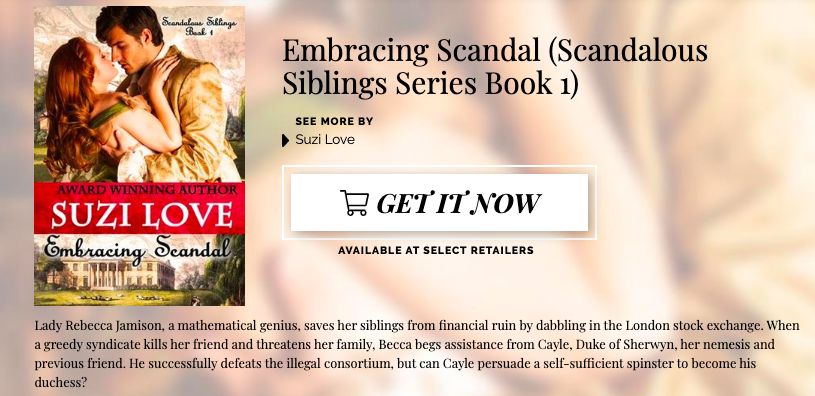
Embracing Scandal By Suzi Love Book 1 Scandalous Siblings. Lady Rebecca Jamison saves her family from financial ruin by investing in railways, but when a greedy syndicate murders her friend, Becca is forced to beg assistance from Cayle St. Martin, the new Duke of Sherwyn. https://books2read.com/suziloveES
Scenting Scandal Book 2 Scandalous Siblings Series. Lady Laura Jamison uses her extraordinary olfactory senses to sniff out her perfect match, but after she evades an assassin’s bullets, twice, she is forced to accept the protection of their family friend, and her nemesis, Richard St. Martin, the Earl of Winchester. https://books2read.com/suziloveSS
The Jamisons join the St. Martins at the duke’s country estate but a December snowstorm doubles guest numbers. #Holidays #FamilySaga #HistoricalRomance https://books2read.com/suziloveDS
ES_ Embracing Scandal Book 1 Scandalous Siblings Series D2D_ES_ https://books2read.com/suziloveES