1810 “A Bonnet Shop” By Thomas Rowlandson.A shopkeeper with a hat in each hand converses with an elderly woman wearing a similar hat. A child holding a rattle looks up at them at left, a plump woman wearing a bonnet sits at center, and a group of young women make bonnets in the background. Many groups of hats hang overhead in the shop. Via British Museum, London, UK. britishmuseum.org (PD-Art)
1815 Blue Dress Bodice, French. Layers of frills on dress back. Hairstyle and Various Bonnets as Jane Austen would have worn. Fashion Plate via Journal des Dames et des Modes, or Costume Parisien.
1811 Green Dress French. High waist with bow under the bust, Mamaluke sleeves as “a long full sleeve partitioned into five sections, each section being drawn and seamed to fit around the arm up sleeves, white collar lining, fashionable blue bonnet tied under the chin and wearing yellow shoes. The sort of fashionable outfit worn by women in Jane Austen’s times, or 1800s, or Regency Era. Fashion Plate via Journal des Dames et des Modes, or Costume Parisien.
Mamaluke Sleeves: Long full sleeves partitioned into five sections, each section being drawn and seamed to fit around the arm up.
1790-1800 ca. Men’s Riding Boots. Black leather with wide tan leather tops, small heel and slightly rounded toes. via Los Angeles County Museum of Art, California, USA. collections.lacma.org
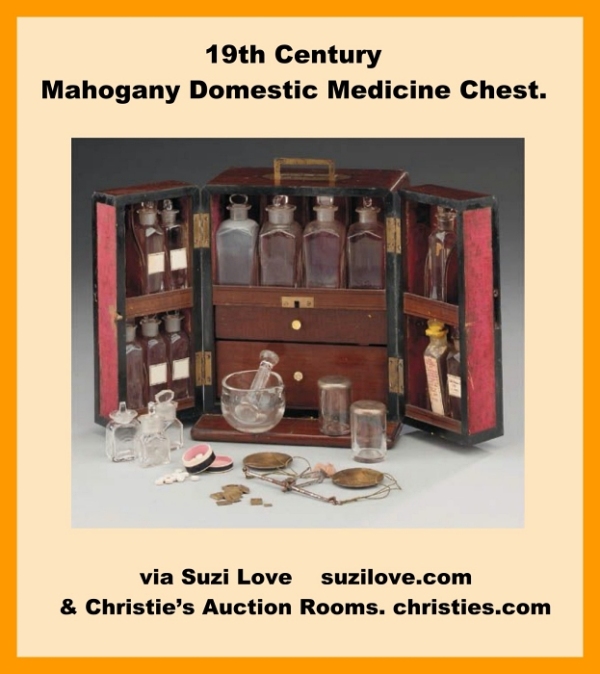
19th Century Mahogany Domestic Medicine Chest as would have been used in Regency England in the lifetime of Jane Austen and the Bridgerton family. via Christie’s Auction Rooms. christies.com
1840s Woman’s Shoes or Slippers, Probably United States. Square toes, silk satin, sueded leather, linen, and kid leather. via Los Angeles County Museum of Art, California, USA. collections.lacma.org Shoes in the early 1800s were flat or low heeled and occasionally decorated with a bow or floral embellishments. From the 1820s onwards, square toes became fashionable.
1820 ca. Blue Beaded Purse, French. Blue and cream beadwork, silver plated frame. via Ruby Lane Antiques rubylane.com
Definition Reticule: Bag or purse, often with a drawstring to pull closed and usually made of cloth or covered cardboard and often decorated with beading or embroidery. A reticule, or purse, or handbag, was usually carried by a woman during the Regency period to carry all their daily necessities. Earlier, women used pockets that tied at the waistline and were hidden in the folds of their skirts. Empire style, or early 1800s, high-waisted dresses made it impossible to either sewn in a pocket or to tie on a pocket. So women began carrying small, decorated bags called Reticules, or ridicules, which generally pulled close at the top with a drawstring. http://books2read.com/suziloveReticules
In the early nineteenth century, reticules started to look like future handbags as they were often made from rigid card or molded mâché or card into a variety of shapes. Early bags were circular and with a drawstring but as women wanted their reticules to look individual they could be made with two halves and a hinged metal closure or with concertina sides. Materials varied from silk, cotton and string and shapes were round, hexagonal or lozenge shapes with shell shaped bags becoming very popular during the Regency and Romantic Eras.
1800s magazines were written for well-bred women who could read, so they gave plenty of ideas for how ladies could make and embellish reticules for their own use and as pretty gifts. Needlework was highly encouraged as a pastime for a lady so bags were frequently embroidered or decorated with beading. By the 1820s, reticules became more like our modern handbags using soft leather gathered at the top or hard leather with a rigid fastener and metal chain for carrying.
1801 Dress With Train, French. English style coat and Polonaise hat to match dress. Fashion Plate via Journal des Dames et des Modes, or Costume Parisien.
19th Century Early Women’s Cotton Caps. Worn as morning caps, night caps, or under other hats. With lappets, hanging ties, or tails, which were also called ‘follow me lads’, or ‘flirtation ribbons’. via Museum of Fine Arts, Boston, U.S.A. mfa.org. via Museum of Fine Arts, Boston, U.S.A. mfa.org
Definition Caps: Worn as morning caps, night caps, or under other hats. Jane Austen and her family and female friends would have worn caps like these, sometimes during the morning at home, to bed to keep their long hair from becoming knotted, or under a bonnet to hold a hairstyle in place. Caps sometimes had hanging ties, or tails, were also called ‘follow me lads’, or ‘flirtation ribbons’.
Definition Lappets: Two long strips of material, often lace, hanging from top of head down back or over shoulders. Sometimes extensions of a headdress and a requirement for court dress.