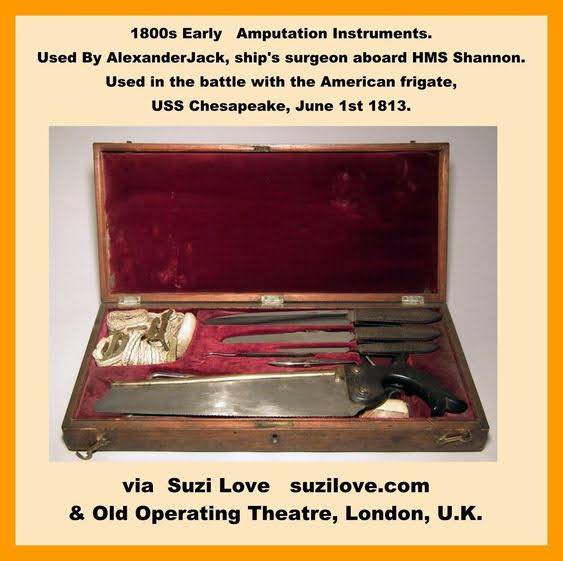
1800s Early Amputation Instruments used by Alexander Jack in Jane Austen’s times. Jack was a ship’s surgeon aboard H.M.S. Shannon and used by him in the battle between the Shannon & the American frigate the USS Chesapeake on June 1st, 1813, during the War of 1812. via Old Operating Theatre, London.
Jane Austen’s brother, Francis William Austen, was appointed Admiral of the Fleet in the British Royal Navy on 27 April, 1863. He had been a Royal Navy Captain from 1799 to 1830, age 25 to 56, Rear Admiral in 1838, age 64, Full Admiral in 1848, age 74. This is the type of medical instruments found on all of his ships.
In Jane Austen’s time, amputations were carried out frequently to prevent infections that could kill.
1817 November Cambric Muslin Walking Dress, English. As would have been worn by Jane Austen and her female contemporaries when out walking. Row of pointed work forms a narrow pelerine, high on the bosom, and ends in a point in front. The skirt has a deep muslin flounce beneath a row of soft muslin bouffone. Brown Spencer of gros de Naples has figured buttons which are intermixed with an elegant trimming. Sleeves ends are like the hem with a double row of buttons and trimming. The newly fashionable epaulette is edged and finished with buttons on the shoulder. Autumnal bonnet has a large front, low crown, and ties under the chin with a large bow. Swansdown muff, lilac sandals and pale lemon kid gloves finish the ensemble. ‘We have been favored this month with both our dresses by a lady, one of our subscribers, who purchased them, we understand, at Mrs. Bell’s in St. James’s Street.’ Fashion Plate via Rudolph Ackermann’s ‘The Repository of Arts’.
Definition Empire Style Dress: Named after the First Empire in France. Empire dresses had a low neckline and skirts started directly under the bust and flowed into the classical relaxed wide styles of Greece and Rome. This style of dress is associated with Jane Austen and her contemporaries as a high-waisted dress was worn most days. Cotton, silk or taffeta were the popular fabrics. Only the very wealthy could afford white dress in this style as the cottons were imported from India and had to be carefully cleaned, usually by a lady’s maid.
Definition Spencer: Short jacket, cropped at the waist, worn over a dress, or gown. These close-fitting, tight sleeved, waist length jackets were modeled on a gentleman’s riding coat, but without tails. Delicate and regency dresses provided so little protection from the cold, so over garments were essential for warmth, modesty and good health.
Fashion Women 1815-1819 History Notes Book 28 https://books2read.com/SuziLoveFashionWomen1815-1819
Fashion Women 1800 By Suzi Love History Notes Book 12 #Regency #Fashion Love gorgeous historical women’s fashions? Take a look at what women wore and carried in 1800 in Europe and around the world. books2read.com/SuziLoveFashionWomen1800
Women’s dress changed dramatically after 1785. The rich fabrics and complicated, formal shapes of the late 18th century gave way to simple, light fabrics that draped easily. These new gowns achieved something of the effect of the simple tunics shown on classical Greek and Roman statues and vases. Inspired in part by the statuary of ancient Greece and Rome, the new fashion was epitomised by light cotton gowns falling around the body in an unstructured way, held around the high waist with a simple sash and accompanied by a soft shawl draped around exposed shoulders. This style was ideal for the Indian imports like Kashmiri shawls and Bengali muslin, as used in this embroidered gown. Championed by such influential figures as Emma Hamilton in England and Madame Récamier in France, the so-called ‘Empire’ style catapulted Indian muslin into the forefront of fashion.
Empire Dress: Owes its name, physical emancipation, popularity, and even its sexiness to France. In this English example, French style is slavishly followed in the gown’s high waist and modish stripes.
Empire style, or early 1800s, high-waisted dresses made it impossible to either sewn in a pocket or to tie on a pocket. So women began carrying small, decorated bags called Reticules, or ridicules, which generally pulled close at the top with a drawstring.
Inspired in part by the statuary of ancient Greece and Rome, the new fashion was epitomised by light cotton gowns falling around the body in an unstructured way, held around the high waist with a simple sash and accompanied by a soft shawl draped around exposed shoulders. This style was ideal for the Indian imports like Kashmiri shawls and Bengali muslin, as used in this embroidered gown. Championed by such influential figures as Emma Hamilton in England and Madame Récamier in France, the so-called ‘Empire’ style catapulted Indian muslin into the forefront of fashion.
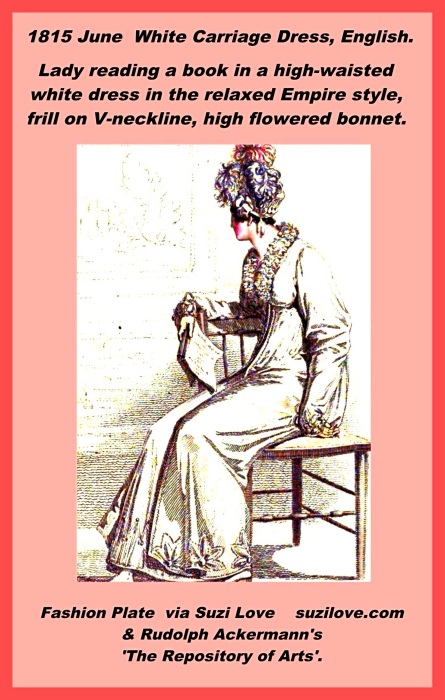
1815 June White Carriage Dress, English. Lady reading a book in a high-waisted white satin Pelisse, or Walking Or Carriage dress in the relaxed Empire style as would have been worn at home in the early 1800s, or during Jane Austen’s time. Richly ornamented with clusters of leaves made in white twilled sarsnet, headed with tull. Open fronts, trimmed to the bottom of the waist with a superb shell trimming of white satin ribbon and tull, loose sleeves trimmed at the wrists. High hat of white satin and tull with a plume of feathers of the pomona green. Half-boots of similar color. Gloves en suite and a necklace. Lady is viewing paintings and the program in her hand says ‘British Institution’. In this issue of The Repository there is an article called ‘Exhibition of Paintings by the Flemish and Dutch Masters at the British Institution, Pall Mall.’ Fashion Plate via Rudolph Ackermann’s ‘The Repository of Arts’.
Fashion Women 1815-1819 History Notes Book 28 https://books2read.com/SuziLoveFashionWomen1815-1819
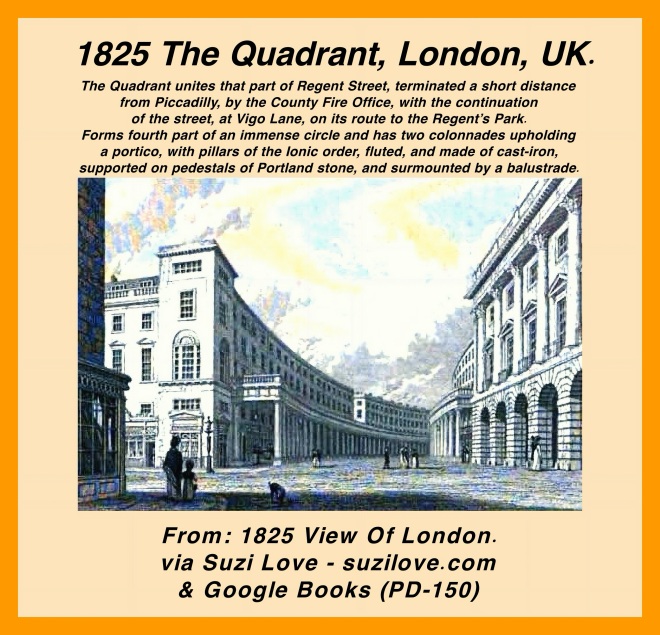
The Quadrant, London, UK. From 1825 Views Of London.
1825 The Quadrant From Views of London via Google Books.
The Quadrant unites that part of Regent Street, terminated a short distance from Piccadilly, by the County Fire-Office, with the continuation of the same street, at Vigo Lane, on it route to the Regent’s Park. As the name imports, it forms the fourth part of an immense circle, and consists of two magnificent colonnades upholding spacious porticos, and attached to two curvilinear ranges of buildings.
The pillars composing the colonnades are of the Ionic order, fluted, and are made of cast-iron. They are supported on pedestals of Portland stone, and surmounted by an appropriate entablature, balustrade, &c. of the same. For elegance of design, and grandeur of effect, the Quadrant may vie with the most celebrated erections of a similar description which have done honour to any period or country. It is well calculated to raise the pride of Englishmen, and excite the admiration of strangers; nor are there many objects in London capable of conveying a higher or juster idea of the architectural taste of the present.
Description The Quadrant: One of the most impressive features of the ‘Royal Mile’ to link Carlton House with Regent’s Park. With the famous curved buildings in Regent Street in central London, it was designed by architect John Nash between 1818 and 1820 to connect lower Regent Street toward Piccadilly Circus. Quadrant Arcade is Regent Street’s only shopping arcade, plus a pedestrian retail passage connecting Regent Street to Glasshouse Street near Piccadilly Circus.
Definition Shawls: The shawl started off in India as a fine wool garment for men that could be worn as a scarf, turban or as a mantle: the word comes from the Persian shäl. Originally imported from the East, European Kashmir shawls were made first in Norwich and Edinburgh in Britain in the late 18th century. Shawls were an essential item in the early 1800s to cover the thin gowns women wore. They were made of muslin, gauze, silk, wool, and velvet, though cashmere shawls were the softest and most prized.
1809 Women’s Fashions: Dresses, Shawls, Hats and Jewelry from various fashion magazines. Typical of the outfits worn by Jane Austen and her contemporaries for daytime and evening activities. An Empire style, or high-waisted white cotton dress worn under a Spencer or short jacket, a Redingote, or coat, for warmth and with pretty hats, shawls and shoes.
History Notes Book 26. Fashion Women 1805-1809 This book looks at early 1800s fashions, which were elegant and pretty with high waists and fabrics that were almost transparent. These Empire style gown named after Napoleon’s first Empress, became popular throughout Europe, and were then copied around the world. Colorful outwear was added to make an ensemble more attractive and warmer. https://books2read.com/SuziLoveFashionWomen1805-1809
Definition Empire Style Dress: Named after the First Empire in France. Empire dresses had a low neckline and skirts started directly under the bust and flowed into the classical relaxed wide styles of Greece and Rome. This style of dress is associated with Jane Austen and her contemporaries as a high-waisted dress was worn most days. Cotton, silk or taffeta were the popular fabrics. Only the very wealthy could afford white dress in this style as the cottons were imported from India and had to be carefully cleaned, usually by a lady’s maid.
Definition Reticule Or Ridicule Or Bag or Purse or Handbag: Often with a drawstring to pull closed and usually made of cloth or covered cardboard and often decorated with beading or embroidery. A reticule, or purse, or handbag, was usually carried by a woman during the Regency period to carry all their daily necessities. Earlier, women used pockets that tied at the waistline and were hidden in the folds of their skirts. Empire style, or early 1800s, high-waisted dresses made it impossible to either sewn in a pocket or to tie on a pocket. So women began carrying small, decorated bags called Reticules, or ridicules, which generally pulled close at the top with a drawstring.
1809 Red Coral Necklace. S1809 White Dress with a Fichu1809 White Dress, French. 1809 White Dress, French. 1809 March. Walking Dress, English. Fashion Women 1805-1809 History Notes Book 26 What did Jane Austen and friends wear? https://books2read.com/SuziLoveFashionWomen1805-1809
1807 Healthful Dipping. Lady in her white linen chemise, or shift, preparing to take a dip in the spa waters. Scenes of Spa life. By F. Eginton, New Bath Guide. ‘How the ladies did giggle and set up their clacks, All the while an old lady was rubbing their backs.’ From Anstey’s ‘The New Bath Guide’. In Jane Austen’s novels, the resorts of Brighton, Scarborough, Cromer, Lyme and the fictional Sandy ton or Sanditon all get mentions. Women bathed in the sea, via bathing machines pulled down to the water’s edge, or promenaded along beautiful walkways, such as in Cheltenham, near Bat in Britain. Visiting seaside resorts became very popular during the Regency years. Le Beau Monde, or fashionable society, went to spa and beach towns to ‘take the waters’ or to holiday in a fashionable town. To see and be seen. Ladies dressed in light muslin gowns but added colorful accessories to make outfits more interesting.
Chemise Or Shift: Sleeveless, mid-calf length garment of white cotton or muslin was worn next to the skin under stays or corset. Called ‘Shift’ from early Georgian (1700-1750) until Late Georgian (1750-1790) to replace ‘Smock’. By 1800, name replaced by ‘Chemise’.
1807 Healthful Dipping.
Lady in her white linen chemise, or shift, preparing to take a dip in the spa waters.
Scenes of Spa life. By F. Eginton.
New Bath Guide.
How the ladies did giggle and set up their clacks, All the while an old lady was rubbing their backs.
From Anstey’s ‘The New Bath Guide’.
Suzi Love – suzilove.com Fashion Women 1805-1809 History Notes Book 26 What did Jane Austen and friends wear? https://books2read.com/SuziLoveFashionWomen1805-1809
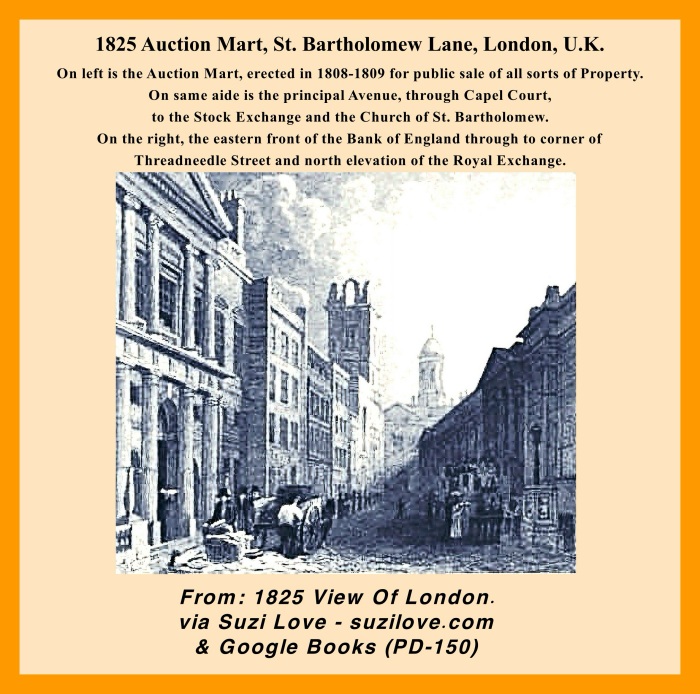
1825 Auction Mart, From Views of London. via Google Books.
The View from the end of St. Bartholomew Lane (at the union of Lothbury and Throgmorton Street), to the entrance into the Royal Exchange at the opposite extremity, has many attractions. Immediately on the left is the Auction Mart, a building which possesses considerable architectural pretensions. It was erected in the year 1808-9, for the public sale of all sorts of Property, and has since had a literary Institution engrafted un the original Establishment.
At some distance, on the same aide, is the principal Avenue, through Capel Court, to the Stock Exchange; and still further, the Church of St. Bartholomew, built in the year 1670. On the right, the eastern front of the Bank of England, which has been lately repaired and much improved, occupies the entire space to the corner of Threadneedle Street: the entrance to the Rotunda. where stockjobbers, &c. carry on their dealings in British Securities, being about the centre of the range, and nearly opposite the Stock Exchange. The View is terminated by a portion of the north elevation of the Royal Exchange, over which the new Tower and Cupola, surmounting the south front of the same Building, and finished in 1824, is conspicuous.
What a scene of even species of Traffic—of the exchange of every denomination of Commodity, and every representative of Wealth—beneath a single glance of eye! Under certain effects and aspects the pictorial correspond in interest and grandeur with the other impressive features of this View.
Regency Life Series Book 2 Young Gentleman’s Day. This book depicts the ups and downs of a young gentleman’s day in the early 1800’s. Through historic images, historical information, and funny anecdotes, it shows how he fills his day, where he goes, and who he spends time with. These light-hearted looks at the longer Regency years are an easy to read overview of what people did and wore, and where they worked and played. There is plenty of information to interest history buffs, and lots of pictures to help readers and writers of historical fiction visualize the people and places from the last years of the 18th Century until Queen Victoria took the throne.
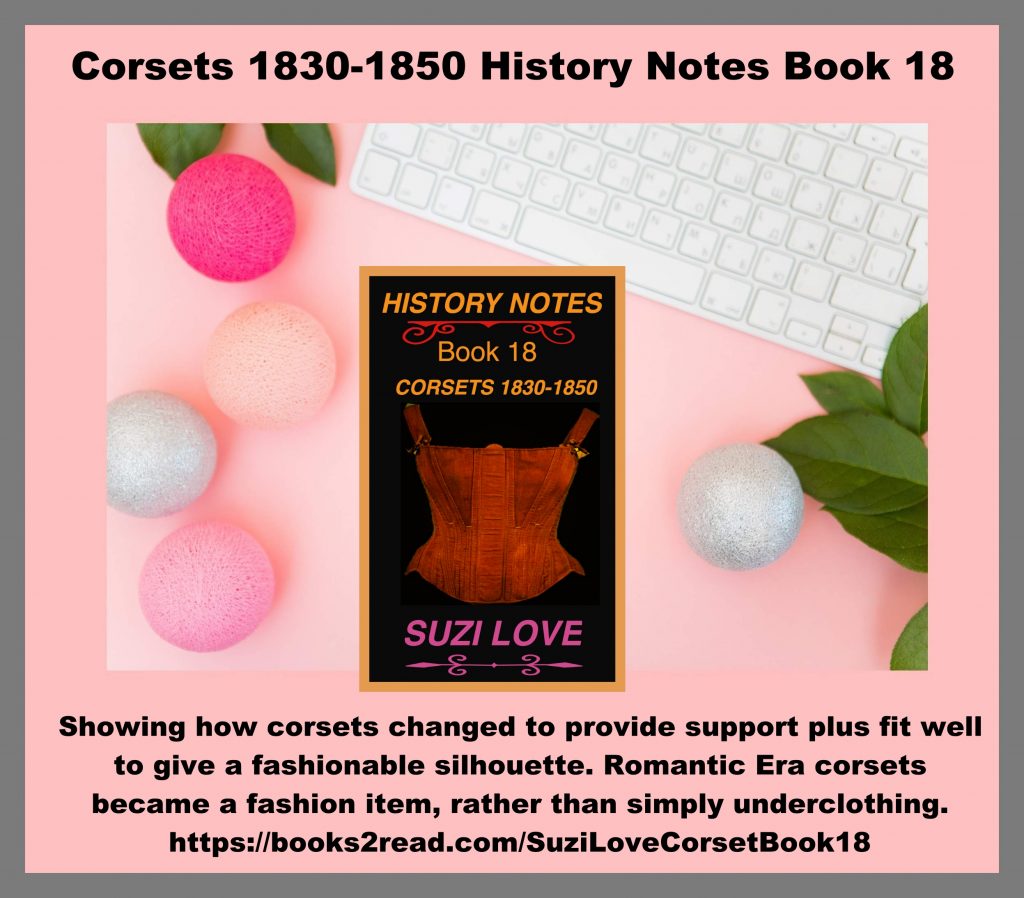
Corsets 1830-1850 History Notes Book 18 This book shows how corsets changed to both provide support and also fit well under clothing to give a fashionable silhouette. Corsets started being a fashion item, rather than simply underclothing to be hidden. Romantic Era women’s fashionable corsets. Corsets worn from 1830-1850, or the Romantic Era of fashion.
Information or drawings on corsets through both the Regency and Romantic Eras is difficult as underwear wasn’t shown in British publications for modesty sake, and only occasionally seen in French magazines. Therefore, most of our knowledge about corsets from the Regency and Romantic Eras is through actual garments, especially those donated to museums. Surviving corsets show that shorter corsets weren’t as common and corsets were generally of a longer length. Many of these corsets were still front fastening, plus many were laced at both the front and the back so our aristocratic fictional heroines could indeed dress and undress themselves without the assistance of a maid.
Corset makers became more skilled and cut garments much better, so the body was controlled and shaped by the cut and grain of the fabric. They developed long corded corsets to suit the classical gowns of the period. A wooden busk was created to help keep the undergarment garment lay flat and to lift and separate the breasts. Busks stopped women from bending at the waist, which encouraged good posture.