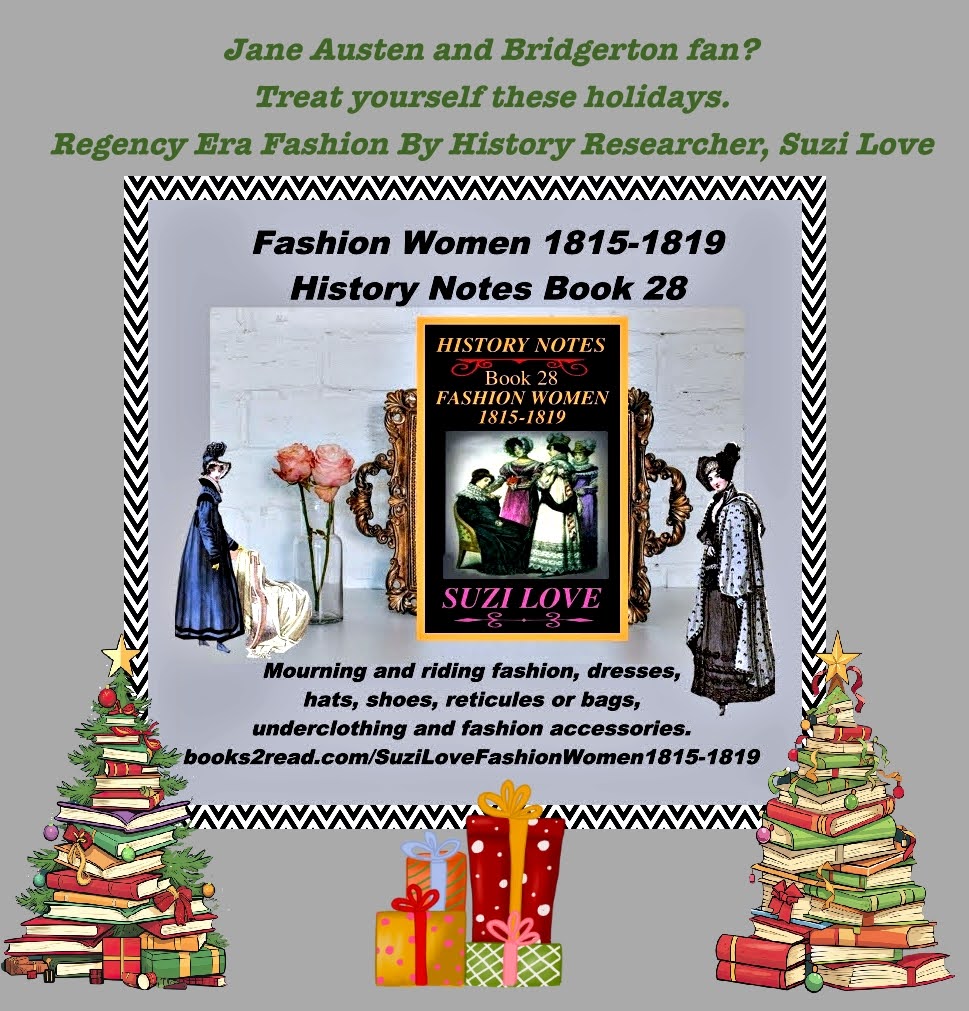
Love the Bridgerton family and Jane Austen? Reader Or Writer of Regency Era stories? Mourning and riding fashion, dresses, hats, shoes, reticules or bags, underclothing and fashion accessories. books2read.com/SuziLoveFashionWomen1815-1819
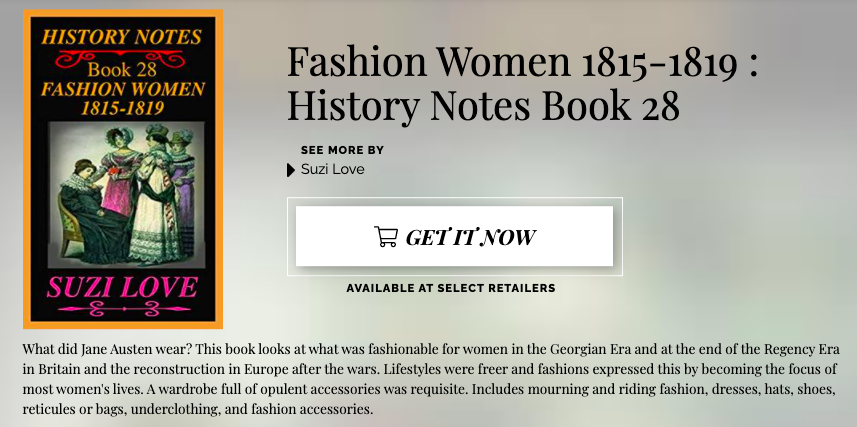
History Notes 28 Fashion Women 1815-1819: This book looks at what was fashionable for women in the Georgian Era and at the end of the Regency Era in Britain and the reconstruction in Europe after the wars. Lifestyles were freer and fashions expressed this by becoming the focus of most women’s lives. A wardrobe full of opulent accessories was requisite. Includes mourning and riding fashion, dresses, hats, shoes, reticules or bags, underclothing, and fashion accessories.
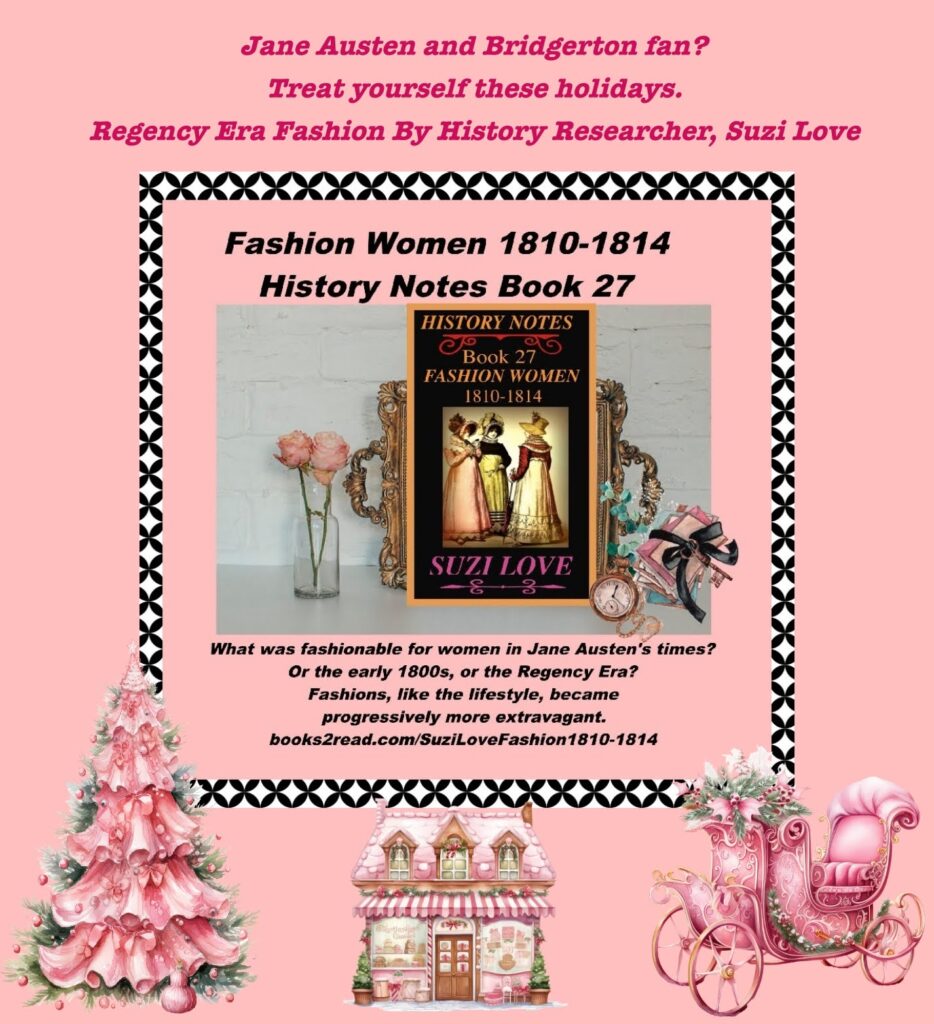
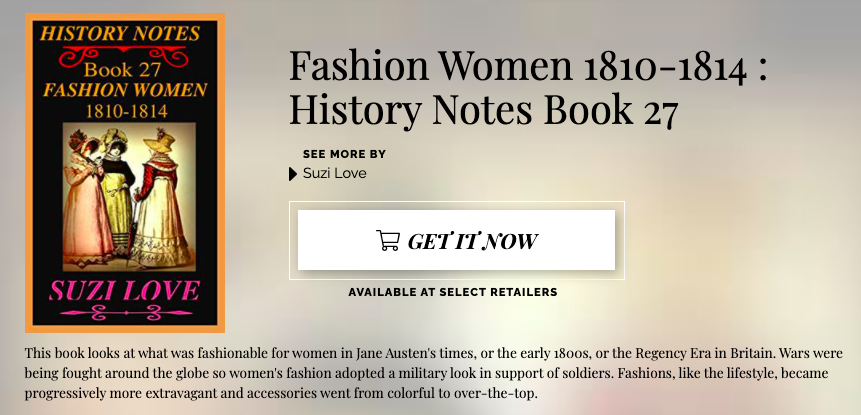
What was fashionable for women in Jane Austen’s times? Mourning, riding, daytime, evening clothing, plus underclothing, corsets and accessories. Fashion Women 1810-1814 History Notes Book 27 This book looks at what was fashionable for women in Jane Austen’s times, or the early 1800s, or the Regency Era in Britain. Wars were being fought around the globe so women’s fashion adopted a military look in support of soldiers. Fashions, like the lifestyle, became progressively more extravagant and accessories went from colorful to over-the-top. https://books2read.com/SuziLoveFashion1810-1814
The Lady’s Magazine said of the basis of women’s fashion that was popular for the first twenty years of the 1800s, ‘White is still the prevailing color for robes. For morning dresses, linen gowns, in large diamonds or squares, are fashionable. Indian muslins, plain or embroidered, are preferred to Florence and satins. The designs of embroidery for shawls are of infinite variety. Long gloves, which reach above the elbow, are not yet laid aside. Medallions are hung around the neck from crossed chains and some of these medallions are shaped like the bags, called ridicules. These reticules are of the lozenge or hexagon shape, with a small tassel at each angle. Reticules, or ridicules, are in lozenge or hexagon shapes with a small tassel at each angle. In capotes, or hats, and ribbands, the violet and dark green prevail over jonquil. Bracelets in hair, pear-shaped ear-rings, medallions on square plates, saltiers of colored stones, are still in fashion.’
Brenton, Lord Mallery, sniffed again. Shook his head in denial. Ridiculous to imagine Lillian, his Lillian, was the wearer of that country orchard scent. Or to picture her here, at a pleasure house ball. Bloody hell, perhaps his family’s worst fears had become a reality and he’d morphed from a recluse into a madman.
His cousin, Michael, stared at him and snorted. ‘What on earth are you doing?’
Brent shook his head again. ‘Must be imagining things. I know only one person who wears that perfume and she mixes it herself, her own blend of citrus fruits. That woman is a lady and a duke’s daughter and certainly wouldn’t be attending a courtesan’s ball.’
“Two nights ago,” Lady Rebecca Jamison said, “the woman we engaged at the Women’s Betterment Society to tally the Stock Exchange ledgers — our friend — was murdered. The killer was still inside Peggy’s house when I arrived. Her slayer stopped at the back door and stared directly at me, memorizing my features.”
Her pronouncement was flat-voiced, deadly calm.
“Thankfully, his immediate concern was escaping with our two accounting books. But when the cache identifies me as the woman who saw their lackey’s face, I am certain they will send him to dispose of me as well. They are peers, titled and wealthy, and cannot risk being exposed as members of an illegal group. If we cannot stop these men, brutes who employ cold-blooded assassins to do their dirty work, I will certainly be the next to die.”
The Duke of Sherwyn’s chilled blood turned to ice.
Pagans burned a great log and a mammoth candle on the 21st of December, the shortest day in the year, because it was seen as the turning-point in the conflict between the contending forces of winter and spring.
From Harpers Bazaaar “The Yule-block, or Christmas-log, with its warm welcome, extending even to the poor and the stranger as they gathered around the hospitable board is being gradually supplanted by the Christmas-tree.”
Formerly the Yule-log, a huge section of the birch, was cut from a tree selected on Candlemas-day, which so late as the time of Queen Elizabeth was the last day of the Christmas holidays. On the following Christmas-eve it was dragged in and placed upon the hearth with great ceremony, the merry-makers pulling with a will, and singing the while the modernized Christmas carol commencing,
“Come, bring with a noise,
My merrie, merrie boys,
The Christmas-log to the firing.”
It was then kindled with a brand from last year’s Christmas fire, which, if it was not thus kept continually burning, still linked the merrymaking of one Christmas-time to that of another.
In Ramsgate, Kent, and the Isle of Thanet, the custom styled “hodening” is still in vogue. The “hoden,” which appears to be a cross between the “white horse” and the Klapperbock of the Germans, is accompanied by a number of youths in fantastic dress, who go round from door to door ringing bells and singing Christmas carols.
Christmas: 24th December Or Christmas Eve. The evening leading up to Christmas Day is filled with excitement, last-minute preparations, and religious services. In many cultures, especially European countries, gifts are exchanged on Christmas Eve, while in other places, this happens on Christmas morning. http://books2read.com/suziloveHOCP.
Leaning in, Lord Mallory whispered in Lady Lillian’s ear. “Well, well. I certainly didn’t expect to find you in attendance at a scandalous ball.”
1820 Blackstone House, Twenty miles south of London. Brenton, Earl Mallory, secreted himself behind a life-sized statue of a naked man. Hiding from the two hundred guests spilling through the rooms Lord Browning had opened for the Pleasure House Ball. Clearly he’d suffered a moment of insanity when he’d yielded to his friend’s pleas to accompany him to this ball. ‘For God’s sake, Michael, why are we wasting our time here? I’ve no intention of engaging a mistress and….’
Brent shook his head. ‘Must be imagining things. I know only one person who wears that perfume and she mixes it herself. That woman is a lady and a duke’s daughter and certainly wouldn’t be attending a courtesan’s ball.’
‘Good God! You don’t mean−’
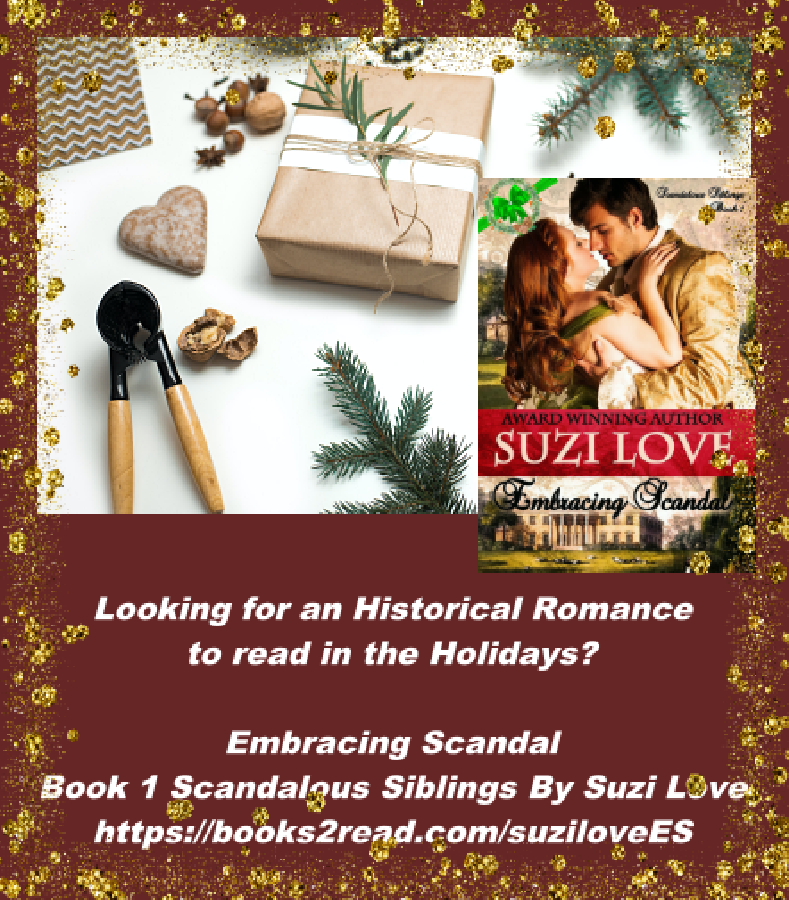
Pleasure House ball Book 3 Irresistible Aristocrats books2read.com/suzilovePHB. Lord Mallory, attends his first courtesan’s ball in ten years to appease his concerned friends, though he’d rather stay home and read to his motherless daughters.
The word ‘carol’ comes from the old French ‘carole’ for a song written and played as a courtly dancing song. Carols then took on a more popular form, telling stories and celebrating religious themes for all seasons until the late 19th century when they became associated with Christmas.
Carols took the place of Psalms in all churches on Christmas Day and, as the whole congregation could join in, were greeted with huge approval. Carols were passed on orally from place to place, often with different words or tunes. The published carols included songs still popular today, including The First Noël, I Saw Three Ships, and God Rest Ye Merry Gentlemen. This collection was followed by compilations of carols from other scholars such as William Sandy’s works in 1833 and 1852.
Because wild boar was the most feared animal, serving it at a meal represented the victory of good over evil. During the 17th century, wild boar became extinct in Britain so a pig’s head was used instead. The head was often presented on a decorated platter with an apple in its mouth and carried in by bearers in a dramatic manner. The tradition of serving ham for Christmas lunch or dinner probably came from the idea of serving boar’s head or roasted boar joints to guests at Christmas.
To say nothing of the roast beef and plum-pudding, Christmas pies, furmity, and snap-dragons, the Yule-log and the mistletoe have not finally abdicated, while the boar’s head, decorated with rosemary or prickly holly, maintains its place at the English Christmas dinner, and is still served up in great state at the royal Christmas table. At Oxford, U.K., the boar’s head was carried in by the strongest of the guardsmen, singing a Christmas carol, and preceded by a forester, a huntsman, and a couple of pages dressed in silk and carrying the mustard which was regarded as a great luxury and an infallible digester.
The following celebrated carol of the Boar’s Head is found in the book of ‘Christmasse Carolles’ published in 1521 by Wynkyn de Warde:
The boar’s head in bande bring I,
With garlandes gay and rosemary,
I pray you all synge merely,
Qui estis in convivio.
“The bore’s head, I understande,
Is the chefe servyce in this lande.
Loke wherever it be fande,
Servite cum cantico.
“Be gladde, lordes, both more and lasse,
For this bath ordayned our stewarde,
To chere you all this Christmasse,
The bore’s head with mustarde.”
At Oxford, U.K., the boar’s head was carried in by the strongest of the guardsmen, singing a Christmas carol, and preceded by a forester, a huntsman, and a couple of pages dressed in silk and carrying the mustard which was regarded as a great luxury and an infallible digester. A similar custom appears to have prevailed in Genoa in the times of the Dorias when a boar decorated with branches of laurel and accompanied by trumpeters was annually presented to the Doria family by the Abbot of San Antonio at Pré at midday on the 24th of December.