And for another tradition we all love, how about a few facts about the beginning of Birthday Parties,
Suzi
The tradition started in Europe a long time ago when it was feared evil spirits were particularly attracted to people on their birthdays. To protect them from harm, friends and family would to come be with the birthday person and bring good thoughts and wishes.
Giving gifts brought even more good cheer to ward off the evil spirits. At first it was only kings who were recognized as important enough to have a birthday celebration (maybe this is how the tradition of birthday crowns began?).
As time went by, children became included in birthday celebrations. The first children’s birthday parties occurred in Germany and were called Kinderfeste.
1770 ca. Corset, Europe. Back lacing, blue and cream silk with cream silk bows.
Corsets 1700-1790 History Notes Book 15 This book shows how body wraps, stomachers and stays were worn during the 1700s. They created a variety of fashionable silhouettes to suit the elaborate fashions worn for court and daily life during the 18th Century. Wearing the correct underclothing was essential for keeping garments in place and giving the best fashion display. Corsets, stays, body wraps, and stomachers worn during the 1700s, or the Georgian Era. https://books2read.com/SuziLoveCorsetBook15
Birthstones and their meanings have fascinated people far back in history.
Enjoy these few facts about them,
Suzi
As far back as 1400 BC, the Assyrians believed that rare and beautiful gemstones possessed magical properties. Some minerals were thought to possess a force or contain certain values and powers.
Tradition associates a gem with each sign of the zodiac based on a color system. Color was thought to release the power attributed to the stone.
Later, birthstones became associated with calendar months rather than the zodiac. People began selecting birthstones in colors other than the original colors.
The Roman, Arabic, Jewish, Polish, Russian and Italian lists were all different. In 1912, the American National Association of Jewelers, which later became Jewelers of America, adopted the list as we now know it.
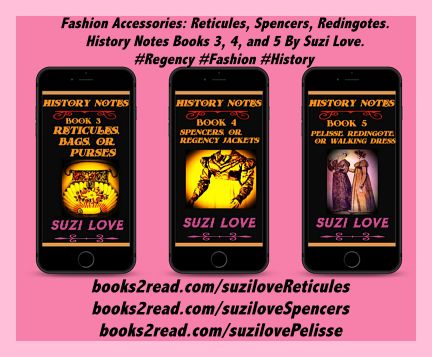
What was fashionable outdoor wear for the Bridgerton ladis, Jane Austen, and their contemporaries? Reticules, Spencers, and Pelisses, or Walking Dresses, Or Redingotes. History Notes Books 3, 4, and 5 By Suzi Love.
What was fashionable for purses in past centuries? Call them what you like: purses, bags, handbags, reticules, ridicules, clutches, or pocket replacements. They all did the same job and they changed greatly with the prevailing fashions of time. books2read.com/suziloveReticules
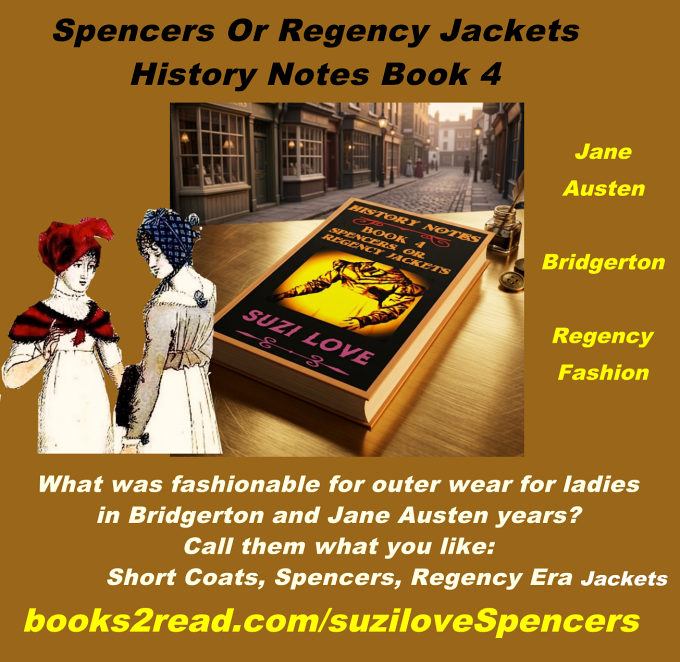
What was fashionable in women’s jackets in the Regency Era? Call them what you like: Spencers, short jackets, or Regency jackets. They provided modesty and warmth and they changed greatly with the prevailing fashions of the time. Take a look at the jackets being worn by women in the early 1800s. books2read.com/suziloveSpencers
What sort of coats did women wear during the Regency years? them what you like: Coat, Pelisse, Redingote, Walking Dress, Promenade Dress. Take a look at what was being worn by women, men, and children. books2read.com/suzilovePelisse
HN_4_Spencers, Or Jackets. #Regency #Georgian #Victorian #Fashion History Notes Book 4 By Suzi Love.
1780-1789 Linen Stays Or Corset, Great Britain. Stays, 1780-1789 (made). Linen, lined with linen and reinforced with whalebone, trimmed with pale blue silk ribbon. Hand sewn with linen thread, applied ribbon, chamois and whalebone.
Stays were an essential item of underwear for women during the 18th century. By the 1780s, the fashionable torso consisted of an inverted cone shape. Achieving smoothness of profile and firmness of contour were the primary function of 18th-century stays, rather than emphasising the bust or constricting the waist. Although custom-made and very intricately designed, stays were usually very plain. In this example a narrow blue ribbon covering the seams is the only decoration.
The narrow rows of very fine, even hand-stitching form the compartments into which thin strips of whalebone were inserted. Although the stays appear very rigid, whalebone was quite flexible. It had the added advantage of softening with the heat of the wearer’s body, allowing the stays to mould to her shape. When worn, the shaped and boned tabs at the lower edge would splay over the wearer’s hips, giving further fullness to the petticoat tied at the waist over the stays. Given by Mrs Strachan. Museum Number T.172-1914. Victoria and Albert Museum, London, U.K.
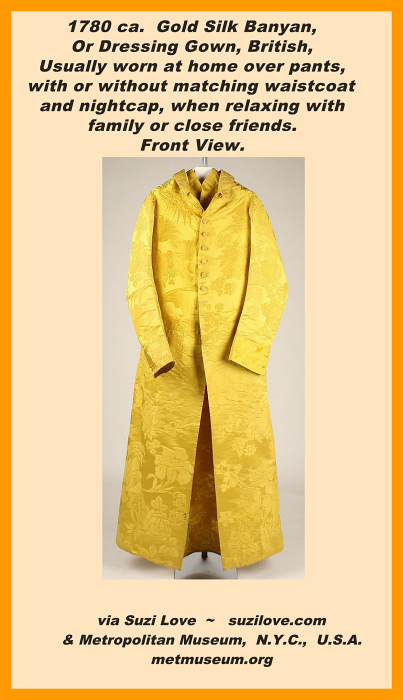
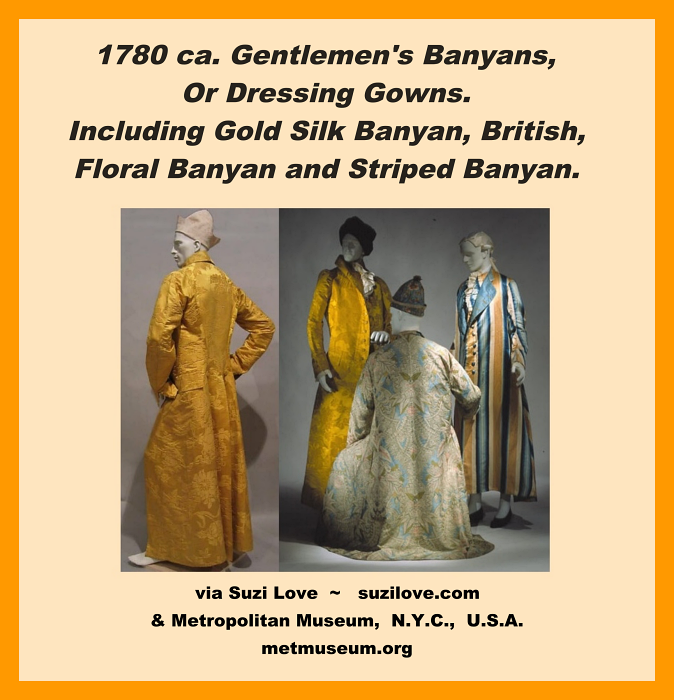
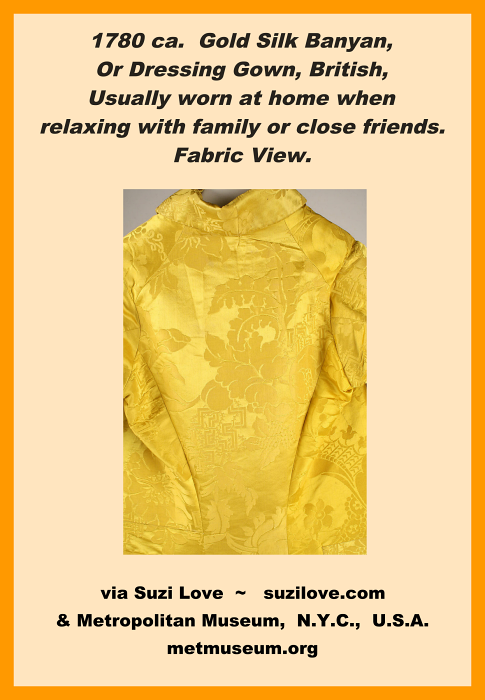
1780 ca. Gold Silk Banyan, British. For at-home wear, a gentleman had a dressing gown, often with a matching waistcoat, and an undress cap or turban. “This yellow damask banyan with its bold Chinese Chippendale – inspired pattern would have been an imposing sight on the streets or in the drawing rooms of London.” via Metropolitan Museum New York City, U.S.A. metmuseum.org Credit: Catharine Breyer Van Bomel Foundation Fund, 1978 Accession Number:1978.135.1
From the Curator: ‘For at-home wear, a gentleman had a dressing gown, often with a matching waistcoat, and an undress cap or turban.As for breeches, they were not designed especially for this casual ensemble, but rather borrowed from other suits.The dressing gown was cut like a man’s loose coat and usually hung to the floor, though there were also versions that stopped below the knees. Since there were no fastenings, the wearer overlapped the dressing gown in front when he walked so that the sides did not billow out behind him.The sleeves were originally rolled back to form cuffs, but later dressing gowns display the fashionable cuff of their period.In England these dressing gowns were called “banyans” or “Indian nightgowns” because of their kimono-like form and Eastern origin. Banyans were made in a variety of fabrics, including silk brocades, damasks, and printed cottons. By the 1780s, gentlemen ventured out of doors in this comfortable and stylish costume. According to Town and Country Magazine in 1785: “Banyans are worn in every part of the town from Wapping to Westminster, and if a sword is occasionally put on it sticks out of the middle of the slit behind. This however is the fashion, the ton, and what can a man do? He must wear a banyan.”This yellow damask banyan with its bold Chinese Chippendale – inspired pattern would have been an imposing sight on the streets or in the drawing rooms of London.’ via Metropolitan Museum New York City, U.S.A. metmuseum.org
1780 ca. Front View. 1780 ca. Back View.1780 ca. Back View. 1780 ca. Fabric View. RL_2_D2D_RetailerBuyLink_RL_2
https://books2read.com/suziloveYGD
What Sort Of Pianoforte or Piano Was Played By Jane Austen and Contemporaries? Pianos, pianofortes and more. History Notes Book 7 Music Pianos books2read.com/suziloveMusicPiano
Definition Pianoforte or Piano: ‘Stringed keyboard instrument with a hammer action, as opposed to the jack and quill action of the harpsichord. Capable of gradations of soft and loud, the piano became the central instrument of music pedagogy and amateur study. By the end of the nineteenth century, no middle-class household of any stature in Europe or North America was without one.’ Definition via the Metropolitan Museum, NYC.
Around 1700, the Pianoforte, or Piano, was invented in Italy by Bartolomeo Cristofori, who created a hammer action keyboard instrument on which a musician could make changes in loudness by changing the force with which the keys were struck. He called his instrument “gravicembalo col piano e forte”, or, (harpsichord with soft and loud). Cristofori’s long name was later shortened to fortepiano or pianoforte, and finally just piano.
Musical Instruments were so important in most of the more affluent households in history that large industries grew all around the world to manufacture instruments, musical accessories, and to print sheet music. Pianos, pianofortes, harpsichords, and organs were found everywhere and were often the focus of a family gathering. By the end of the 18th Century, the pianoforte, or piano, was the leading instrument of Western music.
D2D_RetailerBuyLink_HN_7 Piano
books2read.com/suziloveMusicPiano
Spencers Or Regency Jackets By Suzi Love. History Notes Book 4. What was fashionable for outer wear in past centuries? Call them what you like: Spencers, short jackets, or Regency jackets were very popular. Take a look at the jackets being worn by women in the early 1800s or the times of Jane Austen. books2read.com/suziloveSpencers
Definition: Spencer – Short, bodice hugging, usually long sleeved, outer jacket. For warmth and for fashion.
Definition Caroline Spencer: Worn during the Directoire and First Empire (1790-1815 C.E.). Spencer with pelerine cape that was made of white kerseymere and trimmed with light blue satin cut on bias.
Spencers were short jackets cut to match the high waistlines of Empire dresses. They often copied military styling, such as braiding, shoulder decoration, buttons and loop fasteners, and wrist adornments. They were generally of complex construction, often with a diamond shaped piece in the back.
HN_4_Spencers, Or Jackets. #Regency #Georgian #Victorian #Fashion History Notes Book 4 By Suzi Love.
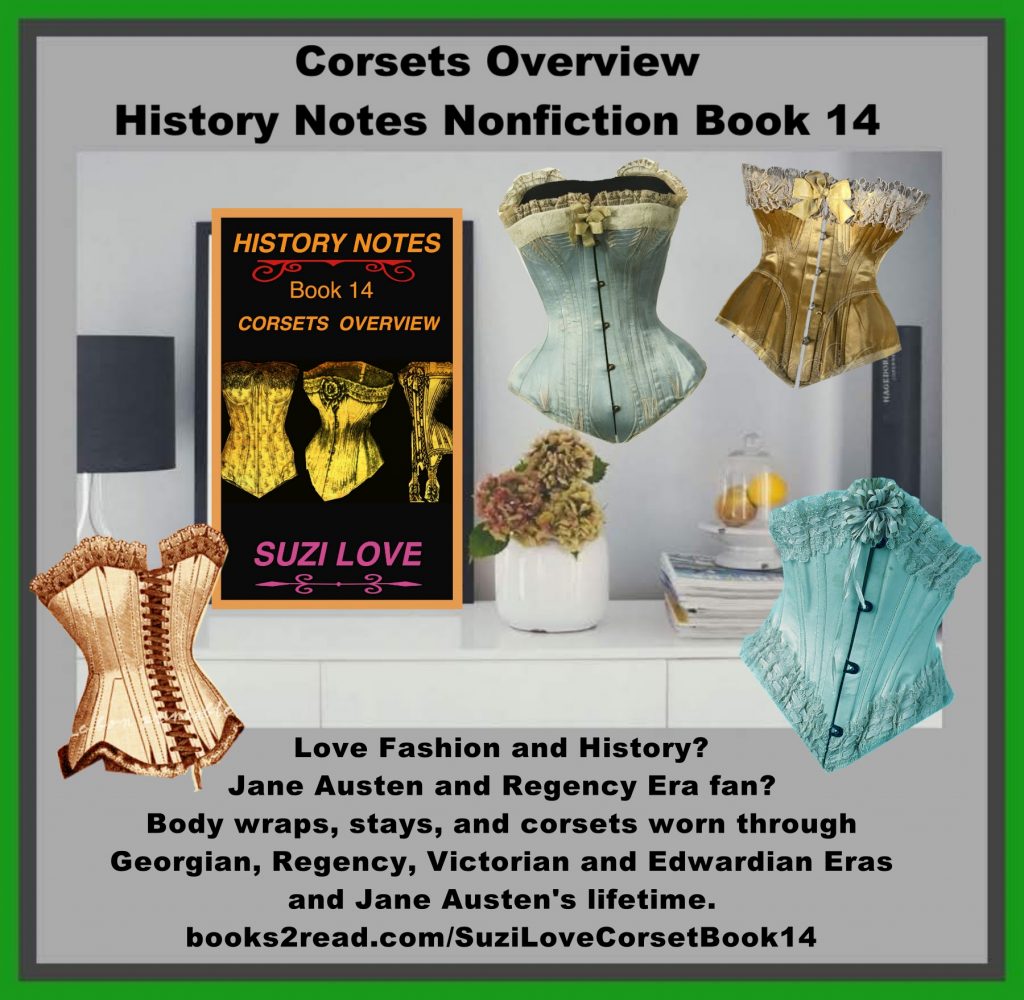
This book shows how body wraps, stays, and corsets were worn to create a variety of fashionable silhouettes through past centuries. Corsets flattened breasts and accentuated rounded hips or pushed up breasts and showed off the bust line depending on the fashions of the time and the desired silhouette. Overview of corsets through history, including the Georgian, Regency, Victorian and Edwardian Eras, and the Bridgerton and Jane Austen’ years. History Notes Book 14.
The name stays probably comes from the French estayer meaning to support. The word corset, which comes from the French word corps for body, had been in use centuries earlier, though often with not quite the same meaning. By the beginning of the 19th century when these undergarments took on more shape and form, the word corset was generally used instead of stays.
During the 1820s, fashions changed from the loose and flowing Regency Era or Empire style gowns and the waistline lowered back to almost the natural position. Towards the mid 1800s, breast cups were added to corsets to give more support and breast comfort. Corsets were lengthened to the hip and gussets added in both the bust area and over the hips. Therefore corsets had more shaping but with less boning.
From the 1820s onwards, menbegan to wear corsets and this continued through the Romantic Era, though the men who wore corsets usually claimed they needed them for back pain.
Queen Victoria ruled England from 1837 to 1901 and at the beginning of her reign, dress waists were around their natural line. But as the years of her reign progressed, fashionable waists became thinner and corsets were redesigned to give more of an hourglass figure.
Early Victorian Era corsets were cotton, boned with mainly whale bone, laced at the back and with tiny hooks and eyes up the front for front fastening. By the middle of the century, corsets were beginning to be more decorative with embroidery and ribbons and then later made of colorful silks and satins.