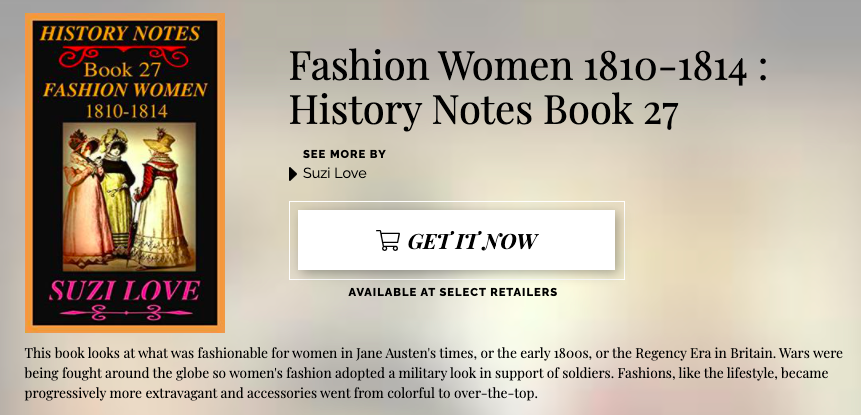
1798 White Dress, French. Gold and black back insert to match gold stripes on the hem, white shawl with gold stripes, gold hat with black decoration. Via Journal des Dames et des Modes or Costume Parisien.


1798 White Dress, French. Gold and black back insert to match gold stripes on the hem, white shawl with gold stripes, gold hat with black decoration. Via Journal des Dames et des Modes or Costume Parisien.

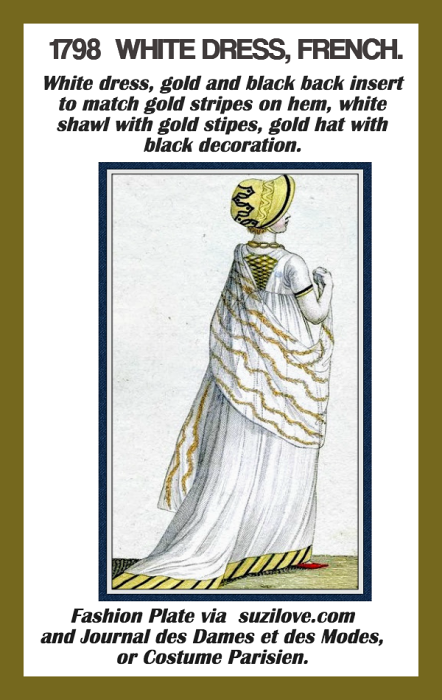
Textile of block-printed white cotton in madder colours with pencilled blue. The cotton is printed with 9.5 octagonal panels intended to be cut out and applied to patchwork quilts. Each panels contains a bunch of flowers. Around the inner border is an inscription of Princess Charlotte of Wales married to Leopold Prince of Saxe-Coburg May 2, 1816. In the borders are three Prince of Wales feathers, the Royal Arms, and a crown on each side. At the end of the textile is printed a rectangular panel containing the manufacturers name and in a corner is the name ‘G. Swindels’.
This quilt has an excise stamp for 1816 and is inscribed ‘John Lowe and Co. Furniture Printers, Shepley Hall’, providing the name of the only identifiable manufacturer of these panels, although there are likely to have been others. John Lowe was a well-known firm of calico printers with large cotton factories and extensive bleaching grounds close to the River Tame near Ashton-under-Lyne in Lancashire.
Hand-quilting is done on a frame using needles called ‘betweens’. The stitches are executed with one hand; the other hand is kept underneath the quilt to feel for the needle. Small, uniform stitches (usually a ‘running stitch’) are taken through the three layers to form a decorative design. In ‘piecing’ or ‘patchwork’, small pieces of fabric are sewn together to produce a decorative design. The most enduring method in Britain is done by hand, and is known as ‘piecing over paper’. The pattern is first drawn onto paper and then accurately cut. Small pieces of fabric are tacked round each of the shapes, and then joined together from the back using overstitch. Most of the quilt top visible here has been pieced over paper, but in some areas the fabrics have been applied directly on to the earlier quilt that forms the wadding.
Victoria and Albert Museum, London, England.

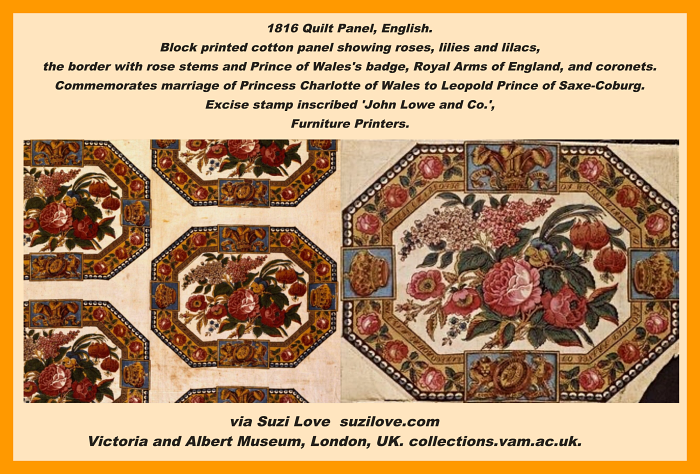


1831-1850 ca. Reticule, English. Round bag of crimson silk with embroidery and a drawstring. via Museum Of London.


1814 April Morning Dress and Lace Cap. ‘”A petticoat and bodice of fine jaconet muslin, finished round the bottom in vandykes and small buttons. The Rochelle spencer composed of the same material, appliqued with footing lace down the sleeve, and trimmed at each edge with a narrow but full border of muslin. Double fan frill of muslin round the neck, very full, continuing round the bottom of the waist, where it is gathered on a beading of needle-work. Bourdeaux mob cap, composed of lace, with treble full borders, narrowed under the chin. A small flower placed backward, on the left side. Hair much divided in front, and in full waved curls on each side. Necklace of twisted gold and pearl, with pendant cross in the center. Spring Green kid slippers and gloves of the same.”
“This dress is from Mrs. Gill, of Cork-street, to whose taste and invention this work as well as the world of fashion, are under continued obligations.” Fashion Plate via Rudolph Ackermann’s ‘The Repository of Arts’.
Definition Van Dyke Points: V-shaped lace and trims named after a 17th Century Flemish painter, Sir Anthony Van Dyck, known for painting V-shaped lace collars and scalloped edges on sitters.
Definition Jaconet: Cotton fabric of medium thickness made in England, lighter than shirting and heavier than mull.
Definition Muslin: Thin fabric said to take its name from Mosul or Moosul, a large town in Turkish Asia where it was first made.

1812 August. Ball Dress, English. Dress with lower waistline than normal in the Empire period, pink laced bodice, with decorative sleeves, skirt with pink hem decoration, pink hat with pretty plume, and yellow gloves. Fashion Plate via John Belle’s ‘La Belle Assemblee’, London. https://books2read.com/SuziLoveFashion1810-1814