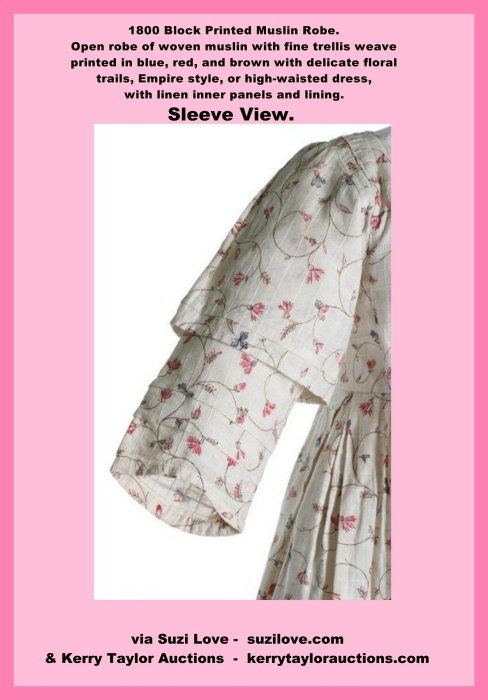
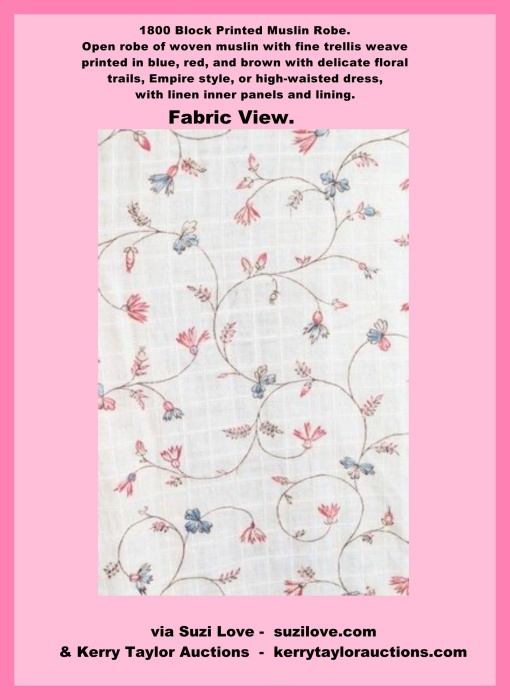
1800 Block Printed Woven Muslin Robe. Open robe of block printed muslin with a fine trellis weave printed in blue, red, and brown, and with delicate floral trails. Empire style high-waisted dress with linen inner panels and lining. via Kerry Taylor Auctions kerrytaylorauctions.com
Definition Empire Style Dress: Named after the First Empire in France. Empire dresses had a low neckline and skirts started directly under the bust and flowed into the classical relaxed wide styles of Greece and Rome. This style of dress is associated with Jane Austen and her contemporaries as a high-waisted dress was worn most days. Cotton, silk or taffeta were the popular fabrics. Only the very wealthy could afford white dress in this style as the cottons were imported from India and had to be carefully cleaned, usually by a lady’s maid.
1800 Block Printed Woven Muslin Robe. Open robe of block printed muslin with a fine
trellis weave printed in blue, red, and brown, and with delicate floral trails. Empire style high-waisted dress with linen inner panels and lining. via Kerry Taylor Auctions kerrytaylorauctions.com1800 Block Printed Woven Muslin Robe. Open robe of block printed muslin with a fine
trellis weave printed in blue, red, and brown, and with delicate floral trails. Empire style high-waisted dress with linen inner panels and lining. via Kerry Taylor Auctions kerrytaylorauctions.com1800 Block Printed Woven Muslin Robe. Open robe of block printed muslin with a fine
trellis weave printed in blue, red, and brown, and with delicate floral trails. Empire style high-waisted dress with linen inner panels and lining. via Kerry Taylor Auctions kerrytaylorauctions.com1800 Block Printed Woven Muslin Robe. Open robe of block printed muslin with a fine
trellis weave printed in blue, red, and brown, and with delicate floral trails. Empire style high-waisted dress with linen inner panels and lining. via Kerry Taylor Auctions kerrytaylorauctions.com1800 Block Printed Woven Muslin Robe. Open robe of block printed muslin with a fine
trellis weave printed in blue, red, and brown, and with delicate floral trails. Empire style high-waisted dress with linen inner panels and lining. via Kerry Taylor Auctions kerrytaylorauctions.com1800 Block Printed Woven Muslin Robe. Open robe of block printed muslin with a fine
trellis weave printed in blue, red, and brown, and with delicate floral trails. Empire style high-waisted dress with linen inner panels and lining. via Kerry Taylor Auctions kerrytaylorauctions.comHN_12 D2D_RetailerBuyLink_HN_12 books2read.com/SuziLoveFashionWomen1800
1805-1810 ca. India Muslin Dress, English. Slight train, embroidered panel down centre between two lines of drawn-thread work, embroidery of cotton in chikan stitch and knots in scrolls and plume design. Elbow length sleeves with two insertions of embroidery in leaf pattern. via Manchester Art Gallery
Definition Empire Style: Named after the First Empire in France, by 1800 Empire dresses had a very low décolleté, or neckline and a short narrow backed bodice attached to a separate skirt. Skirts started directly under the bust and flowed into the classical relaxed wide styles of Greece and Rome. This style of dress is associated with Jane Austen and her contemporaries as a simple cotton high-waisted dress was worn most days and accessorized according to the importance of the occasion.
Fashion Women 1805-1809 History Notes Book 26 What did Jane Austen and friends wear? https://books2read.com/SuziLoveFashionWomen1805-1809
1816-1817 ca. Man’s Linen Shirt, American. High collar, ruffles down front opening, fullness from gathered shoulders and sleeves for unrestricted movement. Beautifully created and monogrammed by Elizabeth Wild Hitchings for her husband, Benjamin Hitchings, a sea captain. Wives or servants regularly hand stitched shirts from 1800s-1840s, before sewing machines, but handiwork rarely recorded.
From The Creator: This shirt was created, from the linen fiber to the finished garment, by the donor’s great-grandmother, Elizabeth Wild Hitchings, for her husband Benjamin Hitchings, a sea captain, in 1816. It was common practice for a wife or servant to hand stitch family members’ shirts prior to the mid-19th century, but rarely was such handiwork recorded, making this case rare and intriguing. In addition, its elegant stitching makes it a perfect example of the familial care taken in sewing prior to the common possession and use of the sewing machine. via Metropolitan Museum, N.Y.C., U.S.A. metmuseum.org
1826 January Promenade Dress, English. Green walking dress with wide lace hem, zigzag white collar edge, white buttons on front vertical, large fur muff with pink lining, large hat with pink ribbons and black bows on crown. Fashion Plate via Rudolph Ackermann’s ‘The Repository of Arts’, London, U.K.
Definition: Promenade Dress, Walking Dress, Pelisse Or Redingote. Woman’s long, fitted overdress or coat often worn open in front to show off the dress underneath. Sometimes cut away in front. Originally made with several capes and trimmed with large buttons. French word developed from English words, riding coat. reefer. Single- or double-breasted, fitted, tailored, over-all coat usually made from sturdy fabric. In England, this sort of coat was generally called a pelisse, walking dress, carriage dress or promenade dress. In France, these coats were called a Redingote.
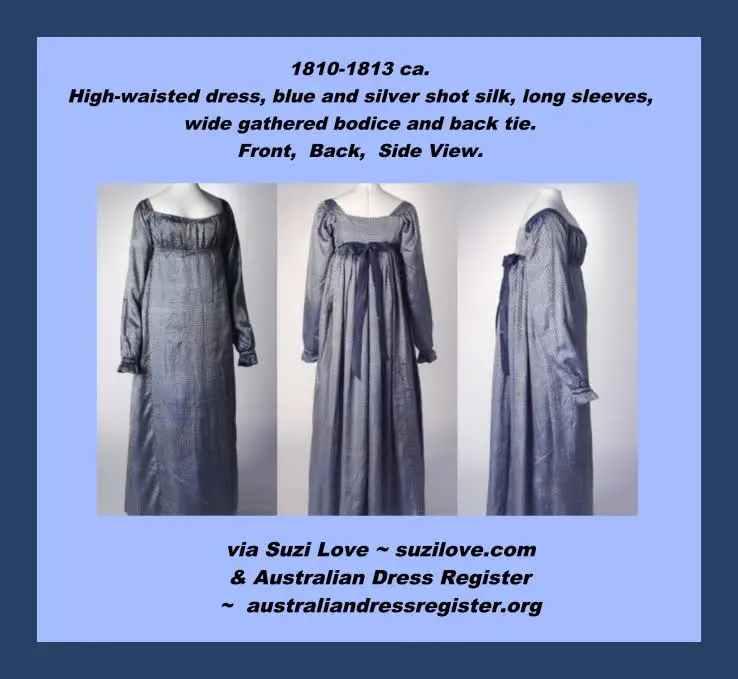
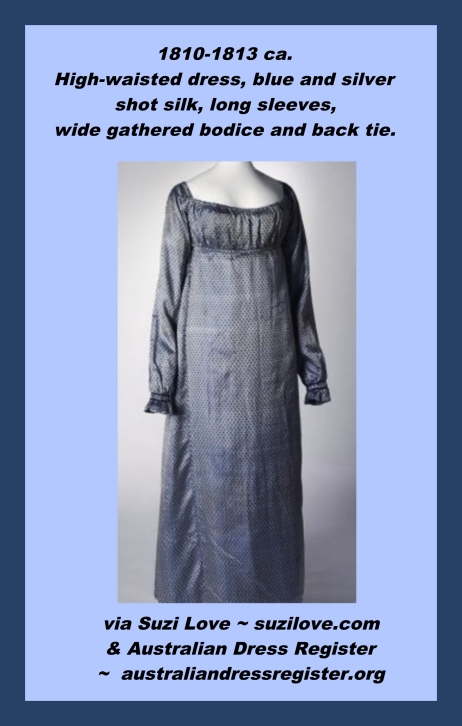
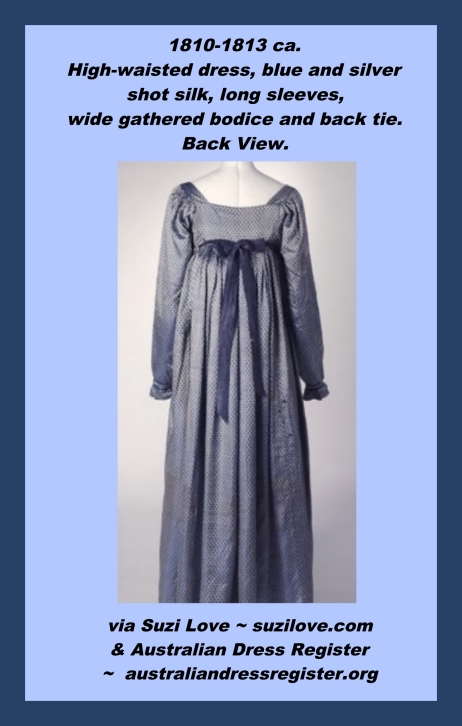
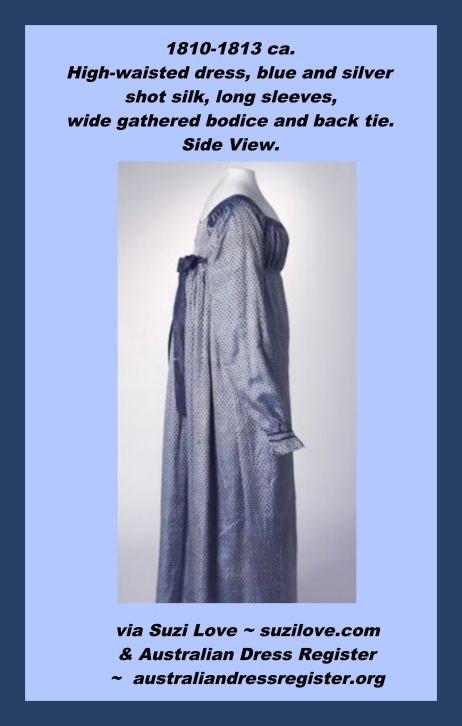
1810-1813 ca. Blue and Silver Shot Silk, Empire style dress, with long sleeves, British. One-piece dress in silver and blue shot silk with a pattern of dark blue flowers. High waist, square back neckline and dropdown bib-front. Bodice interior lined with cream cotton panels. Full-length sleeves have gathered sleeve head and extended cuffs over hands, with silk floss-corded trim at band. Five paneled skirt gathered at centre back and designed to be worn over a small back bustlepad. Cotton tape drawstring attached to interior of bodice and with blue silk ribbon ties at back. The high waist, bib-front and columnar skirt made this Empire dress less restrictive than many other 19th-century styles. Beneath this light, free flowing garment lay several layers of underwear. A shift and petticoat were worn, as well as a soft corset with a busk. Via australiandressregister.org
Probably belonged to Devonshire woman, Ann Deane (mother of Mary Deane, who married pastoralist and founder of Springfield sheep station, William Pitt Faithfull). Ann married Thomas Deane at Upton Pyne in Devon in 1807, and by 1813 had given birth to four of her six children. The dress travelled to Australia with Ann Deane when she and her son Robert, daughters Ann and Mary, and grandson Edgar migrated to New South Wales in early 1838. Ann Deane’s husband Thomas had died over a decade earlier, and her children had been receiving an annuity of 1000 pounds a year from their Uncle Robert Deane, a captain in the West India Company marines, who died in 1827.
When the Deane family embarked upon the three-month sea voyage to Australia they brought a range of objects and material from England, including sketches and paintings of English landscapes and seascapes (by daughters Ann and Mary), scrapbooks filled with newspaper clippings, recipes and poetry, books many of which were inscribed with affectionate messages from friends left behind and a number of eighteenth- and nineteenth-century dresses. After arriving in Sydney Ann’s daughters, Ann and Mary, established a private school for young ladies in Macquarie Place. The school operated until 1844, when Mary married Faithfull, and it was through this union that the dress found its way to Springfield sheep station in Goulburn. Mary and Faithfull had nine children between 1845 and 1859, and their eldest daughter Florence became the caretaker of the dress once her mother and aunt had passed away. Florence Faithfull became an avid collector, keeping hundreds of items left by family members when they moved away or died.
In the early 1950s Florence’s niece and namesake, Florence ‘Bobbie’ Maple-Brown, was faced with the momentous task of sorting through the remarkable collection of material that had accumulated for over 100 years at Springfield. During renovations of the main homestead Bobbie converted two rooms of the nine-bedroom mansion into what was to become known as the Faithfull Family Museum. The blue silk dress and many others collected during the nineteenth and twentieth centuries were hung in a wardrobe in the family museum, springing to life now and again when younger generations of the Maple-Brown family used them for dress-ups.
1808 Two Jane Austen style dress bodices, French. Green and white striped dress has short puffed sleeves and matching green turban. White dress with pink overdress has short sleeves and a pink headdress to match. Fashion Plate via Journal des Dames et des Modes, or Costume Parisien.
French fashions like this were copied by English magazines so these styles of hats would have been worn by Jane Austen and her contemporaries.
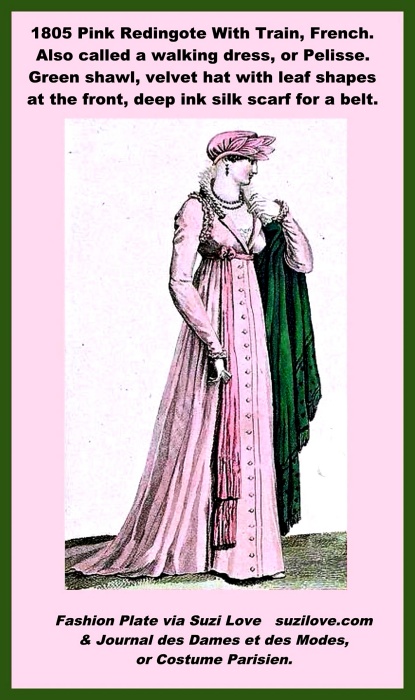
1805 Pink Redingote With Train, French. White dress with high neck frill, green shawl, velvet hat with leaf shapes to decorate the front, necklace, silk scarf as a belt and white gloves.Fashion Plate via Journal des Dames et des Modes, or Costume Parisien.
Jane Austen and her contemporaries would have wore long coats like this one to keep warm when out and about, visiting, shopping etc. The thin muslin dresses worn in the early 1800s were little protection against European winters so coats of some sort were added, plus colorful accessories like this shawl and the hat to add color and another layer of warmth.
Definition Redingote Or Coat Or Pelisse: Long fitted outdoor coat worn over other garments for warmth. French word developed from English words, riding coat. French fashion plates call these coats Redingotes and they are designed for women, men and children. English fashion plates call them a Pelisse, a walking dress, Promenade dress, or Carriage dress.
1811 January Evening Dresses, English. Standing Figure: French frock with half train of black imperial gauze worn over a slip of white sarsnet or satin, ornamented with a Vandyke border of white velvet or thread lace. White velvet hat ornamented with two curled ostrich feathers, with a silver or beaded band. White kid gloves and shoes. Sitting Figure: Grecian robe of silver grey crape worn over a white satin under-dress, ornamented at the hem and each side with a light and tasteful border of black bugles. Stomacher edged with black beads, corresponding with those which finish the bosom and sleeves. Earrings, necklace, and bracelets of jet. Hair in waved curls on each side of the face, divided in front of the forehead with a full plait and barrel comb of jet. White satin slippers with black jet clasps or bugle rosettes. White kid gloves and a fan of silver-frosted crape. Back-ground figure: Dress of black Venetian velvet with short Circassian sleeve, gathered in a knot of white beads or pearl, bosom and stomacher to correspond, pearl necklace, ear-rings, and bracelets. Belt of white velvet with mother-of-pearl clasps. Convent veil of white cobweb net confined with a pearl crescent, à la Diana. Sandal slippers and gloves of white kid and fan of carved ivory. Fashion Plate via Rudolph Ackermann’s ‘The Repository’ of Arts.
Definition Evening Dress: Minute distinctions between ball, dinner, evening and opera gowns meant different quality of fabrics and designs. A Ball Gown differed from an evening dress as expensive silk fabrics were usually worn, light or heavy, decorated with lace, embroidery or beading, with low-cut bodice, short or no sleeves, and full skirts. In the early 1800s, white cotton dresses were considered suitable for many evening events, but not for balls. And definitely not for an evening event in a palace. White dresses with white embroidery for evening were considered fashionable and exclusive as only the wealthy could afford them.
1805-1810 ca. Dress With Train as worn in the time of Jane Austen, or the early 1800s. Ivory silk, plain weave with multicolored silk embroidery in padded satin, buttonhole, and whipped running stitches and French knots running down the dress in stripes, and around the sleeves, square neckline, and train. Philamuseum.org
What did Jane Austen and friends wear? This book looks at early 1800s fashions, which were elegant and pretty with high waists and fabrics that were almost transparent. These Empire style gowns, named after Napoleon’s first Empress, became popular throughout Europe, and were then copied around the world. Colorful outwear was added to make an ensemble more attractive and warmer.
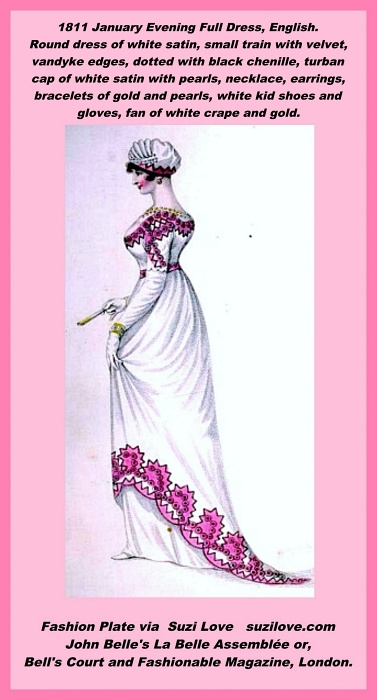
1811 January Evening Full Dress, English. Round dress of white satin, small train with pink velvet, vandyke edges, dotted with black chenille, turban cap of white satin with pearls, necklace, earrings, bracelets of gold and pearls, white kid shoes and gloves, fan of white crape and gold. Fashion Plate via John Belle’s La Belle Assemblée or, Bell’s Court and Fashionable Magazine, London.
Definition Van Dyke Points: V-shaped lace and trims named after a 17th Century Flemish painter, Sir Anthony Van Dyck, known for painting V-shaped lace collars and scalloped edges on sitters.
Definition Velvet or Velour: Silk with short, dense and smooth pile produced by pile warp raised in loops above ground weave through introduction of rods during the weaving.
1811 January Evening Full Dress, English. Round dress of white satin, small train with pink velvet, vandyke edges27_D2D_FashWomen1810-1814