1831-1850 ca. Reticule, English. Round bag of crimson silk with embroidery and a drawstring. via Museum Of London.
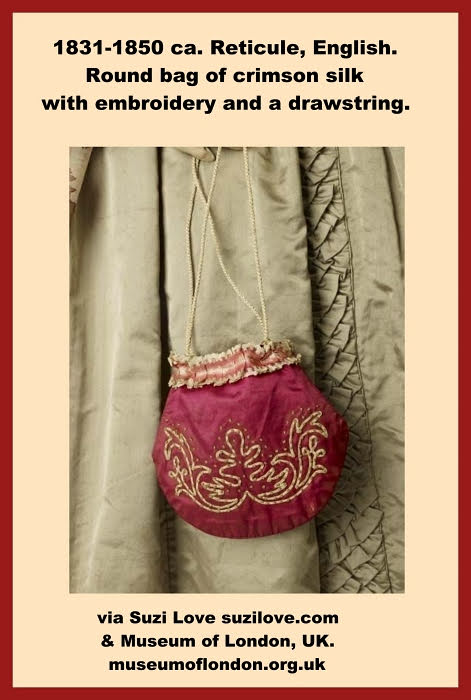

1831-1850 ca. Reticule, English. Round bag of crimson silk with embroidery and a drawstring. via Museum Of London.


1817-1820 ca. Spencer, or Jacket, English. The sort of jacket worn by Jane Austen and friends over their loose Empire style dresses. Green silk Spencer, brown satin puffs, silk cord on deep V collar and sleeves. With the rise of fashionable waistlines in women’s dresses after around 1800, women’s outerwear followed suit. This jacket with very short bodice and long sleeves was known as a Spencer and was named after the male coat. via Museum of London, UK. museumoflondon.org.uk
Description Spencer: Short jackets worn for warmth over the high-waisted Empire style gowns that were popular after the French Revolution, where there was a shift away from opulence and decadence to simpler fashion. This jacket with very short bodice and long sleeves was known as a Spencer and was named after the male coat made famous by the Earl Spencer and said to have originated in accident to Lord Spencer in hunting when coat tails torn off and a cropped jacket was invented. The dresses in the early 1800s therefore became looser, lighter, and flowing and women became cold due to their very low cut and short bodices. Short fitted jackets that went easily over the dresses and provided extra modesty and some warmth. As Europe and many other parts of the world were deep in wars in the late 1700s and early 1800s, men in uniform were found everywhere. In support of these military men, fashions leaned towards military style shoulder paddings, shoulder embellishments, loops, buttons, and braids.


Craftsmen created containers of precious metals, leather, and silks and decorated them with jewels and engraving. Jane Austen and her contemporaries would have used writing boxes, linen boxes when travelling, boxes to hold their food and drink supplies while traveling by carriage, and decorative boxes to keep letters, ribbons, gloves, hairpins etc. Boxes, Cases, and Necessaires By Suzi Love, History Notes Book 11. books2read.com/suziloveBoxesCases.


1814 April Morning Dress and Lace Cap. ‘”A petticoat and bodice of fine jaconet muslin, finished round the bottom in vandykes and small buttons. The Rochelle spencer composed of the same material, appliqued with footing lace down the sleeve, and trimmed at each edge with a narrow but full border of muslin. Double fan frill of muslin round the neck, very full, continuing round the bottom of the waist, where it is gathered on a beading of needle-work. Bourdeaux mob cap, composed of lace, with treble full borders, narrowed under the chin. A small flower placed backward, on the left side. Hair much divided in front, and in full waved curls on each side. Necklace of twisted gold and pearl, with pendant cross in the center. Spring Green kid slippers and gloves of the same.”
“This dress is from Mrs. Gill, of Cork-street, to whose taste and invention this work as well as the world of fashion, are under continued obligations.” Fashion Plate via Rudolph Ackermann’s ‘The Repository of Arts’.
Definition Van Dyke Points: V-shaped lace and trims named after a 17th Century Flemish painter, Sir Anthony Van Dyck, known for painting V-shaped lace collars and scalloped edges on sitters.
Definition Jaconet: Cotton fabric of medium thickness made in England, lighter than shirting and heavier than mull.
Definition Muslin: Thin fabric said to take its name from Mosul or Moosul, a large town in Turkish Asia where it was first made.


1812 August. Ball Dress, English. Dress with lower waistline than normal in the Empire period, pink laced bodice, with decorative sleeves, skirt with pink hem decoration, pink hat with pretty plume, and yellow gloves. Fashion Plate via John Belle’s ‘La Belle Assemblee’, London. https://books2read.com/SuziLoveFashion1810-1814


1823 Pelisse or Redingote or Walking dress, or Coat, English. Made for a wedding trousseau in 1823. Intricate decoration from rouleaux applied in floral shapes, and trimmed with wire wrapped in silk thread which stands out from the garment in loops at the ends. ‘Vandyke’ style of pointed shoulder pieces were fashionable at the time. Via Museum Of London, UK.
Definition Redingote Or Pelisse Or Walking Dress Or Coat: French word developed from English words, riding coat. Long fitted outdoor coat worn over other garments for warmth. Often left open at the front to show off the dress underneath. Sometimes cut away in front. Originally made with several capes and trimmed with large buttons. French fashion plates call these coats Redingotes and they are designed for women, men and children. English fashion plates call them a Pelisse, a walking dress, Promenade dress, or Carriage dress. books2read.com/suzilovePelisse
Definition Vandyke: Edging of v-shaped points, the name coming from the Flemish painter, Sir Anthony Vandyke, who was known for his short pointed beard.


1800 ca. Heptagonal Bag, French. Old rose moiré silk panels on steel cockade frame. Cut steel rosettes at rivets. Steel turn-key closure. White ribbon on steel rings. White silk lining. Credit: The Elizabeth Day McCormick Collection via Museum of Fine Arts, Boston, U.S.A. mfa.org
Reticule Or Bag: As the silhouette of dresses became more form fitting and fabrics lighter and more transparent, pockets could no longer be hidden in the folds of skirts or underwear. Something else was needed to hold a lady’s essentials. Small purses, like men’s money pouches, were used by women to carry money for gambling, sewing necessities, and women’s daily requirements such as combs. A bag or purse, often with a drawstring to pull closed and usually made of cloth or covered cardboard and often decorated with beading or embroidery was called a reticule, or ridicule. They came in a variety of shapes, sizes, and materials. Jane Austen and her contemporaries would have purchased or hand made reticules, or bags, for each other for gifts and carried them with them whenever they went out.


1827 ca. Gentleman’s Dressing Box, London. Mahogany box with brass carrying handles, lid opens to velvet and leather interior with twelve engraved silver topped bottles, all with an engraving of an oak tree. Top tray lifts out to another tray of tools.


1807 Two Ladies In Morning Dress, French. Left: Morning dress with short puffed sleeves over long straight sleeves ruffles around collar sleeves and hem white cap carrying blue parasol. Right: Blue Fichu or neck Shawl, blue Bonnet. Fashion Plate via Journal des Dames et des Modes,
or Costume Parisien.
Definition Fichu: Piece of lace, muslin, or other cloth worn about the neck and cleavage to preserve a lady’s modesty. From French word meaning neckerchief.
These are the types of outfits worn by Jane Austen and contemporaries in English magazines, where French fashions were obsessively copied despite the two countries being at war for many years.


18th Century Early. Silk, Leather, and Linen Mules, European. Embroidered in the Florentine Style, a type of flame stitch canvas work with varied stitch lengths often in subdued tones. via Metropolitan Museum, NYC, U.S.A.